AQUEOUS
HUMOUR
DYNAMICS
FUNCTIONS
• Aqueous humor is a clear, colourless, watery solution continuously
circulated from the posterior chamber throughout the anterior
chamber.
• Maintains the intraocular pressure.
• Maintains the shape and the internal structural arrangement of the
eye.
• Cornea takes glucose and oxygen from the aqueous.
• Lens uses glucose, oxygen and amino acids from the aqueous.
PHYSICOCHEMICAL PROPERTIES
• VOLUME 0.31 ml
• (o.25 ml in anterior chamber and 0.06 ml in posterior chamber)
• Refractive index 1.336
• Density greater than water
• Hyperosmotic ( compared to plasma) 3-5 mOsm/l
• pH: acidic
• Rate of formation: 2.3 µl/min.
• Protein content less.
FACTORS AFFECTING COMPOSITION OF
AQUEOUS HUMOUR
• BLOOD AQUEOUS BARRIER
• Protein and large molecular size substances are largely prevented
from entering the cavities. This maintains the clarity of the media of
the eye.
• Formed by the tight junctions between the cells of epithelium of the
ciliary body and endothelium of iris capillaries.
EFFECT OF BREAKDOWN OF BLOOD AQUEOUS
BARRIER ON AQUEOUS HUMOUR COMPOSITION
• Proteins and antibodies in aqueous equilibrate with those in plasma
to form plasmoid aqueous (secondary aqueous).
• Recognised clinically in slit lamp microscope as Tyndall Beam.
• Fibrinogen appears in aqueous, which may allow the aqueous actually
to clot.
• Ionic composition of the aqueous approches same as plasma.
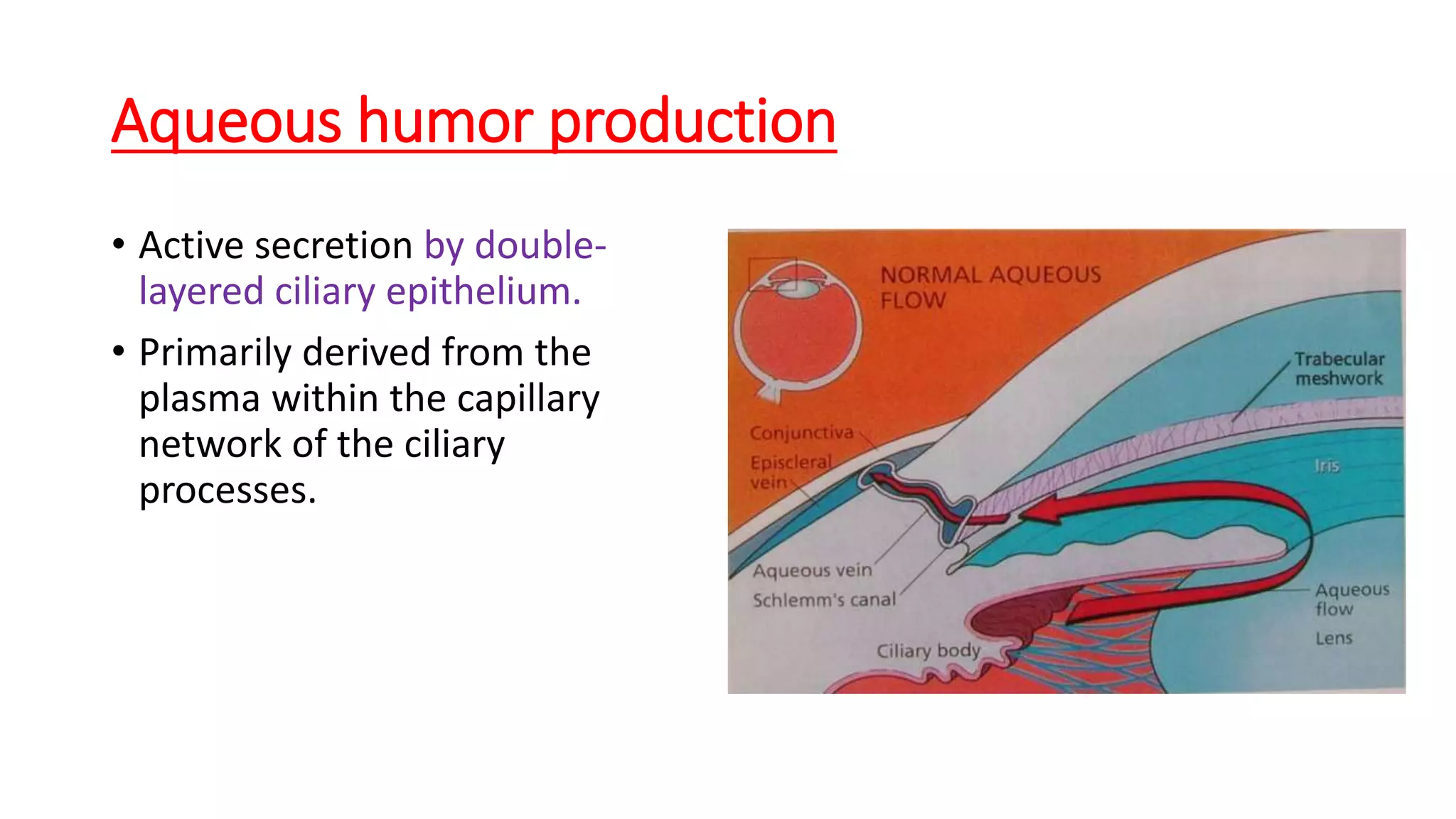
Aqueous humor production
• Active secretion by double-
layered ciliary epithelium.
• Primarily derived from the
plasma within the capillary
network of the ciliary
processes.
Aqueous humor
• Secretion depends on:
• Integrity of blood aqueous barrier
• Blood flow to ciliary body
• Neurohormonal regulation of blood and ciliary body
• Adrenergic innervation
Aqueous humor outflow
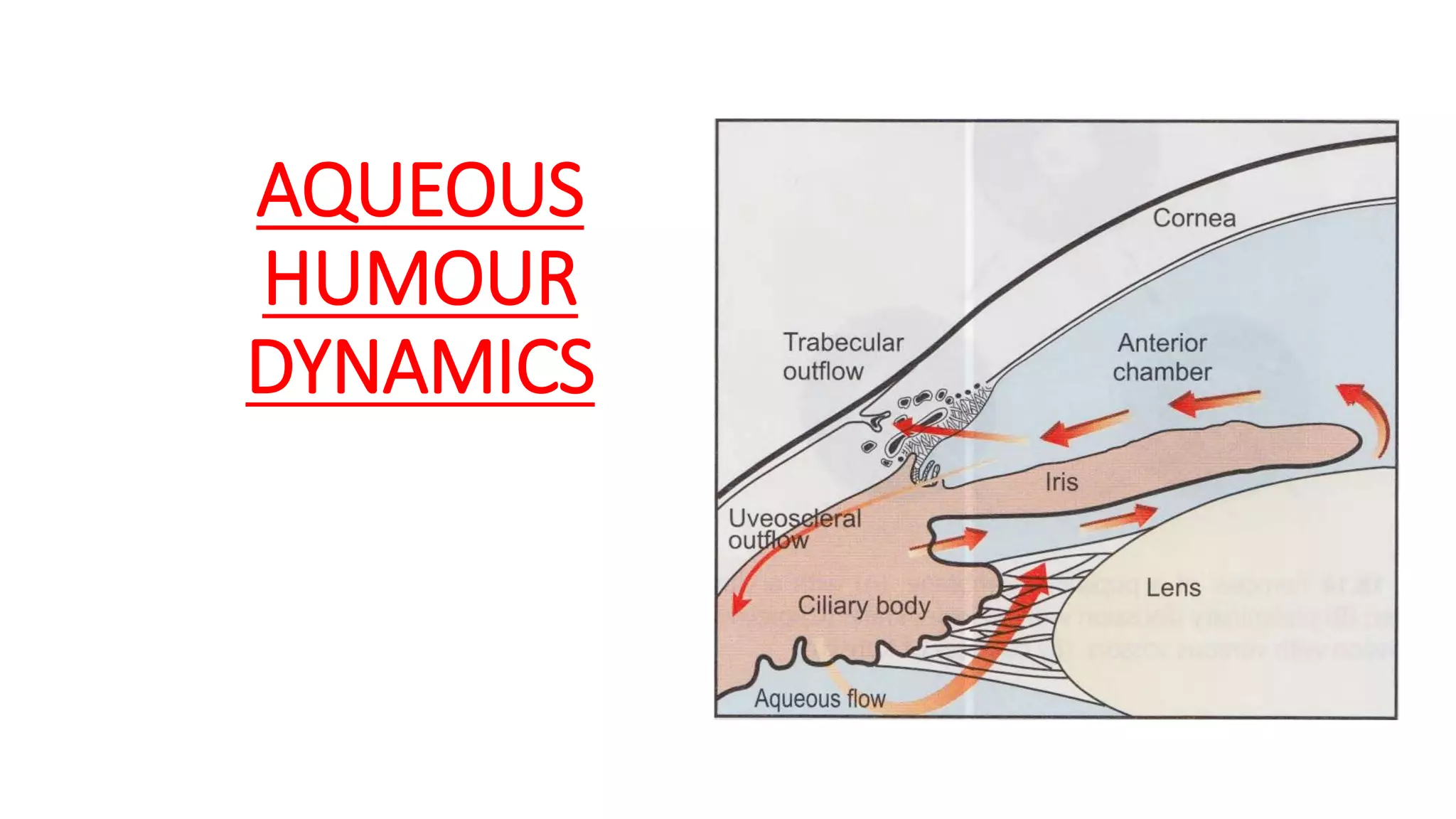
• Trabecular out flow (90%)
• Uveoscleral out flow (10-20%)
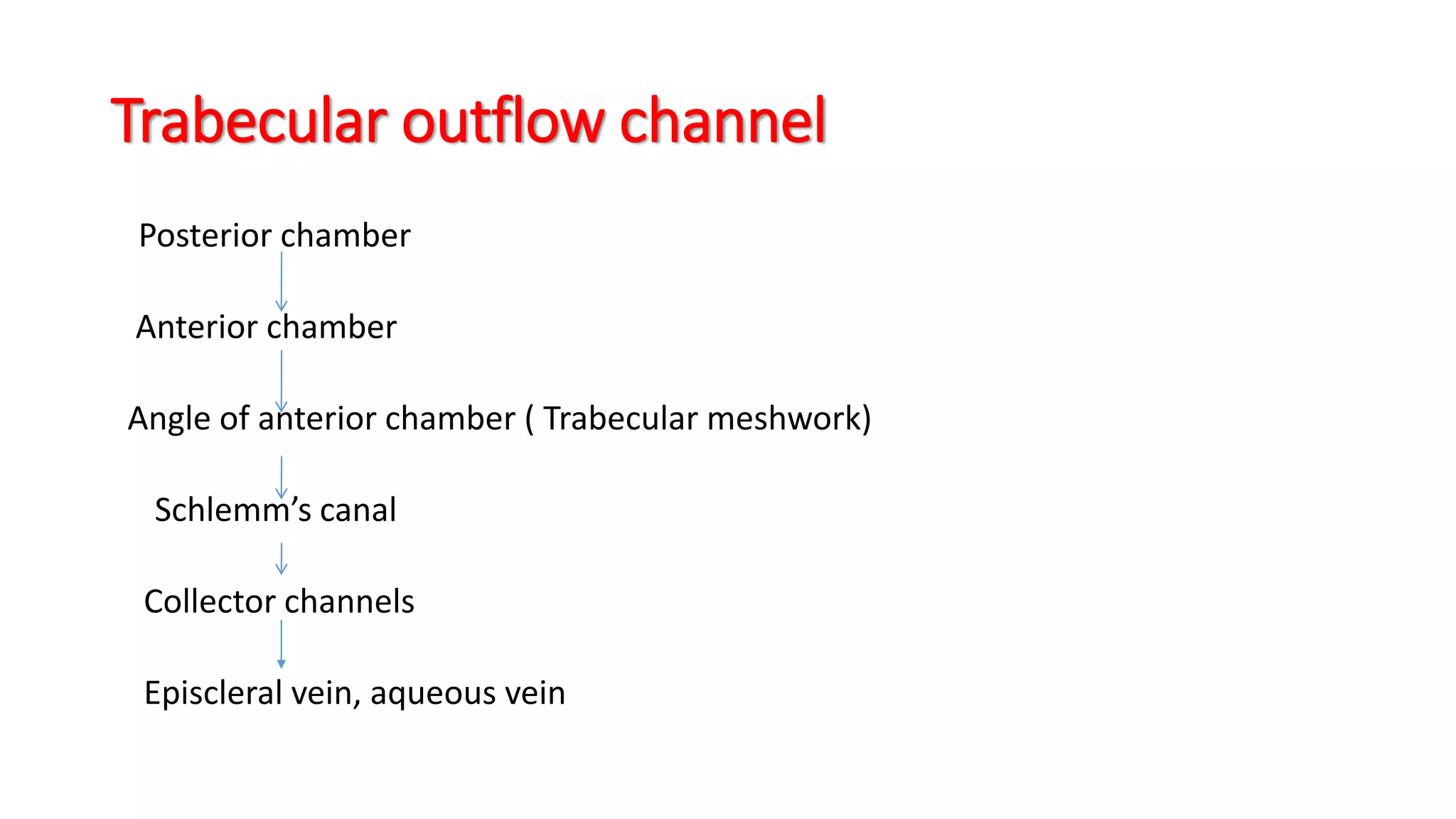
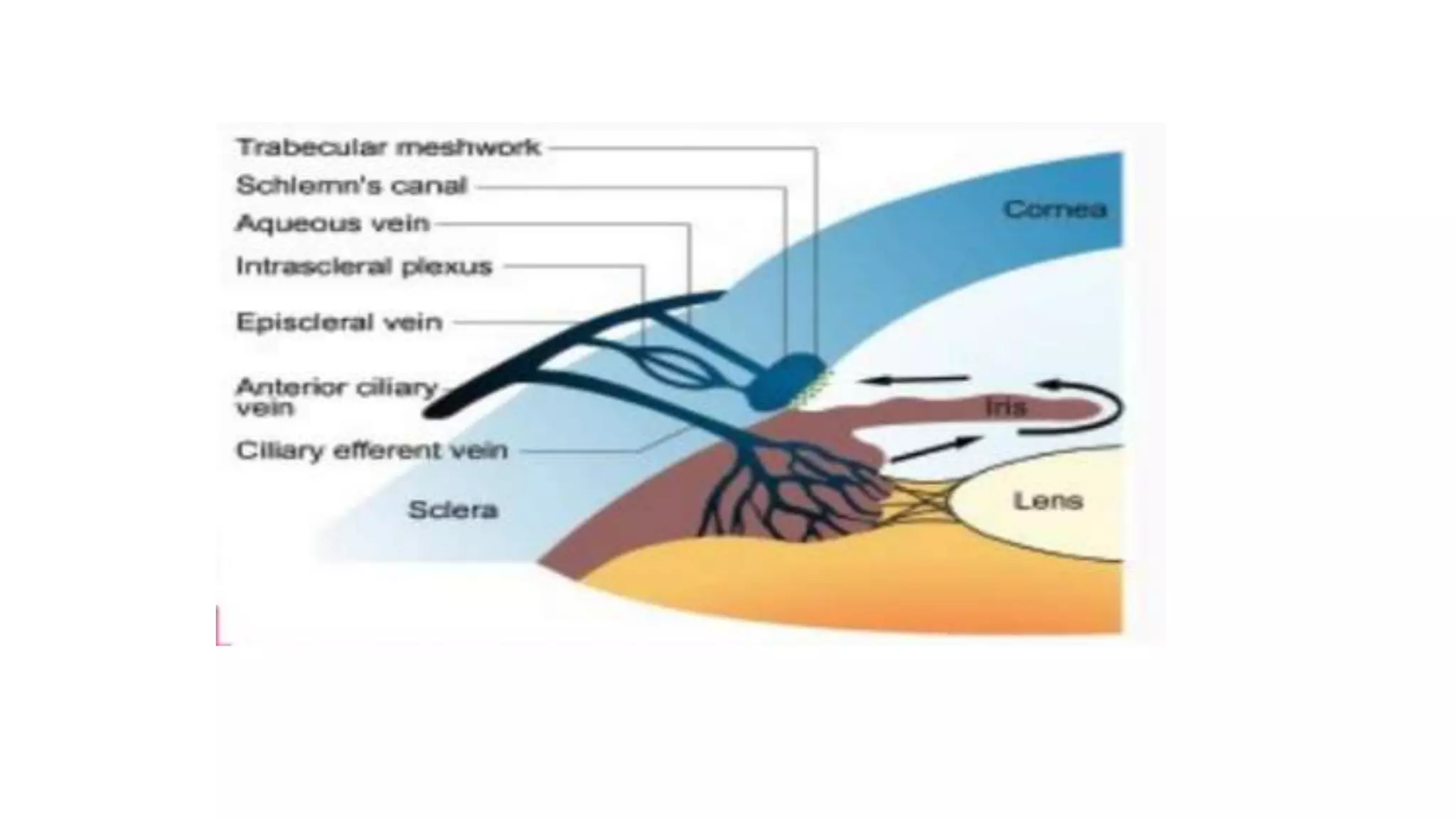
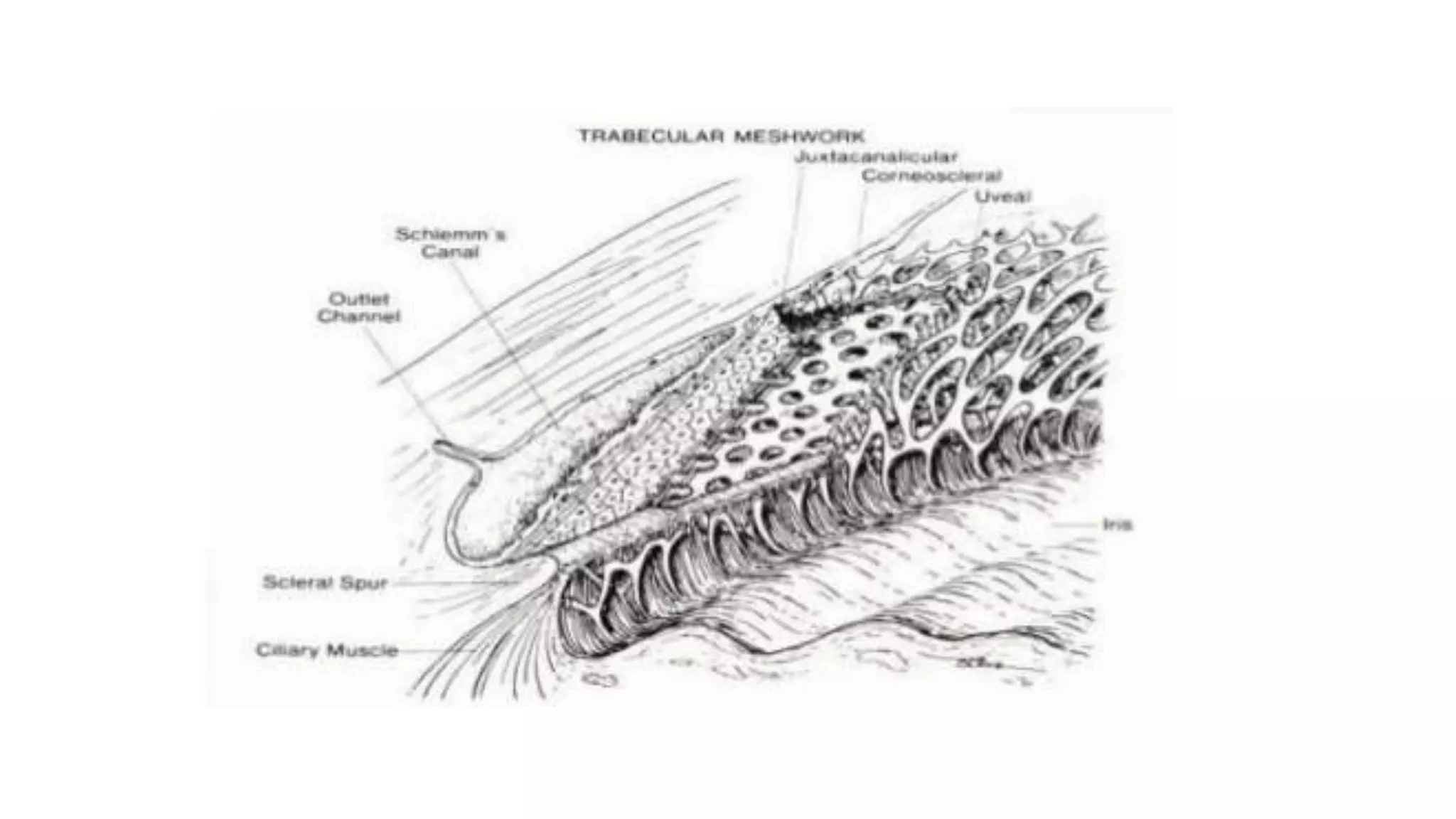
Trabecular outflow channel
Posterior chamber
Anterior chamber
Angle of anterior chamber ( Trabecular meshwork)
Schlemm’s canal
Collector channels
Episcleral vein, aqueous vein
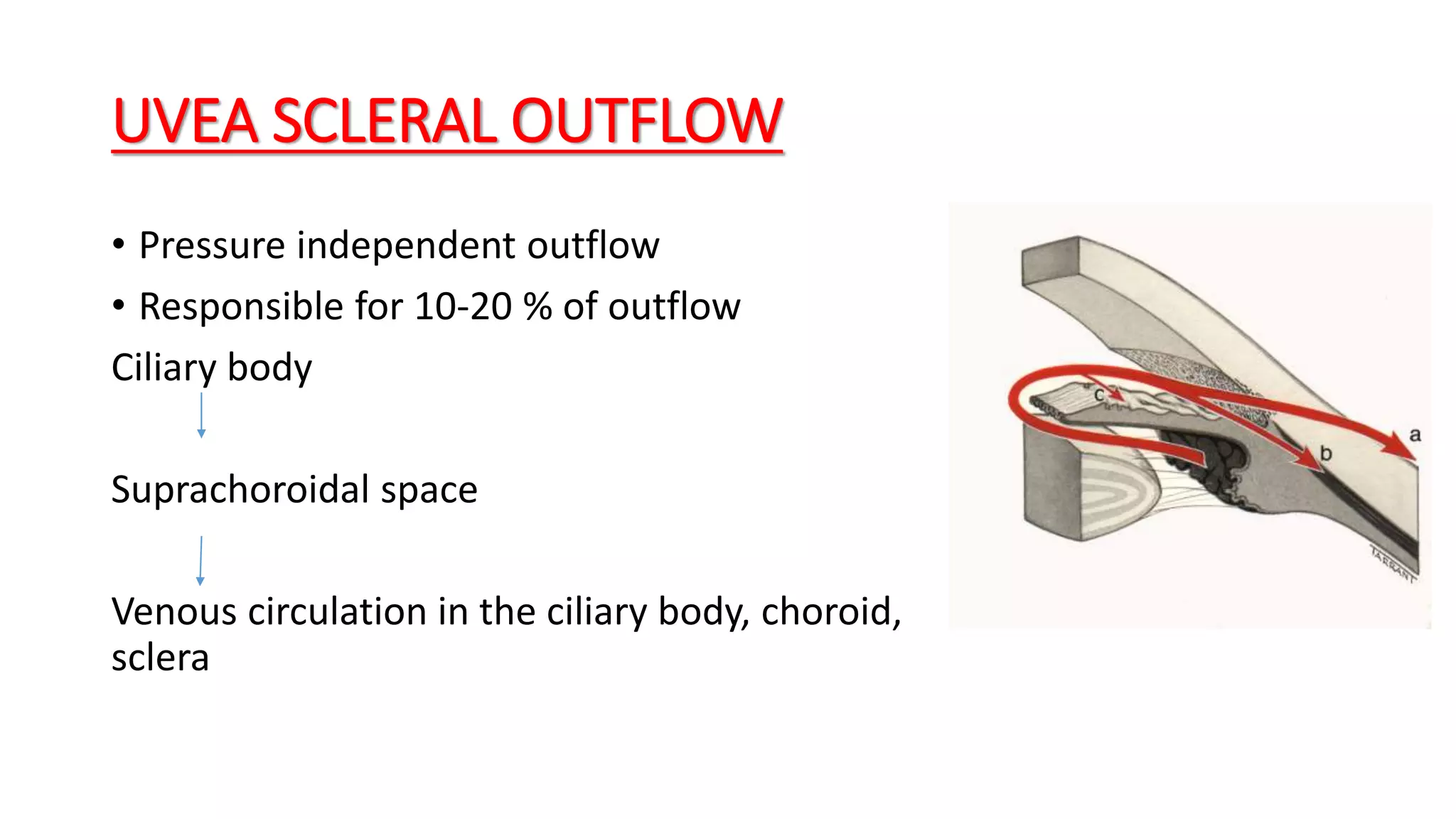
UVEA SCLERAL OUTFLOW
• Pressure independent outflow
• Responsible for 10-20 % of outflow
Ciliary body
Suprachoroidal space
Venous circulation in the ciliary body, choroid,
sclera
INTRAOCULAR PRESSURE
• Refers to the pressure exerted by the intraocular contents on the
coats of the eyeball.
• IOP is maintained by the a dynamic equilibrium between the aqueous
humour formation, aqueous humour outflow, and episcleral venous
pressure.
• Normal IOP is 10 – 21 mm Hg.
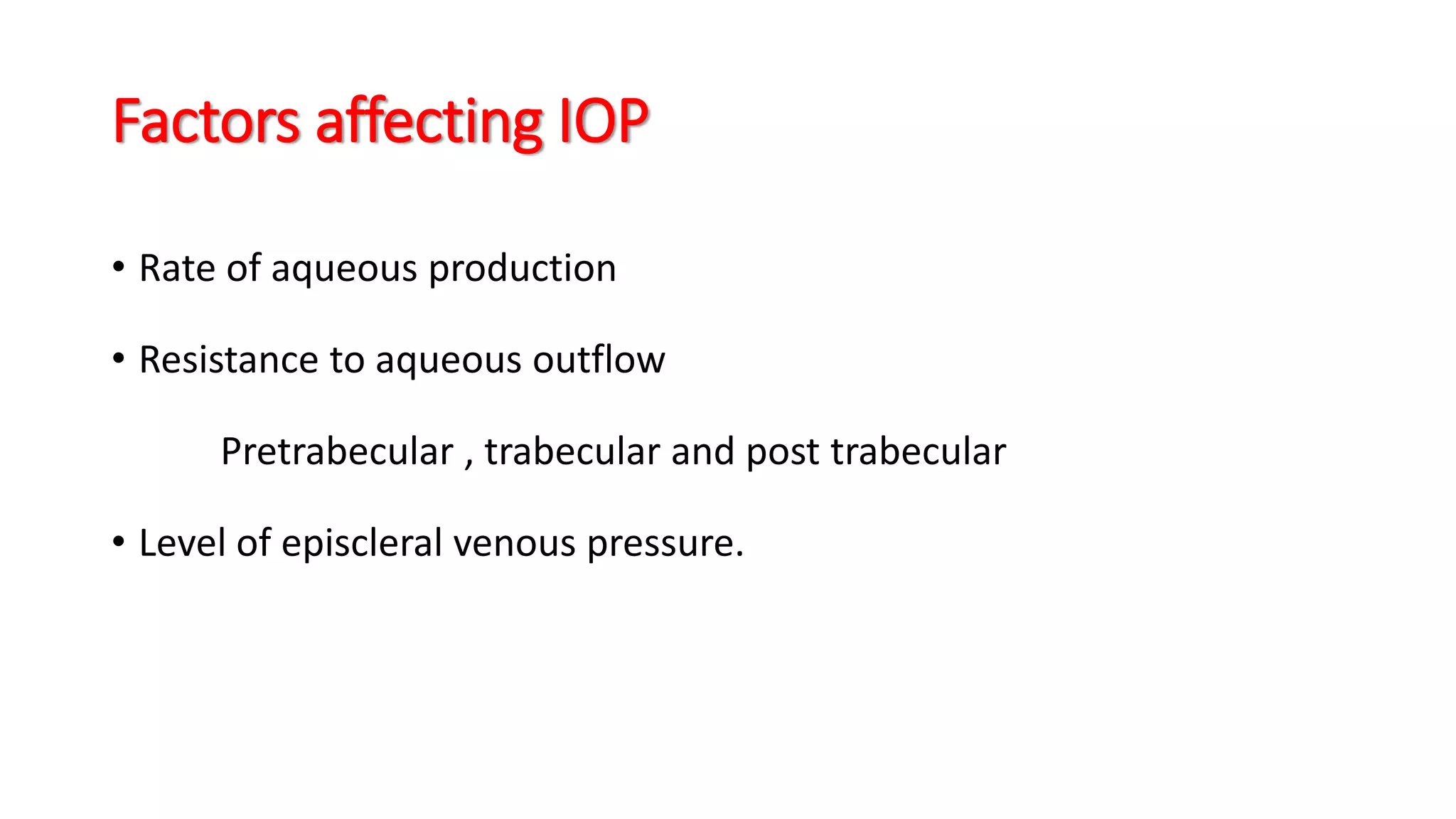
Factors affecting IOP
• Rate of aqueous production
• Resistance to aqueous outflow
Pretrabecular , trabecular and post trabecular
• Level of episcleral venous pressure.
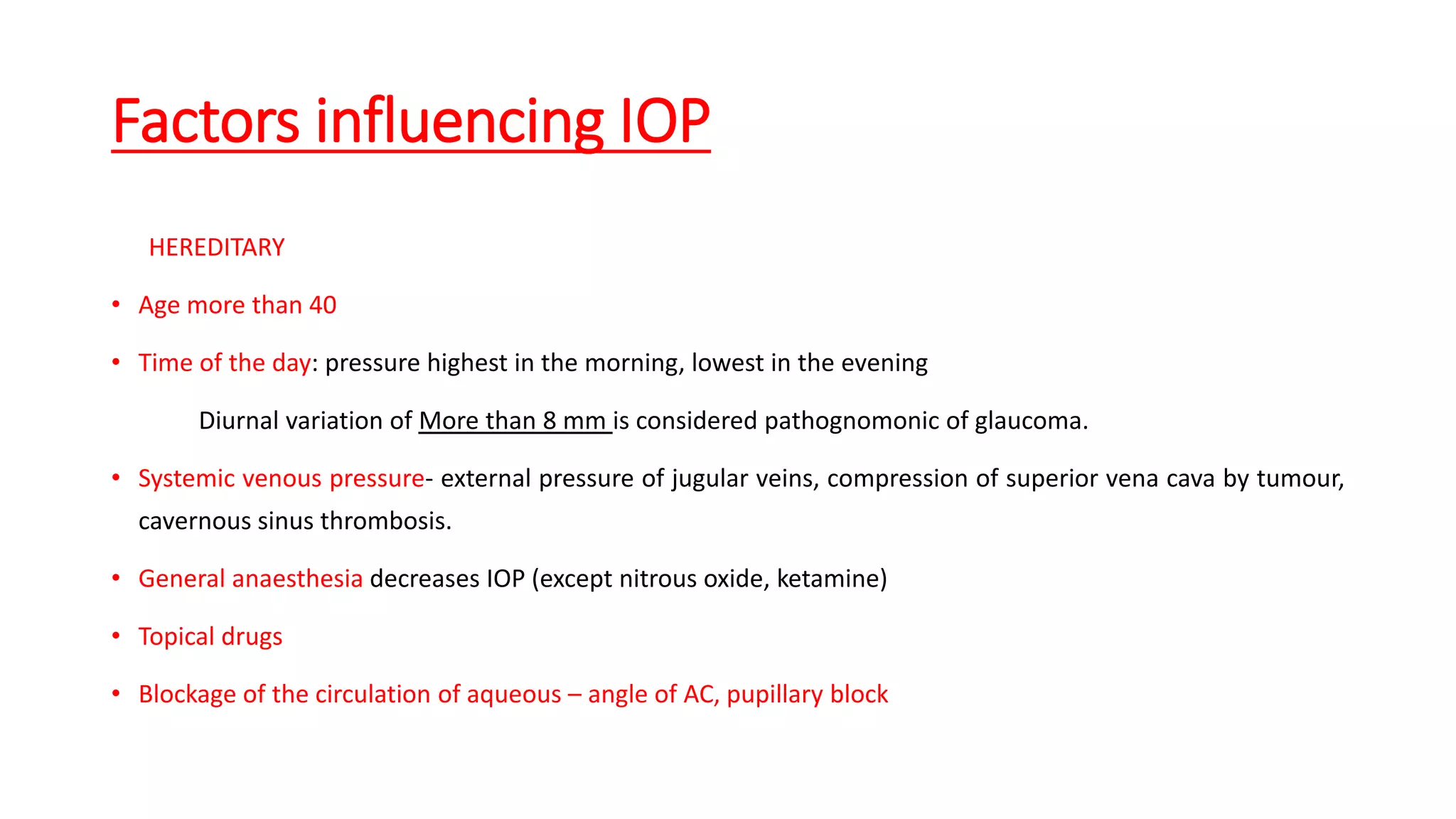
Factors influencing IOP
HEREDITARY
• Age more than 40
• Time of the day: pressure highest in the morning, lowest in the evening
Diurnal variation of More than 8 mm is considered pathognomonic of glaucoma.
• Systemic venous pressure- external pressure of jugular veins, compression of superior vena cava by tumour,
cavernous sinus thrombosis.
• General anaesthesia decreases IOP (except nitrous oxide, ketamine)
• Topical drugs
• Blockage of the circulation of aqueous – angle of AC, pupillary block
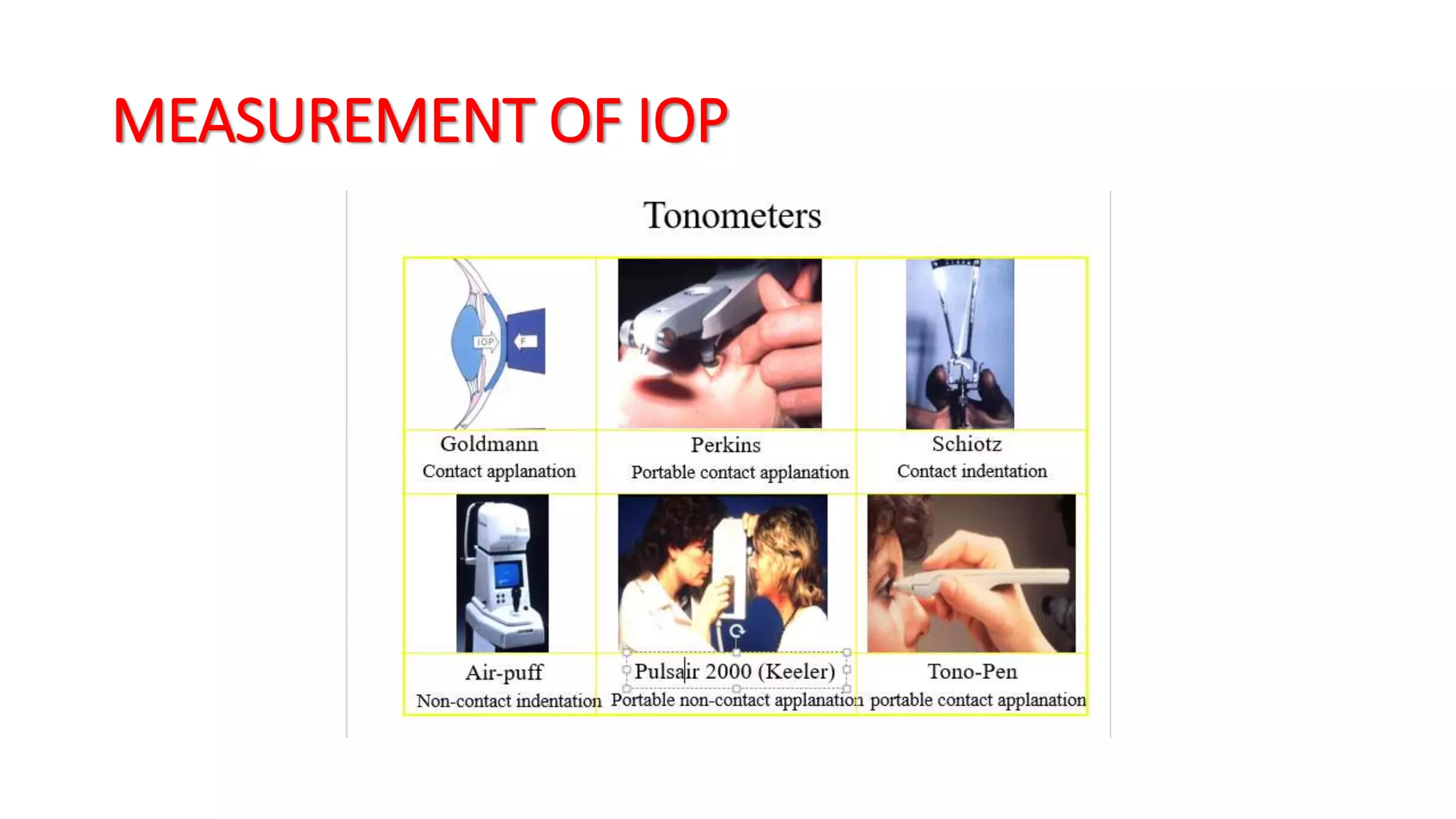
MEASUREMENT OF IOP
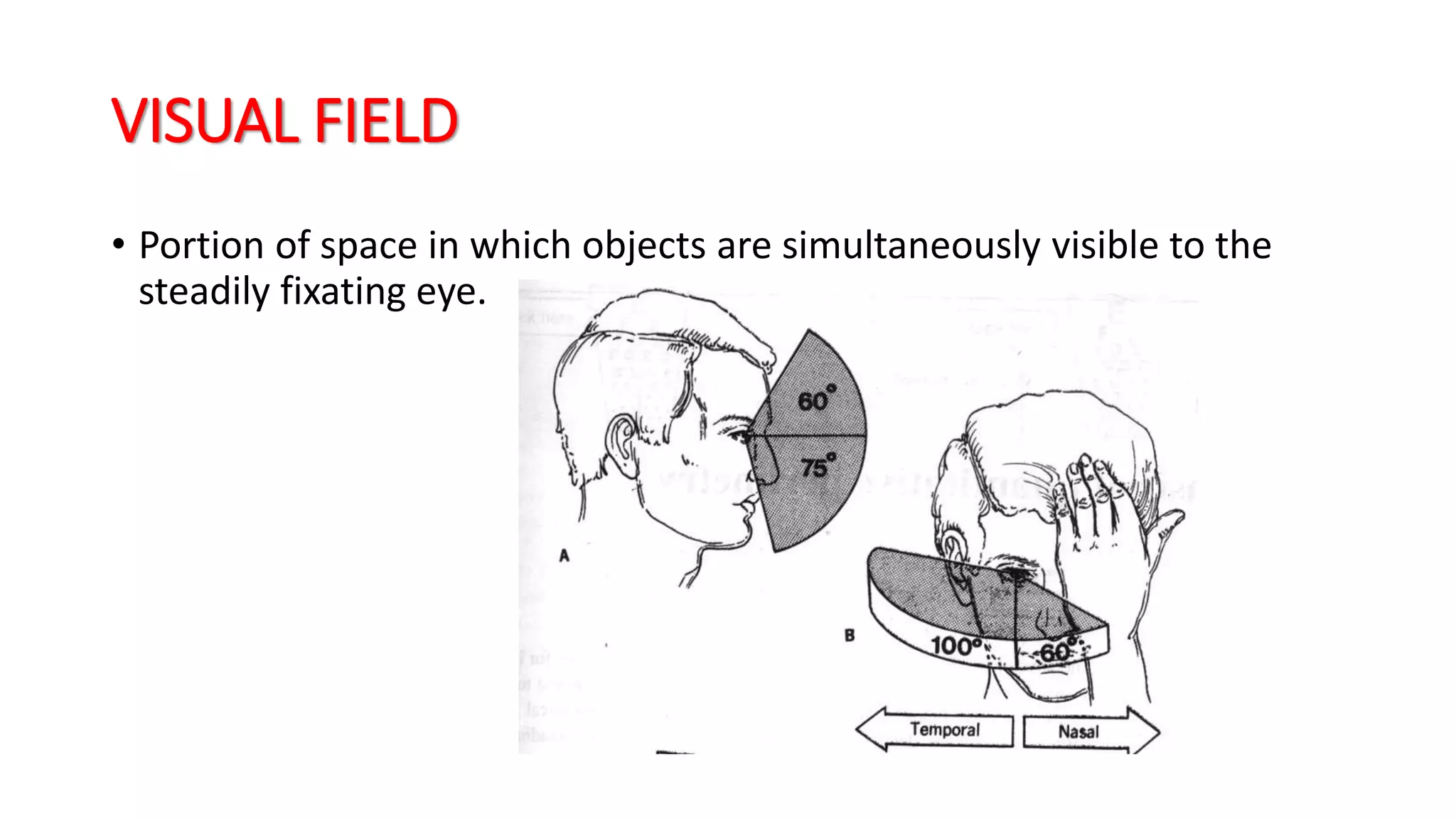
VISUAL FIELD
• Portion of space in which objects are simultaneously visible to the
steadily fixating eye.
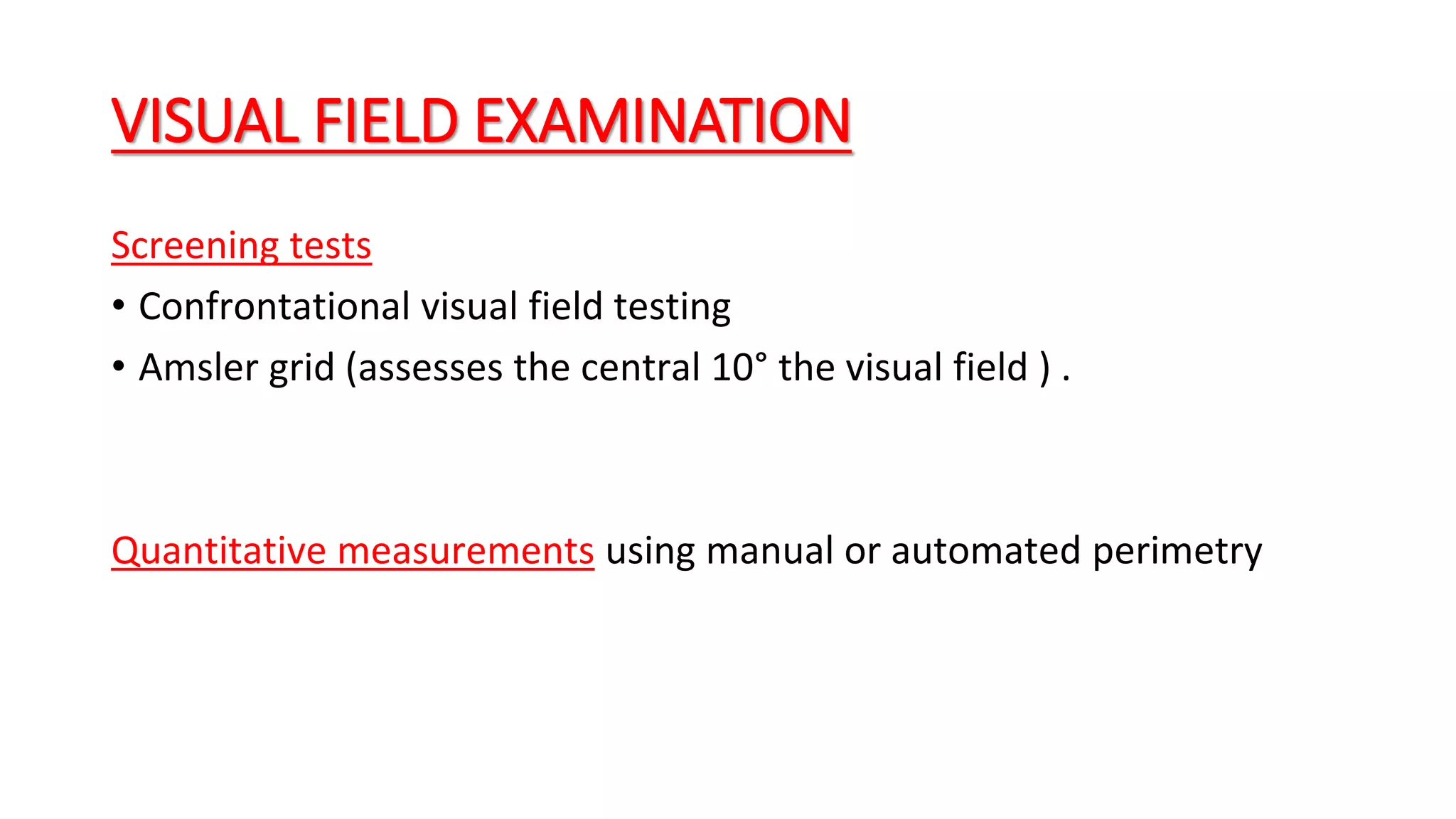
VISUAL FIELD EXAMINATION
Screening tests
• Confrontational visual field testing
• Amsler grid (assesses the central 10° the visual field ) .
Quantitative measurements using manual or automated perimetry
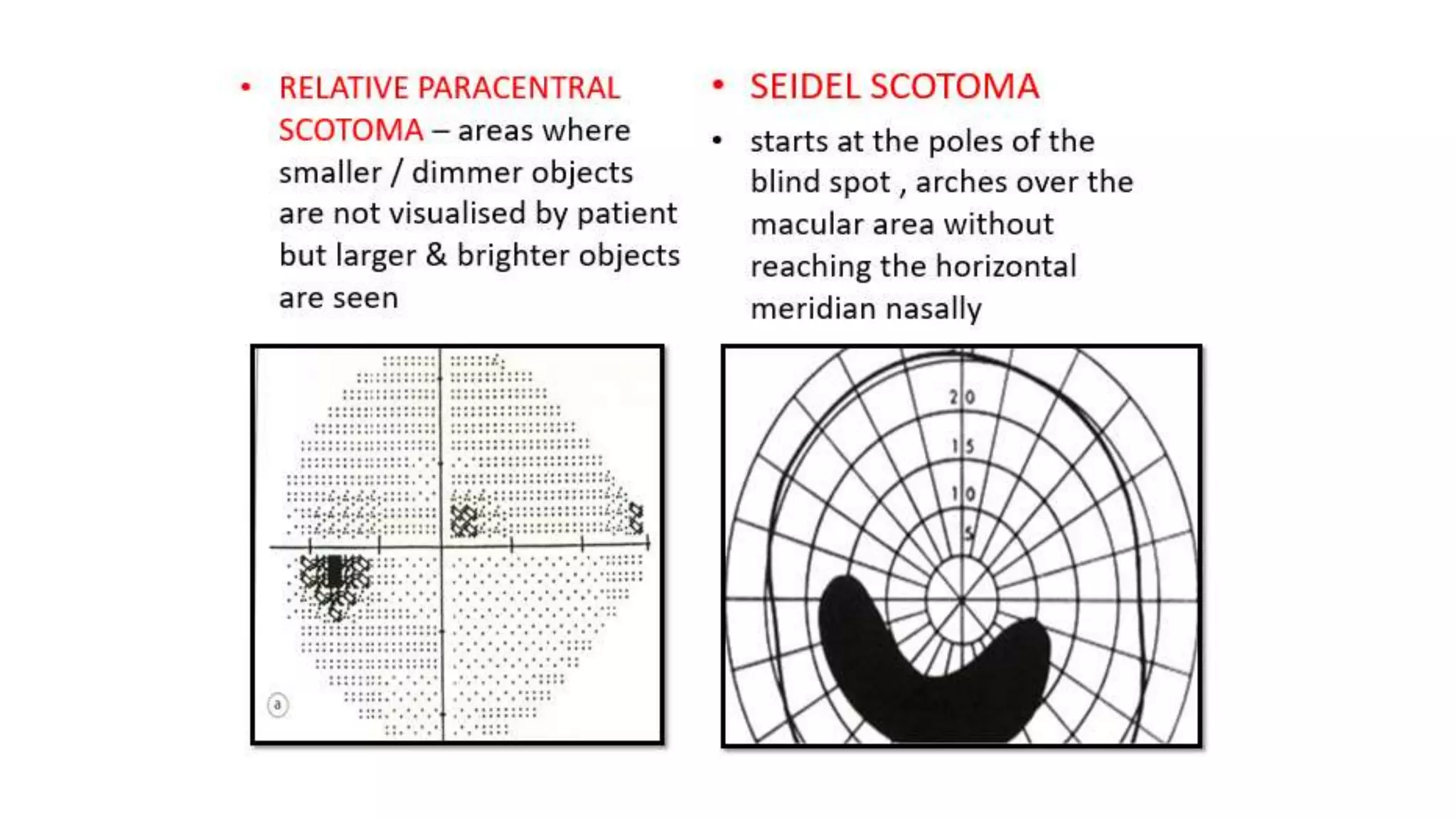
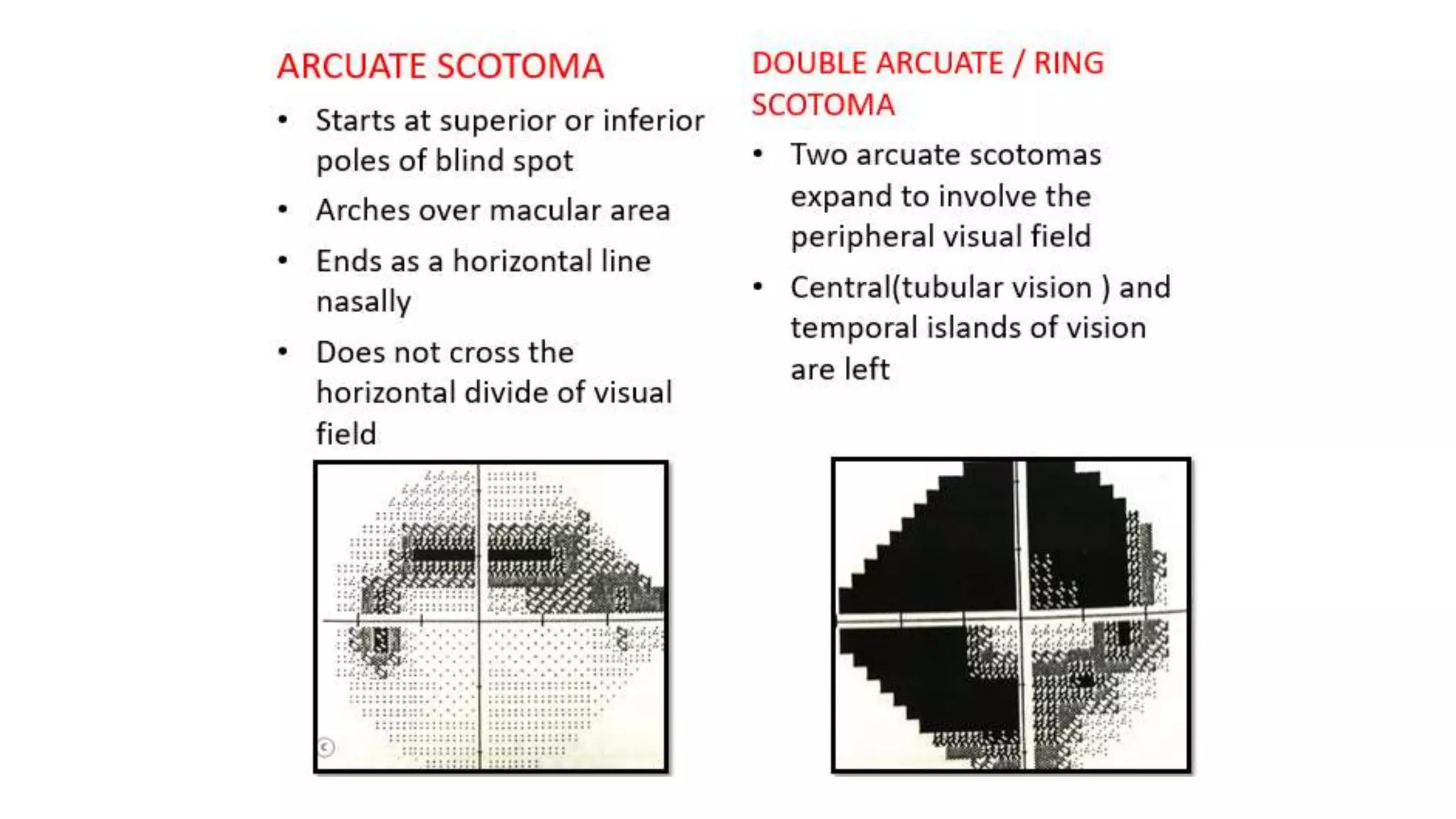
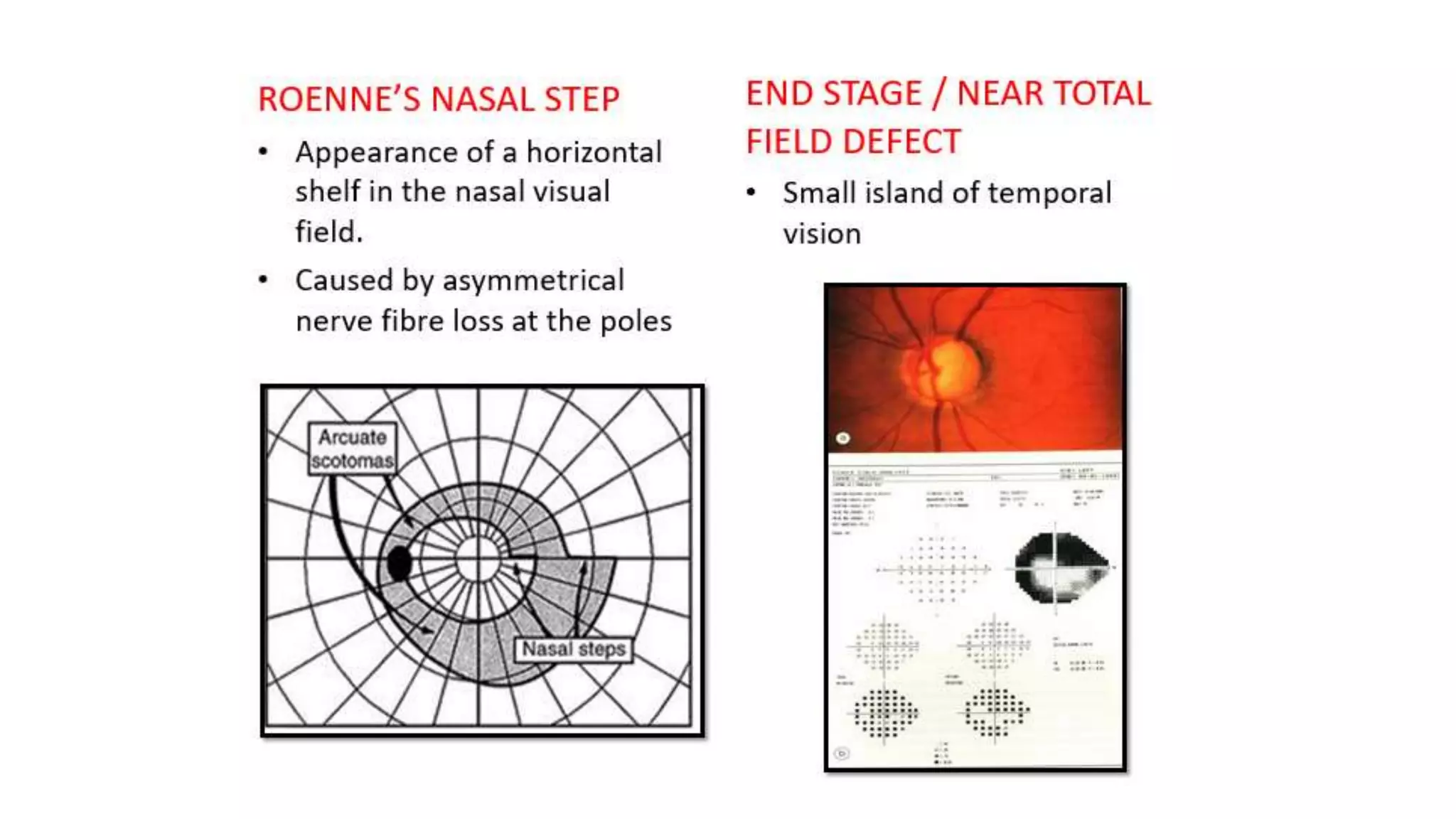
VISUAL FIELD DEFECTS
• Relative paracentral scotoma
• Roenne’s nasal step
• Seidel scotoma
• Arcuate scotoma
• Double arcuate / ring scotoma
• End stage / near total field defect
THANK YOU !!!

Dr.r.subramaniyan, 09 3-17,Aqueous Humour Dynamics

  • 1.
  • 2.
    FUNCTIONS • Aqueous humoris a clear, colourless, watery solution continuously circulated from the posterior chamber throughout the anterior chamber. • Maintains the intraocular pressure. • Maintains the shape and the internal structural arrangement of the eye. • Cornea takes glucose and oxygen from the aqueous. • Lens uses glucose, oxygen and amino acids from the aqueous.
  • 3.
    PHYSICOCHEMICAL PROPERTIES • VOLUME0.31 ml • (o.25 ml in anterior chamber and 0.06 ml in posterior chamber) • Refractive index 1.336 • Density greater than water • Hyperosmotic ( compared to plasma) 3-5 mOsm/l • pH: acidic • Rate of formation: 2.3 µl/min. • Protein content less.
  • 4.
    FACTORS AFFECTING COMPOSITIONOF AQUEOUS HUMOUR • BLOOD AQUEOUS BARRIER • Protein and large molecular size substances are largely prevented from entering the cavities. This maintains the clarity of the media of the eye. • Formed by the tight junctions between the cells of epithelium of the ciliary body and endothelium of iris capillaries.
  • 5.
    EFFECT OF BREAKDOWNOF BLOOD AQUEOUS BARRIER ON AQUEOUS HUMOUR COMPOSITION • Proteins and antibodies in aqueous equilibrate with those in plasma to form plasmoid aqueous (secondary aqueous). • Recognised clinically in slit lamp microscope as Tyndall Beam. • Fibrinogen appears in aqueous, which may allow the aqueous actually to clot. • Ionic composition of the aqueous approches same as plasma.
  • 6.
    Aqueous humor production •Active secretion by double- layered ciliary epithelium. • Primarily derived from the plasma within the capillary network of the ciliary processes.
  • 7.
    Aqueous humor • Secretiondepends on: • Integrity of blood aqueous barrier • Blood flow to ciliary body • Neurohormonal regulation of blood and ciliary body • Adrenergic innervation
  • 8.
    Aqueous humor outflow •Trabecular out flow (90%) • Uveoscleral out flow (10-20%)
  • 9.
    Trabecular outflow channel Posteriorchamber Anterior chamber Angle of anterior chamber ( Trabecular meshwork) Schlemm’s canal Collector channels Episcleral vein, aqueous vein
  • 12.
    UVEA SCLERAL OUTFLOW •Pressure independent outflow • Responsible for 10-20 % of outflow Ciliary body Suprachoroidal space Venous circulation in the ciliary body, choroid, sclera
  • 13.
    INTRAOCULAR PRESSURE • Refersto the pressure exerted by the intraocular contents on the coats of the eyeball. • IOP is maintained by the a dynamic equilibrium between the aqueous humour formation, aqueous humour outflow, and episcleral venous pressure. • Normal IOP is 10 – 21 mm Hg.
  • 14.
    Factors affecting IOP •Rate of aqueous production • Resistance to aqueous outflow Pretrabecular , trabecular and post trabecular • Level of episcleral venous pressure.
  • 15.
    Factors influencing IOP HEREDITARY •Age more than 40 • Time of the day: pressure highest in the morning, lowest in the evening Diurnal variation of More than 8 mm is considered pathognomonic of glaucoma. • Systemic venous pressure- external pressure of jugular veins, compression of superior vena cava by tumour, cavernous sinus thrombosis. • General anaesthesia decreases IOP (except nitrous oxide, ketamine) • Topical drugs • Blockage of the circulation of aqueous – angle of AC, pupillary block
  • 16.
  • 17.
    VISUAL FIELD • Portionof space in which objects are simultaneously visible to the steadily fixating eye.
  • 18.
    VISUAL FIELD EXAMINATION Screeningtests • Confrontational visual field testing • Amsler grid (assesses the central 10° the visual field ) . Quantitative measurements using manual or automated perimetry
  • 21.
    VISUAL FIELD DEFECTS •Relative paracentral scotoma • Roenne’s nasal step • Seidel scotoma • Arcuate scotoma • Double arcuate / ring scotoma • End stage / near total field defect
  • 25.