ORBITAL SPACES & ITS
IMPORTANCE IN OCULAR
ANAESTHESIA
DR. ANKITA MAHAPATRA
1ST YR PG, DEPARTMENT OF
OPHTHALMOLOGY
VSSIMSAR,BURLA
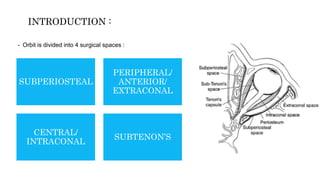
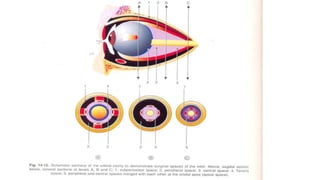
- Orbit is divided into 4 surgical spaces :
SUBPERIOSTEAL
PERIPHERAL/
ANTERIOR/
EXTRACONAL
CENTRAL/
INTRACONAL
SUBTENON’S
INTRODUCTION :
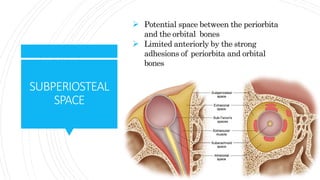
SUBPERIOSTEAL
SPACE
 Potential space between the periorbita
and the orbital bones
 Limited anteriorly by the strong
adhesions of periorbita and orbital
bones
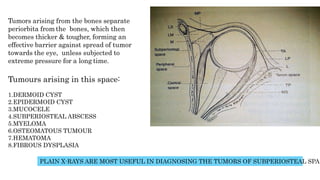
Tumors arising from the bones separate
periorbita from the bones, which then
becomes thicker & tougher, forming an
effective barrier against spread of tumor
towards the eye, unless subjected to
extreme pressure for a long time.
Tumours arising in this space:
1.DERMOID CYST
2.EPIDERMOID CYST
3.MUCOCELE
4.SUBPERIOSTEAL ABSCESS
5.MYELOMA
6.OSTEOMATOUS TUMOUR
7.HEMATOMA
8.FIBROUS DYSPLASIA
PLAIN X-RAYS ARE MOST USEFUL IN DIAGNOSING THE TUMORS OF SUBPERIOSTEAL SPAC
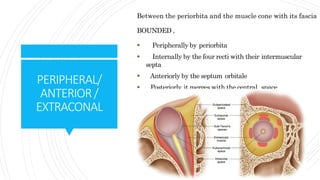
PERIPHERAL/
ANTERIOR/
EXTRACONAL
Between the periorbita and the muscle cone with its fascia
BOUNDED ,
 Peripherally by periorbita
 Internally by the four recti with their intermuscular
septa
 Anteriorly by the septum orbitale
 Posteriorly, it merges with the central space
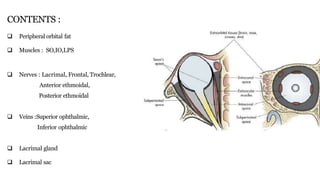
CONTENTS :
 Peripheral orbital fat
 Muscles : SO,IO,LPS
 Nerves : Lacrimal, Frontal, Trochlear,
Anterior ethmoidal,
Posterior ethmoidal
 Veins :Superior ophthalmic,
Inferior ophthalmic
 Lacrimal gland
 Lacrimal sac
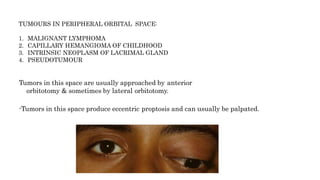
TUMOURS IN PERIPHERAL ORBITAL SPACE:
1. MALIGNANT LYMPHOMA
2. CAPILLARY HEMANGIOMA OF CHILDHOOD
3. INTRINSIC NEOPLASM OF LACRIMAL GLAND
4. PSEUDOTUMOUR
Tumors in this space are usually approached by anterior
orbitotomy & sometimes by lateral orbitotomy.
-Tumors in this space produce eccentric proptosis and can usually be palpated.
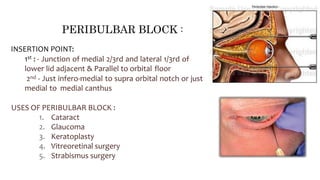
INSERTION POINT:
1st : - Junction of medial 2/3rd and lateral 1/3rd of
lower lid adjacent & Parallel to orbital floor
2nd - Just infero-medial to supra orbital notch or just
medial to medial canthus
USES OF PERIBULBAR BLOCK :
1. Cataract
2. Glaucoma
3. Keratoplasty
4. Vitreoretinal surgery
5. Strabismus surgery
PERIBULBAR BLOCK :
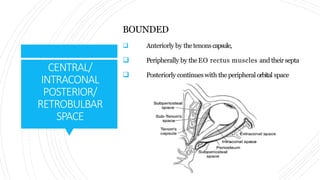
CENTRAL/
INTRACONAL
POSTERIOR/
RETROBULBAR
SPACE
BOUNDED
 Anteriorly by thetenonscapsule,
 Peripherally by theEO rectus muscles and theirsepta
 Posteriorly continueswith theperipheral orbital space
INTRACONAL
SPACE
 CONTENTS :
 Central orbital fat
 Vessels
Ophthalmic artery
Superior Ophthalmic Vein
 Nerves
 Optic nerve (with its meninges)
 Oculomotor
Superior and inferior divisions
 Nasociliary
 Abducent
 Ciliary ganglion
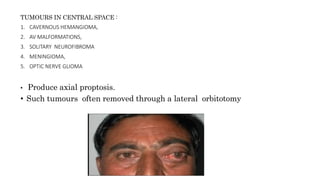
TUMOURS IN CENTRAL SPACE :
1. CAVERNOUS HEMANGIOMA,
2. AV MALFORMATIONS,
3. SOLITARY NEUROFIBROMA
4. MENINGIOMA,
5. OPTIC NERVE GLIOMA
• Produce axial proptosis.
• Such tumours often removed through a lateral orbitotomy
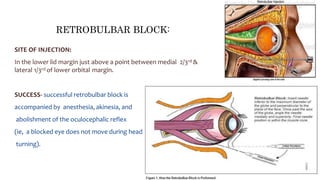
SITE OF INJECTION:
In the lower lid margin just above a point between medial 2/3rd &
lateral 1/3rd of lower orbital margin.
SUCCESS- successful retrobulbar block is
accompanied by anesthesia, akinesia, and
abolishment of the oculocephalic reflex
(ie, a blocked eye does not move during head
turning).
RETROBULBAR BLOCK:
COMPLICATION :
 Retrobulbar haemorrhage
 Globe penetration
 Optic nerve sheath injury
 Optic nerve atrophy
 Retinal vascular occlusion
 Brain stem anaesthesia
 Frank convulsion
 Extra ocular muscle palsy
 Trigeminal nerve block
 Oculo-cardiac reflex
 Respiratory arrest
SUB-TENON’S
SPACE
 Potential space around the eyeball between the
tenons and the sclera.
 Anterior and posterior subtenons injections are
given.
 Abscesses are drained by incising the conjunctiva
Conjunctival incision halfway between inf. limbus
& fornix to open into post. sub-tenon space
Dissection Infiltration
PARABULBAR OR SUB-TENON BLOCK :
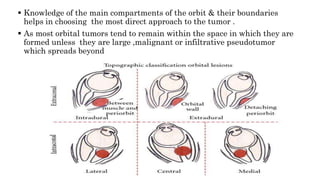
 Knowledge of the main compartments of the orbit & their boundaries
helps in choosing the most direct approach to the tumor .
 As most orbital tumors tend to remain within the space in which they are
formed unless they are large ,malignant or infiltrative pseudotumor
which spreads beyond
THANK YOU

Orbital spaces

  • 1.
    ORBITAL SPACES &ITS IMPORTANCE IN OCULAR ANAESTHESIA DR. ANKITA MAHAPATRA 1ST YR PG, DEPARTMENT OF OPHTHALMOLOGY VSSIMSAR,BURLA
  • 2.
    - Orbit isdivided into 4 surgical spaces : SUBPERIOSTEAL PERIPHERAL/ ANTERIOR/ EXTRACONAL CENTRAL/ INTRACONAL SUBTENON’S INTRODUCTION :
  • 4.
    SUBPERIOSTEAL SPACE  Potential spacebetween the periorbita and the orbital bones  Limited anteriorly by the strong adhesions of periorbita and orbital bones
  • 5.
    Tumors arising fromthe bones separate periorbita from the bones, which then becomes thicker & tougher, forming an effective barrier against spread of tumor towards the eye, unless subjected to extreme pressure for a long time. Tumours arising in this space: 1.DERMOID CYST 2.EPIDERMOID CYST 3.MUCOCELE 4.SUBPERIOSTEAL ABSCESS 5.MYELOMA 6.OSTEOMATOUS TUMOUR 7.HEMATOMA 8.FIBROUS DYSPLASIA PLAIN X-RAYS ARE MOST USEFUL IN DIAGNOSING THE TUMORS OF SUBPERIOSTEAL SPAC
  • 6.
    PERIPHERAL/ ANTERIOR/ EXTRACONAL Between the periorbitaand the muscle cone with its fascia BOUNDED ,  Peripherally by periorbita  Internally by the four recti with their intermuscular septa  Anteriorly by the septum orbitale  Posteriorly, it merges with the central space
  • 7.
    CONTENTS :  Peripheralorbital fat  Muscles : SO,IO,LPS  Nerves : Lacrimal, Frontal, Trochlear, Anterior ethmoidal, Posterior ethmoidal  Veins :Superior ophthalmic, Inferior ophthalmic  Lacrimal gland  Lacrimal sac
  • 8.
    TUMOURS IN PERIPHERALORBITAL SPACE: 1. MALIGNANT LYMPHOMA 2. CAPILLARY HEMANGIOMA OF CHILDHOOD 3. INTRINSIC NEOPLASM OF LACRIMAL GLAND 4. PSEUDOTUMOUR Tumors in this space are usually approached by anterior orbitotomy & sometimes by lateral orbitotomy. -Tumors in this space produce eccentric proptosis and can usually be palpated.
  • 9.
    INSERTION POINT: 1st :- Junction of medial 2/3rd and lateral 1/3rd of lower lid adjacent & Parallel to orbital floor 2nd - Just infero-medial to supra orbital notch or just medial to medial canthus USES OF PERIBULBAR BLOCK : 1. Cataract 2. Glaucoma 3. Keratoplasty 4. Vitreoretinal surgery 5. Strabismus surgery PERIBULBAR BLOCK :
  • 10.
    CENTRAL/ INTRACONAL POSTERIOR/ RETROBULBAR SPACE BOUNDED  Anteriorly bythetenonscapsule,  Peripherally by theEO rectus muscles and theirsepta  Posteriorly continueswith theperipheral orbital space
  • 11.
    INTRACONAL SPACE  CONTENTS : Central orbital fat  Vessels Ophthalmic artery Superior Ophthalmic Vein  Nerves  Optic nerve (with its meninges)  Oculomotor Superior and inferior divisions  Nasociliary  Abducent  Ciliary ganglion
  • 12.
    TUMOURS IN CENTRALSPACE : 1. CAVERNOUS HEMANGIOMA, 2. AV MALFORMATIONS, 3. SOLITARY NEUROFIBROMA 4. MENINGIOMA, 5. OPTIC NERVE GLIOMA • Produce axial proptosis. • Such tumours often removed through a lateral orbitotomy
  • 13.
    SITE OF INJECTION: Inthe lower lid margin just above a point between medial 2/3rd & lateral 1/3rd of lower orbital margin. SUCCESS- successful retrobulbar block is accompanied by anesthesia, akinesia, and abolishment of the oculocephalic reflex (ie, a blocked eye does not move during head turning). RETROBULBAR BLOCK:
  • 14.
    COMPLICATION :  Retrobulbarhaemorrhage  Globe penetration  Optic nerve sheath injury  Optic nerve atrophy  Retinal vascular occlusion  Brain stem anaesthesia  Frank convulsion  Extra ocular muscle palsy  Trigeminal nerve block  Oculo-cardiac reflex  Respiratory arrest
  • 15.
    SUB-TENON’S SPACE  Potential spacearound the eyeball between the tenons and the sclera.  Anterior and posterior subtenons injections are given.  Abscesses are drained by incising the conjunctiva
  • 16.
    Conjunctival incision halfwaybetween inf. limbus & fornix to open into post. sub-tenon space Dissection Infiltration PARABULBAR OR SUB-TENON BLOCK :
  • 17.
     Knowledge ofthe main compartments of the orbit & their boundaries helps in choosing the most direct approach to the tumor .  As most orbital tumors tend to remain within the space in which they are formed unless they are large ,malignant or infiltrative pseudotumor which spreads beyond
  • 18.