ALLIED HEALTH SCIENCES
IIMT UNIVERSITY
MEERUT
ASSESSMENT
field of vision
PRESENTED BY
Rahul tyagi
B. OPTOMETRY
2nd
year
Six types of visual field tests
 Confrontation visual field test. ...
 Automated static perimetry test. ...
 Kinetic visual field test. ...
 Frequency doubling perimetry. ...
 Electroretinography. ...
 Amsler grid: A basic visual field test for central
vision.
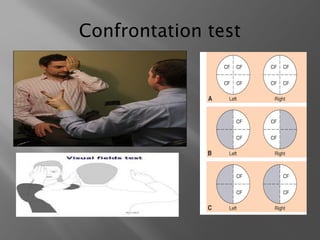
1. Confrontation visual field test
.
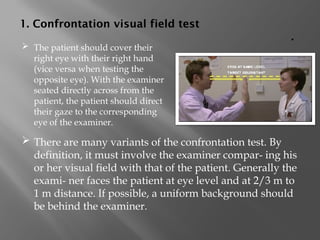
 There are many variants of the confrontation test. By
definition, it must involve the examiner compar- ing his
or her visual field with that of the patient. Generally the
exami- ner faces the patient at eye level and at 2/3 m to
1 m distance. If possible, a uniform background should
be behind the examiner.
 The patient should cover their
right eye with their right hand
(vice versa when testing the
opposite eye). With the examiner
seated directly across from the
patient, the patient should direct
their gaze to the corresponding
eye of the examiner.
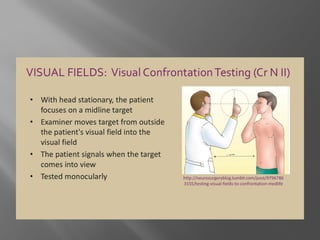
Confrontation test
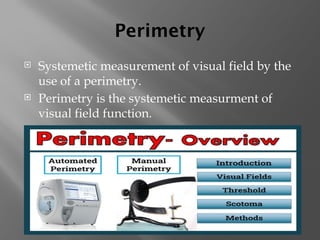
Perimetry
 Systemetic measurement of visual field by the
use of a perimetry.
 Perimetry is the systemetic measurment of
visual field function.
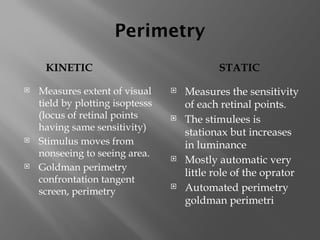
Perimetry
KINETIC STATIC
 Measures extent of visual
tield by plotting isoptesss
(locus of retinal points
having same sensitivity)
 Stimulus moves from
nonseeing to seeing area.
 Goldman perimetry
confrontation tangent
screen, perimetry
 Measures the sensitivity
of each retinal points.
 The stimulees is
stationax but increases
in luminance
 Mostly automatic very
little role of the oprator
 Automated perimetry
goldman perimetri
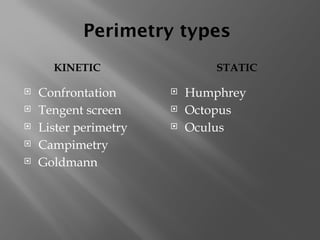
Perimetry types
KINETIC STATIC
 Confrontation
 Tengent screen
 Lister perimetry
 Campimetry
 Goldmann
 Humphrey
 Octopus
 Oculus
History
 1970- The original octopus perimeter was first
introduced. Because of its room size and high
expensive nature it became unpopular.
 1980- BJERRUM developed tangent screen.
 1982- Humphrey field analyzer was first
displayed at american academy of opthalmology.
 1982- Michael patella showed its first clinical trail.
 1984- Started production and became very popular
because of its small size and affordable price.
Indications of perimetry
 Detection of glucoma, progression
 Chorioretinal lesions
 Optic disc and Optic nerve lesions
 Neuro opthalmological diseases
 Abnormal color vision
 Reduction in visual acuty that can not be
improved with pin hole , stenopaic slit or
refractive correction.
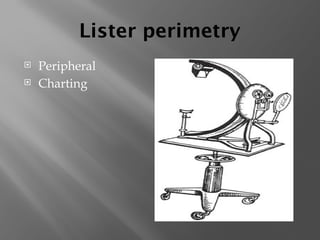
Lister perimetry
 Peripheral
 Charting
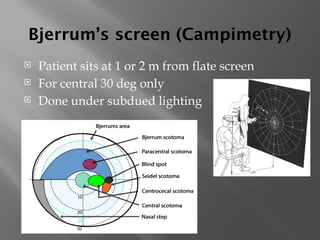
Bjerrum’s screen (Campimetry)
 Patient sits at 1 or 2 m from flate screen
 For central 30 deg only
 Done under subdued lighting
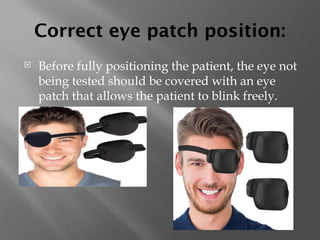
Correct eye patch position:
 Before fully positioning the patient, the eye not
being tested should be covered with an eye
patch that allows the patient to blink freely.
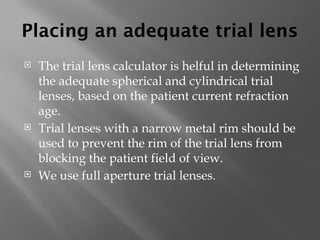
Placing an adequate trial lens
 The trial lens calculator is helful in determining
the adequate spherical and cylindrical trial
lenses, based on the patient current refraction
age.
 Trial lenses with a narrow metal rim should be
used to prevent the rim of the trial lens from
blocking the patient field of view.
 We use full aperture trial lenses.
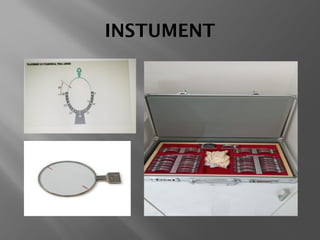
INSTUMENT
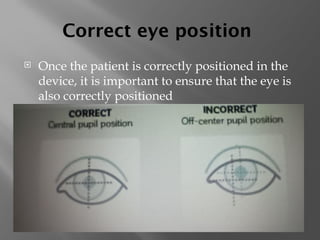
Correct eye position
 Once the patient is correctly positioned in the
device, it is important to ensure that the eye is
also correctly positioned

 The left – hand panel shows an eye that video
monitor that is correctly position, with the
cross-hair target located within the boundaries
of the pupil.
 The right-hand panel shows an eye that is
incorrectly positioned, within the cross-hair
target outside the boundaries of the pupil.
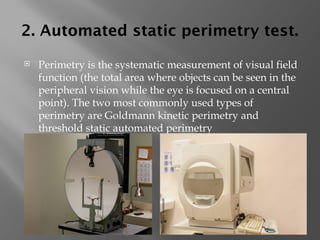
2. Automated static perimetry test.
 Perimetry is the systematic measurement of visual field
function (the total area where objects can be seen in the
peripheral vision while the eye is focused on a central
point). The two most commonly used types of
perimetry are Goldmann kinetic perimetry and
threshold static automated perimetry
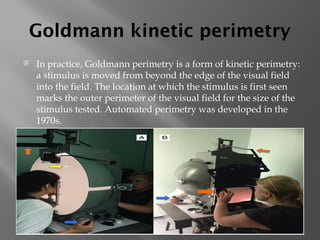
Goldmann kinetic perimetry
 In practice, Goldmann perimetry is a form of kinetic perimetry:
a stimulus is moved from beyond the edge of the visual field
into the field. The location at which the stimulus is first seen
marks the outer perimeter of the visual field for the size of the
stimulus tested. Automated perimetry was developed in the
1970s.
threshold static automated
perimetry
 Static perimetry: This test is automated. [7][8] The
machine presents a stimulus of a particular size but with
varying intensity at various locations in a bowl
perimeter. The patient responds by pressing a button
when they visualize the particular stimulus.
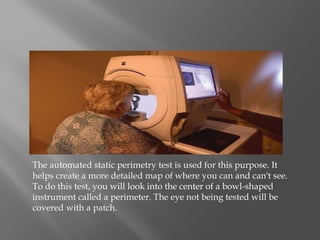
The automated static perimetry test is used for this purpose. It
helps create a more detailed map of where you can and can't see.
To do this test, you will look into the center of a bowl-shaped
instrument called a perimeter. The eye not being tested will be
covered with a patch.
Humphrey visual field test
 The Humphrey visual field test measures the entire area of
peripheral vision that can be seen while the eye is focused
on a central point. During this test, lights of varying
intensities appear in different parts of the visual field
while the patient's eye is focused on a certain spot.

Perimetry is a widely used diagnostic tool that helps
assess glaucoma, optic neuropathies, posterior segment
disorders, and conditions affecting the visual pathway.
It also helps in monitoring the progression of diseases
and guiding the treatment. It helps in the measurement
of the extent of the visual field loss.
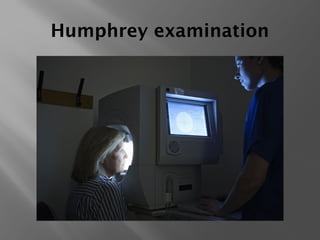
Humphrey examination
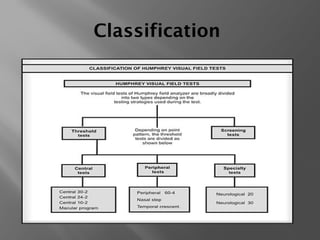
Classification
HUMPHREY TYPES
Available on both Zeiss Humphrey Visual Field Analyzer and Haag-Streit
Octopus perimeters.
Significantly reduces total testing time without compromising the accuracy
and reliability of the data:
•SITA Standard takes 7 min per eye
•SITA Fast takes 4 min per eye
•SITA Faster takes 2 min per eye[18]
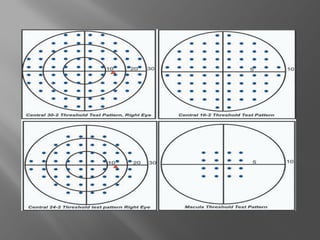
24-2 Program tests 54 points
24-2c Program tests 64 points, including 10 additional macular points
30-2 Program tests 76 points
THRESHOLD TEST POINT PATTERN
 The point pattern where the threshold has to be
determined is usually designed according the
disease pattern.
 Pointed to be noted
 Extension of visual field testing.
 Number of test points.
 Point density (the distance b/w two points in
degree).
 The degree of bare are around the fixation spot.
 The relation of the points to the horizontal and
vertical.
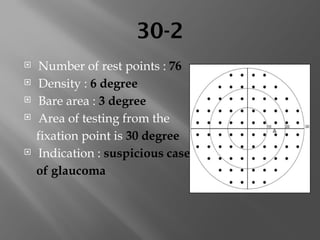
30-2
 Number of rest points : 76
 Density : 6 degree
 Bare area : 3 degree
 Area of testing from the
fixation point is 30 degree
 Indication : suspicious case
of glaucoma
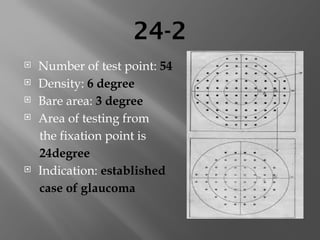
24-2
 Number of test point: 54
 Density: 6 degree
 Bare area: 3 degree
 Area of testing from
the fixation point is
24degree
 Indication: established
case of glaucoma
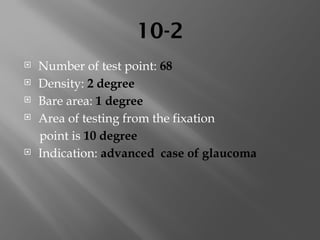
10-2
 Number of test point: 68
 Density: 2 degree
 Bare area: 1 degree
 Area of testing from the fixation
point is 10 degree
 Indication: advanced case of glaucoma
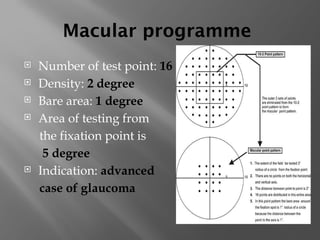
Macular programme
 Number of test point: 16
 Density: 2 degree
 Bare area: 1 degree
 Area of testing from
the fixation point is
5 degree
 Indication: advanced
case of glaucoma
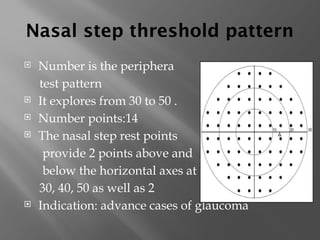
Nasal step threshold pattern
 Number is the periphera
test pattern
 It explores from 30 to 50 .
 Number points:14
 The nasal step rest points
provide 2 points above and
below the horizontal axes at
30, 40, 50 as well as 2
 Indication: advance cases of glaucoma
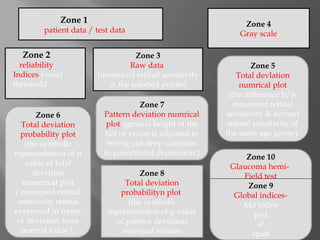
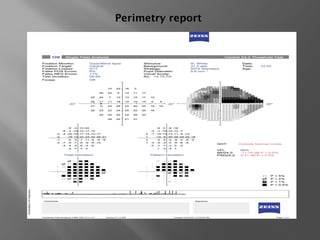
Zone 1
patient data / test data
Zone 2
reliability
Indices foveal
threshold
Zone 3
Raw data
(measured retinal sensitivity
at the selected points)
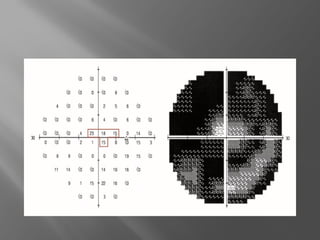
Zone 4
Gray scale
Zone 10
Glaucoma hemi-
Field test
Zone 9
Global indices-
Md index
psd
sf
cpsd
Zone 5
Total devlation
numrical plot
(the difference b/w
measured retinal
sensitivity & normal
retinal sensitivity of
the same age group)
Zone 6
Total deviation
probability plot
(the symbolic
representation of p
value of total
deviation
numerical plot
( measured retinal
sensitivity retinal
expressed in terms
of deviation from
normal value )
Zone 7
Pattern deviation numrical
plot (general height of the
hill of vision is adjusted to
bering out deep scotomas
in generalized depression )
Zone 8
Total deviation
probabilityn plot.
(the symbolic
representation of p value
of pattern deviation
numrical values)
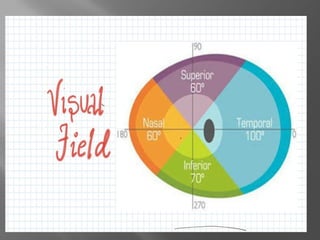
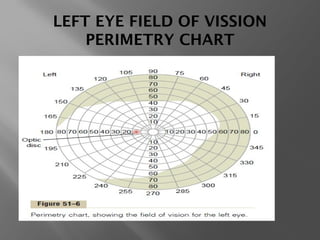
LEFT EYE FIELD OF VISSION
PERIMETRY CHART
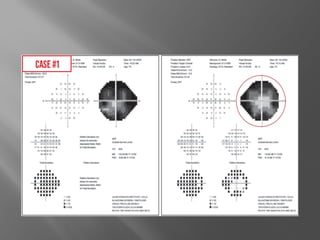
Perimetry report
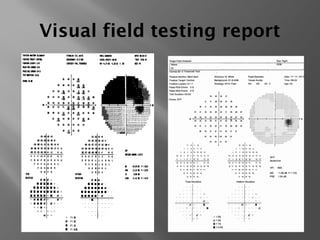
Visual field testing report
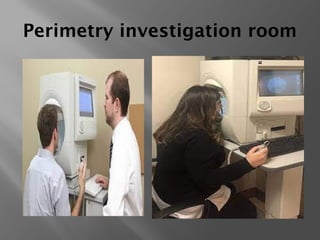
Perimetry investigation room
You tube link perimetry
 https://youthttps://youtu.be/IL20VQweSvE?
si=X7xgEe7mdqkk-T0W
 u.be/oY7mJAGMOkM?
si=bswNSy9MGLKPoKHm
short presentaion on primetry visual field tests

short presentaion on primetry visual field tests

  • 1.
    ALLIED HEALTH SCIENCES IIMTUNIVERSITY MEERUT ASSESSMENT field of vision PRESENTED BY Rahul tyagi B. OPTOMETRY 2nd year
  • 2.
    Six types ofvisual field tests  Confrontation visual field test. ...  Automated static perimetry test. ...  Kinetic visual field test. ...  Frequency doubling perimetry. ...  Electroretinography. ...  Amsler grid: A basic visual field test for central vision.
  • 4.
    1. Confrontation visualfield test .  There are many variants of the confrontation test. By definition, it must involve the examiner compar- ing his or her visual field with that of the patient. Generally the exami- ner faces the patient at eye level and at 2/3 m to 1 m distance. If possible, a uniform background should be behind the examiner.  The patient should cover their right eye with their right hand (vice versa when testing the opposite eye). With the examiner seated directly across from the patient, the patient should direct their gaze to the corresponding eye of the examiner.
  • 6.
  • 7.
    Perimetry  Systemetic measurementof visual field by the use of a perimetry.  Perimetry is the systemetic measurment of visual field function.
  • 8.
    Perimetry KINETIC STATIC  Measuresextent of visual tield by plotting isoptesss (locus of retinal points having same sensitivity)  Stimulus moves from nonseeing to seeing area.  Goldman perimetry confrontation tangent screen, perimetry  Measures the sensitivity of each retinal points.  The stimulees is stationax but increases in luminance  Mostly automatic very little role of the oprator  Automated perimetry goldman perimetri
  • 9.
    Perimetry types KINETIC STATIC Confrontation  Tengent screen  Lister perimetry  Campimetry  Goldmann  Humphrey  Octopus  Oculus
  • 10.
    History  1970- Theoriginal octopus perimeter was first introduced. Because of its room size and high expensive nature it became unpopular.  1980- BJERRUM developed tangent screen.  1982- Humphrey field analyzer was first displayed at american academy of opthalmology.  1982- Michael patella showed its first clinical trail.  1984- Started production and became very popular because of its small size and affordable price.
  • 11.
    Indications of perimetry Detection of glucoma, progression  Chorioretinal lesions  Optic disc and Optic nerve lesions  Neuro opthalmological diseases  Abnormal color vision  Reduction in visual acuty that can not be improved with pin hole , stenopaic slit or refractive correction.
  • 12.
  • 13.
    Bjerrum’s screen (Campimetry) Patient sits at 1 or 2 m from flate screen  For central 30 deg only  Done under subdued lighting
  • 14.
    Correct eye patchposition:  Before fully positioning the patient, the eye not being tested should be covered with an eye patch that allows the patient to blink freely.
  • 15.
    Placing an adequatetrial lens  The trial lens calculator is helful in determining the adequate spherical and cylindrical trial lenses, based on the patient current refraction age.  Trial lenses with a narrow metal rim should be used to prevent the rim of the trial lens from blocking the patient field of view.  We use full aperture trial lenses.
  • 16.
  • 17.
    Correct eye position Once the patient is correctly positioned in the device, it is important to ensure that the eye is also correctly positioned 
  • 18.
     The left– hand panel shows an eye that video monitor that is correctly position, with the cross-hair target located within the boundaries of the pupil.  The right-hand panel shows an eye that is incorrectly positioned, within the cross-hair target outside the boundaries of the pupil.
  • 19.
    2. Automated staticperimetry test.  Perimetry is the systematic measurement of visual field function (the total area where objects can be seen in the peripheral vision while the eye is focused on a central point). The two most commonly used types of perimetry are Goldmann kinetic perimetry and threshold static automated perimetry
  • 20.
    Goldmann kinetic perimetry In practice, Goldmann perimetry is a form of kinetic perimetry: a stimulus is moved from beyond the edge of the visual field into the field. The location at which the stimulus is first seen marks the outer perimeter of the visual field for the size of the stimulus tested. Automated perimetry was developed in the 1970s.
  • 21.
    threshold static automated perimetry Static perimetry: This test is automated. [7][8] The machine presents a stimulus of a particular size but with varying intensity at various locations in a bowl perimeter. The patient responds by pressing a button when they visualize the particular stimulus.
  • 22.
    The automated staticperimetry test is used for this purpose. It helps create a more detailed map of where you can and can't see. To do this test, you will look into the center of a bowl-shaped instrument called a perimeter. The eye not being tested will be covered with a patch.
  • 23.
    Humphrey visual fieldtest  The Humphrey visual field test measures the entire area of peripheral vision that can be seen while the eye is focused on a central point. During this test, lights of varying intensities appear in different parts of the visual field while the patient's eye is focused on a certain spot.  Perimetry is a widely used diagnostic tool that helps assess glaucoma, optic neuropathies, posterior segment disorders, and conditions affecting the visual pathway. It also helps in monitoring the progression of diseases and guiding the treatment. It helps in the measurement of the extent of the visual field loss.
  • 24.
  • 25.
  • 26.
    HUMPHREY TYPES Available onboth Zeiss Humphrey Visual Field Analyzer and Haag-Streit Octopus perimeters. Significantly reduces total testing time without compromising the accuracy and reliability of the data: •SITA Standard takes 7 min per eye •SITA Fast takes 4 min per eye •SITA Faster takes 2 min per eye[18] 24-2 Program tests 54 points 24-2c Program tests 64 points, including 10 additional macular points 30-2 Program tests 76 points
  • 27.
    THRESHOLD TEST POINTPATTERN  The point pattern where the threshold has to be determined is usually designed according the disease pattern.  Pointed to be noted  Extension of visual field testing.  Number of test points.  Point density (the distance b/w two points in degree).  The degree of bare are around the fixation spot.  The relation of the points to the horizontal and vertical.
  • 28.
    30-2  Number ofrest points : 76  Density : 6 degree  Bare area : 3 degree  Area of testing from the fixation point is 30 degree  Indication : suspicious case of glaucoma
  • 29.
    24-2  Number oftest point: 54  Density: 6 degree  Bare area: 3 degree  Area of testing from the fixation point is 24degree  Indication: established case of glaucoma
  • 30.
    10-2  Number oftest point: 68  Density: 2 degree  Bare area: 1 degree  Area of testing from the fixation point is 10 degree  Indication: advanced case of glaucoma
  • 32.
    Macular programme  Numberof test point: 16  Density: 2 degree  Bare area: 1 degree  Area of testing from the fixation point is 5 degree  Indication: advanced case of glaucoma
  • 33.
    Nasal step thresholdpattern  Number is the periphera test pattern  It explores from 30 to 50 .  Number points:14  The nasal step rest points provide 2 points above and below the horizontal axes at 30, 40, 50 as well as 2  Indication: advance cases of glaucoma
  • 34.
    Zone 1 patient data/ test data Zone 2 reliability Indices foveal threshold Zone 3 Raw data (measured retinal sensitivity at the selected points) Zone 4 Gray scale Zone 10 Glaucoma hemi- Field test Zone 9 Global indices- Md index psd sf cpsd Zone 5 Total devlation numrical plot (the difference b/w measured retinal sensitivity & normal retinal sensitivity of the same age group) Zone 6 Total deviation probability plot (the symbolic representation of p value of total deviation numerical plot ( measured retinal sensitivity retinal expressed in terms of deviation from normal value ) Zone 7 Pattern deviation numrical plot (general height of the hill of vision is adjusted to bering out deep scotomas in generalized depression ) Zone 8 Total deviation probabilityn plot. (the symbolic representation of p value of pattern deviation numrical values)
  • 36.
    LEFT EYE FIELDOF VISSION PERIMETRY CHART
  • 37.
  • 39.
  • 41.
  • 42.
    You tube linkperimetry  https://youthttps://youtu.be/IL20VQweSvE? si=X7xgEe7mdqkk-T0W  u.be/oY7mJAGMOkM? si=bswNSy9MGLKPoKHm