Dr. Atul Kumar Anand
Senior Resident
AIIMS Patna
Any opacity of lens or its capsule, whether
developmental or acquired, is called
cataract
Cataract resulting from disturbance of the
nutrition of the lens due to inflammatory or
degenerative disease of the other parts of
the eye
A secondary (complicated) cataract
develops as a result of some other primary
ocular disease
Iridocyclitis – m/c
Ciliary body tumours
Choroiditis
Degenerative myopia
Anterior segment ischemia
Retinitis pigmentosa
Gyrate atrophy
Retinal detachment
Symptoms:
Vision is affected early owing to the position
of the cataract close to the nodal point
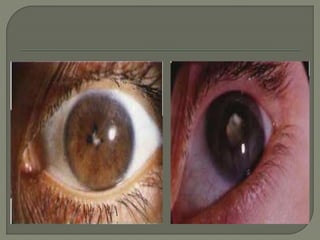
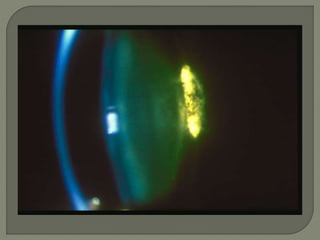
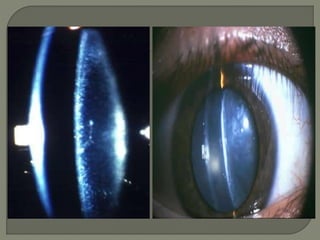
 Slit lamp examination:
- Bread crumb appearance
- Polychromatic luster
- The earliest finding is a polychromatic lustre at the
posterior pole of the lens which may not progress if
the uveitis is arrested. If the inflammation persists,
posterior and anterior opacities develop that may
progress to maturity. The opacities appear to
progress more rapidly in the presence of posterior
synechiae.
 Acute congestive angle-closure may cause small,
grey-white, anterior, subcapsular or capsular
opacities within the pupillary area
(glaukomaflecken )– focal infarcts of the lens
epithelium pathognomonic of past acute angle-
closure glaucoma.
 High (pathological) myopia is associated with
posterior subcapsular lens opacities and early-
onset nuclear sclerosis, which may increase the
myopic refractive error. Simple myopia, however, is
not associated with such cataract formation
Treat the primary cause
ECCE with IOL implantation
Diabetes
Parathyroid tetany
Myotonic dystrophy
Galactosemia
Down’s syndrome
Atopic dermatitis
Diabetes mellitus
Morphologically, same as in age related cataract in
older individuals but appears earlier than the non-
diabetic individuals & matures rapidly.
Accumulation of sorbitol and subsequent hydration and
increased glycosylation of protein
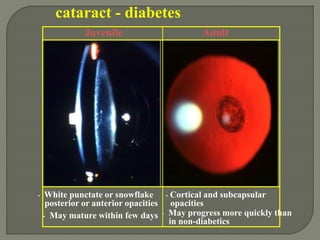
True diabetic cataract occurs in young individuals-
Snow flake cataract or snow-storm cataract
(fluctuating refractive error & cataract in DM)
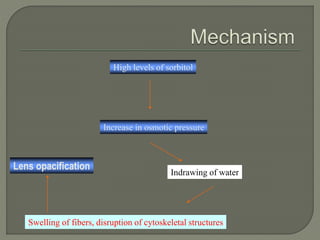
High levels of sorbitol
Increase in osmotic pressure
Indrawing of water
Swelling of fibers, disruption of cytoskeletal structures
Lens opacification
cataract - diabetes
Juvenile
• White punctate or snowflake
posterior or anterior opacities
• May mature within few days
Adult
• Cortical and subcapsular
opacities
• May progress more quickly than
in non-diabetics
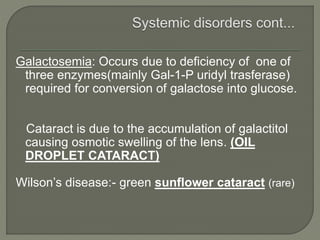
Galactosemia: Occurs due to deficiency of one of
three enzymes(mainly Gal-1-P uridyl trasferase)
required for conversion of galactose into glucose.
Cataract is due to the accumulation of galactitol
causing osmotic swelling of the lens. (OIL
DROPLET CATARACT)
Wilson’s disease:- green sunflower cataract (rare)
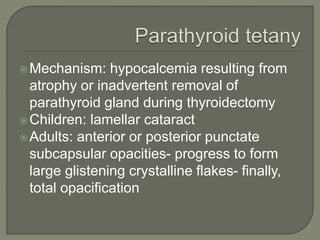
Mechanism: hypocalcemia resulting from
atrophy or inadvertent removal of
parathyroid gland during thyroidectomy
Children: lamellar cataract
Adults: anterior or posterior punctate
subcapsular opacities- progress to form
large glistening crystalline flakes- finally,
total opacification
Fabry’s disease.
Lowe’s syndrome or oculocerebrorenal
syndrome.
Alport’s syndrome.
Myotonic dystrophy :christmas tree cataract
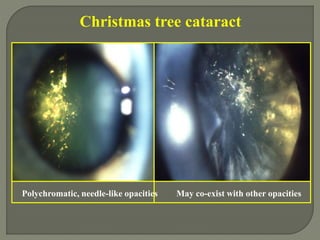
Uncommon
Characterized by striking, polychromatic,
needle-like deposits in the deep cortex
& nucleus which may be solitary or
associated with other opacities
Christmas tree cataract
Polychromatic, needle-like opacities May co-exist with other opacities
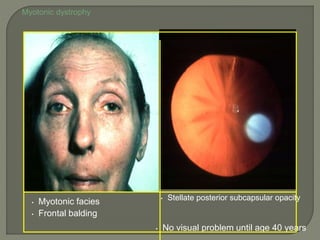
Myotonic dystrophy
• Myotonic facies
• Frontal balding
• Stellate posterior subcapsular opacity
• No visual problem until age 40 years
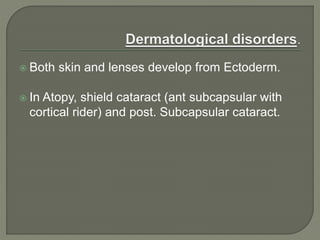
 Both skin and lenses develop from Ectoderm.
 In Atopy, shield cataract (ant subcapsular with
cortical rider) and post. Subcapsular cataract.
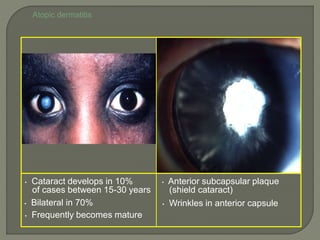
Atopic dermatitis
• Cataract develops in 10%
of cases between 15-30 years
• Bilateral in 70%
• Frequently becomes mature
• Anterior subcapsular plaque
(shield cataract)
• Wrinkles in anterior capsule
 One third of congenital cataract is hereditary –
Without any systemic association.
 Autosomal dominant(most common), Autosomal
recessive or X-linked
 Chromosomal disorders: Down’s syndrome
(Trisomy 21), Patau syndrome, Edward
syndrome, Turner syndrome etc…
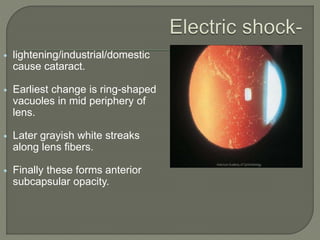
 lightening/industrial/domestic
cause cataract.
 Earliest change is ring-shaped
vacuoles in mid periphery of
lens.
 Later grayish white streaks
along lens fibers.
 Finally these forms anterior
subcapsular opacity.
Radiation cataract
Y -rays, x-rays, U-V rays causes ionization of water
and generation of free radicals--damage cell DNA
causes decrease mitosis.
Infrared( non ionizing) -causes localised temp. rise
of iris pigment epithelium hence causes true
exfoliation of ant. Lens capsule
 Heat (infrared) cataract:
- May clinically occur in industry (glassworkers
and iron workers)
- Mechanism: absorption of heat by pigments in
iris and ciliary body indirectly affecting lens
fibres
- “Glass blower’s cataract”: discoid posterior
subcapsular cataract which may later involve
the entire cortex. In addition, true exfoliation of
anterior lens capsule may occur in large sheets
which may curl up in the pupillary area
Many drugs and chemicals.
Corticosteroids.
Chlorpromazine
Miotic drugs.(ecothiophate)
Phenothiazines.
Gold.
Amiodarone.
Busulphan
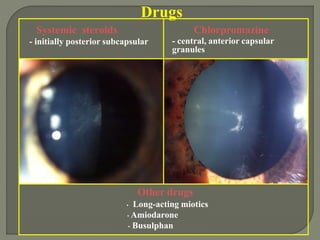
Drugs
Chlorpromazine
• Long-acting miotics
Other drugs
• Amiodarone
• Busulphan
- initially posterior subcapsular
Systemic steroids
- central, anterior capsular
granules
 Cataract formation is a common sequel
to blunt trauma.
Also associated with Subluxation, or
dislocation of lens.
It is the most common cause of Unilateral
cataract in young individuals.
1 Penetrating trauma
2 Blunt trauma may cause a characteristic flower-shaped
opacity
3 Electric shock and lightning strike are very rare causes
that may result in anterior and posterior iridescent opacities
that have a stellate pattern
4 Infrared radiation, if intense as in glassblowers, may
rarely cause true exfoliation of the anterior lens capsule
5 Ionizing radiation for ocular tumours may cause
posterior subcapsular opacities that may develop months or
years later.
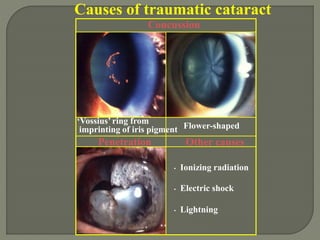
Causes of traumatic cataract
Penetration
Concussion
‘Vossius’ ring from
imprinting of iris pigment Flower-shaped
• Ionizing radiation
• Electric shock
• Lightning
Other causes
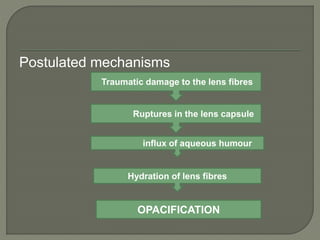
Postulated mechanisms
Traumatic damage to the lens fibres
Ruptures in the lens capsule
influx of aqueous humour
Hydration of lens fibres
OPACIFICATION
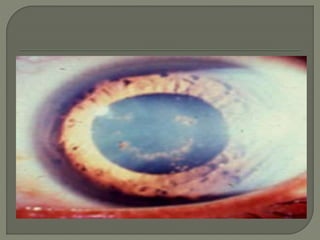
 A ring-shaped anterior subcapsular opacity may underlie a
Vossius ring [ Imprinting of iris pigment on anterior lens
capsule]
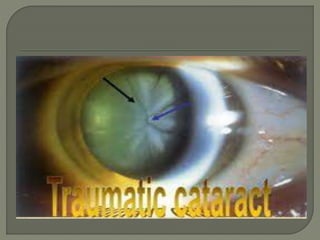
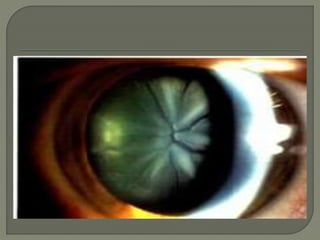
 Commonly opacification occurs in the posterior subcapsular
cortex resulting in flower -shaped opacity [rossette] which
may subsequently disappear, remain stationary or progress to
maturity.
 Cataract surgery may be necessary for visually significant
opacity.
 Lens protein leak can lead to secondary Glaucoma,uveitis.
 Subluxation of the lens may occur,
 secondary to tearing of the suspensory ligament.
 A subluxated lens tends to deviate towards the meridian of intact
zonule
 the anterior chamber may deepen over the area of zonular
dehiscence, if the lens rotates posteriorly.
 The edge of a subluxated lens may be visible under mydriasis
 Trembling of the iris (iridodonesis) or lens (phakodonesis)
on ocular movement.
Subluxation to render the pupil partly aphakic may result in
Uniocular diplopia ; lenticular astigmatism due to tilting may occur.
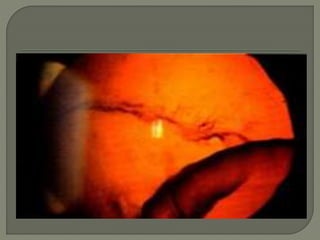
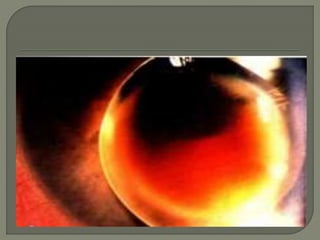
 Dislocation due to 360° rupture of the
zonular fibres is rare and may be into the
vitreous, or less commonly, into the
anterior chamber an underlying
predisposing condition should be
suspected.
Gross visual field defects, Afferent
pupillary defect, Sphincter tears,
iridodialysis, elevated or abnormal low
IOP, angle anomalies, ultrasound
evidence of posterior segment pathology
should be looked for by the surgeon.
Inflammation: -
Cycloplegics , topical &
oral steroid therapy.
In case of synechiae:- Peripheral
iridectomy – to prevent pupillary block.
Primary IOL insertion when intraocular
inflammation and haemorrhage are
minimal and view of anterior segment
structures is good.
Damage to other ocular tissues:
In sphincter tear:- pupilloplasty, distortion
and iridodialysis:– Repair by suturing iris
root to scleral spur.
Metabolic & complicated cataract.pptx

Metabolic & complicated cataract.pptx

  • 1.
    Dr. Atul KumarAnand Senior Resident AIIMS Patna
  • 2.
    Any opacity oflens or its capsule, whether developmental or acquired, is called cataract
  • 4.
    Cataract resulting fromdisturbance of the nutrition of the lens due to inflammatory or degenerative disease of the other parts of the eye A secondary (complicated) cataract develops as a result of some other primary ocular disease
  • 5.
    Iridocyclitis – m/c Ciliarybody tumours Choroiditis Degenerative myopia Anterior segment ischemia Retinitis pigmentosa Gyrate atrophy Retinal detachment
  • 6.
    Symptoms: Vision is affectedearly owing to the position of the cataract close to the nodal point
  • 7.
     Slit lampexamination: - Bread crumb appearance - Polychromatic luster - The earliest finding is a polychromatic lustre at the posterior pole of the lens which may not progress if the uveitis is arrested. If the inflammation persists, posterior and anterior opacities develop that may progress to maturity. The opacities appear to progress more rapidly in the presence of posterior synechiae.
  • 8.
     Acute congestiveangle-closure may cause small, grey-white, anterior, subcapsular or capsular opacities within the pupillary area (glaukomaflecken )– focal infarcts of the lens epithelium pathognomonic of past acute angle- closure glaucoma.  High (pathological) myopia is associated with posterior subcapsular lens opacities and early- onset nuclear sclerosis, which may increase the myopic refractive error. Simple myopia, however, is not associated with such cataract formation
  • 11.
    Treat the primarycause ECCE with IOL implantation
  • 12.
  • 13.
    Diabetes mellitus Morphologically, sameas in age related cataract in older individuals but appears earlier than the non- diabetic individuals & matures rapidly. Accumulation of sorbitol and subsequent hydration and increased glycosylation of protein True diabetic cataract occurs in young individuals- Snow flake cataract or snow-storm cataract (fluctuating refractive error & cataract in DM)
  • 14.
    High levels ofsorbitol Increase in osmotic pressure Indrawing of water Swelling of fibers, disruption of cytoskeletal structures Lens opacification
  • 16.
    cataract - diabetes Juvenile •White punctate or snowflake posterior or anterior opacities • May mature within few days Adult • Cortical and subcapsular opacities • May progress more quickly than in non-diabetics
  • 17.
    Galactosemia: Occurs dueto deficiency of one of three enzymes(mainly Gal-1-P uridyl trasferase) required for conversion of galactose into glucose. Cataract is due to the accumulation of galactitol causing osmotic swelling of the lens. (OIL DROPLET CATARACT) Wilson’s disease:- green sunflower cataract (rare)
  • 18.
    Mechanism: hypocalcemia resultingfrom atrophy or inadvertent removal of parathyroid gland during thyroidectomy Children: lamellar cataract Adults: anterior or posterior punctate subcapsular opacities- progress to form large glistening crystalline flakes- finally, total opacification
  • 19.
    Fabry’s disease. Lowe’s syndromeor oculocerebrorenal syndrome. Alport’s syndrome. Myotonic dystrophy :christmas tree cataract
  • 20.
    Uncommon Characterized by striking,polychromatic, needle-like deposits in the deep cortex & nucleus which may be solitary or associated with other opacities
  • 21.
    Christmas tree cataract Polychromatic,needle-like opacities May co-exist with other opacities
  • 22.
    Myotonic dystrophy • Myotonicfacies • Frontal balding • Stellate posterior subcapsular opacity • No visual problem until age 40 years
  • 23.
     Both skinand lenses develop from Ectoderm.  In Atopy, shield cataract (ant subcapsular with cortical rider) and post. Subcapsular cataract.
  • 24.
    Atopic dermatitis • Cataractdevelops in 10% of cases between 15-30 years • Bilateral in 70% • Frequently becomes mature • Anterior subcapsular plaque (shield cataract) • Wrinkles in anterior capsule
  • 25.
     One thirdof congenital cataract is hereditary – Without any systemic association.  Autosomal dominant(most common), Autosomal recessive or X-linked  Chromosomal disorders: Down’s syndrome (Trisomy 21), Patau syndrome, Edward syndrome, Turner syndrome etc…
  • 26.
     lightening/industrial/domestic cause cataract. Earliest change is ring-shaped vacuoles in mid periphery of lens.  Later grayish white streaks along lens fibers.  Finally these forms anterior subcapsular opacity.
  • 27.
    Radiation cataract Y -rays,x-rays, U-V rays causes ionization of water and generation of free radicals--damage cell DNA causes decrease mitosis. Infrared( non ionizing) -causes localised temp. rise of iris pigment epithelium hence causes true exfoliation of ant. Lens capsule
  • 28.
     Heat (infrared)cataract: - May clinically occur in industry (glassworkers and iron workers) - Mechanism: absorption of heat by pigments in iris and ciliary body indirectly affecting lens fibres - “Glass blower’s cataract”: discoid posterior subcapsular cataract which may later involve the entire cortex. In addition, true exfoliation of anterior lens capsule may occur in large sheets which may curl up in the pupillary area
  • 29.
    Many drugs andchemicals. Corticosteroids. Chlorpromazine Miotic drugs.(ecothiophate) Phenothiazines. Gold. Amiodarone. Busulphan
  • 30.
    Drugs Chlorpromazine • Long-acting miotics Otherdrugs • Amiodarone • Busulphan - initially posterior subcapsular Systemic steroids - central, anterior capsular granules
  • 31.
     Cataract formationis a common sequel to blunt trauma. Also associated with Subluxation, or dislocation of lens. It is the most common cause of Unilateral cataract in young individuals.
  • 32.
    1 Penetrating trauma 2Blunt trauma may cause a characteristic flower-shaped opacity 3 Electric shock and lightning strike are very rare causes that may result in anterior and posterior iridescent opacities that have a stellate pattern 4 Infrared radiation, if intense as in glassblowers, may rarely cause true exfoliation of the anterior lens capsule 5 Ionizing radiation for ocular tumours may cause posterior subcapsular opacities that may develop months or years later.
  • 33.
    Causes of traumaticcataract Penetration Concussion ‘Vossius’ ring from imprinting of iris pigment Flower-shaped • Ionizing radiation • Electric shock • Lightning Other causes
  • 35.
    Postulated mechanisms Traumatic damageto the lens fibres Ruptures in the lens capsule influx of aqueous humour Hydration of lens fibres OPACIFICATION
  • 37.
     A ring-shapedanterior subcapsular opacity may underlie a Vossius ring [ Imprinting of iris pigment on anterior lens capsule]  Commonly opacification occurs in the posterior subcapsular cortex resulting in flower -shaped opacity [rossette] which may subsequently disappear, remain stationary or progress to maturity.  Cataract surgery may be necessary for visually significant opacity.  Lens protein leak can lead to secondary Glaucoma,uveitis.
  • 39.
     Subluxation ofthe lens may occur,  secondary to tearing of the suspensory ligament.  A subluxated lens tends to deviate towards the meridian of intact zonule  the anterior chamber may deepen over the area of zonular dehiscence, if the lens rotates posteriorly.  The edge of a subluxated lens may be visible under mydriasis  Trembling of the iris (iridodonesis) or lens (phakodonesis) on ocular movement. Subluxation to render the pupil partly aphakic may result in Uniocular diplopia ; lenticular astigmatism due to tilting may occur.
  • 40.
     Dislocation dueto 360° rupture of the zonular fibres is rare and may be into the vitreous, or less commonly, into the anterior chamber an underlying predisposing condition should be suspected.
  • 43.
    Gross visual fielddefects, Afferent pupillary defect, Sphincter tears, iridodialysis, elevated or abnormal low IOP, angle anomalies, ultrasound evidence of posterior segment pathology should be looked for by the surgeon.
  • 44.
    Inflammation: - Cycloplegics ,topical & oral steroid therapy. In case of synechiae:- Peripheral iridectomy – to prevent pupillary block.
  • 45.
    Primary IOL insertionwhen intraocular inflammation and haemorrhage are minimal and view of anterior segment structures is good.
  • 46.
    Damage to otherocular tissues: In sphincter tear:- pupilloplasty, distortion and iridodialysis:– Repair by suturing iris root to scleral spur.