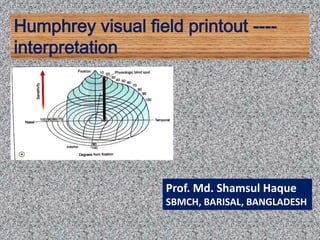
Humphrey visual field printout ----
interpretation
Prof. Md. Shamsul Haque
SBMCH, BARISAL, BANGLADESH
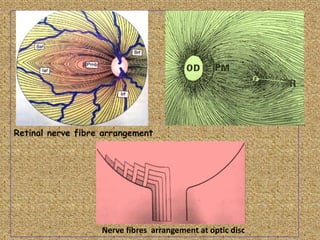
Retinal nerve fibre arrangement
Nerve fibres arrangement at optic disc
What is visual field ?
Aims of today,s topic
Will be able
• to identify field defect
• to recognize that field defect is due to
glaucoma or neurological lesion
•to know that field defect is progressive or not
What is perimetry ?
Bjerrum,s screen Lister octopus
Humphrey
Goldmann
Types of perimetry
a. Kinetic…stimulus moves
confrontation, lister, tangen screen, Goldmann
b. Static …stimulus does not moves
HVFA, OCTOPUS
1970………OCTOPUS, Unpopular
1984………HUMPHREY, Popular
Advantages of Goldmann perimetry
Low vision patient
Neurological patient
Peripheral field to be evaluated
Malinger patients
Difference between kinetic and static
perimetry
Static Kinetic
1.VFD detect earlier with 1. Detect when 40% damage
20% defect
2. Area fixed but stimulus 2. Intensity is fixed but
varies in intensity stimulus moves from
non-seeing to seeing area
3. Three dimensional 3. Two dimensional
4. Computerized 4. Not computerized
5. Threshold type 5. Non threshold type
6. Less error 6. More error
7. Both glaucoma and 7. Good for neurological
neurological
Some importants terms
•Apostilbs(asb)
•Decibel(dB)
•Threshold
•Supra-threshold
•Infra-threshold
Apostilbs(asb) and Decibels(dB) relationship
•Threshold
•Suprathreshold
•Infrathreshold
Aposilbs, Decibels , Retinal sensitivity relation
Humphrey visual field test, Classification
Two types– on the basis of strategies
1. Threshold test—using threshold stimulus for
diagnosis of glaucoma and neurological lesions
2. Screening test– using suprathreshold stimulus for
detection of glaucoma
1.Threshold test—is of three types
a.Central tests b.Peripheral tests c.Special tests
central 30-2 peripheral 60-4 neurological -20
central 24-2 nasal step neurological –30
central 10- 2
macular program
Central 30- 2 threshold test pattern
•No of test points –76
•Point density is 6° (distance between the two points)
•Bare area(non-testing area) is 3° from the fixation point
•Extension of testing area from the fixation point is 30°
NB: one eye is tested at a time,
other eye is occluded
Fixation should be steady and
monitor throughout the test
Central 24-2 threshold test pattern
•No. of test points---54
•Point density is 6° (distance between two points is 6°)
•Bare area (non-seeing area) is 3° from the fixation point
•Extension of testing area from fixation point is 24°
Central 10-2 threshold pattern
•No. of points----68
•Point density is 2°(distance between two points is 2°)
•Bare area(non-seeing area) is 1° from the fixation point
•Extension of testing area from the fixation point is 10°
Macular program
•No. of teat point is 16
•Point density is 2°(distance between two points is 2°)
•Bare area (non-seeing area) is 1° from the fixation point
•Extension of testing area from the fixation point is 5°
Why we select 30-2/24-2/10-2 central threshold test pattern
instead of 30-1/24-1/10-1
-*
Central 30-2
•No. of test points is 76
•Testing points are away from vertical
and horizontal axes
•Bare area is 3° from the fixation point
Central 30-1
•No. of test points is 71
•Testing points fall upon the vertical and
horizontal axes
•Bare area is 6° from the fixation point
Threshold testing strategies
Threshold testing strategies is of two types
1.Old standard strategies – full threshold strategies/standard threshold
strategies
2. Newer threshold trategies
a. FAST PAC
b. SITA standard
c. SITA fast
SITA– Swedish Interactive Threshold Algorithm
Humphrey visual field test printout(single
field)----interpretation
We can divide the printout into 8 zones
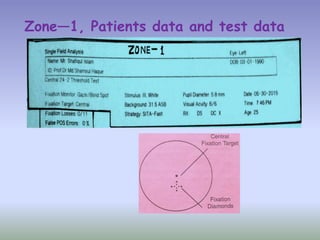
Zone—1, Patients data and test data
Zone—2, Foveal threshold and reliable indices
Zone—3, Gray scale
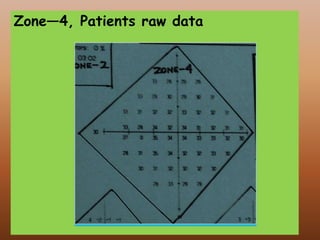
Zone—4. Patients raw data
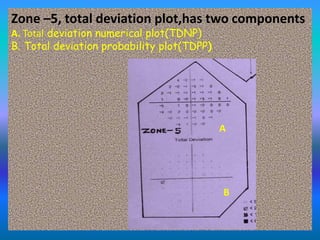
Zone—5, Total deviation plot
Zone– 6, Pattern deviation plot
Zone—7, Global indices
Zone—8, Glaucoma hemifield test
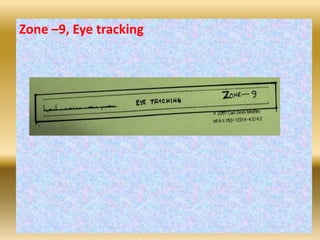
Zone—9, Eye tracking(±)
Identify 8 zones of the Humphrey printout
Zone—1, Patients data and test data
Zone—2 ,Foveal threshold and reliable
indices
Zone—3, Gray scale
•RP
•PRP
•Peripheral retinal degeneration
•Retinoschiasis
•Aphakic glass
Zone—4, Patients raw data
Zone –5, total deviation plot,has two components
A. Total deviation numerical plot(TDNP)
B. Total deviation probability plot(TDPP)
A
B
Zone –6, pattern deviation plot,has two components
A.Pattern deviation numerical plot(PDNP)
B. Pattern deviation probability plot(PDPP)
A
B
•Mild to moderate generalized depression
are eliminated
•Deep focal deviations are height lighted
•Machine adjusts these values and the new
resultant values are displayed as symbolic
form in PDPP
Factors influencing the pattern deviation
plot are
•Hazy media
•Miotic pupil
Zone—7, Global indices
MD—mean deviation
• Indicate average severity of the field loss
• Expressed in decibel(Db) value
•Machine analyses and calculates how often these
values are seen in general population, if the value is
positive it indicates pt,s score is better than normal
person of the same age
PSD—Pattern Standard Deviation
•This is a measure of focal loss or variability within
the field
•If score is high, damage is more
Zone—8, Glaucoma hemifield test(GHT)
GHT
GHT→ Glaucoma Hemifield Test
Compare mirror image locations of superior
and inferior retina and gives five comments
1. GHT—outside normal limit ,if difference
found in 1% population
2. GHT—borderline , if difference found in up
to 3% population
3. GHT—abnormally low sensitive, best
sensitive part is seen in less than 5% of the
population
4. GHT—abnormally high sensitive, best
sensitive part is seen is more that found in
99.5% population
5. GHT—within normal limit, when none of
the above 4 conditions are seen
Zone –9, Eye tracking
SWAP→ Short Wave length Automated Perimetry
When and why SWAP strategies is done
•Done to detect very early glaucomatous damage
•Background colour of the machine bowl is yellow –which
desensitize the red and green cones
•Colour of the stimulus is blue which activates the blue
cones only
Frequency doubling technology(FDT)
•This is a latest machine
•It utilizes latest technology
•Machine is upto 97% sensitive to detect
glaucomatous defect
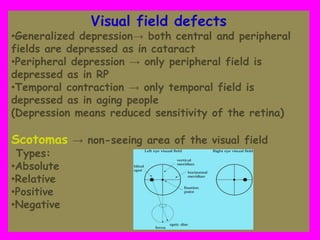
Visual field defects
•Generalized depression→ both central and peripheral
fields are depressed as in cataract
•Peripheral depression → only peripheral field is
depressed as in RP
•Temporal contraction → only temporal field is
depressed as in aging people
(Depression means reduced sensitivity of the retina)
Scotomas → non-seeing area of the visual field
Types:
•Absolute
•Relative
•Positive
•Negative
Cont.
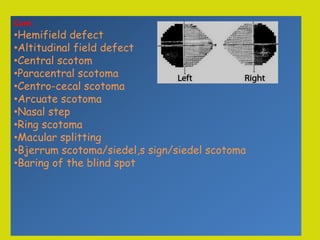
•Hemifield defect
•Altitudinal field defect
•Central scotom
•Paracentral scotoma
•Centro-cecal scotoma
•Arcuate scotoma
•Nasal step
•Ring scotoma
•Macular splitting
•Bjerrum scotoma/siedel,s sign/siedel scotoma
•Baring of the blind spot
Take home message
Octopus printout
Dense superior scotoma originate
From BS, joins superior arcuate
scotoma and finally joins the
superior nasal step
By examining the gray
scale and pattern
probability plots of Right
eye and Left eye , it is
evident that this is a case
of POAG .
Right eye has tubular
vision and Left eye has a
bit more central vision
than the right eye
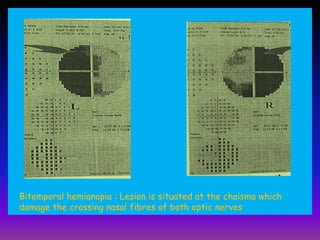
Bitemporal hemianopia : Lesion is situated at the chaisma which
damage the crossing nasal fibres of both optic nerves
Lesion : acute ischaemia in the frontal and parietal lobes affecting the
superior fibres of the left optic radiation causing right inferior
homonymous quardrantanopia , lesion is confirmed by MRI/MRA
Pie in the
floor
Pie in
the sky
Lesion: in the frontal and parietal lobes affecting the lower
fibres of the right optic radiation causing left homonymous
superior quadrantanopia –should be confirmed by MRI/MRA
Field of left eye
Superior altitudinal
field defect (L/E)
Causes
•AION
• Optic neuritis
• Hemiretinal vein occlusion
•Hemiretinal artery occlusion
•Optic nerve coloboma
•Glaucoma
Left homonymous hemianopia
Lesion: in the right temporo-parietal region affecting the
right optic radiation
MRI shows haematoma of the right temporo-parietal region
Visual field analysis--interpretation

Visual field analysis--interpretation

  • 1.
    Humphrey visual fieldprintout ---- interpretation Prof. Md. Shamsul Haque SBMCH, BARISAL, BANGLADESH
  • 2.
    Retinal nerve fibrearrangement Nerve fibres arrangement at optic disc
  • 4.
  • 5.
    Aims of today,stopic Will be able • to identify field defect • to recognize that field defect is due to glaucoma or neurological lesion •to know that field defect is progressive or not
  • 6.
    What is perimetry? Bjerrum,s screen Lister octopus Humphrey Goldmann
  • 7.
    Types of perimetry a.Kinetic…stimulus moves confrontation, lister, tangen screen, Goldmann b. Static …stimulus does not moves HVFA, OCTOPUS 1970………OCTOPUS, Unpopular 1984………HUMPHREY, Popular
  • 8.
    Advantages of Goldmannperimetry Low vision patient Neurological patient Peripheral field to be evaluated Malinger patients
  • 9.
    Difference between kineticand static perimetry Static Kinetic 1.VFD detect earlier with 1. Detect when 40% damage 20% defect 2. Area fixed but stimulus 2. Intensity is fixed but varies in intensity stimulus moves from non-seeing to seeing area 3. Three dimensional 3. Two dimensional 4. Computerized 4. Not computerized 5. Threshold type 5. Non threshold type 6. Less error 6. More error 7. Both glaucoma and 7. Good for neurological neurological
  • 10.
  • 11.
  • 12.
  • 13.
    Aposilbs, Decibels ,Retinal sensitivity relation
  • 14.
    Humphrey visual fieldtest, Classification Two types– on the basis of strategies 1. Threshold test—using threshold stimulus for diagnosis of glaucoma and neurological lesions 2. Screening test– using suprathreshold stimulus for detection of glaucoma
  • 15.
    1.Threshold test—is ofthree types a.Central tests b.Peripheral tests c.Special tests central 30-2 peripheral 60-4 neurological -20 central 24-2 nasal step neurological –30 central 10- 2 macular program
  • 16.
    Central 30- 2threshold test pattern •No of test points –76 •Point density is 6° (distance between the two points) •Bare area(non-testing area) is 3° from the fixation point •Extension of testing area from the fixation point is 30° NB: one eye is tested at a time, other eye is occluded Fixation should be steady and monitor throughout the test
  • 17.
    Central 24-2 thresholdtest pattern •No. of test points---54 •Point density is 6° (distance between two points is 6°) •Bare area (non-seeing area) is 3° from the fixation point •Extension of testing area from fixation point is 24°
  • 18.
    Central 10-2 thresholdpattern •No. of points----68 •Point density is 2°(distance between two points is 2°) •Bare area(non-seeing area) is 1° from the fixation point •Extension of testing area from the fixation point is 10°
  • 19.
    Macular program •No. ofteat point is 16 •Point density is 2°(distance between two points is 2°) •Bare area (non-seeing area) is 1° from the fixation point •Extension of testing area from the fixation point is 5°
  • 20.
    Why we select30-2/24-2/10-2 central threshold test pattern instead of 30-1/24-1/10-1 -* Central 30-2 •No. of test points is 76 •Testing points are away from vertical and horizontal axes •Bare area is 3° from the fixation point Central 30-1 •No. of test points is 71 •Testing points fall upon the vertical and horizontal axes •Bare area is 6° from the fixation point
  • 21.
    Threshold testing strategies Thresholdtesting strategies is of two types 1.Old standard strategies – full threshold strategies/standard threshold strategies 2. Newer threshold trategies a. FAST PAC b. SITA standard c. SITA fast SITA– Swedish Interactive Threshold Algorithm
  • 22.
    Humphrey visual fieldtest printout(single field)----interpretation We can divide the printout into 8 zones Zone—1, Patients data and test data Zone—2, Foveal threshold and reliable indices Zone—3, Gray scale Zone—4. Patients raw data Zone—5, Total deviation plot Zone– 6, Pattern deviation plot Zone—7, Global indices Zone—8, Glaucoma hemifield test Zone—9, Eye tracking(±)
  • 23.
    Identify 8 zonesof the Humphrey printout
  • 24.
  • 25.
    Zone—2 ,Foveal thresholdand reliable indices
  • 26.
    Zone—3, Gray scale •RP •PRP •Peripheralretinal degeneration •Retinoschiasis •Aphakic glass
  • 27.
  • 28.
    Zone –5, totaldeviation plot,has two components A. Total deviation numerical plot(TDNP) B. Total deviation probability plot(TDPP) A B
  • 29.
    Zone –6, patterndeviation plot,has two components A.Pattern deviation numerical plot(PDNP) B. Pattern deviation probability plot(PDPP) A B •Mild to moderate generalized depression are eliminated •Deep focal deviations are height lighted •Machine adjusts these values and the new resultant values are displayed as symbolic form in PDPP Factors influencing the pattern deviation plot are •Hazy media •Miotic pupil
  • 30.
    Zone—7, Global indices MD—meandeviation • Indicate average severity of the field loss • Expressed in decibel(Db) value •Machine analyses and calculates how often these values are seen in general population, if the value is positive it indicates pt,s score is better than normal person of the same age PSD—Pattern Standard Deviation •This is a measure of focal loss or variability within the field •If score is high, damage is more
  • 31.
    Zone—8, Glaucoma hemifieldtest(GHT) GHT GHT→ Glaucoma Hemifield Test Compare mirror image locations of superior and inferior retina and gives five comments 1. GHT—outside normal limit ,if difference found in 1% population 2. GHT—borderline , if difference found in up to 3% population 3. GHT—abnormally low sensitive, best sensitive part is seen in less than 5% of the population 4. GHT—abnormally high sensitive, best sensitive part is seen is more that found in 99.5% population 5. GHT—within normal limit, when none of the above 4 conditions are seen
  • 32.
  • 33.
    SWAP→ Short Wavelength Automated Perimetry When and why SWAP strategies is done •Done to detect very early glaucomatous damage •Background colour of the machine bowl is yellow –which desensitize the red and green cones •Colour of the stimulus is blue which activates the blue cones only
  • 34.
    Frequency doubling technology(FDT) •Thisis a latest machine •It utilizes latest technology •Machine is upto 97% sensitive to detect glaucomatous defect
  • 35.
    Visual field defects •Generalizeddepression→ both central and peripheral fields are depressed as in cataract •Peripheral depression → only peripheral field is depressed as in RP •Temporal contraction → only temporal field is depressed as in aging people (Depression means reduced sensitivity of the retina) Scotomas → non-seeing area of the visual field Types: •Absolute •Relative •Positive •Negative
  • 36.
    Cont. •Hemifield defect •Altitudinal fielddefect •Central scotom •Paracentral scotoma •Centro-cecal scotoma •Arcuate scotoma •Nasal step •Ring scotoma •Macular splitting •Bjerrum scotoma/siedel,s sign/siedel scotoma •Baring of the blind spot
  • 38.
  • 39.
  • 40.
    Dense superior scotomaoriginate From BS, joins superior arcuate scotoma and finally joins the superior nasal step
  • 41.
    By examining thegray scale and pattern probability plots of Right eye and Left eye , it is evident that this is a case of POAG . Right eye has tubular vision and Left eye has a bit more central vision than the right eye
  • 42.
    Bitemporal hemianopia :Lesion is situated at the chaisma which damage the crossing nasal fibres of both optic nerves
  • 43.
    Lesion : acuteischaemia in the frontal and parietal lobes affecting the superior fibres of the left optic radiation causing right inferior homonymous quardrantanopia , lesion is confirmed by MRI/MRA Pie in the floor
  • 44.
    Pie in the sky Lesion:in the frontal and parietal lobes affecting the lower fibres of the right optic radiation causing left homonymous superior quadrantanopia –should be confirmed by MRI/MRA
  • 45.
    Field of lefteye Superior altitudinal field defect (L/E) Causes •AION • Optic neuritis • Hemiretinal vein occlusion •Hemiretinal artery occlusion •Optic nerve coloboma •Glaucoma
  • 46.
    Left homonymous hemianopia Lesion:in the right temporo-parietal region affecting the right optic radiation MRI shows haematoma of the right temporo-parietal region