By
Mutahir Shah
Resident M Phil VS
2nd Semester
Pakistan Institute of Community
Ophthalmology
Visual Pathway and its Defects
Brief Anatomy of Visual Pathway
 Afferent Visual Pathways:-
 It is important to recognize that any disturbance in
afferent function may result in the same symptoms of
vision loss as observed with pathology affecting the
retina, optic nerve,and visual pathway.
 Retina
 The afferent visual pathway begins within the retina.
 Optic Nerve
 The optic nerve begins anatomically at the optic
disc but physiologically and functionally within the
ganglion cell layer that covers the entire retina.
 The first portion of the optic nerve, representing
the confluence of approximately 1.0- 1.2 million
ganglion cell axons.
 The combination of small channels and a unique blood
supply (largely from branches of the posterior ciliary
arteries) probably plays a role in several optic
neuropathies.
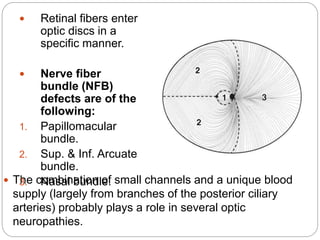
 Retinal fibers enter
optic discs in a
specific manner.
 Nerve fiber
bundle (NFB)
defects are of the
following:
1. Papillomacular
bundle.
2. Sup. & Inf. Arcuate
bundle.
3. Nasal bundle.
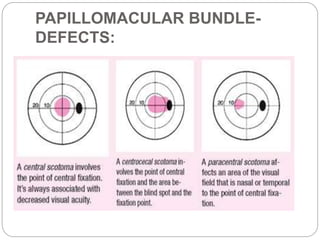
PAPILLOMACULAR BUNDLE-
DEFECTS:
Optic Chiasm
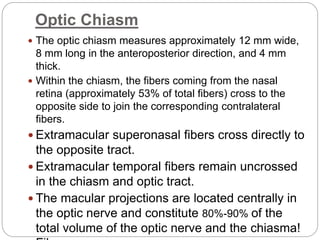
 The optic chiasm measures approximately 12 mm wide,
8 mm long in the anteroposterior direction, and 4 mm
thick.
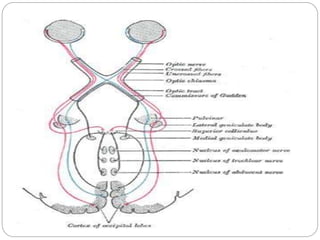
 Within the chiasm, the fibers coming from the nasal
retina (approximately 53% of total fibers) cross to the
opposite side to join the corresponding contralateral
fibers.
 Extramacular superonasal fibers cross directly to
the opposite tract.
 Extramacular temporal fibers remain uncrossed
in the chiasm and optic tract.
 The macular projections are located centrally in
the optic nerve and constitute 80%-90% of the
total volume of the optic nerve and the chiasma!
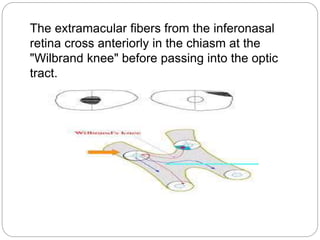
The extramacular fibers from the inferonasal
retina cross anteriorly in the chiasm at the
"Wilbrand knee" before passing into the optic
tract.
 Optic Tract
 Starting from the posterior part of the chiasma upto
the LGB.
 Fibers (both crossed and uncrossed) from the upper
retinal projections travel medially in the optic tract;
lower projections move laterally.
 The macular fibers adopt a dorsolateral orientation as
they course toward the lateral geniculate body
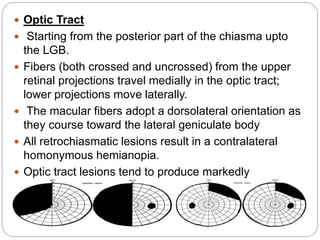
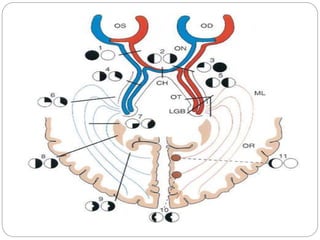
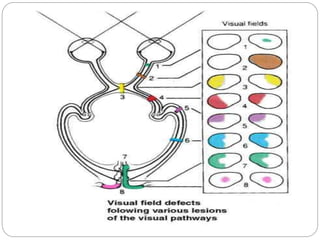
 All retrochiasmatic lesions result in a contralateral
homonymous hemianopia.
 Optic tract lesions tend to produce markedly
incongruous field defect.
Lateral Ganiculate Body or
Nucleus
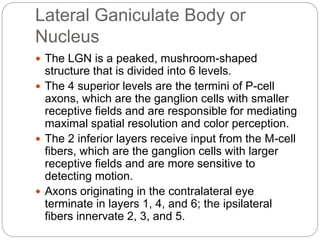
 The LGN is a peaked, mushroom-shaped
structure that is divided into 6 levels.
 The 4 superior levels are the termini of P-cell
axons, which are the ganglion cells with smaller
receptive fields and are responsible for mediating
maximal spatial resolution and color perception.
 The 2 inferior layers receive input from the M-cell
fibers, which are the ganglion cells with larger
receptive fields and are more sensitive to
detecting motion.
 Axons originating in the contralateral eye
terminate in layers 1, 4, and 6; the ipsilateral
fibers innervate 2, 3, and 5.
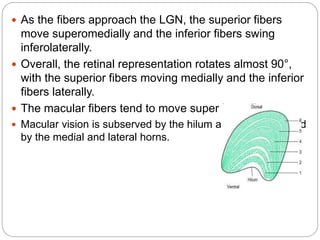
 As the fibers approach the LGN, the superior fibers
move superomedially and the inferior fibers swing
inferolaterally.
 Overall, the retinal representation rotates almost 90°,
with the superior fibers moving medially and the inferior
fibers laterally.
 The macular fibers tend to move super laterally
 Macular vision is subserved by the hilum and peripheral field
by the medial and lateral horns.
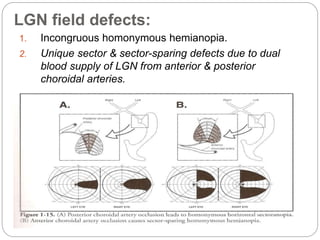
LGN field defects:
1. Incongruous homonymous hemianopia.
2. Unique sector & sector-sparing defects due to dual
blood supply of LGN from anterior & posterior
choroidal arteries.
Optic Radiation
 Following a synapse in the LGN, the axons travel
posteriorly as the optic radiations toterminate in
the primary visual (calcarine) cortex in the
occipital lobe.
 The most inferior of the fibers first travel
anteriorly, then laterally and posteriorly to loop
around the temporal horn of the lateral ventricles
(Meyer loop) .
 More superiorly, the fibers travel posteriorly
through the deep white matter of the parietal lobe.
 The macular (central) fibers course laterally, with
the peripheral fibers concentrated more at the
superior and inferior aspects of the radiations.
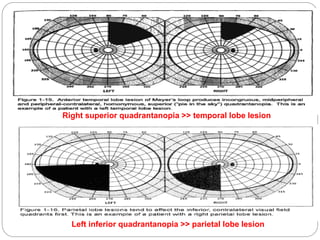
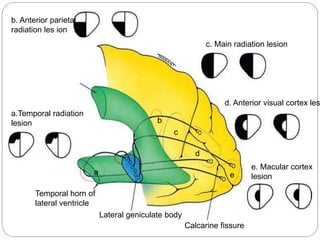
Right superior quadrantanopia >> temporal lobe lesion
Left inferior quadrantanopia >> parietal lobe lesion
Visual Cortex
 The visual cortex, the thinnest area of the human
cerebral cortex, has 6 cellular layers
 It occupies the superior and inferior lips of the
calcarine fissure on the posterior and medial surfaces
of the occipital lobes.
 Macular function is extremely well represented in the
visual cortex and occupies the most posterior position
at the tip of the occipital lobe.
 The most anterior portion of the calcarine fissure is
occupied by contralateral nasal retinal fibers only.
 The visual cortex usually have dual blood supply.
 The ‘macular’ visual cortex is supplied by terminal
branches of posterior & middle cerebral arteries.
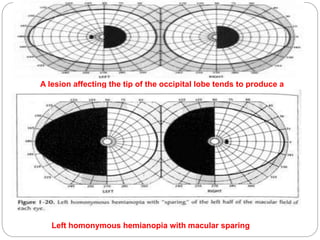
A lesion affecting the tip of the occipital lobe tends to produce a
central homonymous hemianopia
Left homonymous hemianopia with macular sparing
Related terms used in Visual Field defects
 Scotoma –
 It is a defect in Visual Field surrounded by normal
visual field.
 Relative scotoma - an area where objects of low
luminance cannot be seen but larger or brighter ones
can.
 Absolute scotoma - nothing can be seen at all within
that area.
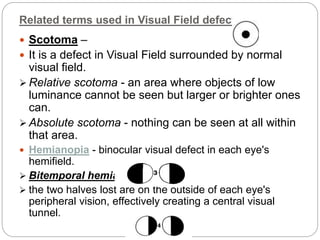
 Hemianopia - binocular visual defect in each eye's
hemifield.
 Bitemporal hemianopia –
 the two halves lost are on the outside of each eye's
peripheral vision, effectively creating a central visual
tunnel.
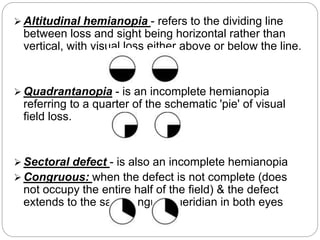
 Altitudinal hemianopia - refers to the dividing line
between loss and sight being horizontal rather than
vertical, with visual loss either above or below the line.
 Quadrantanopia - is an incomplete hemianopia
referring to a quarter of the schematic 'pie' of visual
field loss.
 Sectoral defect - is also an incomplete hemianopia
 Congruous: when the defect is not complete (does
not occupy the entire half of the field) & the defect
extends to the same angular meridian in both eyes
 Congruity describes incomplete homonymous
hemianopic defects that are identical in all attributes:
location, shape, size, depth, slope of margins.
 Remember: the more posterior ‘toward the occipital
cortex’ the lesion in the postchiasmal visual
pathways, the more likely the defects will be
congruous.
b. Anterior parietal
radiation les ion
a.Temporal radiation
lesion
c. Main radiation lesion
d. Anterior visual cortex les
e. Macular cortex
lesion
Temporal horn of
lateral ventricle
Lateral geniculate body
Calcarine fissure
a
b
c
d
e
Visual pathway and its defects

Visual pathway and its defects

  • 1.
    By Mutahir Shah Resident MPhil VS 2nd Semester Pakistan Institute of Community Ophthalmology Visual Pathway and its Defects
  • 2.
    Brief Anatomy ofVisual Pathway  Afferent Visual Pathways:-  It is important to recognize that any disturbance in afferent function may result in the same symptoms of vision loss as observed with pathology affecting the retina, optic nerve,and visual pathway.  Retina  The afferent visual pathway begins within the retina.  Optic Nerve  The optic nerve begins anatomically at the optic disc but physiologically and functionally within the ganglion cell layer that covers the entire retina.  The first portion of the optic nerve, representing the confluence of approximately 1.0- 1.2 million ganglion cell axons.
  • 3.
     The combinationof small channels and a unique blood supply (largely from branches of the posterior ciliary arteries) probably plays a role in several optic neuropathies.  Retinal fibers enter optic discs in a specific manner.  Nerve fiber bundle (NFB) defects are of the following: 1. Papillomacular bundle. 2. Sup. & Inf. Arcuate bundle. 3. Nasal bundle.
  • 4.
  • 5.
    Optic Chiasm  Theoptic chiasm measures approximately 12 mm wide, 8 mm long in the anteroposterior direction, and 4 mm thick.  Within the chiasm, the fibers coming from the nasal retina (approximately 53% of total fibers) cross to the opposite side to join the corresponding contralateral fibers.  Extramacular superonasal fibers cross directly to the opposite tract.  Extramacular temporal fibers remain uncrossed in the chiasm and optic tract.  The macular projections are located centrally in the optic nerve and constitute 80%-90% of the total volume of the optic nerve and the chiasma!
  • 6.
    The extramacular fibersfrom the inferonasal retina cross anteriorly in the chiasm at the "Wilbrand knee" before passing into the optic tract.
  • 7.
     Optic Tract Starting from the posterior part of the chiasma upto the LGB.  Fibers (both crossed and uncrossed) from the upper retinal projections travel medially in the optic tract; lower projections move laterally.  The macular fibers adopt a dorsolateral orientation as they course toward the lateral geniculate body  All retrochiasmatic lesions result in a contralateral homonymous hemianopia.  Optic tract lesions tend to produce markedly incongruous field defect.
  • 8.
    Lateral Ganiculate Bodyor Nucleus  The LGN is a peaked, mushroom-shaped structure that is divided into 6 levels.  The 4 superior levels are the termini of P-cell axons, which are the ganglion cells with smaller receptive fields and are responsible for mediating maximal spatial resolution and color perception.  The 2 inferior layers receive input from the M-cell fibers, which are the ganglion cells with larger receptive fields and are more sensitive to detecting motion.  Axons originating in the contralateral eye terminate in layers 1, 4, and 6; the ipsilateral fibers innervate 2, 3, and 5.
  • 9.
     As thefibers approach the LGN, the superior fibers move superomedially and the inferior fibers swing inferolaterally.  Overall, the retinal representation rotates almost 90°, with the superior fibers moving medially and the inferior fibers laterally.  The macular fibers tend to move super laterally  Macular vision is subserved by the hilum and peripheral field by the medial and lateral horns.
  • 10.
    LGN field defects: 1.Incongruous homonymous hemianopia. 2. Unique sector & sector-sparing defects due to dual blood supply of LGN from anterior & posterior choroidal arteries.
  • 11.
    Optic Radiation  Followinga synapse in the LGN, the axons travel posteriorly as the optic radiations toterminate in the primary visual (calcarine) cortex in the occipital lobe.  The most inferior of the fibers first travel anteriorly, then laterally and posteriorly to loop around the temporal horn of the lateral ventricles (Meyer loop) .  More superiorly, the fibers travel posteriorly through the deep white matter of the parietal lobe.  The macular (central) fibers course laterally, with the peripheral fibers concentrated more at the superior and inferior aspects of the radiations.
  • 12.
    Right superior quadrantanopia>> temporal lobe lesion Left inferior quadrantanopia >> parietal lobe lesion
  • 13.
    Visual Cortex  Thevisual cortex, the thinnest area of the human cerebral cortex, has 6 cellular layers  It occupies the superior and inferior lips of the calcarine fissure on the posterior and medial surfaces of the occipital lobes.  Macular function is extremely well represented in the visual cortex and occupies the most posterior position at the tip of the occipital lobe.  The most anterior portion of the calcarine fissure is occupied by contralateral nasal retinal fibers only.  The visual cortex usually have dual blood supply.  The ‘macular’ visual cortex is supplied by terminal branches of posterior & middle cerebral arteries.
  • 14.
    A lesion affectingthe tip of the occipital lobe tends to produce a central homonymous hemianopia Left homonymous hemianopia with macular sparing
  • 16.
    Related terms usedin Visual Field defects  Scotoma –  It is a defect in Visual Field surrounded by normal visual field.  Relative scotoma - an area where objects of low luminance cannot be seen but larger or brighter ones can.  Absolute scotoma - nothing can be seen at all within that area.  Hemianopia - binocular visual defect in each eye's hemifield.  Bitemporal hemianopia –  the two halves lost are on the outside of each eye's peripheral vision, effectively creating a central visual tunnel.
  • 17.
     Altitudinal hemianopia- refers to the dividing line between loss and sight being horizontal rather than vertical, with visual loss either above or below the line.  Quadrantanopia - is an incomplete hemianopia referring to a quarter of the schematic 'pie' of visual field loss.  Sectoral defect - is also an incomplete hemianopia  Congruous: when the defect is not complete (does not occupy the entire half of the field) & the defect extends to the same angular meridian in both eyes
  • 18.
     Congruity describesincomplete homonymous hemianopic defects that are identical in all attributes: location, shape, size, depth, slope of margins.  Remember: the more posterior ‘toward the occipital cortex’ the lesion in the postchiasmal visual pathways, the more likely the defects will be congruous.
  • 21.
    b. Anterior parietal radiationles ion a.Temporal radiation lesion c. Main radiation lesion d. Anterior visual cortex les e. Macular cortex lesion Temporal horn of lateral ventricle Lateral geniculate body Calcarine fissure a b c d e