 Aperture in the centre of iris
 One in number,rarely more than one called polycoria
 Placed almost central(slight nasally),rarely eccentric called
corectopia
 Normal size 1.5-8mm
 Almost circular in shape
 Two pupil are equal in size
 Colour greyish black.
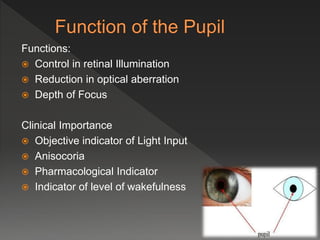
Functions:
 Control in retinal Illumination
 Reduction in optical aberration
 Depth of Focus
Clinical Importance
 Objective indicator of Light Input
 Anisocoria
 Pharmacological Indicator
 Indicator of level of wakefulness
 The light reflex consist of simultaneous and equal
constriction of pupils in response to stimulation of one
eye by light
 Constriction is elicited with extremely low intensities and
is proportional within limits to both intensities and
duration of stimulus.
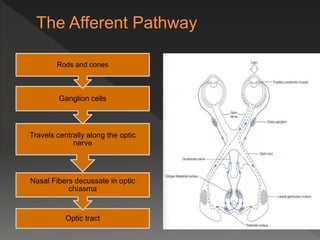
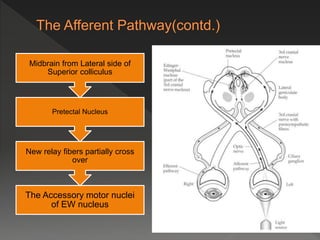
Optic tract
Nasal Fibers decussate in optic
chiasma
Travels centrally along the optic
nerve
Ganglion cells
Rods and cones
The Accessory motor nuclei
of EW nucleus
New relay fibers partially cross
over
Pretectal Nucleus
Midbrain from Lateral side of
Superior colliculus
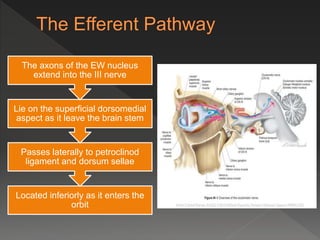
Located inferiorly as it enters the
orbit
Passes laterally to petroclinod
ligament and dorsum sellae
Lie on the superficial dorsomedial
aspect as it leave the brain stem
The axons of the EW nucleus
extend into the III nerve
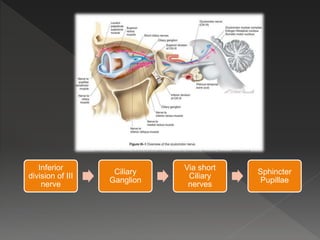
Inferior
division of III
nerve
Ciliary
Ganglion
Via short
Ciliary
nerves
Sphincter
Pupillae
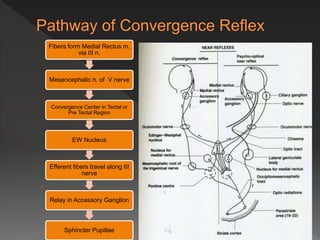
 Two components:
1. Convergence Reflex: Convergence of visual axis
and associated constriction of pupil
2. Accommodation Reflex: Increased
accommodation and associated constriction of pupil
 Near Reflex Traid consists of:
- Increased Accommodation
- Convergence of Visual Axis
- Constriction of pupils
Fibers form Medial Rectus m.
via III n.
Mesencephalic n. of V nerve
Convergence Center in Tectal or
Pre Tectal Region
EW Nucleus
Efferent fibers travel along III
nerve
Relay in Accessory Ganglion
Sphincter Pupillae
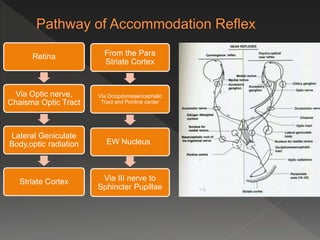
Retina
Via Optic nerve,
Chaisma Optic Tract
Lateral Geniculate
Body,optic radiation
Striate Cortex
From the Para
Striate Cortex
Via Occipitomesencephalic
Tract and Pontine center
EW Nucleus
Via III nerve to
Sphincter Pupillae
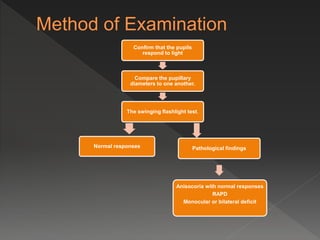
Confirm that the pupils
respond to light
Compare the pupillary
diameters to one another.
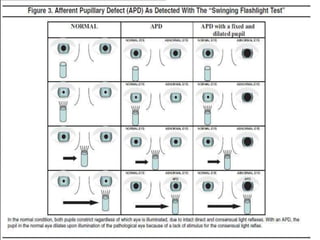
The swinging flashlight test.
Normal responses Pathological findings
Anisocoria with normal responses
RAPD
Monocular or bilateral deficit
 Instruct the patient to look at the distant target
 The examiner holds up a target containing fine detail
approximately 25cm from the patient
 Ask the patient to fixate the near target and look for
pupil constriction
 Note the speed of the constriction and the roundness of
each pupil
 Assessment of afferent input from the retina, optic nerve,
and chiasma, optic tract and midbrain till LGB
 Damage anywhere along this portion of the visual
pathway reduces the amplitude of pupil movement in
response to a light stimulus
 Absence of Direct light reflex on affected side and
absence of consensual light reflex on normal side
 When the normal is stimulated both pupils react
normally
 Diffuse illumination both pupils are equal in size
 Near reflex is normal in both eyes
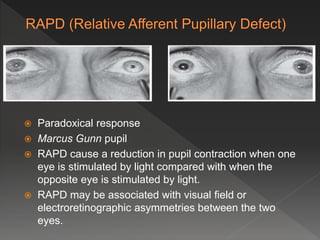
 Paradoxical response
 Marcus Gunn pupil
 RAPD cause a reduction in pupil contraction when one
eye is stimulated by light compared with when the
opposite eye is stimulated by light.
 RAPD may be associated with visual field or
electroretinographic asymmetries between the two
eyes.
 Grade 1+: A weak initial pupillary constriction followed by
greater redilation
Grade 2+: An initial pupillary stall followed by greater
redilation
Grade 3+: An immediate pupillary dilation
Grade 4+: No reaction to light – Amaurotic pupil
 Optic neuritis
 Anterior ischemic optic neuropathy
 Compressive optic neuropathy
 Glaucoma
 Optic Nerve Tumors
 Orbital Diseases
 Ischemic Retinal Diseases : CRAO CRVO BRAO BRVO
 Ocular Ischemic Syndrome
 CSCR or CME
 RD
 Chiasmal compression
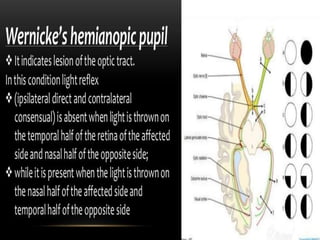
 Optic tract lesion
 Postgeniculate damage
 Midbrain tectal damage
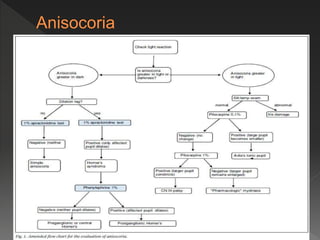
 Anisocoria is defined by a difference in the size of the
two pupils of 0.4 mm or greater
 Anisocoria may be a sign of ocular or neurologic
disease
 It should be considered a neurosurgical emergency if a
patient has anisocoria with acute onset of third-nerve
palsy and associated with headache or trauma.
 To evaluate anisocoria, the examiner must determine
which pupil is abnormal by noting pupil size under light
and dark illumination
 If the difference in pupil size in both light and dark
illumination is constant, then it is called Physiologic or
Essential anisocoria
 Afferent pathways not affected
 A lesion in the midbrain produces a subtle and transient
anisocoria
 However, most neurologic causes of anisocoria involve
lesions in the parasympathetic (efferent) and
sympathetic pupillary pathways
 If the Larger pupil is abnormal (poor constriction), the
anisocoria is greatest in Bright illumination, as the
normal pupil becomes small
 This is caused from the disruption of the
Parasympathetic (efferent) pupillary pathway [BPL]
 If the Smaller pupil is abnormal (poor dilation), the
anisocoria is greatest in Dark illumination, as the normal
pupil becomes large
 It is caused from the disruption of the Sympathetic
pupillary pathway
 Horner’s syndrome
 Adie’s tonic syndrome
 Third-nerve palsy
 Adrenergic mydriasis
 Anticholinergic mydriasis
 Argyll Robertson pupils
 Local iris disease (e.g., sphincter atrophy, posterior
synechiae, pseudoexofoliation syndrome)
 Hutchinson’s pupil
 Iris sphincter damage from trauma
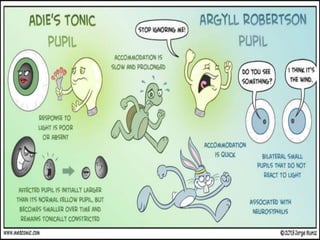
 Tonic pupil (Adie’s pupil)
 Third-nerve palsy
 Traumatic iritis, uveitis, angle-closure glaucoma,
pseudoexofoliation syndrome and recent eye surgery
 Pharmacologic agents:
› Unilateral use of dilating drops
 Atropine, cyclopentolate, homatropine, scopolamine,
tropicamide, phenylephrine.
 Sympathomimetic agents: ephedrine, cocaine,
ecstasy
 A traumatic dilated pupil could be ruled out clinically by
careful history and slit lamp biomicroscopic examination
 A patient with traumatic iris sphincter damage will
present with torn pupillary margin or iris illumination
defects seen on biomicroscopic examination.
 Caused by denervation of the postganglionic supply to
sphincter pupillae and the ciliary muscle
 May follow a viral illness
 Occasionally AD pattern
 Site of leison: ciliary ganglia or dorsal root ganglion
 Typically affects young women
 Symptoms:
Difference in the size of the pupils
Unilateral blurred vision
May be asymptomatic
 Signs:
Anisocoria (Light > Dark)
Large,regular pupil
Direct light reflex absent or sluggish
Segmental pupil response – “vermiform” pupil
response movement.
 Other Characteristics:
Decreased amplitude of accommodation
Diminished deep tendon reflexes of the knee and
ankle – Holmes-Adie syndrome.
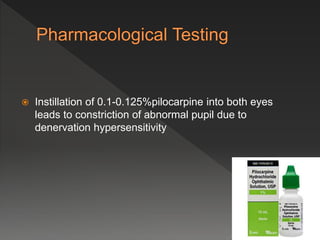
 Instillation of 0.1-0.125%pilocarpine into both eyes
leads to constriction of abnormal pupil due to
denervation hypersensitivity
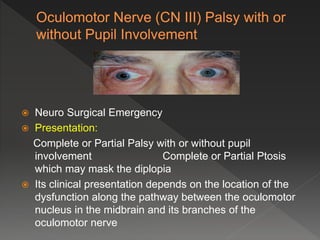
 Neuro Surgical Emergency
 Presentation:
Complete or Partial Palsy with or without pupil
involvement Complete or Partial Ptosis
which may mask the diplopia
 Its clinical presentation depends on the location of the
dysfunction along the pathway between the oculomotor
nucleus in the midbrain and its branches of the
oculomotor nerve
 DDx: ischemia, aneurysm, tumor, trauma, infection,
inflammation or congenital anomalies
 Diagnosis is critical if pupil in involved
 Sparing of the pupil is an important diagnostic sign for
ruling out a more serious etiology such as aneurysm or
tumor
 Most pupil sparing cases are microvascular in origin
such as diabetes or hypertension
 As a rule of thumb, a patient with sudden onset of
painful third-nerve palsy with pupil involvement and no
history of trauma or vascular disease should assume an
intracranial aneurysm until proven otherwise
 The most common site of an intracranial aneurysm
causing third-nerve palsy is :
The posterior communicating artery
Internal carotid artery and basilar artery
 Life-threatening emergency : Potential of rupturing and
leading to subarachnoid hemorrhage (within hours or
days)
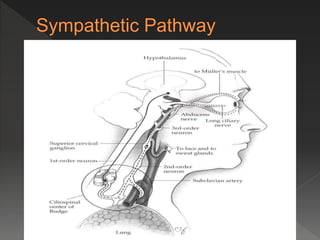
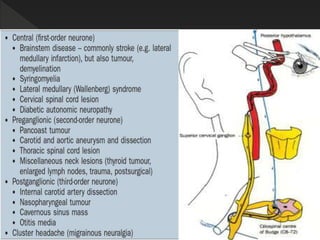
 Disruption along the sympathetic pupillary fibers from
hypothalamus to iris dilator.
 Causes of Miotic Pupils:
Horner's Syndrome(Oculosympathetic paralysis)
Argyll Robertson Pupils
Long-Standing Adie's Pupil
 Pharmacologic Agents:
› Unilateral use of miotic drops:
 Pilocarpine
› Drugs causing miosis : Narcotics, Barbiturates, Chloral
hydrate, Morphine, Propoxyphene,Tamsulosin
 Uveitis, pseudoexofoliation syndrome and recent eye
surgery
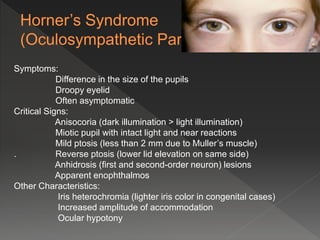
Symptoms:
Difference in the size of the pupils
Droopy eyelid
Often asymptomatic
Critical Signs:
Anisocoria (dark illumination > light illumination)
Miotic pupil with intact light and near reactions
Mild ptosis (less than 2 mm due to Muller’s muscle)
. Reverse ptosis (lower lid elevation on same side)
Anhidrosis (first and second-order neuron) lesions
Apparent enophthalmos
Other Characteristics:
Iris heterochromia (lighter iris color in congenital cases)
Increased amplitude of accommodation
Ocular hypotony
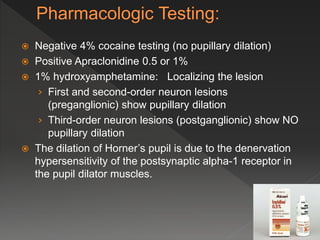
 Negative 4% cocaine testing (no pupillary dilation)
 Positive Apraclonidine 0.5 or 1%
 1% hydroxyamphetamine: Localizing the lesion
› First and second-order neuron lesions
(preganglionic) show pupillary dilation
› Third-order neuron lesions (postganglionic) show NO
pupillary dilation
 The dilation of Horner’s pupil is due to the denervation
hypersensitivity of the postsynaptic alpha-1 receptor in
the pupil dilator muscles.
 LND refers to any situation where the light reaction is
absent and pupillary near reaction is present
 The near reflex fibers are more ventrally located than
the light reflex fibers, thus the near reflex fibers are
spared even with afferent light reflex fiber lesions.
 IF unilateral or bilateral and it’s associated ocular
manifestations such as extra-ocular muscle
abnormalities and nystagmus (Parinaud’s syndrome).
 Argyll Robertson pupils
 Advanced diabetes mellitus
 Pituitary tumors
 Midbrain lesions: Pinealomas causing Parinaud’s
syndrome (Sylvian aqueduct syndrome, dorsal midbrain
syndrome)
 Myotonic dystrophy
 Adie’s tonic pupil (aberrant regeneration in a mixed
nerve)
 Argyll Robertson pupils are miotic pupils with irregular in
shape.
 It is usually bilateral, but asymmetric.
 The light reflex is absent or very sluggish, but the near
reflex is normal (light-near dissociation).
 Rule out Tertiary Syphillis
 Involvement is usually Bilateral but Asymmetrical
 The retinae are sensitive to light
 The pupils are small in size and irregular in shape
 The light reflex is absent but near reflex is present
 Dilate poorly with mydriatics like Atropine
 Physiostigmine may cause further constriction
Pupil dr ferdous
Pupil dr ferdous

Pupil dr ferdous

  • 2.
     Aperture inthe centre of iris  One in number,rarely more than one called polycoria  Placed almost central(slight nasally),rarely eccentric called corectopia  Normal size 1.5-8mm  Almost circular in shape  Two pupil are equal in size  Colour greyish black.
  • 3.
    Functions:  Control inretinal Illumination  Reduction in optical aberration  Depth of Focus Clinical Importance  Objective indicator of Light Input  Anisocoria  Pharmacological Indicator  Indicator of level of wakefulness
  • 4.
     The lightreflex consist of simultaneous and equal constriction of pupils in response to stimulation of one eye by light  Constriction is elicited with extremely low intensities and is proportional within limits to both intensities and duration of stimulus.
  • 5.
    Optic tract Nasal Fibersdecussate in optic chiasma Travels centrally along the optic nerve Ganglion cells Rods and cones
  • 6.
    The Accessory motornuclei of EW nucleus New relay fibers partially cross over Pretectal Nucleus Midbrain from Lateral side of Superior colliculus
  • 7.
    Located inferiorly asit enters the orbit Passes laterally to petroclinod ligament and dorsum sellae Lie on the superficial dorsomedial aspect as it leave the brain stem The axons of the EW nucleus extend into the III nerve
  • 8.
    Inferior division of III nerve Ciliary Ganglion Viashort Ciliary nerves Sphincter Pupillae
  • 10.
     Two components: 1.Convergence Reflex: Convergence of visual axis and associated constriction of pupil 2. Accommodation Reflex: Increased accommodation and associated constriction of pupil  Near Reflex Traid consists of: - Increased Accommodation - Convergence of Visual Axis - Constriction of pupils
  • 11.
    Fibers form MedialRectus m. via III n. Mesencephalic n. of V nerve Convergence Center in Tectal or Pre Tectal Region EW Nucleus Efferent fibers travel along III nerve Relay in Accessory Ganglion Sphincter Pupillae
  • 12.
    Retina Via Optic nerve, ChaismaOptic Tract Lateral Geniculate Body,optic radiation Striate Cortex From the Para Striate Cortex Via Occipitomesencephalic Tract and Pontine center EW Nucleus Via III nerve to Sphincter Pupillae
  • 13.
    Confirm that thepupils respond to light Compare the pupillary diameters to one another. The swinging flashlight test. Normal responses Pathological findings Anisocoria with normal responses RAPD Monocular or bilateral deficit
  • 14.
     Instruct thepatient to look at the distant target  The examiner holds up a target containing fine detail approximately 25cm from the patient  Ask the patient to fixate the near target and look for pupil constriction  Note the speed of the constriction and the roundness of each pupil
  • 15.
     Assessment ofafferent input from the retina, optic nerve, and chiasma, optic tract and midbrain till LGB  Damage anywhere along this portion of the visual pathway reduces the amplitude of pupil movement in response to a light stimulus
  • 16.
     Absence ofDirect light reflex on affected side and absence of consensual light reflex on normal side  When the normal is stimulated both pupils react normally  Diffuse illumination both pupils are equal in size  Near reflex is normal in both eyes
  • 17.
     Paradoxical response Marcus Gunn pupil  RAPD cause a reduction in pupil contraction when one eye is stimulated by light compared with when the opposite eye is stimulated by light.  RAPD may be associated with visual field or electroretinographic asymmetries between the two eyes.
  • 19.
     Grade 1+:A weak initial pupillary constriction followed by greater redilation Grade 2+: An initial pupillary stall followed by greater redilation Grade 3+: An immediate pupillary dilation Grade 4+: No reaction to light – Amaurotic pupil
  • 20.
     Optic neuritis Anterior ischemic optic neuropathy  Compressive optic neuropathy  Glaucoma  Optic Nerve Tumors  Orbital Diseases  Ischemic Retinal Diseases : CRAO CRVO BRAO BRVO  Ocular Ischemic Syndrome  CSCR or CME  RD  Chiasmal compression  Optic tract lesion  Postgeniculate damage  Midbrain tectal damage
  • 22.
     Anisocoria isdefined by a difference in the size of the two pupils of 0.4 mm or greater  Anisocoria may be a sign of ocular or neurologic disease  It should be considered a neurosurgical emergency if a patient has anisocoria with acute onset of third-nerve palsy and associated with headache or trauma.
  • 23.
     To evaluateanisocoria, the examiner must determine which pupil is abnormal by noting pupil size under light and dark illumination  If the difference in pupil size in both light and dark illumination is constant, then it is called Physiologic or Essential anisocoria  Afferent pathways not affected  A lesion in the midbrain produces a subtle and transient anisocoria  However, most neurologic causes of anisocoria involve lesions in the parasympathetic (efferent) and sympathetic pupillary pathways
  • 24.
     If theLarger pupil is abnormal (poor constriction), the anisocoria is greatest in Bright illumination, as the normal pupil becomes small  This is caused from the disruption of the Parasympathetic (efferent) pupillary pathway [BPL]  If the Smaller pupil is abnormal (poor dilation), the anisocoria is greatest in Dark illumination, as the normal pupil becomes large  It is caused from the disruption of the Sympathetic pupillary pathway
  • 25.
     Horner’s syndrome Adie’s tonic syndrome  Third-nerve palsy  Adrenergic mydriasis  Anticholinergic mydriasis  Argyll Robertson pupils  Local iris disease (e.g., sphincter atrophy, posterior synechiae, pseudoexofoliation syndrome)  Hutchinson’s pupil
  • 27.
     Iris sphincterdamage from trauma  Tonic pupil (Adie’s pupil)  Third-nerve palsy  Traumatic iritis, uveitis, angle-closure glaucoma, pseudoexofoliation syndrome and recent eye surgery  Pharmacologic agents: › Unilateral use of dilating drops  Atropine, cyclopentolate, homatropine, scopolamine, tropicamide, phenylephrine.  Sympathomimetic agents: ephedrine, cocaine, ecstasy
  • 28.
     A traumaticdilated pupil could be ruled out clinically by careful history and slit lamp biomicroscopic examination  A patient with traumatic iris sphincter damage will present with torn pupillary margin or iris illumination defects seen on biomicroscopic examination.
  • 29.
     Caused bydenervation of the postganglionic supply to sphincter pupillae and the ciliary muscle  May follow a viral illness  Occasionally AD pattern  Site of leison: ciliary ganglia or dorsal root ganglion  Typically affects young women
  • 30.
     Symptoms: Difference inthe size of the pupils Unilateral blurred vision May be asymptomatic  Signs: Anisocoria (Light > Dark) Large,regular pupil Direct light reflex absent or sluggish Segmental pupil response – “vermiform” pupil response movement.  Other Characteristics: Decreased amplitude of accommodation Diminished deep tendon reflexes of the knee and ankle – Holmes-Adie syndrome.
  • 31.
     Instillation of0.1-0.125%pilocarpine into both eyes leads to constriction of abnormal pupil due to denervation hypersensitivity
  • 32.
     Neuro SurgicalEmergency  Presentation: Complete or Partial Palsy with or without pupil involvement Complete or Partial Ptosis which may mask the diplopia  Its clinical presentation depends on the location of the dysfunction along the pathway between the oculomotor nucleus in the midbrain and its branches of the oculomotor nerve
  • 33.
     DDx: ischemia,aneurysm, tumor, trauma, infection, inflammation or congenital anomalies  Diagnosis is critical if pupil in involved  Sparing of the pupil is an important diagnostic sign for ruling out a more serious etiology such as aneurysm or tumor  Most pupil sparing cases are microvascular in origin such as diabetes or hypertension
  • 34.
     As arule of thumb, a patient with sudden onset of painful third-nerve palsy with pupil involvement and no history of trauma or vascular disease should assume an intracranial aneurysm until proven otherwise  The most common site of an intracranial aneurysm causing third-nerve palsy is : The posterior communicating artery Internal carotid artery and basilar artery  Life-threatening emergency : Potential of rupturing and leading to subarachnoid hemorrhage (within hours or days)
  • 35.
     Disruption alongthe sympathetic pupillary fibers from hypothalamus to iris dilator.  Causes of Miotic Pupils: Horner's Syndrome(Oculosympathetic paralysis) Argyll Robertson Pupils Long-Standing Adie's Pupil  Pharmacologic Agents: › Unilateral use of miotic drops:  Pilocarpine › Drugs causing miosis : Narcotics, Barbiturates, Chloral hydrate, Morphine, Propoxyphene,Tamsulosin  Uveitis, pseudoexofoliation syndrome and recent eye surgery
  • 37.
    Symptoms: Difference in thesize of the pupils Droopy eyelid Often asymptomatic Critical Signs: Anisocoria (dark illumination > light illumination) Miotic pupil with intact light and near reactions Mild ptosis (less than 2 mm due to Muller’s muscle) . Reverse ptosis (lower lid elevation on same side) Anhidrosis (first and second-order neuron) lesions Apparent enophthalmos Other Characteristics: Iris heterochromia (lighter iris color in congenital cases) Increased amplitude of accommodation Ocular hypotony
  • 39.
     Negative 4%cocaine testing (no pupillary dilation)  Positive Apraclonidine 0.5 or 1%  1% hydroxyamphetamine: Localizing the lesion › First and second-order neuron lesions (preganglionic) show pupillary dilation › Third-order neuron lesions (postganglionic) show NO pupillary dilation  The dilation of Horner’s pupil is due to the denervation hypersensitivity of the postsynaptic alpha-1 receptor in the pupil dilator muscles.
  • 40.
     LND refersto any situation where the light reaction is absent and pupillary near reaction is present  The near reflex fibers are more ventrally located than the light reflex fibers, thus the near reflex fibers are spared even with afferent light reflex fiber lesions.  IF unilateral or bilateral and it’s associated ocular manifestations such as extra-ocular muscle abnormalities and nystagmus (Parinaud’s syndrome).
  • 41.
     Argyll Robertsonpupils  Advanced diabetes mellitus  Pituitary tumors  Midbrain lesions: Pinealomas causing Parinaud’s syndrome (Sylvian aqueduct syndrome, dorsal midbrain syndrome)  Myotonic dystrophy  Adie’s tonic pupil (aberrant regeneration in a mixed nerve)
  • 42.
     Argyll Robertsonpupils are miotic pupils with irregular in shape.  It is usually bilateral, but asymmetric.  The light reflex is absent or very sluggish, but the near reflex is normal (light-near dissociation).  Rule out Tertiary Syphillis
  • 43.
     Involvement isusually Bilateral but Asymmetrical  The retinae are sensitive to light  The pupils are small in size and irregular in shape  The light reflex is absent but near reflex is present  Dilate poorly with mydriatics like Atropine  Physiostigmine may cause further constriction

Editor's Notes

  • #6 Melanopsin Retinal Ganglion cells act via the input received from the rods and cones but also a direct transduction of light invokes a light reflex.
  • #7 Fibers pass into the midbrain from the lateral side of superior colliculus Reach the Pretectal nucleus where they terminate. New relay fibers partially cross the posterior commisurae ,go ventrally from the aqueduct They reach the Accessory motar nuclei of EW nucleus on both Ipsilateral and contra lateral side
  • #9 From the inferior division of the III n. by the way of its branch to Inf Oblique m . A short and a thick nerve trunk reaches the ciliary ganglion. Myelinated PG PS terminate in synapses with ganglionic neurons. The PG fibers innervate the sphincter pupillae.through the short ciliary
  • #12 Affeerent fibers from MR via III n. To Mesencephalic nuclei of 5th n To convergence center in Tectal or Pre Tectal region From convergence center to EW nucleus Efferent fibers travel along the III n. Relay in accessory ganglion Reaches the sphincter pupillae
  • #13 From Retina to Para striate cortex Via ON,chiasma,OT, LGB,optic radiation and Striate cortex Relay the impulses from para striate cortex to EW nucleus of both sides Via the occipito mesencephalic tract and the pontine center Efferent fibers travel along the III n. Relay in accessory ganglion Reaches the sphincter pupillae
  • #33 Neurosurgical emergency if a patient has anisocoria with acute onset of third-nerve palsy and associated with headache or trauma.