Dr.Puskar Ghosh
PGT
Burdwan Medical College
• It is a condition in which the visual axis of the two eyes does
not meet at the point of regard.
• Greek word-”strabos”:crooked
• PHORIA:latent visual axis deviation,held in check by fusion.
• TROPIA:a manifest visual axis deviation.
• Intermittent Tropia:deviation may exist in only certain gaze
positions or target distance.
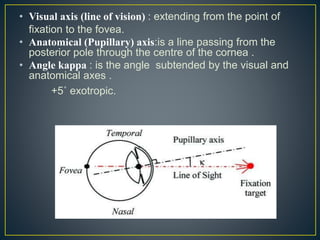
• Visual axis (line of vision) : extending from the point of
fixation to the fovea.
• Anatomical (Pupillary) axis:is a line passing from the
posterior pole through the centre of the cornea .
• Angle kappa : is the angle subtended by the visual and
anatomical axes .
+5˚ exotropic.
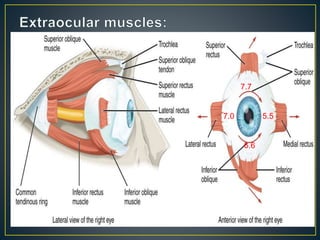
5.5
6.6
7.0
7.7
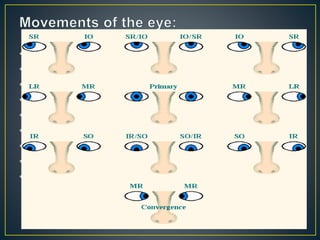
• Uniocularly-Duction
• Binocularly-Version.-Same direction
• Opposite direction-Vergence
• Adduction-nasally horizontal
• Abduction-temporally horizontal
• Sursumduction or elevation-upward
• Deorsumduction or depression-downward
• Incycloduction
• Excycloduction
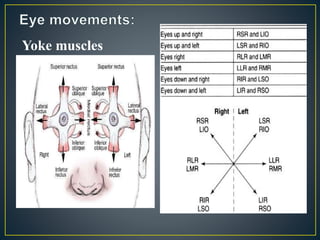
Yoke muscles
For co ordinated eye
movements one muscle of the
each eye act togather.These
are called yoke muscle.
• Hering’s law,for a
binocular movement the
corresponding muscle
(yoked) receive equal and
simultaneous innervation.
• Sherington’s law of
reciprocal innervation,for
any binocular movement the
direct antagonist receives
an equal and simultaneous
inhibition of its innervation.
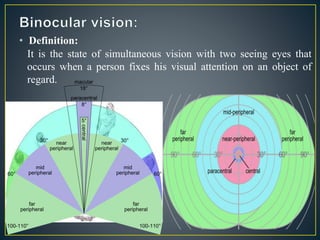
• Definition:
It is the state of simultaneous vision with two seeing eyes that
occurs when a person fixes his visual attention on an object of
regard.
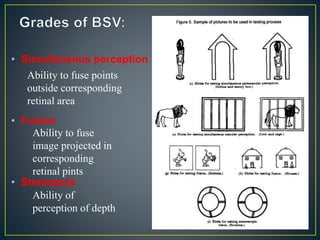
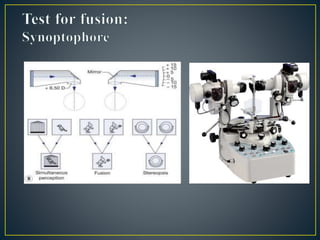
• Simultaneous perception
• Fusion
• Stereopsis
Ability to fuse points
outside corresponding
retinal area
Ability to fuse
image projected in
corresponding
retinal pints
Ability of
perception of depth
• Confusion-
due to different image viewed by two fovea
Immediately checked by cortical or retinal rivalry mechanism.
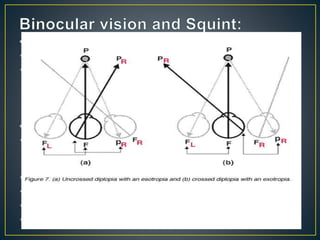
• Diplopia-
one object is perceived by one of the fovea of one eye and
other object is perceived by extrafoveal point of the other eye
which has a different localization value in space.
Binocular diplopia-single image on closing one eye
Monocular diplopia-in astigmatism,neurological conditions
Uncrossed diplopia-esodeviation
Crossed diplopia-exodeviation
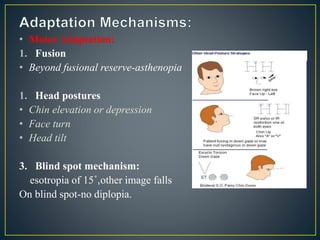
• Motor Adaptation:
1. Fusion
• Beyond fusional reserve-asthenopia
1. Head postures
• Chin elevation or depression
• Face turn
• Head tilt
3. Blind spot mechanism:
esotropia of 15˚,other image falls
On blind spot-no diplopia.
• Sensory Adaptation:
• Supression:
Confusion is takled by foveal rivalry which is actually a
suppression.
extrafoveal image suppression is readily occurs if the
visual potential of the extrafoveal point is poor.
Facultative
Obligatory
• Anomalous Retinal Correspondence:
It is the binocular functional adaptation to strabismus at
the cortical level.The fovea of the fixing eye develops a
correspondence (binocular relationship) with an
extrafoveal point of the other eye.
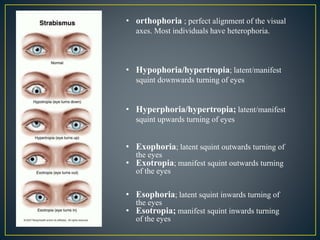
• orthophoria ; perfect alignment of the visual
axes. Most individuals have heterophoria.
• Hypophoria/hypertropia; latent/manifest
squint downwards turning of eyes
• Hyperphoria/hypertropia; latent/manifest
squint upwards turning of eyes
• Exophoria; latent squint outwards turning of
the eyes
• Exotropia; manifest squint outwards turning
of the eyes
• Esophoria; latent squint inwards turning of
the eyes
• Esotropia; manifest squint inwards turning
of the eyes
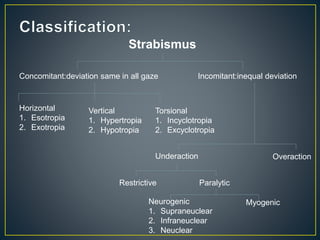
Strabismus
Concomitant:deviation same in all gaze Incomitant:inequal deviation
Horizontal
1. Esotropia
2. Exotropia
Vertical
1. Hypertropia
2. Hypotropia
Torsional
1. Incyclotropia
2. Excyclotropia
Underaction Overaction
Restrictive Paralytic
Neurogenic
1. Supraneuclear
2. Infraneuclear
3. Neuclear
Myogenic
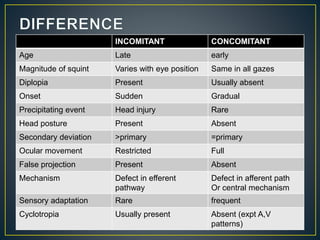
INCOMITANT CONCOMITANT
Age Late early
Magnitude of squint Varies with eye position Same in all gazes
Diplopia Present Usually absent
Onset Sudden Gradual
Precipitating event Head injury Rare
Head posture Present Absent
Secondary deviation >primary =primary
Ocular movement Restricted Full
False projection Present Absent
Mechanism Defect in efferent
pathway
Defect in afferent path
Or central mechanism
Sensory adaptation Rare frequent
Cyclotropia Usually present Absent (expt A,V
patterns)
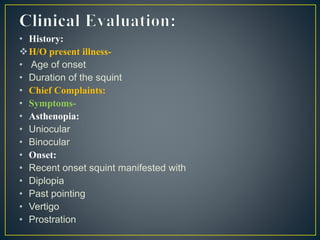
• History:
H/O present illness-
• Age of onset
• Duration of the squint
• Chief Complaints:
• Symptoms-
• Asthenopia:
• Uniocular
• Binocular
• Onset:
• Recent onset squint manifested with
• Diplopia
• Past pointing
• Vertigo
• Prostration
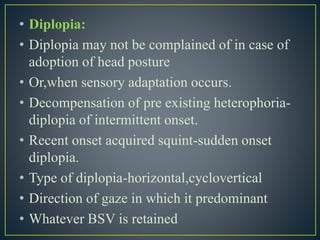
• Diplopia:
• Diplopia may not be complained of in case of
adoption of head posture
• Or,when sensory adaptation occurs.
• Decompensation of pre existing heterophoria-
diplopia of intermittent onset.
• Recent onset acquired squint-sudden onset
diplopia.
• Type of diplopia-horizontal,cyclovertical
• Direction of gaze in which it predominant
• Whatever BSV is retained
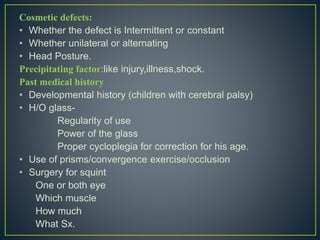
Cosmetic defects:
• Whether the defect is Intermittent or constant
• Whether unilateral or alternating
• Head Posture.
Precipitating factor:like injury,illness,shock.
Past medical history
• Developmental history (children with cerebral palsy)
• H/O glass-
Regularity of use
Power of the glass
Proper cycloplegia for correction for his age.
• Use of prisms/convergence exercise/occlusion
• Surgery for squint
One or both eye
Which muscle
How much
What Sx.
Birth History
• Antenatal history-drugs taken/illness during pregnancy
• Gestational age & birth weight at delivery
• Type and length/problem during labour.
Family history
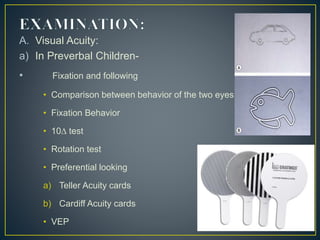
A. Visual Acuity:
a) In Preverbal Children-
• Fixation and following
• Comparison between behavior of the two eyes.
• Fixation Behavior
• 10∆ test
• Rotation test
• Preferential looking
a) Teller Acuity cards
b) Cardiff Acuity cards
• VEP
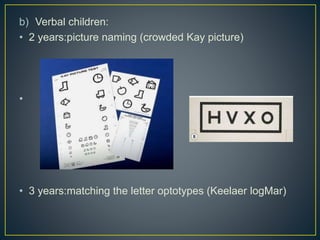
b) Verbal children:
• 2 years:picture naming (crowded Kay picture)
•
• 3 years:matching the letter optotypes (Keelaer logMar)
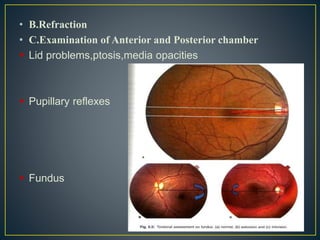
• B.Refraction
• C.Examination of Anterior and Posterior chamber
 Lid problems,ptosis,media opacities
 Pupillary reflexes
 Fundus
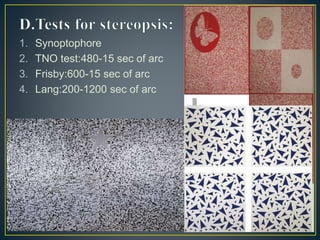
1. Synoptophore
2. TNO test:480-15 sec of arc
3. Frisby:600-15 sec of arc
4. Lang:200-1200 sec of arc
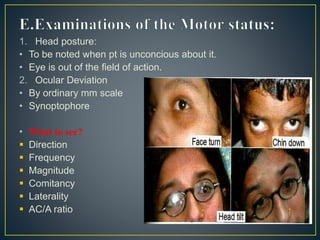
1. Head posture:
• To be noted when pt is unconcious about it.
• Eye is out of the field of action.
2. Ocular Deviation
• By ordinary mm scale
• Synoptophore
• What to see?
 Direction
 Frequency
 Magnitude
 Comitancy
 Laterality
 AC/A ratio
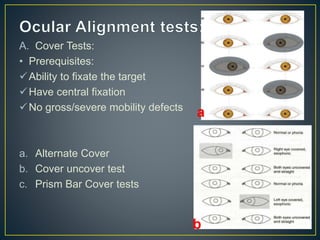
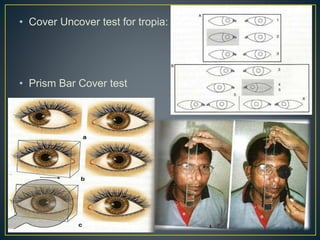
A. Cover Tests:
• Prerequisites:
Ability to fixate the target
Have central fixation
No gross/severe mobility defects
a. Alternate Cover
b. Cover uncover test
c. Prism Bar Cover tests
a
b
• Cover Uncover test for tropia:
• Prism Bar Cover test
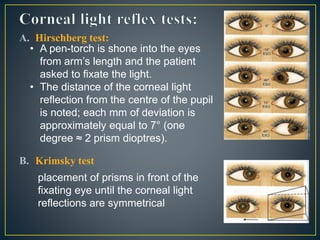
A. Hirschberg test:
B. Krimsky test
• A pen-torch is shone into the eyes
from arm’s length and the patient
asked to fixate the light.
• The distance of the corneal light
reflection from the centre of the pupil
is noted; each mm of deviation is
approximately equal to 7° (one
degree ≈ 2 prism dioptres).
placement of prisms in front of the
fixating eye until the corneal light
reflections are symmetrical
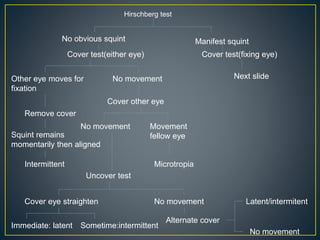
Hirschberg test
No obvious squint Manifest squint
Cover test(either eye) Cover test(fixing eye)
Other eye moves for
fixation
No movement
Remove cover
Squint remains
momentarily then aligned
Intermittent
Cover other eye
No movement Movement
fellow eye
Uncover test
Cover eye straighten No movement
Immediate: latent Sometime:intermittent
Alternate cover
Latent/intermitent
No movement
Microtropia
Next slide
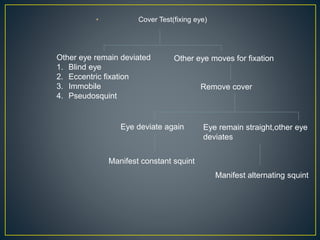
• Cover Test(fixing eye)
Other eye remain deviated
1. Blind eye
2. Eccentric fixation
3. Immobile
4. Pseudosquint
Other eye moves for fixation
Remove cover
Eye deviate again Eye remain straight,other eye
deviates
Manifest constant squint
Manifest alternating squint
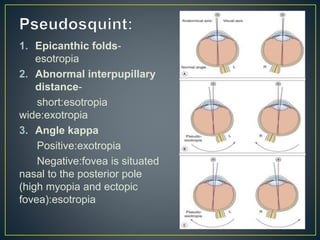
1. Epicanthic folds-
esotropia
2. Abnormal interpupillary
distance-
short:esotropia
wide:exotropia
3. Angle kappa
Positive:exotropia
Negative:fovea is situated
nasal to the posterior pole
(high myopia and ectopic
fovea):esotropia
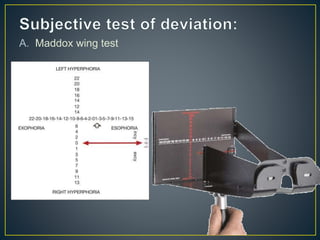
A. Maddox wing test
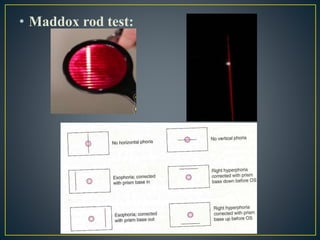
• Maddox rod test:
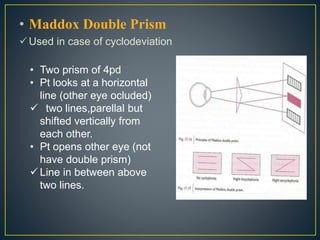
• Maddox Double Prism
Used in case of cyclodeviation
• Two prism of 4pd
• Pt looks at a horizontal
line (other eye ocluded)
 two lines,parellal but
shifted vertically from
each other.
• Pt opens other eye (not
have double prism)
 Line in between above
two lines.
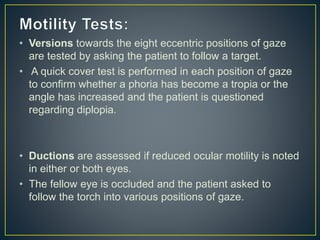
• Versions towards the eight eccentric positions of gaze
are tested by asking the patient to follow a target.
• A quick cover test is performed in each position of gaze
to confirm whether a phoria has become a tropia or the
angle has increased and the patient is questioned
regarding diplopia.
• Ductions are assessed if reduced ocular motility is noted
in either or both eyes.
• The fellow eye is occluded and the patient asked to
follow the torch into various positions of gaze.
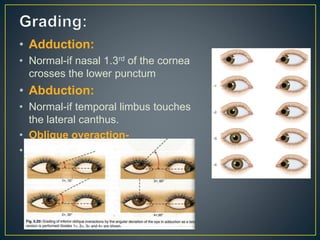
• Adduction:
• Normal-if nasal 1.3rd of the cornea
crosses the lower punctum
• Abduction:
• Normal-if temporal limbus touches
the lateral canthus.
• Oblique overaction-
• Angle of adducting eye makes
with horizontal line as it
elevates,abducts on lateral
version to opposite side.
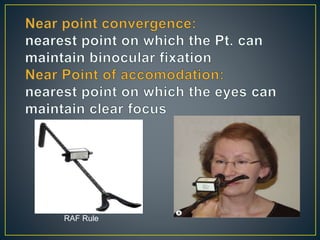
RAF Rule
• It determines the capability of the motor system to cope
with an induced misalignment of visual axes.If it is
large,even a large angle squint remains latent.
• They may be tested with prisms bars or the
synoptophore.
• An increasingly strong prism is placed in front of one
eye, which will then abduct or adduct (depending on
whether the prism is base-in or base-out), in order to
maintain bifoveal fixation. When a prism greater than the
fusional amplitude is reached, diplopia is reported or one
eye drifts the other way, indicating the limit of vergence
ability.
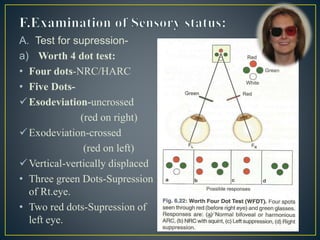
A. Test for supression-
a) Worth 4 dot test:
• Four dots-NRC/HARC
• Five Dots-
Esodeviation-uncrossed
(red on right)
Exodeviation-crossed
(red on left)
Vertical-vertically displaced
• Three green Dots-Supression
of Rt.eye.
• Two red dots-Supression of
left eye.
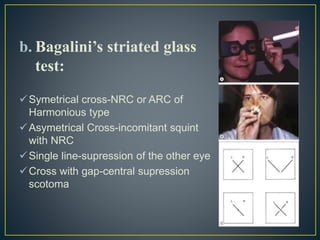
b. Bagalini’s striated glass
test:
Symetrical cross-NRC or ARC of
Harmonious type
Asymetrical Cross-incomitant squint
with NRC
Single line-supression of the other eye
Cross with gap-central supression
scotoma
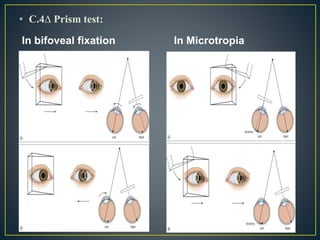
• C.4∆ Prism test:
In bifoveal fixation In Microtropia
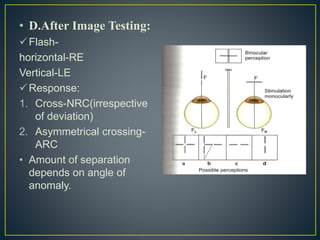
• D.After Image Testing:
Flash-
horizontal-RE
Vertical-LE
Response:
1. Cross-NRC(irrespective
of deviation)
2. Asymmetrical crossing-
ARC
• Amount of separation
depends on angle of
anomaly.
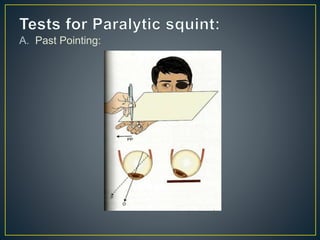
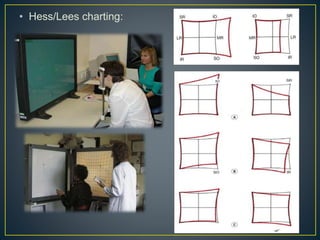
A. Past Pointing:
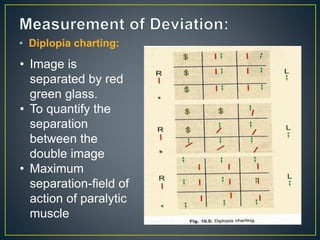
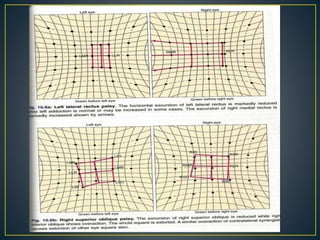
• Diplopia charting:
• Image is
separated by red
green glass.
• To quantify the
separation
between the
double image
• Maximum
separation-field of
action of paralytic
muscle
• Hess/Lees charting:
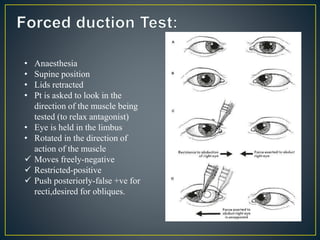
• Anaesthesia
• Supine position
• Lids retracted
• Pt is asked to look in the
direction of the muscle being
tested (to relax antagonist)
• Eye is held in the limbus
• Rotated in the direction of
action of the muscle
 Moves freely-negative
 Restricted-positive
 Push posteriorly-false +ve for
recti,desired for obliques.
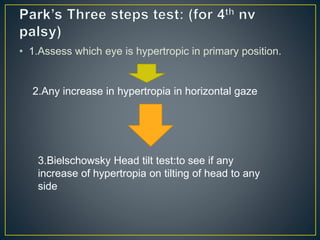
• 1.Assess which eye is hypertropic in primary position.
2.Any increase in hypertropia in horizontal gaze
3.Bielschowsky Head tilt test:to see if any
increase of hypertropia on tilting of head to any
side
Strabismus-Clinical Examinations

Strabismus-Clinical Examinations

  • 1.
  • 2.
    • It isa condition in which the visual axis of the two eyes does not meet at the point of regard. • Greek word-”strabos”:crooked • PHORIA:latent visual axis deviation,held in check by fusion. • TROPIA:a manifest visual axis deviation. • Intermittent Tropia:deviation may exist in only certain gaze positions or target distance.
  • 3.
    • Visual axis(line of vision) : extending from the point of fixation to the fovea. • Anatomical (Pupillary) axis:is a line passing from the posterior pole through the centre of the cornea . • Angle kappa : is the angle subtended by the visual and anatomical axes . +5˚ exotropic.
  • 4.
  • 5.
    • Uniocularly-Duction • Binocularly-Version.-Samedirection • Opposite direction-Vergence • Adduction-nasally horizontal • Abduction-temporally horizontal • Sursumduction or elevation-upward • Deorsumduction or depression-downward • Incycloduction • Excycloduction
  • 6.
    Yoke muscles For coordinated eye movements one muscle of the each eye act togather.These are called yoke muscle. • Hering’s law,for a binocular movement the corresponding muscle (yoked) receive equal and simultaneous innervation. • Sherington’s law of reciprocal innervation,for any binocular movement the direct antagonist receives an equal and simultaneous inhibition of its innervation.
  • 7.
    • Definition: It isthe state of simultaneous vision with two seeing eyes that occurs when a person fixes his visual attention on an object of regard.
  • 9.
    • Simultaneous perception •Fusion • Stereopsis Ability to fuse points outside corresponding retinal area Ability to fuse image projected in corresponding retinal pints Ability of perception of depth
  • 10.
    • Confusion- due todifferent image viewed by two fovea Immediately checked by cortical or retinal rivalry mechanism. • Diplopia- one object is perceived by one of the fovea of one eye and other object is perceived by extrafoveal point of the other eye which has a different localization value in space. Binocular diplopia-single image on closing one eye Monocular diplopia-in astigmatism,neurological conditions Uncrossed diplopia-esodeviation Crossed diplopia-exodeviation
  • 11.
    • Motor Adaptation: 1.Fusion • Beyond fusional reserve-asthenopia 1. Head postures • Chin elevation or depression • Face turn • Head tilt 3. Blind spot mechanism: esotropia of 15˚,other image falls On blind spot-no diplopia.
  • 12.
    • Sensory Adaptation: •Supression: Confusion is takled by foveal rivalry which is actually a suppression. extrafoveal image suppression is readily occurs if the visual potential of the extrafoveal point is poor. Facultative Obligatory • Anomalous Retinal Correspondence: It is the binocular functional adaptation to strabismus at the cortical level.The fovea of the fixing eye develops a correspondence (binocular relationship) with an extrafoveal point of the other eye.
  • 13.
    • orthophoria ;perfect alignment of the visual axes. Most individuals have heterophoria. • Hypophoria/hypertropia; latent/manifest squint downwards turning of eyes • Hyperphoria/hypertropia; latent/manifest squint upwards turning of eyes • Exophoria; latent squint outwards turning of the eyes • Exotropia; manifest squint outwards turning of the eyes • Esophoria; latent squint inwards turning of the eyes • Esotropia; manifest squint inwards turning of the eyes
  • 14.
    Strabismus Concomitant:deviation same inall gaze Incomitant:inequal deviation Horizontal 1. Esotropia 2. Exotropia Vertical 1. Hypertropia 2. Hypotropia Torsional 1. Incyclotropia 2. Excyclotropia Underaction Overaction Restrictive Paralytic Neurogenic 1. Supraneuclear 2. Infraneuclear 3. Neuclear Myogenic
  • 15.
    INCOMITANT CONCOMITANT Age Lateearly Magnitude of squint Varies with eye position Same in all gazes Diplopia Present Usually absent Onset Sudden Gradual Precipitating event Head injury Rare Head posture Present Absent Secondary deviation >primary =primary Ocular movement Restricted Full False projection Present Absent Mechanism Defect in efferent pathway Defect in afferent path Or central mechanism Sensory adaptation Rare frequent Cyclotropia Usually present Absent (expt A,V patterns)
  • 16.
    • History: H/O presentillness- • Age of onset • Duration of the squint • Chief Complaints: • Symptoms- • Asthenopia: • Uniocular • Binocular • Onset: • Recent onset squint manifested with • Diplopia • Past pointing • Vertigo • Prostration
  • 17.
    • Diplopia: • Diplopiamay not be complained of in case of adoption of head posture • Or,when sensory adaptation occurs. • Decompensation of pre existing heterophoria- diplopia of intermittent onset. • Recent onset acquired squint-sudden onset diplopia. • Type of diplopia-horizontal,cyclovertical • Direction of gaze in which it predominant • Whatever BSV is retained
  • 18.
    Cosmetic defects: • Whetherthe defect is Intermittent or constant • Whether unilateral or alternating • Head Posture. Precipitating factor:like injury,illness,shock. Past medical history • Developmental history (children with cerebral palsy) • H/O glass- Regularity of use Power of the glass Proper cycloplegia for correction for his age. • Use of prisms/convergence exercise/occlusion • Surgery for squint One or both eye Which muscle How much What Sx.
  • 19.
    Birth History • Antenatalhistory-drugs taken/illness during pregnancy • Gestational age & birth weight at delivery • Type and length/problem during labour. Family history
  • 20.
    A. Visual Acuity: a)In Preverbal Children- • Fixation and following • Comparison between behavior of the two eyes. • Fixation Behavior • 10∆ test • Rotation test • Preferential looking a) Teller Acuity cards b) Cardiff Acuity cards • VEP
  • 21.
    b) Verbal children: •2 years:picture naming (crowded Kay picture) • • 3 years:matching the letter optotypes (Keelaer logMar)
  • 22.
    • B.Refraction • C.Examinationof Anterior and Posterior chamber  Lid problems,ptosis,media opacities  Pupillary reflexes  Fundus
  • 23.
    1. Synoptophore 2. TNOtest:480-15 sec of arc 3. Frisby:600-15 sec of arc 4. Lang:200-1200 sec of arc
  • 25.
    1. Head posture: •To be noted when pt is unconcious about it. • Eye is out of the field of action. 2. Ocular Deviation • By ordinary mm scale • Synoptophore • What to see?  Direction  Frequency  Magnitude  Comitancy  Laterality  AC/A ratio
  • 26.
    A. Cover Tests: •Prerequisites: Ability to fixate the target Have central fixation No gross/severe mobility defects a. Alternate Cover b. Cover uncover test c. Prism Bar Cover tests a b
  • 27.
    • Cover Uncovertest for tropia: • Prism Bar Cover test
  • 28.
    A. Hirschberg test: B.Krimsky test • A pen-torch is shone into the eyes from arm’s length and the patient asked to fixate the light. • The distance of the corneal light reflection from the centre of the pupil is noted; each mm of deviation is approximately equal to 7° (one degree ≈ 2 prism dioptres). placement of prisms in front of the fixating eye until the corneal light reflections are symmetrical
  • 29.
    Hirschberg test No obvioussquint Manifest squint Cover test(either eye) Cover test(fixing eye) Other eye moves for fixation No movement Remove cover Squint remains momentarily then aligned Intermittent Cover other eye No movement Movement fellow eye Uncover test Cover eye straighten No movement Immediate: latent Sometime:intermittent Alternate cover Latent/intermitent No movement Microtropia Next slide
  • 30.
    • Cover Test(fixingeye) Other eye remain deviated 1. Blind eye 2. Eccentric fixation 3. Immobile 4. Pseudosquint Other eye moves for fixation Remove cover Eye deviate again Eye remain straight,other eye deviates Manifest constant squint Manifest alternating squint
  • 31.
    1. Epicanthic folds- esotropia 2.Abnormal interpupillary distance- short:esotropia wide:exotropia 3. Angle kappa Positive:exotropia Negative:fovea is situated nasal to the posterior pole (high myopia and ectopic fovea):esotropia
  • 32.
  • 33.
  • 34.
    • Maddox DoublePrism Used in case of cyclodeviation • Two prism of 4pd • Pt looks at a horizontal line (other eye ocluded)  two lines,parellal but shifted vertically from each other. • Pt opens other eye (not have double prism)  Line in between above two lines.
  • 35.
    • Versions towardsthe eight eccentric positions of gaze are tested by asking the patient to follow a target. • A quick cover test is performed in each position of gaze to confirm whether a phoria has become a tropia or the angle has increased and the patient is questioned regarding diplopia. • Ductions are assessed if reduced ocular motility is noted in either or both eyes. • The fellow eye is occluded and the patient asked to follow the torch into various positions of gaze.
  • 36.
    • Adduction: • Normal-ifnasal 1.3rd of the cornea crosses the lower punctum • Abduction: • Normal-if temporal limbus touches the lateral canthus. • Oblique overaction- • Angle of adducting eye makes with horizontal line as it elevates,abducts on lateral version to opposite side.
  • 37.
  • 38.
    • It determinesthe capability of the motor system to cope with an induced misalignment of visual axes.If it is large,even a large angle squint remains latent. • They may be tested with prisms bars or the synoptophore. • An increasingly strong prism is placed in front of one eye, which will then abduct or adduct (depending on whether the prism is base-in or base-out), in order to maintain bifoveal fixation. When a prism greater than the fusional amplitude is reached, diplopia is reported or one eye drifts the other way, indicating the limit of vergence ability.
  • 39.
    A. Test forsupression- a) Worth 4 dot test: • Four dots-NRC/HARC • Five Dots- Esodeviation-uncrossed (red on right) Exodeviation-crossed (red on left) Vertical-vertically displaced • Three green Dots-Supression of Rt.eye. • Two red dots-Supression of left eye.
  • 40.
    b. Bagalini’s striatedglass test: Symetrical cross-NRC or ARC of Harmonious type Asymetrical Cross-incomitant squint with NRC Single line-supression of the other eye Cross with gap-central supression scotoma
  • 41.
    • C.4∆ Prismtest: In bifoveal fixation In Microtropia
  • 42.
    • D.After ImageTesting: Flash- horizontal-RE Vertical-LE Response: 1. Cross-NRC(irrespective of deviation) 2. Asymmetrical crossing- ARC • Amount of separation depends on angle of anomaly.
  • 43.
  • 44.
    • Diplopia charting: •Image is separated by red green glass. • To quantify the separation between the double image • Maximum separation-field of action of paralytic muscle
  • 45.
  • 47.
    • Anaesthesia • Supineposition • Lids retracted • Pt is asked to look in the direction of the muscle being tested (to relax antagonist) • Eye is held in the limbus • Rotated in the direction of action of the muscle  Moves freely-negative  Restricted-positive  Push posteriorly-false +ve for recti,desired for obliques.
  • 48.
    • 1.Assess whicheye is hypertropic in primary position. 2.Any increase in hypertropia in horizontal gaze 3.Bielschowsky Head tilt test:to see if any increase of hypertropia on tilting of head to any side

Editor's Notes