LOW VISION AIDS
By
Capt Ayinun Nahar
Dept of Ophthalmology
Armed Forces Medical Institute
Definition
“A person with low vision is one who has
impairment of visual functioning even after
treatment, and/ or standard refractive correction,
and has a visual acuity of less than 6/18 to light
perception or a visual field of less than 10 degrees
from the point of fixation, but who uses, or is
potentially able to use, vision for the planning
and/or execution of a task .”
(WHO/PBL/93.27)
Definition
“A person with low vision is one who suffers visual
acuity between 6/18 to 3/60 in the better eye after
the best possible correction or a field of vision
between 20 to 30 degrees.”
(WHO : ICD-10 definition)
Visual dysfunctions
 Disorder
 Impairment
 Disability
 Handicaped
Visual dysfunctions
• Visual disorder
Deviation from normal visual structure by disease, injury
or anomaly affecting vision
• Visual impairment
Reduction of visual function results from the visual
disorder
Visual dysfunctions
• Visual disability
Reduced ability to perform a certain task
• Visual handicap
Non-performance of the tasks related to individual and
social expectation because of visual disability
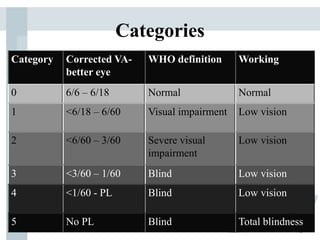
Categories
Category Corrected VA-
better eye
WHO definition Working
0 6/6 – 6/18 Normal Normal
1 <6/18 – 6/60 Visual impairment Low vision
2 <6/60 – 3/60 Severe visual
impairment
Low vision
3 <3/60 – 1/60 Blind Low vision
4 <1/60 - PL Blind Low vision
5 No PL Blind Total blindness
Low vision Aids
An optical/non-optical device that improves or
enhances residual vision by magnifying the image of
the object at the retinal level.
Basic principle of LVA
Optical LVAs are based on the fact that with
sufficient magnification, the normal retina
surrounding the damaged central retina can be used
for central vision.
Types of magnification
Low vision aids make use of angular magnifications by :
– Relative size
– Relative distance
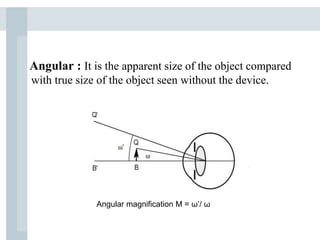
Angular : It is the apparent size of the object compared
with true size of the object seen without the device.
Angular magnification M = ω’/ ω
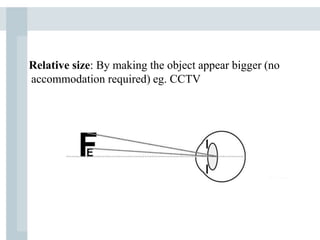
Relative size: By making the object appear bigger (no
accommodation required) eg. CCTV
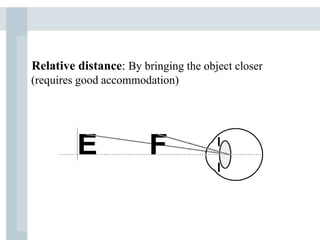
Relative distance: By bringing the object closer
(requires good accommodation)
Indication
Children :
• Albinism
• ROP
• Congenital malformation
• Optic neuropathy
Yound Adult :
• Keratoconus
• Ocular injuries
• Late menifestation of congenital
malformation
Indication
Old age :
• Glaucoma
• ARMD
• Diabetic maculopathy
• Macular degeneration
• Retinal degeneration
• Chorioretinitis
• Optic atrophy
• Myopic degeneration
Types of LVA
• Optical devices
• Non-optical devices
Optical LVA :
• Magnifying spectacles
• Hand magnifiers
• Stand magnifiers
• Telescopes
• Intraocular low vision aids
• Other optical devices
Non-optical devices :
• Approach magnification
• Lighting
• Contrast enhancement
• Increased size object
• Electronic magnifiers ( CCTV, LVIS, V-max)
• Writing and communication devices
• Orientation and mobility LVAs
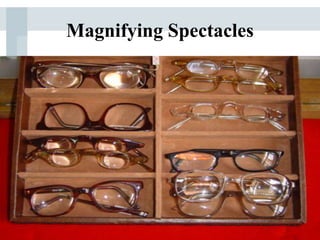
Magnifying Spectacles
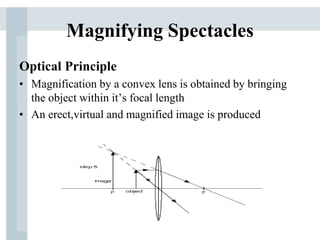
Optical Principle
• Magnification by a convex lens is obtained by bringing
the object within it’s focal length
• An erect,virtual and magnified image is produced
Magnifying Spectacles
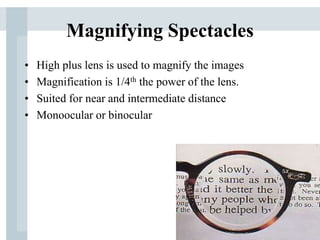
• High plus lens is used to magnify the images
• Magnification is 1/4th the power of the lens.
• Suited for near and intermediate distance
• Monoocular or binocular
Magnifying Spectacles
Advantages :
• Hands are free
• Field of view larger when compared to telescope
• Simultaneous near and intermediate vision
• Can be given in both monocular and binocular forms
• More portable
• Cosmetically acceptable
Magnifying Spectacles
Disadvantages:
• Spherical aberration
• Higher the power, closer the reading distance
• Close reading distance causes fatigue and
unacceptable posture
• Patients with eccentric fixation are unable to fix
through these glasses
• Illumination problem
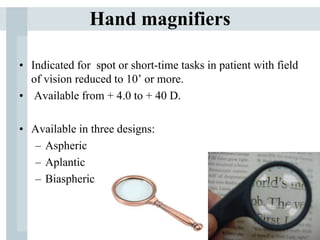
Hand magnifiers
• Indicated for spot or short-time tasks in patient with field
of vision reduced to 10’ or more.
• Available from + 4.0 to + 40 D.
• Available in three designs:
– Aspheric
– Aplantic
– Biaspheric
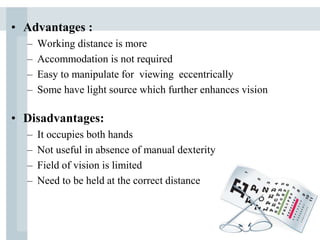
• Advantages :
– Working distance is more
– Accommodation is not required
– Easy to manipulate for viewing eccentrically
– Some have light source which further enhances vision
• Disadvantages:
– It occupies both hands
– Not useful in absence of manual dexterity
– Field of vision is limited
– Need to be held at the correct distance
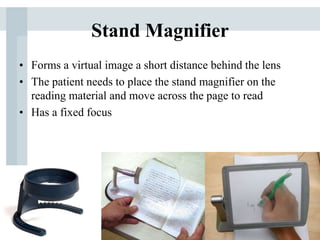
Stand Magnifier
• Forms a virtual image a short distance behind the lens
• The patient needs to place the stand magnifier on the
reading material and move across the page to read
• Has a fixed focus
• Advantages :
– Technically simple
– They are a choice for patients with tremors, arthritis
and constricted visual fields.
• Disadvantage :
– Small field of vision
– Too close reading posture is uncomfortable for the
patient
– Difficult to use if the surface is not flat
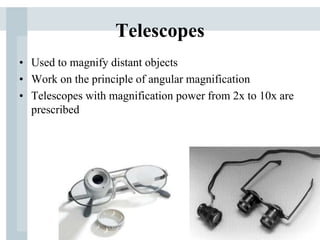
Telescopes
• Used to magnify distant objects
• Work on the principle of angular magnification
• Telescopes with magnification power from 2x to 10x are
prescribed
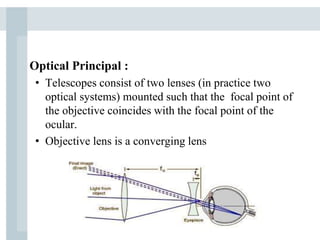
Optical Principal :
• Telescopes consist of two lenses (in practice two
optical systems) mounted such that the focal point of
the objective coincides with the focal point of the
ocular.
• Objective lens is a converging lens
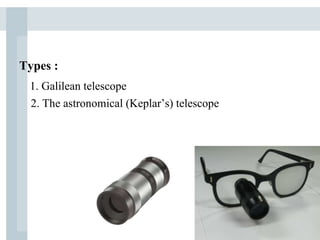
Types :
1. Galilean telescope
2. The astronomical (Keplar’s) telescope
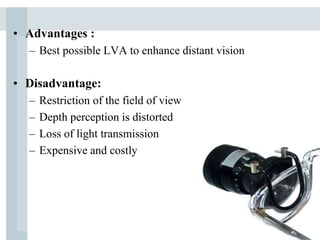
• Advantages :
– Best possible LVA to enhance distant vision
• Disadvantage:
– Restriction of the field of view
– Depth perception is distorted
– Loss of light transmission
– Expensive and costly
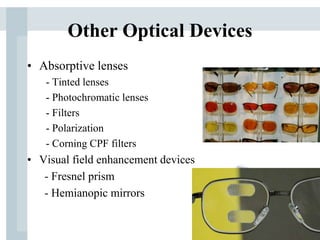
Other Optical Devices
• Absorptive lenses
- Tinted lenses
- Photochromatic lenses
- Filters
- Polarization
- Corning CPF filters
• Visual field enhancement devices
- Fresnel prism
- Hemianopic mirrors
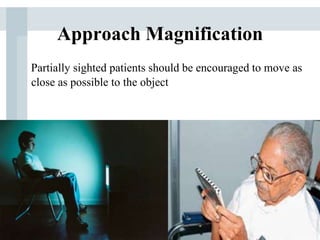
Approach Magnification
Partially sighted patients should be encouraged to move as
close as possible to the object
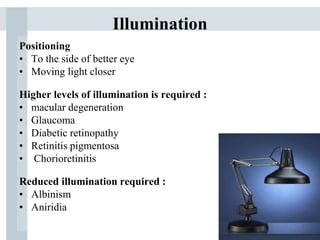
Illumination
Positioning
• To the side of better eye
• Moving light closer
Higher levels of illumination is required :
• macular degeneration
• Glaucoma
• Diabetic retinopathy
• Retinitis pigmentosa
• Chorioretinitis
Reduced illumination required :
• Albinism
• Aniridia
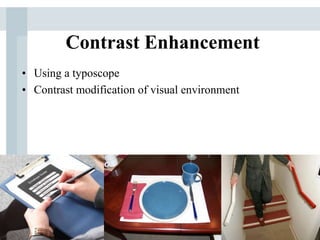
Contrast Enhancement
• Using a typoscope
• Contrast modification of visual environment
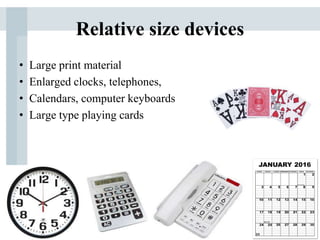
Relative size devices
• Large print material
• Enlarged clocks, telephones,
• Calendars, computer keyboards
• Large type playing cards
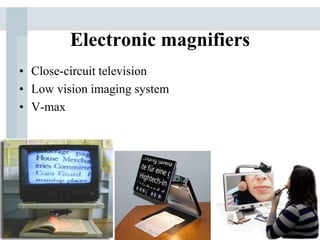
Electronic magnifiers
• Close-circuit television
• Low vision imaging system
• V-max
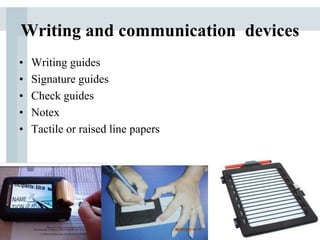
Writing and communication devices
• Writing guides
• Signature guides
• Check guides
• Notex
• Tactile or raised line papers
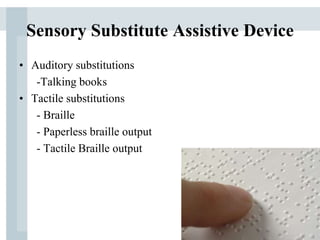
Sensory Substitute Assistive Device
• Auditory substitutions
-Talking books
• Tactile substitutions
- Braille
- Paperless braille output
- Tactile Braille output
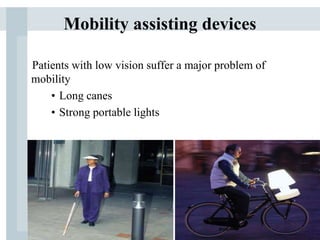
Mobility assisting devices
Patients with low vision suffer a major problem of
mobility
• Long canes
• Strong portable lights
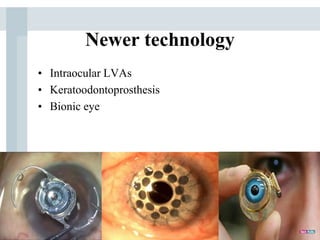
Newer technology
• Intraocular LVAs
• Keratoodontoprosthesis
• Bionic eye
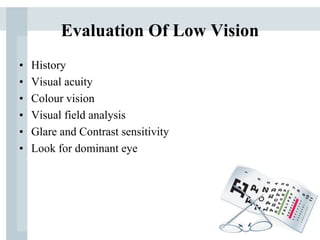
Evaluation Of Low Vision
• History
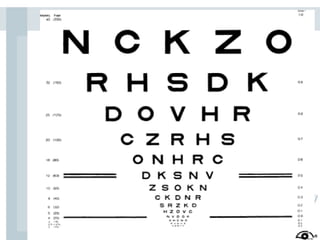
• Visual acuity
• Colour vision
• Visual field analysis
• Glare and Contrast sensitivity
• Look for dominant eye
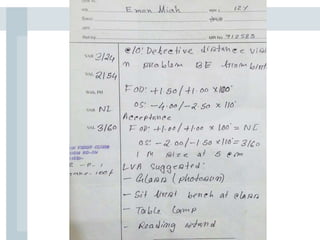
Prescribing LVAs
• Aim
• Simple, lightweight, portable and flexible
• Patient’s visual and mental status, needs, and motivation
• Working distance and field of vision decrese with an increased
magnification
• All the devices should be tried
• Both eyes should be corrected
• Careful consideration of children, old age and single eyed
person
Conclusion
THANK YOU
Low Vision Aids

Low Vision Aids

  • 1.
    LOW VISION AIDS By CaptAyinun Nahar Dept of Ophthalmology Armed Forces Medical Institute
  • 2.
    Definition “A person withlow vision is one who has impairment of visual functioning even after treatment, and/ or standard refractive correction, and has a visual acuity of less than 6/18 to light perception or a visual field of less than 10 degrees from the point of fixation, but who uses, or is potentially able to use, vision for the planning and/or execution of a task .” (WHO/PBL/93.27)
  • 3.
    Definition “A person withlow vision is one who suffers visual acuity between 6/18 to 3/60 in the better eye after the best possible correction or a field of vision between 20 to 30 degrees.” (WHO : ICD-10 definition)
  • 4.
    Visual dysfunctions  Disorder Impairment  Disability  Handicaped
  • 5.
    Visual dysfunctions • Visualdisorder Deviation from normal visual structure by disease, injury or anomaly affecting vision • Visual impairment Reduction of visual function results from the visual disorder
  • 6.
    Visual dysfunctions • Visualdisability Reduced ability to perform a certain task • Visual handicap Non-performance of the tasks related to individual and social expectation because of visual disability
  • 7.
    Categories Category Corrected VA- bettereye WHO definition Working 0 6/6 – 6/18 Normal Normal 1 <6/18 – 6/60 Visual impairment Low vision 2 <6/60 – 3/60 Severe visual impairment Low vision 3 <3/60 – 1/60 Blind Low vision 4 <1/60 - PL Blind Low vision 5 No PL Blind Total blindness
  • 8.
    Low vision Aids Anoptical/non-optical device that improves or enhances residual vision by magnifying the image of the object at the retinal level.
  • 9.
    Basic principle ofLVA Optical LVAs are based on the fact that with sufficient magnification, the normal retina surrounding the damaged central retina can be used for central vision.
  • 10.
    Types of magnification Lowvision aids make use of angular magnifications by : – Relative size – Relative distance
  • 11.
    Angular : Itis the apparent size of the object compared with true size of the object seen without the device. Angular magnification M = ω’/ ω
  • 12.
    Relative size: Bymaking the object appear bigger (no accommodation required) eg. CCTV
  • 13.
    Relative distance: Bybringing the object closer (requires good accommodation)
  • 14.
    Indication Children : • Albinism •ROP • Congenital malformation • Optic neuropathy Yound Adult : • Keratoconus • Ocular injuries • Late menifestation of congenital malformation
  • 15.
    Indication Old age : •Glaucoma • ARMD • Diabetic maculopathy • Macular degeneration • Retinal degeneration • Chorioretinitis • Optic atrophy • Myopic degeneration
  • 16.
    Types of LVA •Optical devices • Non-optical devices
  • 17.
    Optical LVA : •Magnifying spectacles • Hand magnifiers • Stand magnifiers • Telescopes • Intraocular low vision aids • Other optical devices
  • 18.
    Non-optical devices : •Approach magnification • Lighting • Contrast enhancement • Increased size object • Electronic magnifiers ( CCTV, LVIS, V-max) • Writing and communication devices • Orientation and mobility LVAs
  • 19.
  • 20.
    Magnifying Spectacles Optical Principle •Magnification by a convex lens is obtained by bringing the object within it’s focal length • An erect,virtual and magnified image is produced
  • 21.
    Magnifying Spectacles • Highplus lens is used to magnify the images • Magnification is 1/4th the power of the lens. • Suited for near and intermediate distance • Monoocular or binocular
  • 22.
    Magnifying Spectacles Advantages : •Hands are free • Field of view larger when compared to telescope • Simultaneous near and intermediate vision • Can be given in both monocular and binocular forms • More portable • Cosmetically acceptable
  • 23.
    Magnifying Spectacles Disadvantages: • Sphericalaberration • Higher the power, closer the reading distance • Close reading distance causes fatigue and unacceptable posture • Patients with eccentric fixation are unable to fix through these glasses • Illumination problem
  • 24.
    Hand magnifiers • Indicatedfor spot or short-time tasks in patient with field of vision reduced to 10’ or more. • Available from + 4.0 to + 40 D. • Available in three designs: – Aspheric – Aplantic – Biaspheric
  • 25.
    • Advantages : –Working distance is more – Accommodation is not required – Easy to manipulate for viewing eccentrically – Some have light source which further enhances vision • Disadvantages: – It occupies both hands – Not useful in absence of manual dexterity – Field of vision is limited – Need to be held at the correct distance
  • 26.
    Stand Magnifier • Formsa virtual image a short distance behind the lens • The patient needs to place the stand magnifier on the reading material and move across the page to read • Has a fixed focus
  • 27.
    • Advantages : –Technically simple – They are a choice for patients with tremors, arthritis and constricted visual fields. • Disadvantage : – Small field of vision – Too close reading posture is uncomfortable for the patient – Difficult to use if the surface is not flat
  • 28.
    Telescopes • Used tomagnify distant objects • Work on the principle of angular magnification • Telescopes with magnification power from 2x to 10x are prescribed
  • 29.
    Optical Principal : •Telescopes consist of two lenses (in practice two optical systems) mounted such that the focal point of the objective coincides with the focal point of the ocular. • Objective lens is a converging lens
  • 30.
    Types : 1. Galileantelescope 2. The astronomical (Keplar’s) telescope
  • 31.
    • Advantages : –Best possible LVA to enhance distant vision • Disadvantage: – Restriction of the field of view – Depth perception is distorted – Loss of light transmission – Expensive and costly
  • 32.
    Other Optical Devices •Absorptive lenses - Tinted lenses - Photochromatic lenses - Filters - Polarization - Corning CPF filters • Visual field enhancement devices - Fresnel prism - Hemianopic mirrors
  • 33.
    Approach Magnification Partially sightedpatients should be encouraged to move as close as possible to the object
  • 34.
    Illumination Positioning • To theside of better eye • Moving light closer Higher levels of illumination is required : • macular degeneration • Glaucoma • Diabetic retinopathy • Retinitis pigmentosa • Chorioretinitis Reduced illumination required : • Albinism • Aniridia
  • 35.
    Contrast Enhancement • Usinga typoscope • Contrast modification of visual environment
  • 36.
    Relative size devices •Large print material • Enlarged clocks, telephones, • Calendars, computer keyboards • Large type playing cards
  • 37.
    Electronic magnifiers • Close-circuittelevision • Low vision imaging system • V-max
  • 38.
    Writing and communicationdevices • Writing guides • Signature guides • Check guides • Notex • Tactile or raised line papers
  • 39.
    Sensory Substitute AssistiveDevice • Auditory substitutions -Talking books • Tactile substitutions - Braille - Paperless braille output - Tactile Braille output
  • 40.
    Mobility assisting devices Patientswith low vision suffer a major problem of mobility • Long canes • Strong portable lights
  • 41.
    Newer technology • IntraocularLVAs • Keratoodontoprosthesis • Bionic eye
  • 42.
    Evaluation Of LowVision • History • Visual acuity • Colour vision • Visual field analysis • Glare and Contrast sensitivity • Look for dominant eye
  • 44.
    Prescribing LVAs • Aim •Simple, lightweight, portable and flexible • Patient’s visual and mental status, needs, and motivation • Working distance and field of vision decrese with an increased magnification • All the devices should be tried • Both eyes should be corrected • Careful consideration of children, old age and single eyed person
  • 48.
  • 49.

Editor's Notes

  • #21 Relative distance magnification
  • #22 Reading distance is calculated by 100 divided by add
  • #25 Most patient accept 8,12, 16 or 10 D depending upon the task and degree of impairment. Most patients accept upto 6x magnification
  • #32 Field of view decreases with magnification
  • #33  lenses of large aperture and short focal length
  • #35 Lost cone functions (
  • #36 Masking device with a line cut out from an opaque, non reflecting black plastic or thick paper.
  • #37 Larger object subtends a larger visual angle at the eye and is thus easier to resolve
  • #38 CCTV has control for brightness, contrast and change of polarity LVIs- autofocal camera,magnification optics,contrast enhancement electronics…. V-max – color camera,liquid crystal display
  • #41 Bloom portable light
  • #42  removal of a tooth from the patient or a donor.[2] After removal, a lamina of tissue cut from the tooth is drilled and the hole is fitted with optics. The lamina is grown in the patients' cheek for a period of months and then is implanted upon the eye. Trachome,Chemival burn, Graft failure, stephen johnson syndrome.
  • #43 Peripheral field: using Humphery or octopus perimetry,Central field: using Amsler grid dominant eye by testing contrast sensitivity monocularly and binocularly
  • #44 Beily lovie logmar distant acuity and reading chart Left column metric notation . Vision is distance divided by this. Next column gives the snellens equivalence Right column log units