Dr Md Ferdous Islam
Dept of Ophthalmolgy
CMH,Dhaka
PRIMARY
ANGLE
CLOSURE
GLAUCOMA
Angle Closure
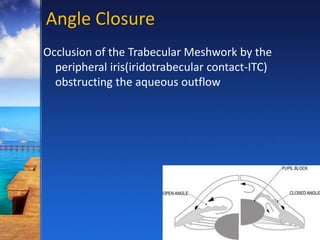
Occlusion of the Trabecular Meshwork by the
peripheral iris(iridotrabecular contact-ITC)
obstructing the aqueous outflow
Stages In Natural History
1 Primary angle-closure suspect (PACS)
• Gonioscopy shows posterior meshwork ITC in
three or more quadrants but no PAS
• Normal IOP, optic disc and visual field
2 Primary angle-closure (PAC)
• Gonioscopy shows three or more quadrants of
ITC with raised IOP and/or PAS, or excessive
pigment smudging on the TM
• Normal optic disc and field
3 Primary angle-closure glaucoma (PACG)
• Gonioscopy shows ITC in three or more
quadrants
• Optic neuropathy
Risk Factors
• Positive family history for angle closure
• Age : relative pupillary block 60 yrs or over. Younger
for non pupillary block
• Women
• History of Angle closure symptoms
• Hypermetropia
• Axial length
• Racial group Indian Asians & Far Eastern
Mechanism
Relative Pupillary Block
• Failure of aqueous flow through the mid dilated
pupil leads to a pressure differential between the
anterior and posterior chambers, with resultant
anterior bowing of the lax iris [Iris bombe] blocks
trabecular meshwork and iridolenticular contact
Non-pupillary block
• Specific anatomical factors include plateau iris
(anteriorly positioned ciliary processes), and a
thicker or more anteriorly-positioned iris
• Plateau iris configuration is characterized by a flat
central iris plane in association with normal central
anterior chamber depth. The angle recess is very
narrow, with a sharp iris angulation over anteriorly
positioned and/or orientated ciliary processes
• Plateau iris syndrome describes the occurrence of
angle-closure despite a patent iridotomy in a
patient with morphological plateau iris
• Lens induced angle closure
• Retrolenticular
• Combined mechanism
• Reduced aqueous outflow
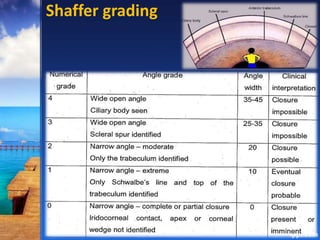
Shaffer grading
Ocular Manifestations
• Symptoms
Decreased vision
Halos around lights
Frontal headache
Ocular pain
Nausea and vomiting
Precipitating factors
Watching TV in a dark room
Pharmacological Mydriasis
Sympathetic agonist (Inhalers)
Signs
APAC
Elevated IOP risen rapidly
Conjunctival congestion
Corneal epithelial /stromal edema
Shallow or flat peripheral AC
Mid dilated [vertical oval] pupil
Absent /sluggish pupil reaction
Fellow eye generally shows an occludable angle
Subacute Angle Closure
Resolved APAC
• Folds in Descemet membrane (if IOP has been
reduced rapidly), optic nerve head congestion and
choroidal folds.
• Later iris atrophy [spiral-like configuration],
irregular pupil, posterior synechiae and
glaukomflecken
• Iris torsion
Chronic Presentation
• ‘Creeping’ angle-closure [gradual band-like anterior
advance of the apparent insertion of the iris].
From deepest part of the angle and spreads
circumferentially
• Episodic (intermittent) ITC is associated with the
formation of discrete PAS, individual lesions having
a pyramidal (‘saw-tooth’) appearance
• Disc cupping /nerve fibre defects with or without
visual field defect
Sequence Of Events
• Acute angle closure
sudden ,circumferential , iridotrabecular
apposition-rapid severe rise in IOP
• Intermittent angle closure
Self limiting episodes of ITC ,milder signs &
symptoms of former
• Creeping angle closure
slowly progressive ITC –Elevated IOP
• Chronic angle closure
irreversible , iridotrabecular adhesion
,asymptomatic unless significant raised IOP
Investigations
1. Anterior segment OCT
2. Anterior chamber depth measurement
3. Posterior segment USG
4. Provocative tests
Pharmacological test
 pupillary block mechanism in mid dilated state ,increased
tension of iris .
 Performed with short acting mydriatic [phenylephrine eye
drops]
if test proves positive –acute attack may be triggered
Dark room prone test
pupil dilates in dark,lens moves forwards in prone.
- Patient sits for 30 minutes in dark with head
prone ,no sleeping
- IOP checked rapidly ,positive if increases by 8 mm
Hg
Treatment
APAC
Initial Treatment
1.Supine Position
2. IV Acetazolamide 500mg if IOP >50mm of Hg. oral if <50mm
of Hg
3.Additional oral dose of 500 mg of Acetazolamide
4.Apraclonidine 0.5%-1%,timolol 0.5%,prednisolone 1%
5.Pilocarpine 2-4% 1drop ½ hourly repeatedly,1% 1 drop to the
fellow eye
6. Analgesic and antipyretic
Resistant case
1.Central corneal indentation
2.Further pilocarpine, timolol, apraclonidine, prednisolone
3.Mannitol 20% IV 1-2gm/kg over 1 hr, oral glycerol 50%
1gm/kg or oral isosorbide 1gm/kg
4.Paracentesis
5.Clearing cornel oedeme with glycerol
6.Surgical :PI, Laser iridotomy, iridoplasty, lens extraction,
goniosynechialysis,trabeculectomy
Subsequent Med Treatment
1.Pilocarpine 2% 4 times to affected eye,1% 4 times to
fellow eye
2.Topical steroid 4 times
3.(Any of ) timolol or apraclonidine or oral acetazolamide
PACS
1.Laser iridotomy
2. If ITC persists –laser iridoplasty, long term pilocarpine
prophylaxis, lens extraction
PAC & PACG
1.As for PACS but urgency & intensity of treatment with
frequent review with anti glaucoma medications and
neuroprotective drugs.
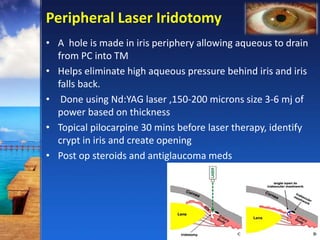
Peripheral Laser Iridotomy
• A hole is made in iris periphery allowing aqueous to drain
from PC into TM
• Helps eliminate high aqueous pressure behind iris and iris
falls back.
• Done using Nd:YAG laser ,150-200 microns size 3-6 mj of
power based on thickness
• Topical pilocarpine 30 mins before laser therapy, identify
crypt in iris and create opening
• Post op steroids and antiglaucoma meds
Surgical Peripheral Iridectomy
• Removal of iris tissue by knife or scissors
• 2-3 mm peripheral corneal incision in
superotemporal site
• Alternatively ,conjunctival peritomy and scleral
limbus incision wound closure
• Externalised iris piece held with toothed forceps ,
incised with fine scissors
Primary Angle Closure Glaucoma.Dr Ferdous

Primary Angle Closure Glaucoma.Dr Ferdous

  • 1.
    Dr Md FerdousIslam Dept of Ophthalmolgy CMH,Dhaka PRIMARY ANGLE CLOSURE GLAUCOMA
  • 2.
    Angle Closure Occlusion ofthe Trabecular Meshwork by the peripheral iris(iridotrabecular contact-ITC) obstructing the aqueous outflow
  • 3.
    Stages In NaturalHistory 1 Primary angle-closure suspect (PACS) • Gonioscopy shows posterior meshwork ITC in three or more quadrants but no PAS • Normal IOP, optic disc and visual field 2 Primary angle-closure (PAC) • Gonioscopy shows three or more quadrants of ITC with raised IOP and/or PAS, or excessive pigment smudging on the TM • Normal optic disc and field 3 Primary angle-closure glaucoma (PACG) • Gonioscopy shows ITC in three or more quadrants • Optic neuropathy
  • 4.
    Risk Factors • Positivefamily history for angle closure • Age : relative pupillary block 60 yrs or over. Younger for non pupillary block • Women • History of Angle closure symptoms • Hypermetropia • Axial length • Racial group Indian Asians & Far Eastern
  • 5.
    Mechanism Relative Pupillary Block •Failure of aqueous flow through the mid dilated pupil leads to a pressure differential between the anterior and posterior chambers, with resultant anterior bowing of the lax iris [Iris bombe] blocks trabecular meshwork and iridolenticular contact
  • 6.
    Non-pupillary block • Specificanatomical factors include plateau iris (anteriorly positioned ciliary processes), and a thicker or more anteriorly-positioned iris • Plateau iris configuration is characterized by a flat central iris plane in association with normal central anterior chamber depth. The angle recess is very narrow, with a sharp iris angulation over anteriorly positioned and/or orientated ciliary processes • Plateau iris syndrome describes the occurrence of angle-closure despite a patent iridotomy in a patient with morphological plateau iris
  • 7.
    • Lens inducedangle closure • Retrolenticular • Combined mechanism • Reduced aqueous outflow
  • 8.
  • 9.
    Ocular Manifestations • Symptoms Decreasedvision Halos around lights Frontal headache Ocular pain Nausea and vomiting Precipitating factors Watching TV in a dark room Pharmacological Mydriasis Sympathetic agonist (Inhalers)
  • 10.
    Signs APAC Elevated IOP risenrapidly Conjunctival congestion Corneal epithelial /stromal edema Shallow or flat peripheral AC Mid dilated [vertical oval] pupil Absent /sluggish pupil reaction Fellow eye generally shows an occludable angle Subacute Angle Closure
  • 11.
    Resolved APAC • Foldsin Descemet membrane (if IOP has been reduced rapidly), optic nerve head congestion and choroidal folds. • Later iris atrophy [spiral-like configuration], irregular pupil, posterior synechiae and glaukomflecken • Iris torsion
  • 12.
    Chronic Presentation • ‘Creeping’angle-closure [gradual band-like anterior advance of the apparent insertion of the iris]. From deepest part of the angle and spreads circumferentially • Episodic (intermittent) ITC is associated with the formation of discrete PAS, individual lesions having a pyramidal (‘saw-tooth’) appearance • Disc cupping /nerve fibre defects with or without visual field defect
  • 13.
    Sequence Of Events •Acute angle closure sudden ,circumferential , iridotrabecular apposition-rapid severe rise in IOP • Intermittent angle closure Self limiting episodes of ITC ,milder signs & symptoms of former • Creeping angle closure slowly progressive ITC –Elevated IOP • Chronic angle closure irreversible , iridotrabecular adhesion ,asymptomatic unless significant raised IOP
  • 14.
    Investigations 1. Anterior segmentOCT 2. Anterior chamber depth measurement 3. Posterior segment USG 4. Provocative tests Pharmacological test  pupillary block mechanism in mid dilated state ,increased tension of iris .  Performed with short acting mydriatic [phenylephrine eye drops] if test proves positive –acute attack may be triggered
  • 15.
    Dark room pronetest pupil dilates in dark,lens moves forwards in prone. - Patient sits for 30 minutes in dark with head prone ,no sleeping - IOP checked rapidly ,positive if increases by 8 mm Hg
  • 16.
    Treatment APAC Initial Treatment 1.Supine Position 2.IV Acetazolamide 500mg if IOP >50mm of Hg. oral if <50mm of Hg 3.Additional oral dose of 500 mg of Acetazolamide 4.Apraclonidine 0.5%-1%,timolol 0.5%,prednisolone 1% 5.Pilocarpine 2-4% 1drop ½ hourly repeatedly,1% 1 drop to the fellow eye 6. Analgesic and antipyretic
  • 17.
    Resistant case 1.Central cornealindentation 2.Further pilocarpine, timolol, apraclonidine, prednisolone 3.Mannitol 20% IV 1-2gm/kg over 1 hr, oral glycerol 50% 1gm/kg or oral isosorbide 1gm/kg 4.Paracentesis 5.Clearing cornel oedeme with glycerol 6.Surgical :PI, Laser iridotomy, iridoplasty, lens extraction, goniosynechialysis,trabeculectomy Subsequent Med Treatment 1.Pilocarpine 2% 4 times to affected eye,1% 4 times to fellow eye 2.Topical steroid 4 times 3.(Any of ) timolol or apraclonidine or oral acetazolamide
  • 18.
    PACS 1.Laser iridotomy 2. IfITC persists –laser iridoplasty, long term pilocarpine prophylaxis, lens extraction PAC & PACG 1.As for PACS but urgency & intensity of treatment with frequent review with anti glaucoma medications and neuroprotective drugs.
  • 19.
    Peripheral Laser Iridotomy •A hole is made in iris periphery allowing aqueous to drain from PC into TM • Helps eliminate high aqueous pressure behind iris and iris falls back. • Done using Nd:YAG laser ,150-200 microns size 3-6 mj of power based on thickness • Topical pilocarpine 30 mins before laser therapy, identify crypt in iris and create opening • Post op steroids and antiglaucoma meds
  • 20.
    Surgical Peripheral Iridectomy •Removal of iris tissue by knife or scissors • 2-3 mm peripheral corneal incision in superotemporal site • Alternatively ,conjunctival peritomy and scleral limbus incision wound closure • Externalised iris piece held with toothed forceps , incised with fine scissors