PRESENTER- DR. DAISY VISHWAKARMA, 2nd YR
PG STUDENT DEPTT. OF
OPHTHALMOLOGY, A.M.C.H.
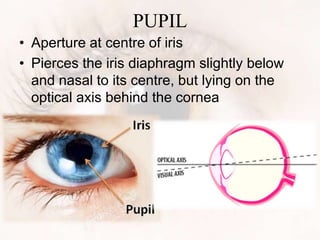
PUPIL
• Aperture at centre of iris
• Pierces the iris diaphragm slightly below
and nasal to its centre, but lying on the
optical axis behind the cornea
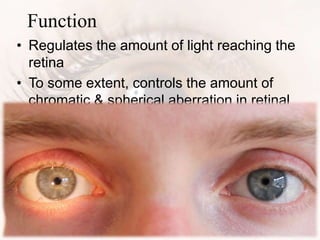
Function
• Regulates the amount of light reaching the
retina
• To some extent, controls the amount of
chromatic & spherical aberration in retinal
images
ANATOMY
of
PUPIL
Anatomy
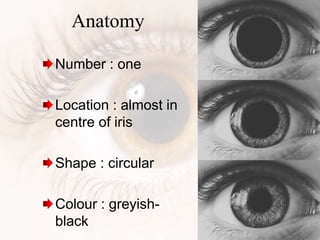
Number : one
Location : almost in
centre of iris
Shape : circular
Colour : greyish-
black
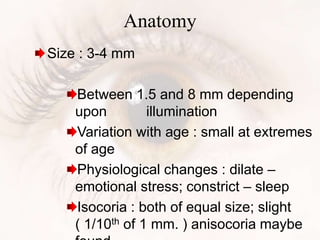
Size : 3-4 mm
Between 1.5 and 8 mm depending
upon illumination
Variation with age : small at extremes
of age
Physiological changes : dilate –
emotional stress; constrict – sleep
Isocoria : both of equal size; slight
( 1/10th of 1 mm. ) anisocoria maybe
Anatomy
Anatomy
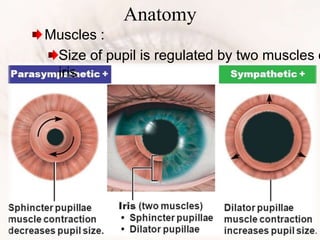
Muscles :
Size of pupil is regulated by two muscles o
iris
Development
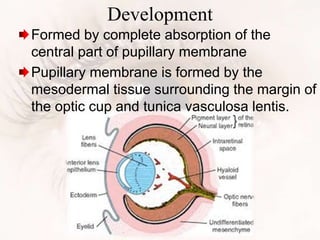
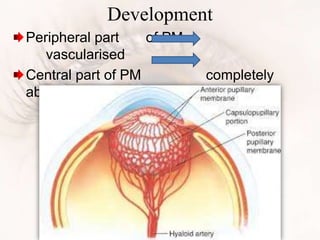
Formed by complete absorption of the
central part of pupillary membrane
Pupillary membrane is formed by the
mesodermal tissue surrounding the margin of
the optic cup and tunica vasculosa lentis.
Peripheral part of PM
vascularised
Central part of PM completely
absorbed
forming the PUPIL
Development
PHYSIOLOGY
Of
PUPIL
Pupillary Pathways
PATHWAY OF LIGHT REFLEX
PATHWAY OF CONVERGENCE
REFLEX
PATHWAY OF ACCOMMODATION
REFLEX
PATHWAY OF SYMPATHETIC
DISCHARGE
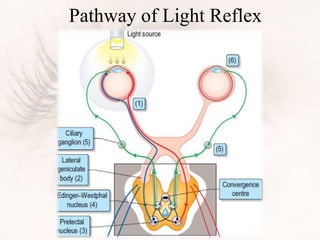
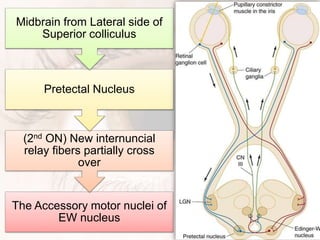
Pathway of Light Reflex
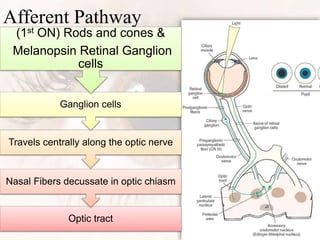
Afferent Pathway
Optic tract
Nasal Fibers decussate in optic chiasm
Travels centrally along the optic nerve
Ganglion cells
(1st ON) Rods and cones &
Melanopsin Retinal Ganglion
cells
The Accessory motor nuclei of
EW nucleus
(2nd ON) New internuncial
relay fibers partially cross
over
Pretectal Nucleus
Midbrain from Lateral side of
Superior colliculus
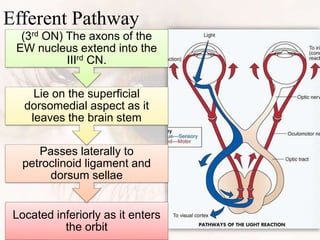
Efferent Pathway
Located inferiorly as it enters
the orbit
Passes laterally to
petroclinoid ligament and
dorsum sellae
Lie on the superficial
dorsomedial aspect as it
leaves the brain stem
(3rd ON) The axons of the
EW nucleus extend into the
IIIrd CN.
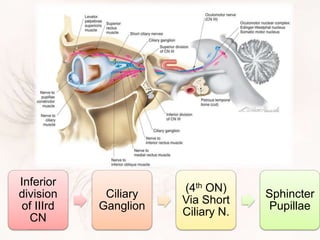
Inferior
division
of IIIrd
CN
Ciliary
Ganglion
(4th ON)
Via Short
Ciliary N.
Sphincter
Pupillae
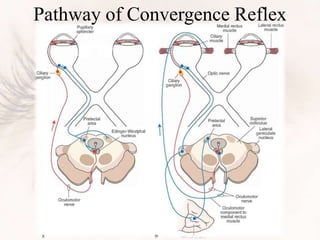
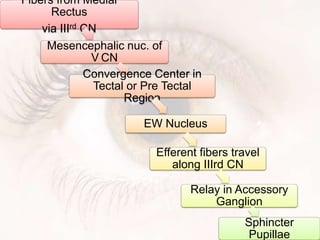
Pathway of Convergence Reflex
Fibers from Medial
Rectus
via IIIrd CN
Mesencephalic nuc. of
V CN
Convergence Center in
Tectal or Pre Tectal
Region
EW Nucleus
Efferent fibers travel
along IIIrd CN
Relay in Accessory
Ganglion
Sphincter
Pupillae
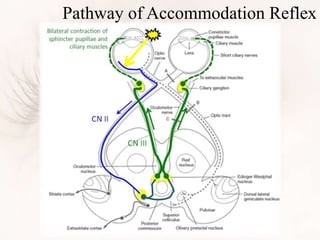
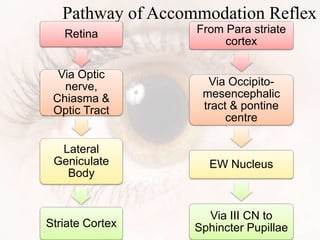
Pathway of Accommodation Reflex
Retina
Via Optic
nerve,
Chiasma &
Optic Tract
Lateral
Geniculate
Body
Striate Cortex
From Para striate
cortex
Via Occipito-
mesencephalic
tract & pontine
centre
EW Nucleus
Via III CN to
Sphincter Pupillae
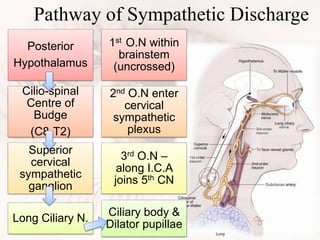
Pathway of Sympathetic Discharge
Posterior
Hypothalamus
1st O.N within
brainstem
(uncrossed)
Cilio-spinal
Centre of
Budge
(C8-T2)
2nd O.N enter
cervical
sympathetic
plexus
Superior
cervical
sympathetic
ganglion
3rd O.N –
along I.C.A
joins 5th CN
Long Ciliary N.
Ciliary body &
Dilator pupillae
PUPILLARY
REFLEXES
PUPILLARY REFLEXES
LIGHT REFLEX
NEAR REFLEX
OTHER REFLEXES
• DARKNESS REFLEX
• PSYCHOSENSORY
REFLEX
• LID CLOSURE REFLEX
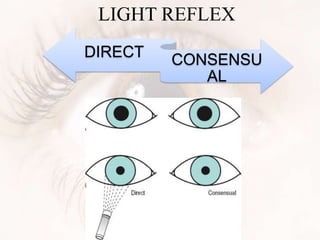
LIGHT REFLEX
DIRECT CONSENSU
AL
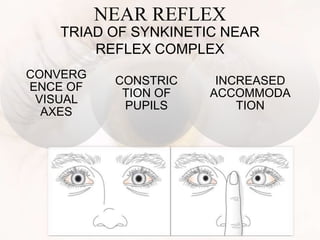
NEAR REFLEX
CONVERG
ENCE OF
VISUAL
AXES
CONSTRIC
TION OF
PUPILS
INCREASED
ACCOMMODA
TION
TRIAD OF SYNKINETIC NEAR
REFLEX COMPLEX
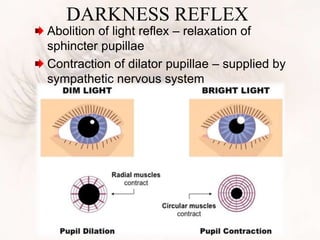
DARKNESS REFLEX
Abolition of light reflex – relaxation of
sphincter pupillae
Contraction of dilator pupillae – supplied by
sympathetic nervous system
Dilatation of pupil in response to sensory &
psychic stimuli
Fully developed by 6 months of age
Pathways – unknown
Two components –
Sympathetic discharge to dilator pupillae
muscle
Inhibition of parasympathetic discharge to
sphincter pupillae muscle
PSYCHOSENSORY REFLEX
Constriction of pupil associated with
blinking –
type of darkness reflex
Homolateral pupillary constriction
associated with closure of lid –
attempt at near gaze
Pupillary dilatation associated with
lid-closure on touching the cornea
(oculopupillary reflex) –
type of psychosensory reflex
LID CLOSURE REFLEX
MORPHOLOGICAL
ABNORMALITIES
OF
PUPIL
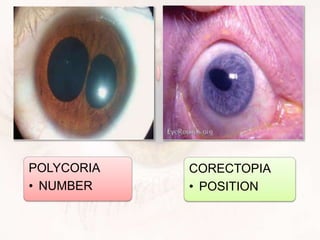
POLYCORIA
• NUMBER
CORECTOPIA
• POSITION
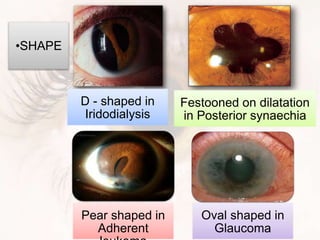
D - shaped in
Iridodialysis
Festooned on dilatation
in Posterior synaechia
Pear shaped in
Adherent
Oval shaped in
Glaucoma
•SHAPE
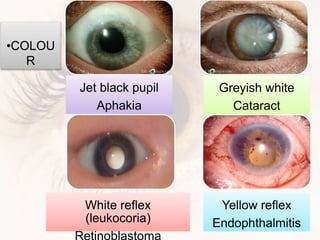
Jet black pupil
Aphakia
Greyish white
Cataract
White reflex
(leukocoria)
Yellow reflex
Endophthalmitis
•COLOU
R
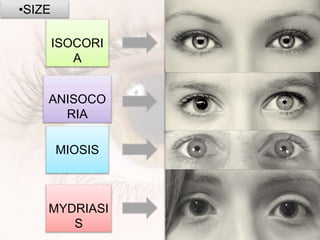
•SIZE
ISOCORI
A
ANISOCO
RIA
MIOSIS
MYDRIASI
S
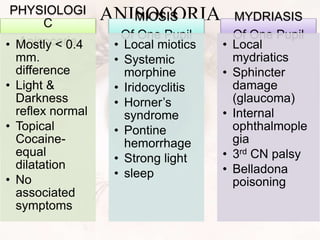
ANISOCORIAPHYSIOLOGI
C
Anisocoria• Mostly < 0.4
mm.
difference
• Light &
Darkness
reflex normal
• Topical
Cocaine-
equal
dilatation
• No
associated
symptoms
MIOSIS
Of One Pupil
• Local miotics
• Systemic
morphine
• Iridocyclitis
• Horner’s
syndrome
• Pontine
hemorrhage
• Strong light
• sleep
MYDRIASIS
Of One Pupil
• Local
mydriatics
• Sphincter
damage
(glaucoma)
• Internal
ophthalmople
gia
• 3rd CN palsy
• Belladona
poisoning
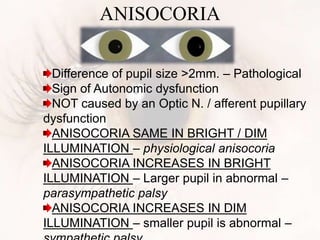
ANISOCORIA
Difference of pupil size >2mm. – Pathological
Sign of Autonomic dysfunction
NOT caused by an Optic N. / afferent pupillary
dysfunction
ANISOCORIA SAME IN BRIGHT / DIM
ILLUMINATION – physiological anisocoria
ANISOCORIA INCREASES IN BRIGHT
ILLUMINATION – Larger pupil in abnormal –
parasympathetic palsy
ANISOCORIA INCREASES IN DIM
ILLUMINATION – smaller pupil is abnormal –
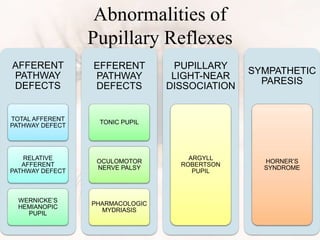
ABNORMALITIES
OF
PUPILLARY REFLEXES
Abnormalities of
Pupillary Reflexes
AFFERENT
PATHWAY
DEFECTS
TOTAL AFFERENT
PATHWAY DEFECT
RELATIVE
AFFERENT
PATHWAY DEFECT
WERNICKE’S
HEMIANOPIC
PUPIL
EFFERENT
PATHWAY
DEFECTS
TONIC PUPIL
OCULOMOTOR
NERVE PALSY
PHARMACOLOGIC
MYDRIASIS
PUPILLARY
LIGHT-NEAR
DISSOCIATION
ARGYLL
ROBERTSON
PUPIL
SYMPATHETIC
PARESIS
HORNER’S
SYNDROME
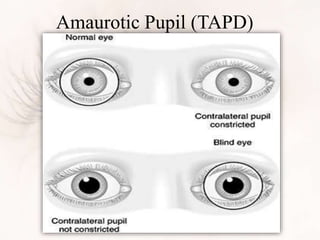
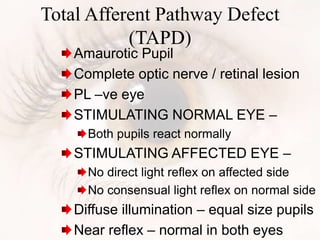
Total Afferent Pathway Defect
(TAPD)
Amaurotic Pupil
Complete optic nerve / retinal lesion
PL –ve eye
STIMULATING NORMAL EYE –
Both pupils react normally
STIMULATING AFFECTED EYE –
No direct light reflex on affected side
No consensual light reflex on normal side
Diffuse illumination – equal size pupils
Near reflex – normal in both eyes
Amaurotic Pupil (TAPD)
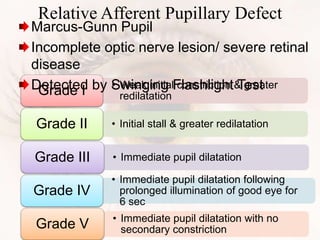
• Weak initial constriction & greater
redilatationGrade I
• Initial stall & greater redilatationGrade II
• Immediate pupil dilatationGrade III
• Immediate pupil dilatation following
prolonged illumination of good eye for
6 sec
Grade IV
• Immediate pupil dilatation with no
secondary constrictionGrade V
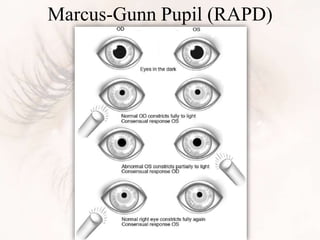
Relative Afferent Pupillary Defect
Marcus-Gunn Pupil
Incomplete optic nerve lesion/ severe retinal
disease
Detected by Swinging Flashlight Test
Marcus-Gunn Pupil (RAPD)
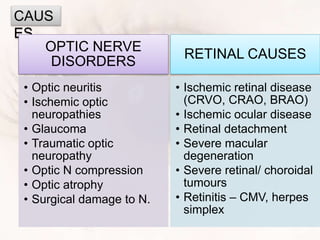
CAUS
ES
OPTIC NERVE
DISORDERS
• Optic neuritis
• Ischemic optic
neuropathies
• Glaucoma
• Traumatic optic
neuropathy
• Optic N compression
• Optic atrophy
• Surgical damage to N.
RETINAL CAUSES
• Ischemic retinal disease
(CRVO, CRAO, BRAO)
• Ischemic ocular disease
• Retinal detachment
• Severe macular
degeneration
• Severe retinal/ choroidal
tumours
• Retinitis – CMV, herpes
simplex
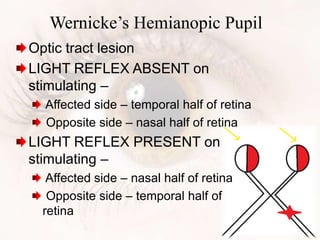
Wernicke’s Hemianopic Pupil
Optic tract lesion
LIGHT REFLEX ABSENT on
stimulating –
Affected side – temporal half of retina
Opposite side – nasal half of retina
LIGHT REFLEX PRESENT on
stimulating –
Affected side – nasal half of retina
Opposite side – temporal half of
retina
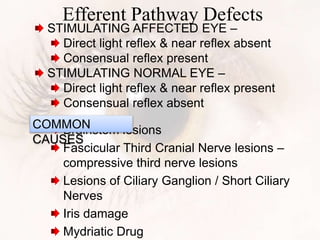
Efferent Pathway Defects
Brainstem lesions
Fascicular Third Cranial Nerve lesions –
compressive third nerve lesions
Lesions of Ciliary Ganglion / Short Ciliary
Nerves
Iris damage
Mydriatic Drug
COMMON
CAUSES
STIMULATING AFFECTED EYE –
Direct light reflex & near reflex absent
Consensual reflex present
STIMULATING NORMAL EYE –
Direct light reflex & near reflex present
Consensual reflex absent
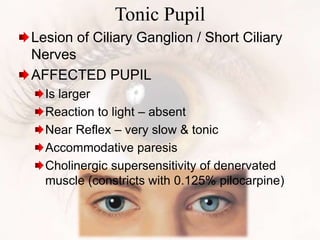
Tonic Pupil
Lesion of Ciliary Ganglion / Short Ciliary
Nerves
AFFECTED PUPIL
Is larger
Reaction to light – absent
Near Reflex – very slow & tonic
Accommodative paresis
Cholinergic supersensitivity of denervated
muscle (constricts with 0.125% pilocarpine)
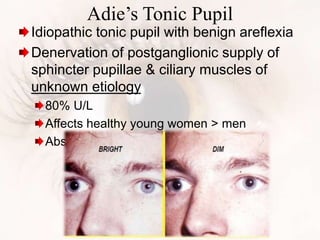
Adie’s Tonic Pupil
Idiopathic tonic pupil with benign areflexia
Denervation of postganglionic supply of
sphincter pupillae & ciliary muscles of
unknown etiology
80% U/L
Affects healthy young women > men
Absent knee jerk
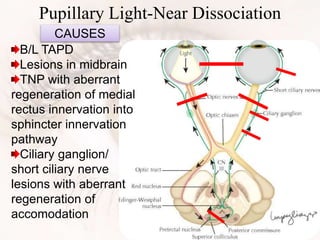
Pupillary Light-Near Dissociation
CAUSES
B/L TAPD
Lesions in midbrain
TNP with aberrant
regeneration of medial
rectus innervation into
sphincter innervation
pathway
Ciliary ganglion/
short ciliary nerve
lesions with aberrant
regeneration of
accomodation
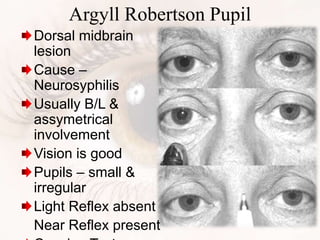
Argyll Robertson Pupil
Dorsal midbrain
lesion
Cause –
Neurosyphilis
Usually B/L &
assymetrical
involvement
Vision is good
Pupils – small &
irregular
Light Reflex absent
Near Reflex present
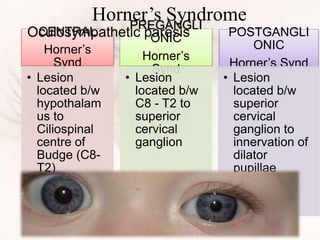
CENTRAL
Horner’s
Synd
• Lesion
located b/w
hypothalam
us to
Ciliospinal
centre of
Budge (C8-
T2)
PREGANGLI
ONIC
Horner’s
Synd
• Lesion
located b/w
C8 - T2 to
superior
cervical
ganglion
POSTGANGLI
ONIC
Horner’s Synd
• Lesion
located b/w
superior
cervical
ganglion to
innervation of
dilator
pupillae
Oculosympathetic paresis
Horner’s Syndrome
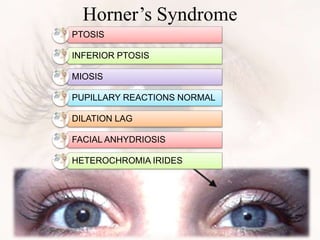
Horner’s Syndrome
PTOSIS
INFERIOR PTOSIS
MIOSIS
PUPILLARY REACTIONS NORMAL
DILATION LAG
FACIAL ANHYDRIOSIS
HETEROCHROMIA IRIDES
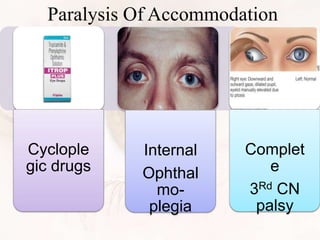
Paralysis Of Accommodation
Cyclople
gic drugs
Internal
Ophthal
mo-
plegia
Complet
e
3Rd CN
palsy
Paralysis Of Convergence
Head Injury
Encephalitis
Disseminated sclerosis
Tumours
WEBINO
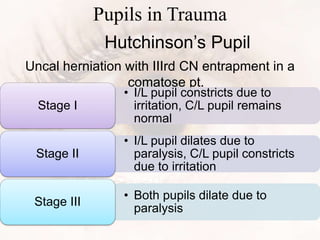
Pupils in Trauma
Uncal herniation with IIIrd CN entrapment in a
comatose pt.
Hutchinson’s Pupil
• I/L pupil constricts due to
irritation, C/L pupil remains
normal
Stage I
• I/L pupil dilates due to
paralysis, C/L pupil constricts
due to irritation
Stage II
• Both pupils dilate due to
paralysis
Stage III
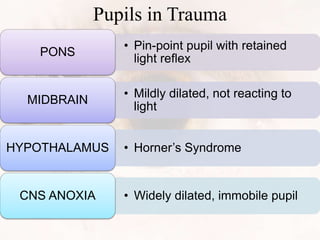
Pupils in Trauma
• Pin-point pupil with retained
light reflex
PONS
• Mildly dilated, not reacting to
light
MIDBRAIN
• Horner’s SyndromeHYPOTHALAMUS
• Widely dilated, immobile pupilCNS ANOXIA
PHARMACOLOGY
OF
PUPIL
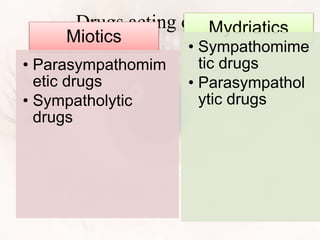
Drugs acting on Pupil
Miotics
• Parasympathomim
etic drugs
• Sympatholytic
drugs
Mydriatics
• Sympathomime
tic drugs
• Parasympathol
ytic drugs
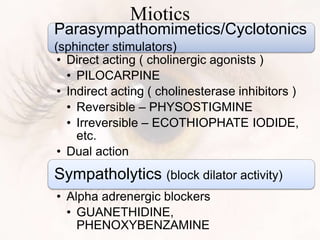
Miotics
Parasympathomimetics/Cyclotonics
(sphincter stimulators)
• Direct acting ( cholinergic agonists )
• PILOCARPINE
• Indirect acting ( cholinesterase inhibitors )
• Reversible – PHYSOSTIGMINE
• Irreversible – ECOTHIOPHATE IODIDE,
etc.
• Dual action
Sympatholytics (block dilator activity)
• Alpha adrenergic blockers
• GUANETHIDINE,
PHENOXYBENZAMINE
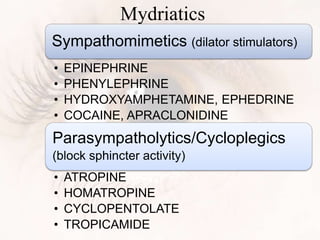
Mydriatics
Sympathomimetics (dilator stimulators)
• EPINEPHRINE
• PHENYLEPHRINE
• HYDROXYAMPHETAMINE, EPHEDRINE
• COCAINE, APRACLONIDINE
Parasympatholytics/Cycloplegics
(block sphincter activity)
• ATROPINE
• HOMATROPINE
• CYCLOPENTOLATE
• TROPICAMIDE
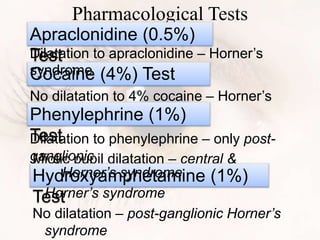
Pharmacological Tests
Miotic pupil dilatation – central &
preganglionic
Horner’s syndrome
No dilatation – post-ganglionic Horner’s
syndrome
Cocaine (4%) Test
Hydroxyamphetamine (1%)
Test
No dilatation to 4% cocaine – Horner’s
syndrome
Apraclonidine (0.5%)
TestDilatation to apraclonidine – Horner’s
syndrome
Phenylephrine (1%)
TestDilatation to phenylephrine – only post-
ganglionic
Horner’s syndrome
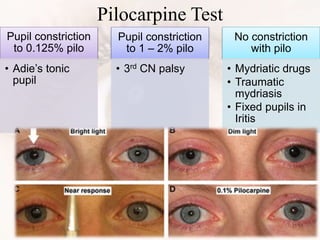
Pilocarpine Test
Pupil constriction
to 0.125% pilo
• Adie’s tonic
pupil
Pupil constriction
to 1 – 2% pilo
• 3rd CN palsy
No constriction
with pilo
• Mydriatic drugs
• Traumatic
mydriasis
• Fixed pupils in
Iritis
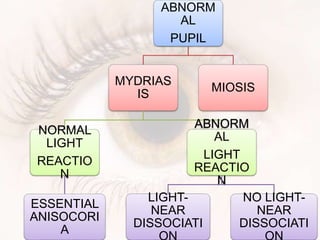
ABNORM
AL
PUPIL
MYDRIAS
IS
NORMAL
LIGHT
REACTIO
N
ESSENTIAL
ANISOCORI
A
ABNORM
AL
LIGHT
REACTIO
N
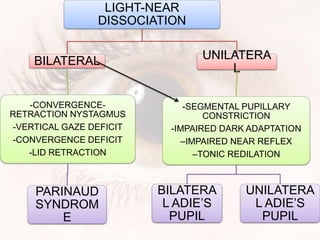
LIGHT-
NEAR
DISSOCIATI
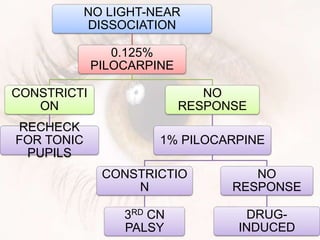
NO LIGHT-
NEAR
DISSOCIATI
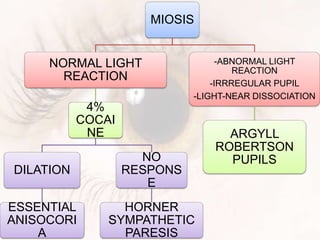
MIOSIS
LIGHT-NEAR
DISSOCIATION
BILATERAL
-CONVERGENCE-
RETRACTION NYSTAGMUS
-VERTICAL GAZE DEFICIT
-CONVERGENCE DEFICIT
-LID RETRACTION
PARINAUD
SYNDROM
E
UNILATERA
L
-SEGMENTAL PUPILLARY
CONSTRICTION
-IMPAIRED DARK ADAPTATION
–IMPAIRED NEAR REFLEX
–TONIC REDILATION
BILATERA
L ADIE’S
PUPIL
UNILATERA
L ADIE’S
PUPIL
NO LIGHT-NEAR
DISSOCIATION
0.125%
PILOCARPINE
CONSTRICTI
ON
RECHECK
FOR TONIC
PUPILS
NO
RESPONSE
1% PILOCARPINE
CONSTRICTIO
N
3RD CN
PALSY
NO
RESPONSE
DRUG-
INDUCED
MIOSIS
NORMAL LIGHT
REACTION
4%
COCAI
NE
DILATION
ESSENTIAL
ANISOCORI
A
NO
RESPONS
E
HORNER
SYMPATHETIC
PARESIS
-ABNORMAL LIGHT
REACTION
-IRRREGULAR PUPIL
-LIGHT-NEAR DISSOCIATION
ARGYLL
ROBERTSON
PUPILS
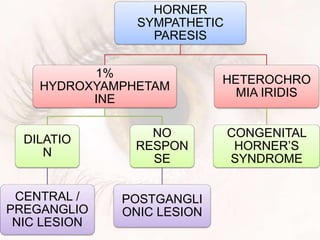
HORNER
SYMPATHETIC
PARESIS
1%
HYDROXYAMPHETAM
INE
DILATIO
N
CENTRAL /
PREGANGLIO
NIC LESION
NO
RESPON
SE
POSTGANGLI
ONIC LESION
HETEROCHRO
MIA IRIDIS
CONGENITAL
HORNER’S
SYNDROME
Conclusion
The pupil is a very important structure in the
human eye.
It regulates the amount of light entering the
eye.
It improves the optical quality of the image
formed on the retina by reducing the optical
aberrations.
It increases the depth of focus.
It also allows flow of aqueous humour from
posterior to anterior chamber.
Knowledge of the normal & abnormal
PUPIL - ANATOMY, PHYSIOLOGY AND REFLEXES

PUPIL - ANATOMY, PHYSIOLOGY AND REFLEXES

  • 1.
    PRESENTER- DR. DAISYVISHWAKARMA, 2nd YR PG STUDENT DEPTT. OF OPHTHALMOLOGY, A.M.C.H.
  • 2.
    PUPIL • Aperture atcentre of iris • Pierces the iris diaphragm slightly below and nasal to its centre, but lying on the optical axis behind the cornea
  • 3.
    Function • Regulates theamount of light reaching the retina • To some extent, controls the amount of chromatic & spherical aberration in retinal images
  • 4.
  • 5.
    Anatomy Number : one Location: almost in centre of iris Shape : circular Colour : greyish- black
  • 6.
    Size : 3-4mm Between 1.5 and 8 mm depending upon illumination Variation with age : small at extremes of age Physiological changes : dilate – emotional stress; constrict – sleep Isocoria : both of equal size; slight ( 1/10th of 1 mm. ) anisocoria maybe Anatomy
  • 7.
    Anatomy Muscles : Size ofpupil is regulated by two muscles o iris
  • 8.
    Development Formed by completeabsorption of the central part of pupillary membrane Pupillary membrane is formed by the mesodermal tissue surrounding the margin of the optic cup and tunica vasculosa lentis.
  • 9.
    Peripheral part ofPM vascularised Central part of PM completely absorbed forming the PUPIL Development
  • 10.
  • 11.
    Pupillary Pathways PATHWAY OFLIGHT REFLEX PATHWAY OF CONVERGENCE REFLEX PATHWAY OF ACCOMMODATION REFLEX PATHWAY OF SYMPATHETIC DISCHARGE
  • 12.
  • 13.
    Afferent Pathway Optic tract NasalFibers decussate in optic chiasm Travels centrally along the optic nerve Ganglion cells (1st ON) Rods and cones & Melanopsin Retinal Ganglion cells
  • 14.
    The Accessory motornuclei of EW nucleus (2nd ON) New internuncial relay fibers partially cross over Pretectal Nucleus Midbrain from Lateral side of Superior colliculus
  • 15.
    Efferent Pathway Located inferiorlyas it enters the orbit Passes laterally to petroclinoid ligament and dorsum sellae Lie on the superficial dorsomedial aspect as it leaves the brain stem (3rd ON) The axons of the EW nucleus extend into the IIIrd CN.
  • 16.
  • 17.
  • 18.
    Fibers from Medial Rectus viaIIIrd CN Mesencephalic nuc. of V CN Convergence Center in Tectal or Pre Tectal Region EW Nucleus Efferent fibers travel along IIIrd CN Relay in Accessory Ganglion Sphincter Pupillae
  • 19.
  • 20.
    Pathway of AccommodationReflex Retina Via Optic nerve, Chiasma & Optic Tract Lateral Geniculate Body Striate Cortex From Para striate cortex Via Occipito- mesencephalic tract & pontine centre EW Nucleus Via III CN to Sphincter Pupillae
  • 21.
    Pathway of SympatheticDischarge Posterior Hypothalamus 1st O.N within brainstem (uncrossed) Cilio-spinal Centre of Budge (C8-T2) 2nd O.N enter cervical sympathetic plexus Superior cervical sympathetic ganglion 3rd O.N – along I.C.A joins 5th CN Long Ciliary N. Ciliary body & Dilator pupillae
  • 22.
  • 23.
    PUPILLARY REFLEXES LIGHT REFLEX NEARREFLEX OTHER REFLEXES • DARKNESS REFLEX • PSYCHOSENSORY REFLEX • LID CLOSURE REFLEX
  • 24.
  • 25.
    NEAR REFLEX CONVERG ENCE OF VISUAL AXES CONSTRIC TIONOF PUPILS INCREASED ACCOMMODA TION TRIAD OF SYNKINETIC NEAR REFLEX COMPLEX
  • 26.
    DARKNESS REFLEX Abolition oflight reflex – relaxation of sphincter pupillae Contraction of dilator pupillae – supplied by sympathetic nervous system
  • 27.
    Dilatation of pupilin response to sensory & psychic stimuli Fully developed by 6 months of age Pathways – unknown Two components – Sympathetic discharge to dilator pupillae muscle Inhibition of parasympathetic discharge to sphincter pupillae muscle PSYCHOSENSORY REFLEX
  • 28.
    Constriction of pupilassociated with blinking – type of darkness reflex Homolateral pupillary constriction associated with closure of lid – attempt at near gaze Pupillary dilatation associated with lid-closure on touching the cornea (oculopupillary reflex) – type of psychosensory reflex LID CLOSURE REFLEX
  • 29.
  • 30.
  • 31.
    D - shapedin Iridodialysis Festooned on dilatation in Posterior synaechia Pear shaped in Adherent Oval shaped in Glaucoma •SHAPE
  • 32.
    Jet black pupil Aphakia Greyishwhite Cataract White reflex (leukocoria) Yellow reflex Endophthalmitis •COLOU R
  • 33.
  • 34.
    ANISOCORIAPHYSIOLOGI C Anisocoria• Mostly <0.4 mm. difference • Light & Darkness reflex normal • Topical Cocaine- equal dilatation • No associated symptoms MIOSIS Of One Pupil • Local miotics • Systemic morphine • Iridocyclitis • Horner’s syndrome • Pontine hemorrhage • Strong light • sleep MYDRIASIS Of One Pupil • Local mydriatics • Sphincter damage (glaucoma) • Internal ophthalmople gia • 3rd CN palsy • Belladona poisoning
  • 35.
    ANISOCORIA Difference of pupilsize >2mm. – Pathological Sign of Autonomic dysfunction NOT caused by an Optic N. / afferent pupillary dysfunction ANISOCORIA SAME IN BRIGHT / DIM ILLUMINATION – physiological anisocoria ANISOCORIA INCREASES IN BRIGHT ILLUMINATION – Larger pupil in abnormal – parasympathetic palsy ANISOCORIA INCREASES IN DIM ILLUMINATION – smaller pupil is abnormal –
  • 36.
  • 37.
    Abnormalities of Pupillary Reflexes AFFERENT PATHWAY DEFECTS TOTALAFFERENT PATHWAY DEFECT RELATIVE AFFERENT PATHWAY DEFECT WERNICKE’S HEMIANOPIC PUPIL EFFERENT PATHWAY DEFECTS TONIC PUPIL OCULOMOTOR NERVE PALSY PHARMACOLOGIC MYDRIASIS PUPILLARY LIGHT-NEAR DISSOCIATION ARGYLL ROBERTSON PUPIL SYMPATHETIC PARESIS HORNER’S SYNDROME
  • 38.
    Total Afferent PathwayDefect (TAPD) Amaurotic Pupil Complete optic nerve / retinal lesion PL –ve eye STIMULATING NORMAL EYE – Both pupils react normally STIMULATING AFFECTED EYE – No direct light reflex on affected side No consensual light reflex on normal side Diffuse illumination – equal size pupils Near reflex – normal in both eyes
  • 39.
  • 40.
    • Weak initialconstriction & greater redilatationGrade I • Initial stall & greater redilatationGrade II • Immediate pupil dilatationGrade III • Immediate pupil dilatation following prolonged illumination of good eye for 6 sec Grade IV • Immediate pupil dilatation with no secondary constrictionGrade V Relative Afferent Pupillary Defect Marcus-Gunn Pupil Incomplete optic nerve lesion/ severe retinal disease Detected by Swinging Flashlight Test
  • 41.
  • 42.
    CAUS ES OPTIC NERVE DISORDERS • Opticneuritis • Ischemic optic neuropathies • Glaucoma • Traumatic optic neuropathy • Optic N compression • Optic atrophy • Surgical damage to N. RETINAL CAUSES • Ischemic retinal disease (CRVO, CRAO, BRAO) • Ischemic ocular disease • Retinal detachment • Severe macular degeneration • Severe retinal/ choroidal tumours • Retinitis – CMV, herpes simplex
  • 43.
    Wernicke’s Hemianopic Pupil Optictract lesion LIGHT REFLEX ABSENT on stimulating – Affected side – temporal half of retina Opposite side – nasal half of retina LIGHT REFLEX PRESENT on stimulating – Affected side – nasal half of retina Opposite side – temporal half of retina
  • 44.
    Efferent Pathway Defects Brainstemlesions Fascicular Third Cranial Nerve lesions – compressive third nerve lesions Lesions of Ciliary Ganglion / Short Ciliary Nerves Iris damage Mydriatic Drug COMMON CAUSES STIMULATING AFFECTED EYE – Direct light reflex & near reflex absent Consensual reflex present STIMULATING NORMAL EYE – Direct light reflex & near reflex present Consensual reflex absent
  • 45.
    Tonic Pupil Lesion ofCiliary Ganglion / Short Ciliary Nerves AFFECTED PUPIL Is larger Reaction to light – absent Near Reflex – very slow & tonic Accommodative paresis Cholinergic supersensitivity of denervated muscle (constricts with 0.125% pilocarpine)
  • 46.
    Adie’s Tonic Pupil Idiopathictonic pupil with benign areflexia Denervation of postganglionic supply of sphincter pupillae & ciliary muscles of unknown etiology 80% U/L Affects healthy young women > men Absent knee jerk
  • 47.
    Pupillary Light-Near Dissociation CAUSES B/LTAPD Lesions in midbrain TNP with aberrant regeneration of medial rectus innervation into sphincter innervation pathway Ciliary ganglion/ short ciliary nerve lesions with aberrant regeneration of accomodation
  • 48.
    Argyll Robertson Pupil Dorsalmidbrain lesion Cause – Neurosyphilis Usually B/L & assymetrical involvement Vision is good Pupils – small & irregular Light Reflex absent Near Reflex present
  • 49.
    CENTRAL Horner’s Synd • Lesion located b/w hypothalam usto Ciliospinal centre of Budge (C8- T2) PREGANGLI ONIC Horner’s Synd • Lesion located b/w C8 - T2 to superior cervical ganglion POSTGANGLI ONIC Horner’s Synd • Lesion located b/w superior cervical ganglion to innervation of dilator pupillae Oculosympathetic paresis Horner’s Syndrome
  • 50.
    Horner’s Syndrome PTOSIS INFERIOR PTOSIS MIOSIS PUPILLARYREACTIONS NORMAL DILATION LAG FACIAL ANHYDRIOSIS HETEROCHROMIA IRIDES
  • 51.
    Paralysis Of Accommodation Cyclople gicdrugs Internal Ophthal mo- plegia Complet e 3Rd CN palsy
  • 52.
    Paralysis Of Convergence HeadInjury Encephalitis Disseminated sclerosis Tumours WEBINO
  • 53.
    Pupils in Trauma Uncalherniation with IIIrd CN entrapment in a comatose pt. Hutchinson’s Pupil • I/L pupil constricts due to irritation, C/L pupil remains normal Stage I • I/L pupil dilates due to paralysis, C/L pupil constricts due to irritation Stage II • Both pupils dilate due to paralysis Stage III
  • 54.
    Pupils in Trauma •Pin-point pupil with retained light reflex PONS • Mildly dilated, not reacting to light MIDBRAIN • Horner’s SyndromeHYPOTHALAMUS • Widely dilated, immobile pupilCNS ANOXIA
  • 55.
  • 56.
    Drugs acting onPupil Miotics • Parasympathomim etic drugs • Sympatholytic drugs Mydriatics • Sympathomime tic drugs • Parasympathol ytic drugs
  • 57.
    Miotics Parasympathomimetics/Cyclotonics (sphincter stimulators) • Directacting ( cholinergic agonists ) • PILOCARPINE • Indirect acting ( cholinesterase inhibitors ) • Reversible – PHYSOSTIGMINE • Irreversible – ECOTHIOPHATE IODIDE, etc. • Dual action Sympatholytics (block dilator activity) • Alpha adrenergic blockers • GUANETHIDINE, PHENOXYBENZAMINE
  • 58.
    Mydriatics Sympathomimetics (dilator stimulators) •EPINEPHRINE • PHENYLEPHRINE • HYDROXYAMPHETAMINE, EPHEDRINE • COCAINE, APRACLONIDINE Parasympatholytics/Cycloplegics (block sphincter activity) • ATROPINE • HOMATROPINE • CYCLOPENTOLATE • TROPICAMIDE
  • 59.
    Pharmacological Tests Miotic pupildilatation – central & preganglionic Horner’s syndrome No dilatation – post-ganglionic Horner’s syndrome Cocaine (4%) Test Hydroxyamphetamine (1%) Test No dilatation to 4% cocaine – Horner’s syndrome Apraclonidine (0.5%) TestDilatation to apraclonidine – Horner’s syndrome Phenylephrine (1%) TestDilatation to phenylephrine – only post- ganglionic Horner’s syndrome
  • 60.
    Pilocarpine Test Pupil constriction to0.125% pilo • Adie’s tonic pupil Pupil constriction to 1 – 2% pilo • 3rd CN palsy No constriction with pilo • Mydriatic drugs • Traumatic mydriasis • Fixed pupils in Iritis
  • 61.
  • 62.
    LIGHT-NEAR DISSOCIATION BILATERAL -CONVERGENCE- RETRACTION NYSTAGMUS -VERTICAL GAZEDEFICIT -CONVERGENCE DEFICIT -LID RETRACTION PARINAUD SYNDROM E UNILATERA L -SEGMENTAL PUPILLARY CONSTRICTION -IMPAIRED DARK ADAPTATION –IMPAIRED NEAR REFLEX –TONIC REDILATION BILATERA L ADIE’S PUPIL UNILATERA L ADIE’S PUPIL
  • 63.
  • 64.
  • 65.
  • 66.
    Conclusion The pupil isa very important structure in the human eye. It regulates the amount of light entering the eye. It improves the optical quality of the image formed on the retina by reducing the optical aberrations. It increases the depth of focus. It also allows flow of aqueous humour from posterior to anterior chamber. Knowledge of the normal & abnormal