Domina Petric, MD
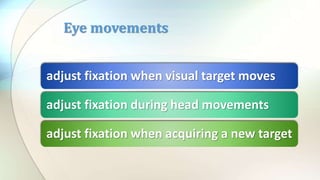
Eye movements
adjust fixation when visual target moves
adjust fixation during head movements
adjust fixation when acquiring a new target
Eye movements
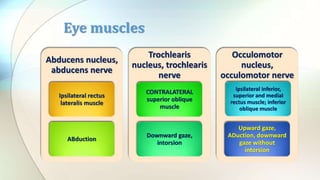
Abducens nucleus,
abducens nerve
Ipsilateral rectus
lateralis muscle
ABduction
Trochlearis
nucleus, trochlearis
nerve
CONTRALATERAL
superior oblique
muscle
Downward gaze,
intorsion
Occulomotor
nucleus,
occulomotor nerve
Ipsilateral inferior,
superior and medial
rectus muscle; inferior
oblique muscle
Upward gaze,
ADuction, downward
gaze without
intorsion
Eye muscles
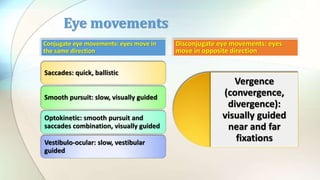
Vergence
(convergence,
divergence):
visually guided
near and far
fixations
Disconjugate eye movements: eyes
move in opposite direction
Saccades: quick, ballistic
Smooth pursuit: slow, visually guided
Optokinetic: smooth pursuit and
saccades combination, visually guided
Vestibulo-ocular: slow, vestibular
guided
Conjugate eye movements: eyes move in
the same direction
Eye movements
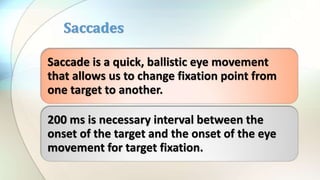
Saccade is a quick, ballistic eye movement
that allows us to change fixation point from
one target to another.
200 ms is necessary interval between the
onset of the target and the onset of the eye
movement for target fixation.
Saccades
Visually guided eye movements.
After catch-up saccade, eyes can
track the target smoothly.
Smooth pursuit eye movements
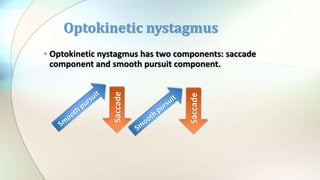
• Optokinetic nystagmus has two components: saccade
component and smooth pursuit component.
Optokinetic nystagmus
Saccade
Saccade
Both eyes are in
adduction.
Near objects fixation.
Convergence
Both eyes are in
abduction.
Far objects fixation.
Divergence
• PPRF is Paramedian Pontine Reticular Formation and it is
horizontal gaze center.
• PPRF controls horizontal movements of the eyes.
• When we look at the right, right PPRF sends excitatory
signals to the right abducens nucleus so the right lateral
rectus muscle is activated.
• Internuclear neuron that crosses the midline, sends
excitatory impulse to the contralateral (in this case left)
oculomotor nucleus: activation of the left medial rectus
muscle.
PPRF
Vertical gaze center is
located in the
mesencephalon.
Vertical gaze
Frontal eye field
Superior colliculus in the
midbrain
Upper motor neuronal control of eye
movements
Sensory map represents locations in the contralateral
visual hemifield.
Sensory map is present in both frontal eye field and
superior colliculus.
There is also a motor map for saccadic eye
movements located in frontal eye field and superior
colliculus.
Upper motor neuronal control of eye
movements
• Frontal eye field is connected with ipsilateral superior colliculus
and with contralateral gaze centers of the reticular formation
(horizontal and vertical gaze centers).
• Lesion in the frontal eye field or in the superior colliculus
causes deficit in saccadic eye movements.
• Frontal eye fields are concerned with intentional saccades to
the opposite (contralateral) direction.
• If the patient has a stroke involving the anterior parts of the
premotor cortex, that patient can not intentionally look at the
opposite side: if the left frontal eye field is damaged, patient
can not look to the right side if asked.
Frontal eye field (Brodmann“s area 8)
Superior colliculus generate express saccades
that are not associated with planned
movements of the eyes.
If we hear a noise, we will automatically look
towards the source of that noise.
Superior colliculus
https://www.coursera.org/learn/medical-
neuroscience/lecture: Leonard E. White,
PhD, Duke University
Literature

Eye movements

  • 1.
  • 2.
    adjust fixation whenvisual target moves adjust fixation during head movements adjust fixation when acquiring a new target Eye movements
  • 3.
    Abducens nucleus, abducens nerve Ipsilateralrectus lateralis muscle ABduction Trochlearis nucleus, trochlearis nerve CONTRALATERAL superior oblique muscle Downward gaze, intorsion Occulomotor nucleus, occulomotor nerve Ipsilateral inferior, superior and medial rectus muscle; inferior oblique muscle Upward gaze, ADuction, downward gaze without intorsion Eye muscles
  • 4.
    Vergence (convergence, divergence): visually guided near andfar fixations Disconjugate eye movements: eyes move in opposite direction Saccades: quick, ballistic Smooth pursuit: slow, visually guided Optokinetic: smooth pursuit and saccades combination, visually guided Vestibulo-ocular: slow, vestibular guided Conjugate eye movements: eyes move in the same direction Eye movements
  • 5.
    Saccade is aquick, ballistic eye movement that allows us to change fixation point from one target to another. 200 ms is necessary interval between the onset of the target and the onset of the eye movement for target fixation. Saccades
  • 6.
    Visually guided eyemovements. After catch-up saccade, eyes can track the target smoothly. Smooth pursuit eye movements
  • 7.
    • Optokinetic nystagmushas two components: saccade component and smooth pursuit component. Optokinetic nystagmus Saccade Saccade
  • 8.
    Both eyes arein adduction. Near objects fixation. Convergence
  • 9.
    Both eyes arein abduction. Far objects fixation. Divergence
  • 10.
    • PPRF isParamedian Pontine Reticular Formation and it is horizontal gaze center. • PPRF controls horizontal movements of the eyes. • When we look at the right, right PPRF sends excitatory signals to the right abducens nucleus so the right lateral rectus muscle is activated. • Internuclear neuron that crosses the midline, sends excitatory impulse to the contralateral (in this case left) oculomotor nucleus: activation of the left medial rectus muscle. PPRF
  • 11.
    Vertical gaze centeris located in the mesencephalon. Vertical gaze
  • 12.
    Frontal eye field Superiorcolliculus in the midbrain Upper motor neuronal control of eye movements
  • 13.
    Sensory map representslocations in the contralateral visual hemifield. Sensory map is present in both frontal eye field and superior colliculus. There is also a motor map for saccadic eye movements located in frontal eye field and superior colliculus. Upper motor neuronal control of eye movements
  • 14.
    • Frontal eyefield is connected with ipsilateral superior colliculus and with contralateral gaze centers of the reticular formation (horizontal and vertical gaze centers). • Lesion in the frontal eye field or in the superior colliculus causes deficit in saccadic eye movements. • Frontal eye fields are concerned with intentional saccades to the opposite (contralateral) direction. • If the patient has a stroke involving the anterior parts of the premotor cortex, that patient can not intentionally look at the opposite side: if the left frontal eye field is damaged, patient can not look to the right side if asked. Frontal eye field (BrodmannĀ“s area 8)
  • 15.
    Superior colliculus generateexpress saccades that are not associated with planned movements of the eyes. If we hear a noise, we will automatically look towards the source of that noise. Superior colliculus
  • 16.