ABNORMAL REACTIONS OF
PUPIL
Lamyaa Anwar AlGhafli
211523025
OBJECTIVES
1- Pupil.
2- Normal Pupil Reactions.
3- Anisocoria Vs Isocoria.
4- abnormally shaped pupil.
5- Abnormalities of pupil.
PUPIL
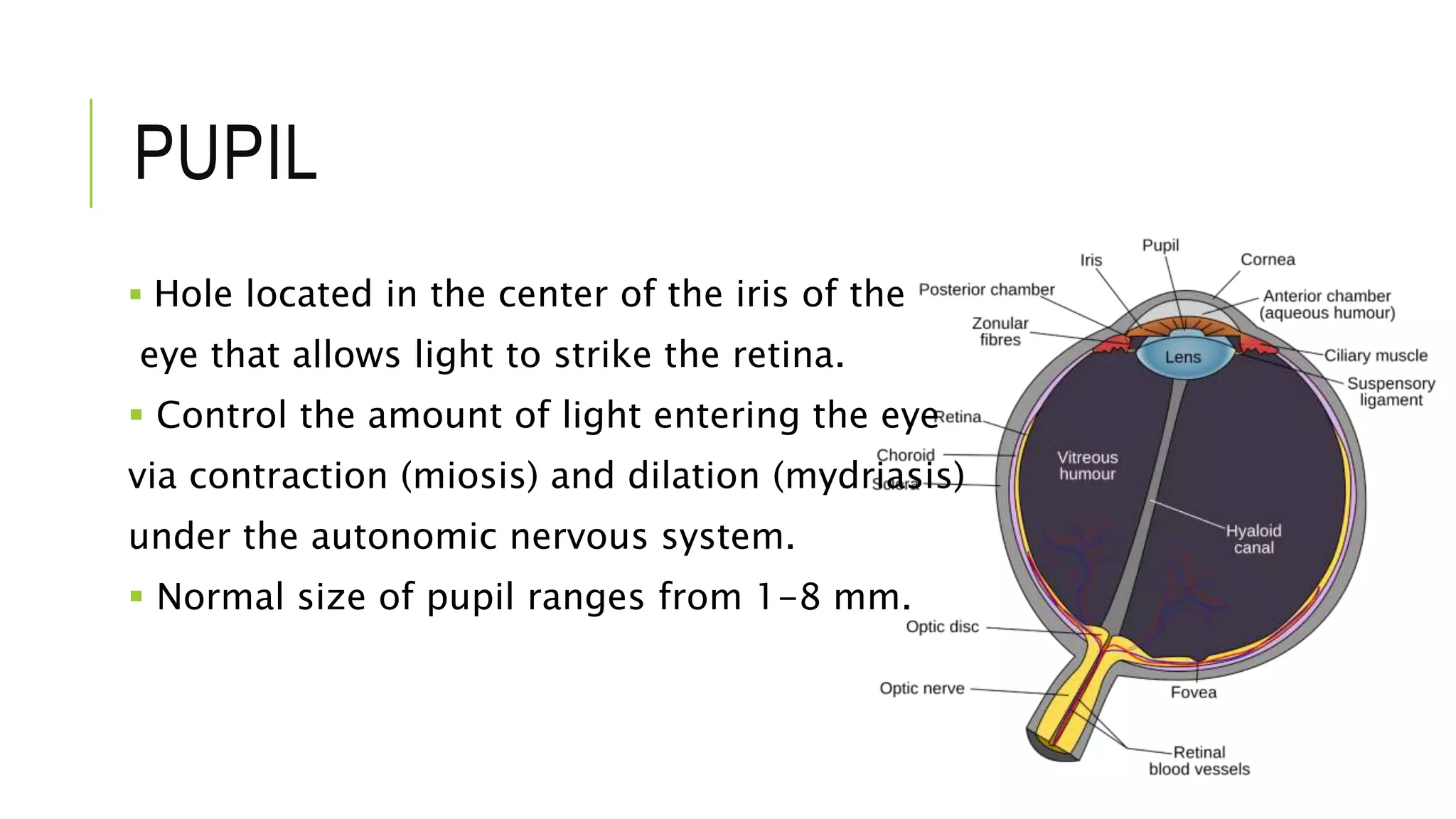
 Hole located in the center of the iris of the
eye that allows light to strike the retina.
 Control the amount of light entering the eye
via contraction (miosis) and dilation (mydriasis)
under the autonomic nervous system.
 Normal size of pupil ranges from 1-8 mm.
NORMAL PUPIL REACTIONS
Mydriasis
“pupil dilate”
sympathetic
activation
parasympathetic
relaxation
Miosis “pupil
constrict”
parasympathetic
activation
sympathetic
relaxation
NORMAL PUPIL REACTIONS
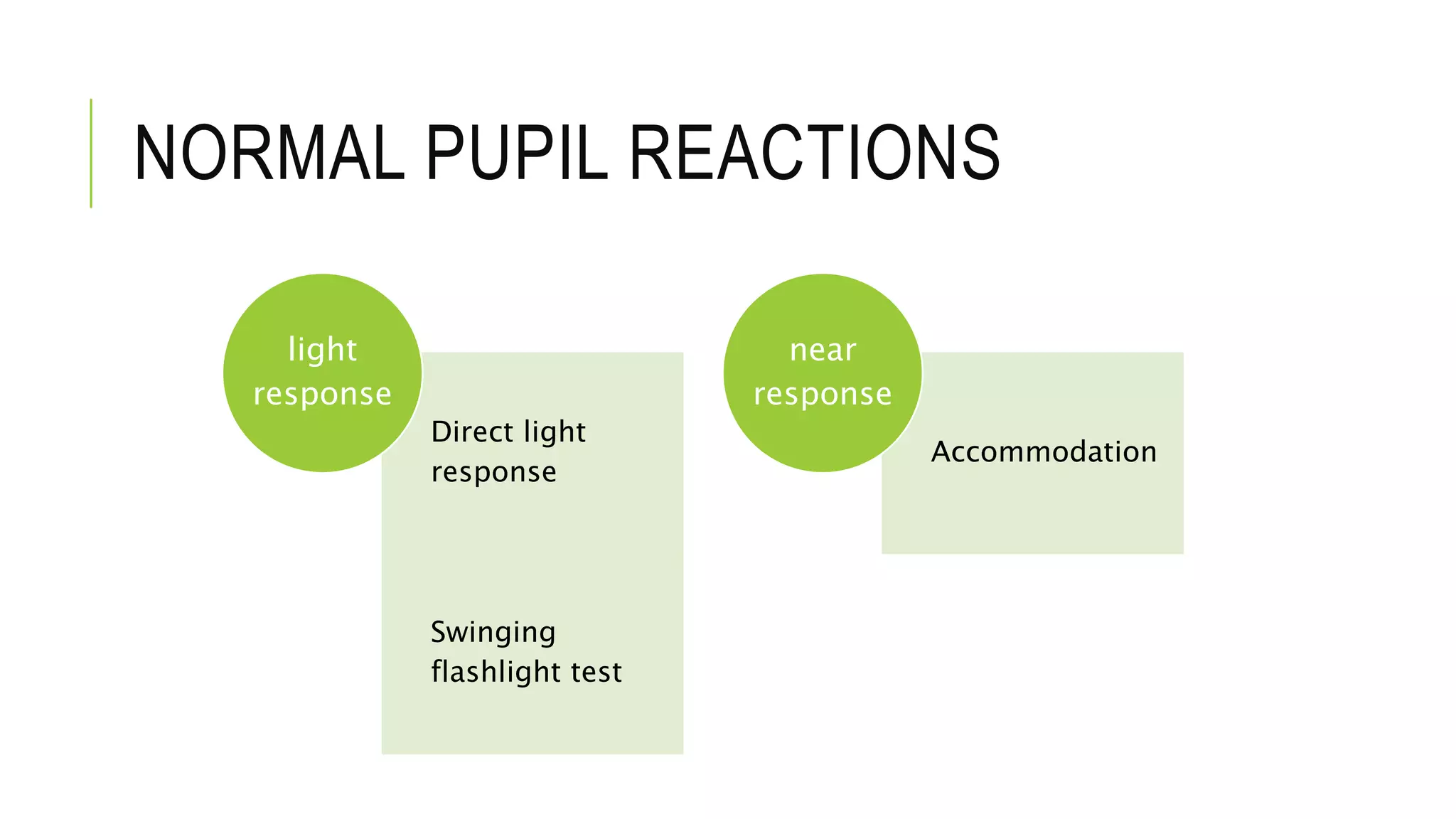
Direct light
response
Swinging
flashlight test
light
response
Accommodation
near
response
NORMAL PUPIL REACTIONS
ABNORMAL PUPILS
ABNORMALLY SHAPED PUPIL
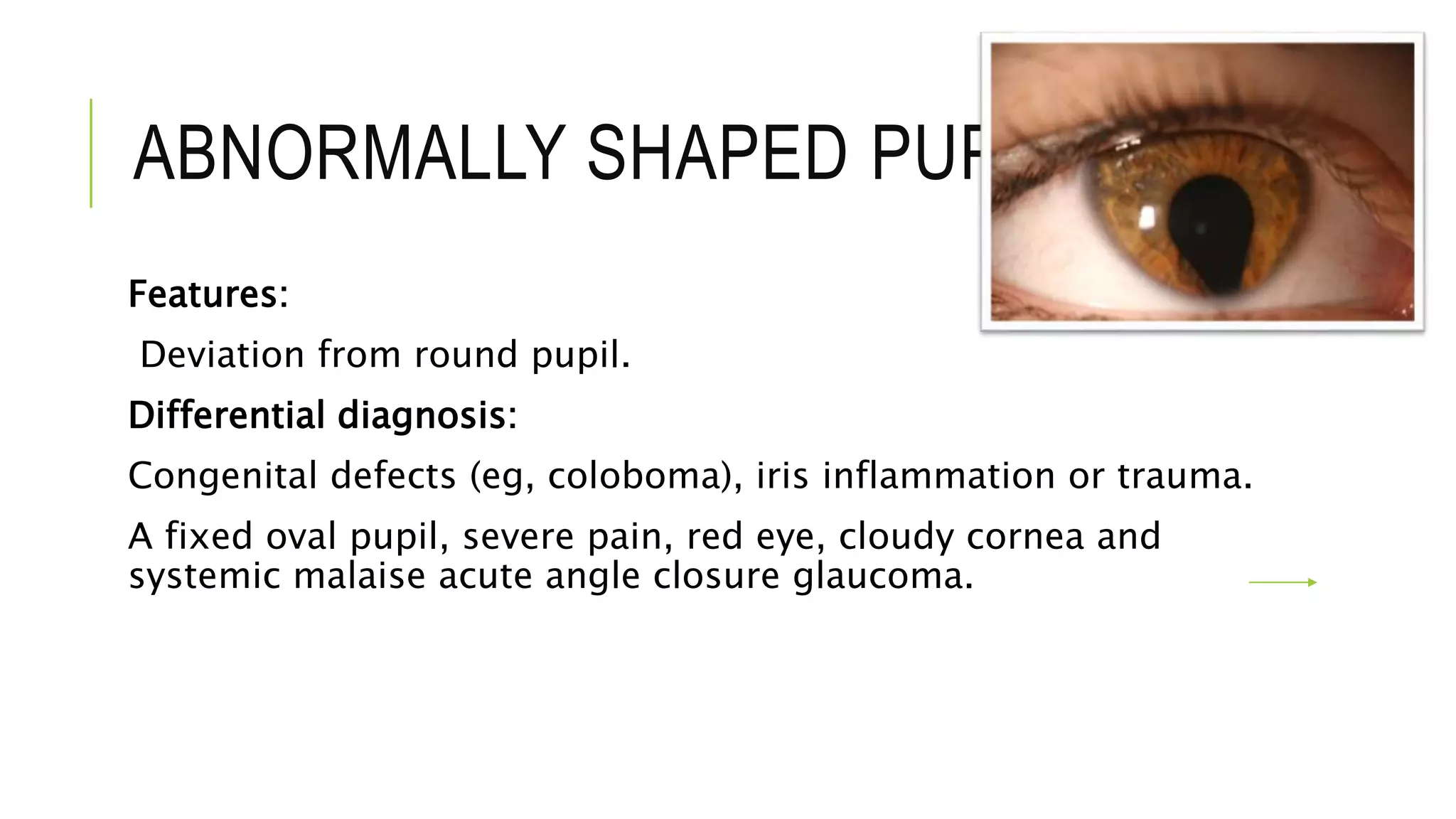
Features:
Deviation from round pupil.
Differential diagnosis:
Congenital defects (eg, coloboma), iris inflammation or trauma.
A fixed oval pupil, severe pain, red eye, cloudy cornea and
systemic malaise acute angle closure glaucoma.
ABNORMALITIES OF PUPIL
 They include ocular disorders and
neurologic disorders.
Abnormalities of pupil
Isocoria with Normal
Pupil Size
Relative Afferent
Pupillary Defect
Bilateral Afferent
Pupillary Defect
Anisocoria with Dilated
Pupil in the Affected
Eye
Complete Oculomotor
Palsy
Tonic Pupil
Iris Defects
Following Eyedrop
Application
Anisocoria with a
Constricted Pupil in the
Affected Eye
Horner Syndrome
Following Eyedrop
Application
Isocoria with
Constricted Pupils
Argyll Robertson Pupil
Bilateral Pupillary
Constriction due to
Pharmacologic Agents
Toxic Bilateral Pupillary
Constriction
Inflammatory Bilateral
Pupillary Constriction
Isocoria with Dilated
Pupils
Parinaud
Oculoglandular
Syndrome
Intoxication
Disorders
1-ISOCORIA WITH NORMAL PUPIL
SIZE
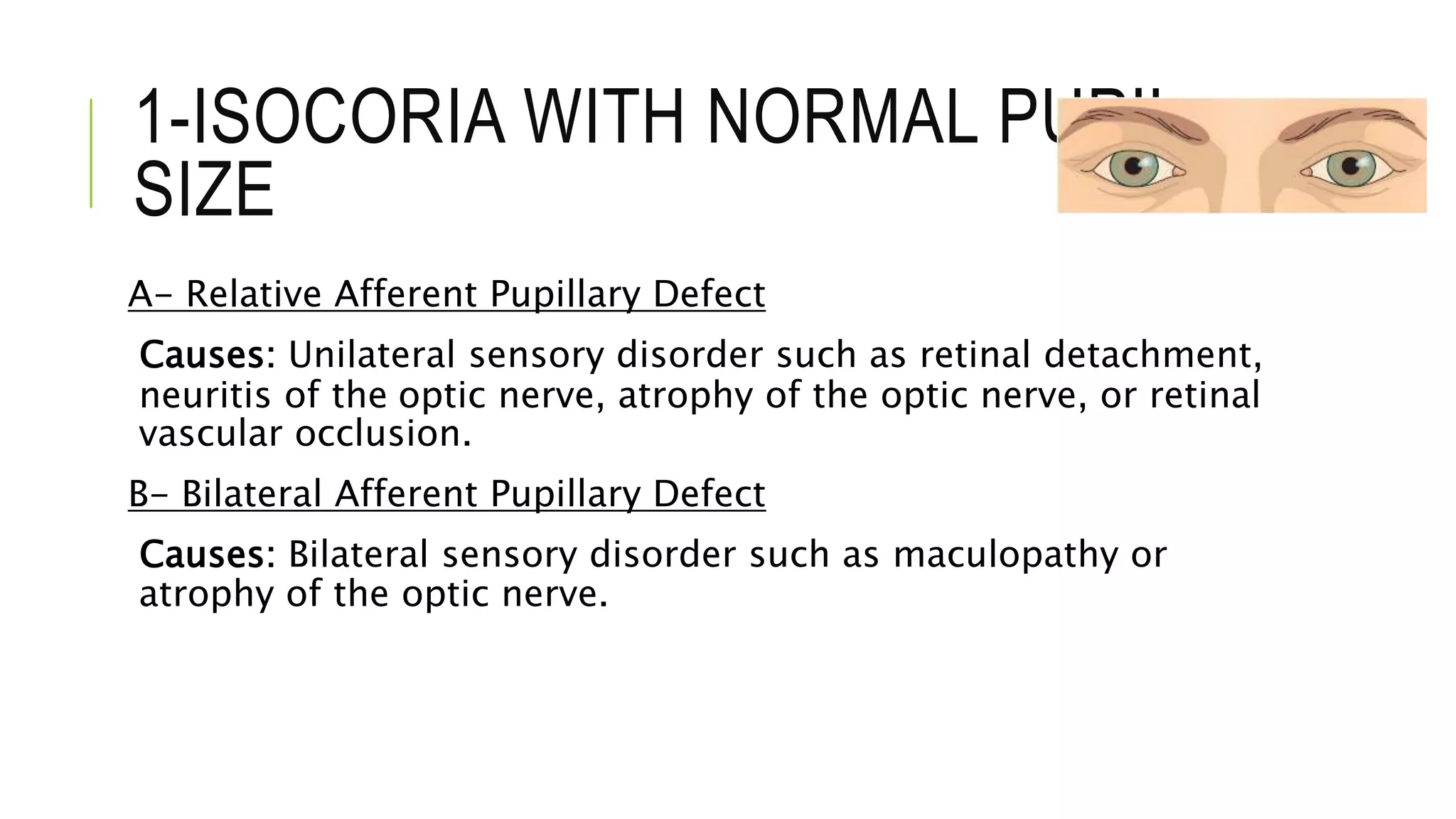
A- Relative Afferent Pupillary Defect
Causes: Unilateral sensory disorder such as retinal detachment,
neuritis of the optic nerve, atrophy of the optic nerve, or retinal
vascular occlusion.
B- Bilateral Afferent Pupillary Defect
Causes: Bilateral sensory disorder such as maculopathy or
atrophy of the optic nerve.
2- ANISOCORIA WITH DILATED
PUPIL
IN THE AFFECTED EYE
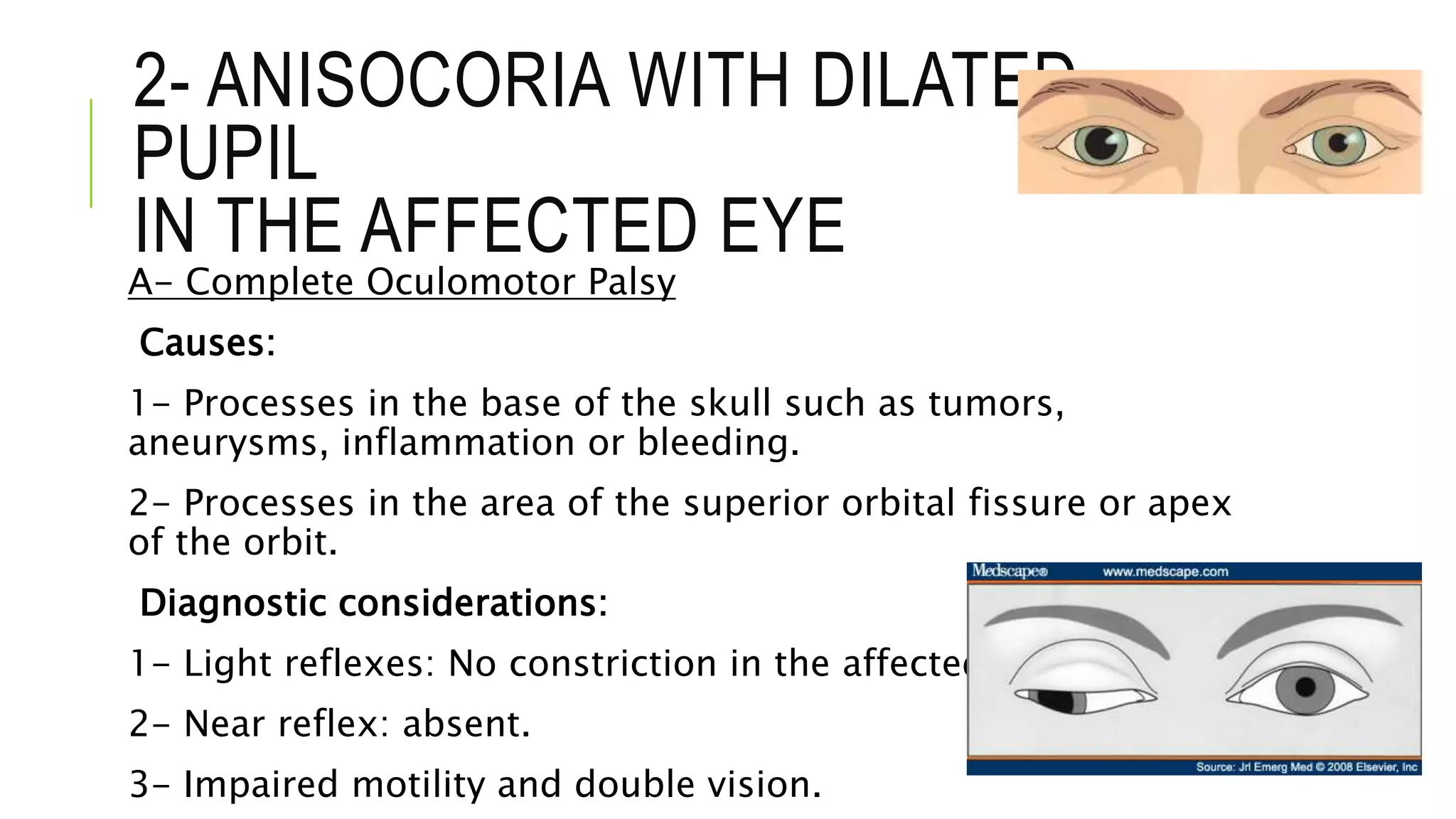
A- Complete Oculomotor Palsy
Causes:
1- Processes in the base of the skull such as tumors,
aneurysms, inflammation or bleeding.
2- Processes in the area of the superior orbital fissure or apex
of the orbit.
Diagnostic considerations:
1- Light reflexes: No constriction in the affected eye.
2- Near reflex: absent.
3- Impaired motility and double vision.
2- ANISOCORIA WITH DILATED
PUPIL IN
THE AFFECTED EYE
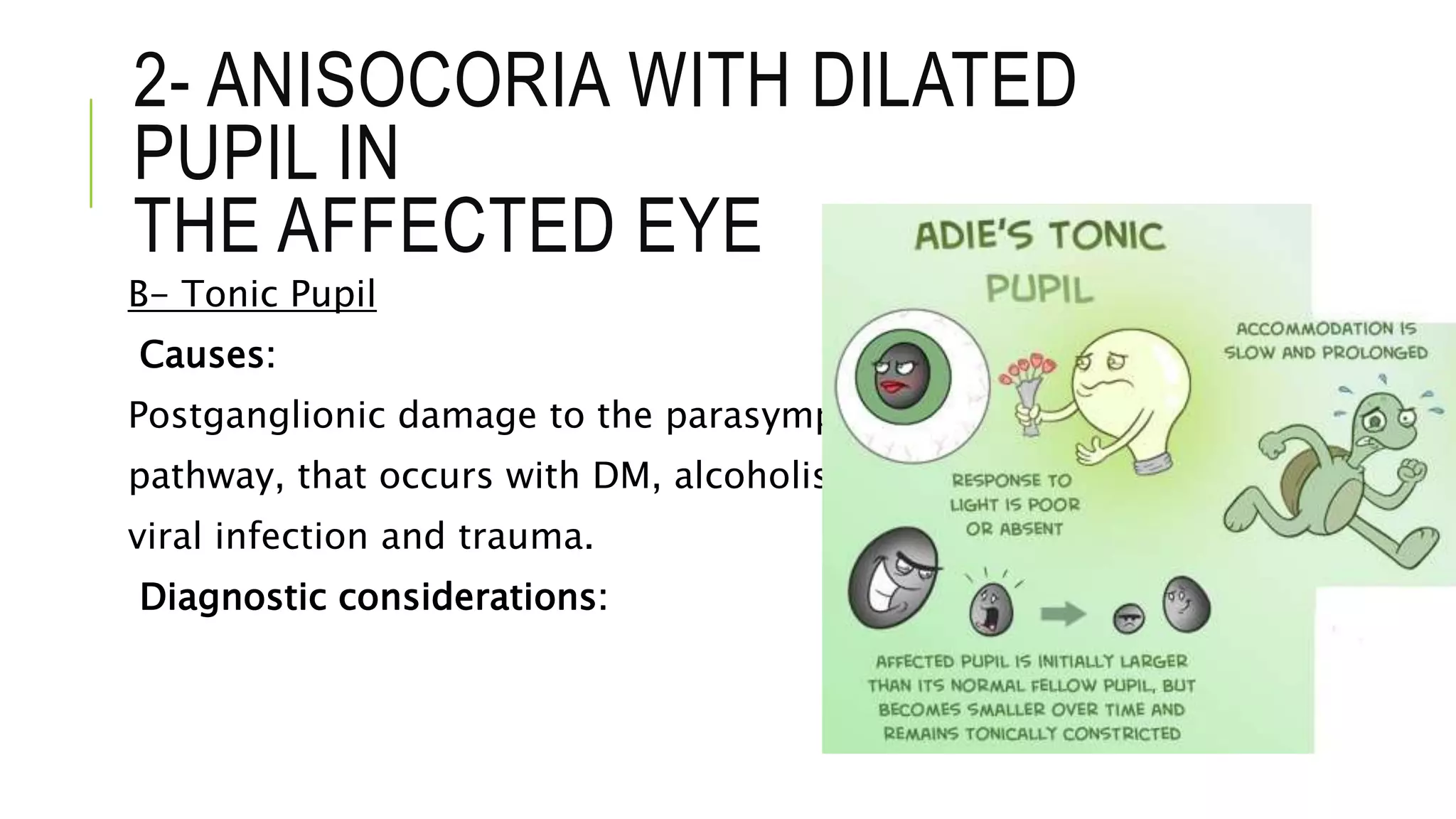
B- Tonic Pupil
Causes:
Postganglionic damage to the parasympathetic
pathway, that occurs with DM, alcoholism,
viral infection and trauma.
Diagnostic considerations:
2- ANISOCORIA WITH DILATED
PUPIL IN
THE AFFECTED EYE
C- Iris Defects
Causes:
Trauma, Secondary to acute angle closure glaucoma, Synechiae
(post-iritis or postoperative)
D- Following Eyedrop Application
By asymmetrical supranuclear inhibition of the Edinger–Westphal
nucleus.
3- ANISOCORIA WITH A
CONSTRICTED PUPIL IN THE
AFFECTED EYE
A- Horner Syndrome
Causes: Damage to the sympathetic pathway.
1- Central (first neuron):
Tumors, Encephalitis
2- Peripheral (second neuron):
Same the central, Trauma ,Rhinopharyngeal tumors, Goiter,
Aneurysm.
3- Peripheral in the strict sense (third neuron):
Vascular processes, Internal carotid aneurysm.
3- ANISOCORIA WITH A
CONSTRICTED PUPIL IN THE
AFFECTED EYE
Clinical picture:
SAMPLE
3- ANISOCORIA WITH A
CONSTRICTED PUPIL IN THE
AFFECTED EYE
Peripheral Horner syndrome.
On the affected side, there is slight mydriasis
On the unaffected side, there is significant mydriasis.
Central Horner syndrome.
On both, the pupils are dilated.
B- Following Eyedrop Application
Unilateral Administration of a Miotic as in Glaucoma Therapy.
4- ISOCORIA WITH CONSTRICTED
PUPILS
A- Argyll Robertson Pupil:
Causes:
The precise location of the lesion is not known.
Diagnostic considerations:
1- The pupil is not roundand and constriction is not
always symmetrical.
2- There is no reaction to darkness or pharmacologic stimuli.
4- ISOCORIA WITH CONSTRICTED
PUPILS
B- Bilateral Pupillary Constriction due to Pharmacologic Agents
Causes:
Morphine, Deep general anesthesia.
C- Toxic Bilateral Pupillary Constriction
Causes:
mushroom poisoning.
D- Inflammatory Bilateral Pupillary Constriction
Causes:
Encephalitis, Meningitis
5- ISOCORIA WITH DILATED PUPILS
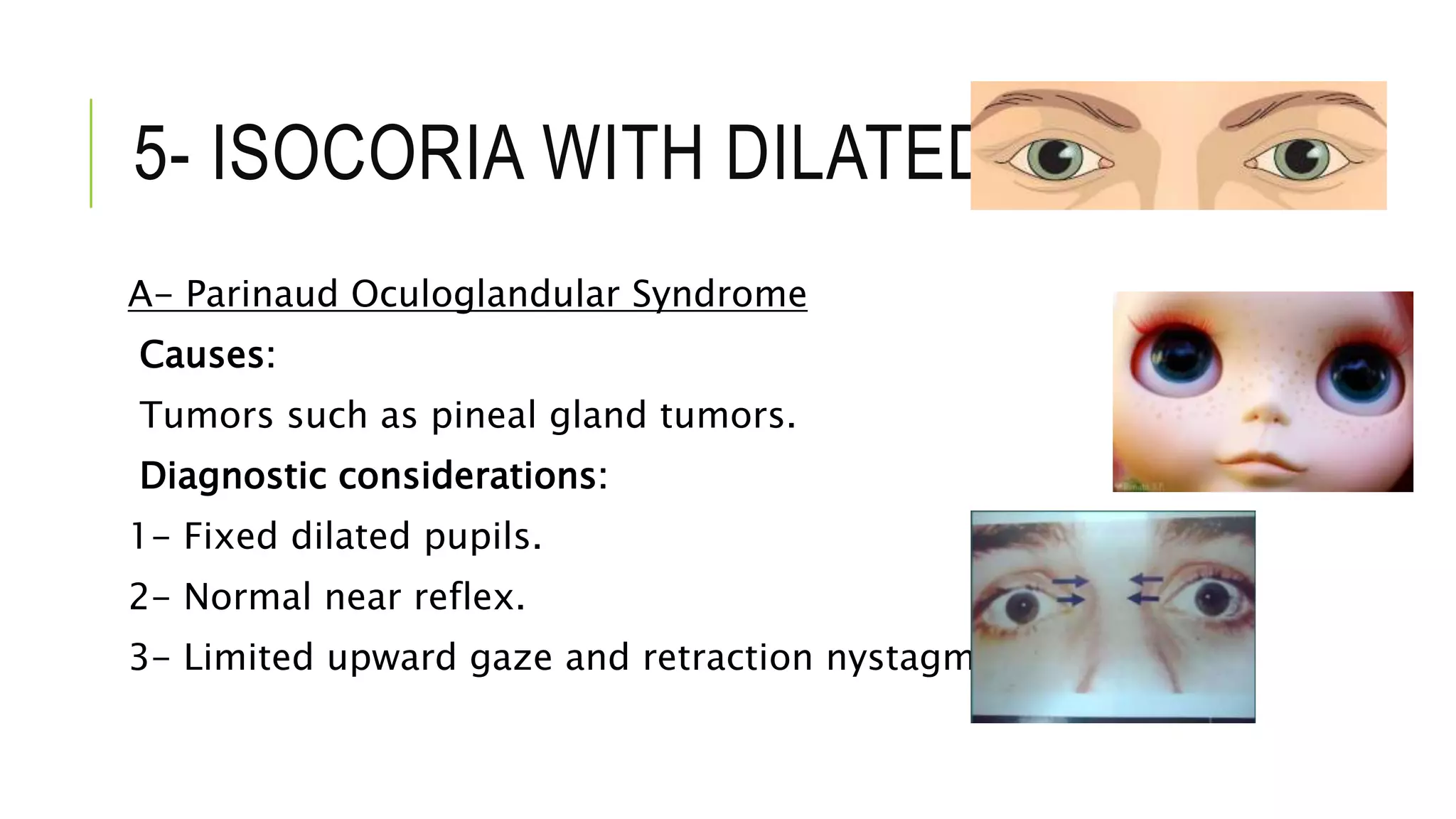
A- Parinaud Oculoglandular Syndrome
Causes:
Tumors such as pineal gland tumors.
Diagnostic considerations:
1- Fixed dilated pupils.
2- Normal near reflex.
3- Limited upward gaze and retraction nystagmus.
5- ISOCORIA WITH DILATED PUPILS
B- Intoxication
Causes:
Atropine, spasmolytic agents, anti-Parkinson agents,
antidepressants, botulism, carbon monoxide and cocaine.
C- Disorders
Causes:
Migraine, Schizophrenia, Hyperthyredosis, Hysteria, Epileptic
seizure and Coma.
HTTP://WWW.IMEDICALAPPS.COM/
SUMMARY
1- Isocoria: the problem in afferent pathway
Anisocoria: the problem in efferent pathway
2- Direct light response, Swinging flashlight test and
accommodation test are important tests to assess the pupil.
3- Disorders cause isocoria: Argyll Robertson Pupil and
Parinaud Oculoglandular Syndrome.
Disorders cause anisocoria: Complete Oculomotor Palsy,
Tonic Pupil and Horner Syndrome.
RESOURCES
1- Ophthalmology A Pocket Textbook Atlas, Gerhard K. Lang,
MD, Oskar Gareis, Gabriele E. Lang, Doris Recker, Peter Wagner,
Second edition
2- Lecture Notes On Ophthalmology, BRUCE JAMES, CHRIS
CHEW, ANTHONY BRON, Ninth Edition
3- http://www.patient.co.uk/doctor/pupillary-abnormalities
Abnormal reactions of pupil

Abnormal reactions of pupil

  • 1.
    ABNORMAL REACTIONS OF PUPIL LamyaaAnwar AlGhafli 211523025
  • 2.
    OBJECTIVES 1- Pupil. 2- NormalPupil Reactions. 3- Anisocoria Vs Isocoria. 4- abnormally shaped pupil. 5- Abnormalities of pupil.
  • 3.
    PUPIL  Hole locatedin the center of the iris of the eye that allows light to strike the retina.  Control the amount of light entering the eye via contraction (miosis) and dilation (mydriasis) under the autonomic nervous system.  Normal size of pupil ranges from 1-8 mm.
  • 4.
    NORMAL PUPIL REACTIONS Mydriasis “pupildilate” sympathetic activation parasympathetic relaxation Miosis “pupil constrict” parasympathetic activation sympathetic relaxation
  • 5.
    NORMAL PUPIL REACTIONS Directlight response Swinging flashlight test light response Accommodation near response
  • 6.
  • 7.
  • 8.
    ABNORMALLY SHAPED PUPIL Features: Deviationfrom round pupil. Differential diagnosis: Congenital defects (eg, coloboma), iris inflammation or trauma. A fixed oval pupil, severe pain, red eye, cloudy cornea and systemic malaise acute angle closure glaucoma.
  • 9.
    ABNORMALITIES OF PUPIL They include ocular disorders and neurologic disorders.
  • 10.
    Abnormalities of pupil Isocoriawith Normal Pupil Size Relative Afferent Pupillary Defect Bilateral Afferent Pupillary Defect Anisocoria with Dilated Pupil in the Affected Eye Complete Oculomotor Palsy Tonic Pupil Iris Defects Following Eyedrop Application Anisocoria with a Constricted Pupil in the Affected Eye Horner Syndrome Following Eyedrop Application Isocoria with Constricted Pupils Argyll Robertson Pupil Bilateral Pupillary Constriction due to Pharmacologic Agents Toxic Bilateral Pupillary Constriction Inflammatory Bilateral Pupillary Constriction Isocoria with Dilated Pupils Parinaud Oculoglandular Syndrome Intoxication Disorders
  • 11.
    1-ISOCORIA WITH NORMALPUPIL SIZE A- Relative Afferent Pupillary Defect Causes: Unilateral sensory disorder such as retinal detachment, neuritis of the optic nerve, atrophy of the optic nerve, or retinal vascular occlusion. B- Bilateral Afferent Pupillary Defect Causes: Bilateral sensory disorder such as maculopathy or atrophy of the optic nerve.
  • 12.
    2- ANISOCORIA WITHDILATED PUPIL IN THE AFFECTED EYE A- Complete Oculomotor Palsy Causes: 1- Processes in the base of the skull such as tumors, aneurysms, inflammation or bleeding. 2- Processes in the area of the superior orbital fissure or apex of the orbit. Diagnostic considerations: 1- Light reflexes: No constriction in the affected eye. 2- Near reflex: absent. 3- Impaired motility and double vision.
  • 13.
    2- ANISOCORIA WITHDILATED PUPIL IN THE AFFECTED EYE B- Tonic Pupil Causes: Postganglionic damage to the parasympathetic pathway, that occurs with DM, alcoholism, viral infection and trauma. Diagnostic considerations:
  • 14.
    2- ANISOCORIA WITHDILATED PUPIL IN THE AFFECTED EYE C- Iris Defects Causes: Trauma, Secondary to acute angle closure glaucoma, Synechiae (post-iritis or postoperative) D- Following Eyedrop Application By asymmetrical supranuclear inhibition of the Edinger–Westphal nucleus.
  • 15.
    3- ANISOCORIA WITHA CONSTRICTED PUPIL IN THE AFFECTED EYE A- Horner Syndrome Causes: Damage to the sympathetic pathway. 1- Central (first neuron): Tumors, Encephalitis 2- Peripheral (second neuron): Same the central, Trauma ,Rhinopharyngeal tumors, Goiter, Aneurysm. 3- Peripheral in the strict sense (third neuron): Vascular processes, Internal carotid aneurysm.
  • 16.
    3- ANISOCORIA WITHA CONSTRICTED PUPIL IN THE AFFECTED EYE Clinical picture: SAMPLE
  • 17.
    3- ANISOCORIA WITHA CONSTRICTED PUPIL IN THE AFFECTED EYE Peripheral Horner syndrome. On the affected side, there is slight mydriasis On the unaffected side, there is significant mydriasis. Central Horner syndrome. On both, the pupils are dilated. B- Following Eyedrop Application Unilateral Administration of a Miotic as in Glaucoma Therapy.
  • 18.
    4- ISOCORIA WITHCONSTRICTED PUPILS A- Argyll Robertson Pupil: Causes: The precise location of the lesion is not known. Diagnostic considerations: 1- The pupil is not roundand and constriction is not always symmetrical. 2- There is no reaction to darkness or pharmacologic stimuli.
  • 19.
    4- ISOCORIA WITHCONSTRICTED PUPILS B- Bilateral Pupillary Constriction due to Pharmacologic Agents Causes: Morphine, Deep general anesthesia. C- Toxic Bilateral Pupillary Constriction Causes: mushroom poisoning. D- Inflammatory Bilateral Pupillary Constriction Causes: Encephalitis, Meningitis
  • 20.
    5- ISOCORIA WITHDILATED PUPILS A- Parinaud Oculoglandular Syndrome Causes: Tumors such as pineal gland tumors. Diagnostic considerations: 1- Fixed dilated pupils. 2- Normal near reflex. 3- Limited upward gaze and retraction nystagmus.
  • 21.
    5- ISOCORIA WITHDILATED PUPILS B- Intoxication Causes: Atropine, spasmolytic agents, anti-Parkinson agents, antidepressants, botulism, carbon monoxide and cocaine. C- Disorders Causes: Migraine, Schizophrenia, Hyperthyredosis, Hysteria, Epileptic seizure and Coma.
  • 22.
  • 23.
    SUMMARY 1- Isocoria: theproblem in afferent pathway Anisocoria: the problem in efferent pathway 2- Direct light response, Swinging flashlight test and accommodation test are important tests to assess the pupil. 3- Disorders cause isocoria: Argyll Robertson Pupil and Parinaud Oculoglandular Syndrome. Disorders cause anisocoria: Complete Oculomotor Palsy, Tonic Pupil and Horner Syndrome.
  • 24.
    RESOURCES 1- Ophthalmology APocket Textbook Atlas, Gerhard K. Lang, MD, Oskar Gareis, Gabriele E. Lang, Doris Recker, Peter Wagner, Second edition 2- Lecture Notes On Ophthalmology, BRUCE JAMES, CHRIS CHEW, ANTHONY BRON, Ninth Edition 3- http://www.patient.co.uk/doctor/pupillary-abnormalities