HETEROPHORIA
PRESENTED BY
RANJANA ARYAL
BOVS-2ND YEAR
DEFINITION
• Condition wherein tendency of the
eyes to deviate is kept latent by
fusional reflex
• Both visual axes are directed
towards the fixation point but
deviate in dissociation
• Also called latent strabismus
CLASSIFICATION
A)ON THE BASIS OF DIRECTION OF
DEVIATION
1)Esophoria
 Convergence excess
 Divergence excess
 Non specific(basic)
2)Exophoria
 Convergence weakness
 Divergence excess
 Non specific(basic)
3)Hyperphoria /hyophoria
4)Cyclophoria
B)ON THE BASIS OF SYMPTOMS
1)Compensated
2)Decompensated
1)ESOPHORIA
 Non deviating eye becomes
convergent i.e deviates nasally
when fusion is interrupted
 Less frequent than exophoria
CLINICAL TYPES
a)Convergrnce excess :esophoria
greater on near fixation than on
distance fixation
b)Divergence weakness:eso greater
on distance than near
 c)Non specific:doesnot vary in
degree for any distance
ETIOLOGY
 Endopthalmos
 Narrow IPD
 Eom anomalies
 Refractive
causes:hypermetropia,anisometropi
a,
high AC/A ratio,weak divergent
fusional reserve
2)EXOPHORIA
 Non fixitating eye becomes
divergent on dissociation
 Commonest type of heterophoria
CLINICAL TYPES
a)Convergence weakness;exophoria
greater on near than distant fixation
b)Divergence excess:exo greater on
distance than near fixation
c)Non specific:no variation of degree
for any distance
ETIOLOGY
 Anatomical
anomalies:exopthalmos,wide
IPD,EOM anomalies
 Refractive
anomalies:myopia,presbyopia &
anisometropia
 Weak convergent fusional reserve
 Passage of time
3)HYPERPHORIA/HYPOPHORIA
 Vertical deviation occurring on
dissociation in which one eye
rotates upwards and the other
downwards depending on the
fixation
ETIOLOGY
 Refractive: High myopia (heavy eye
syndrome)
 Weak vertical fusional reserves
 Anatomical: Displaced globes,
abnormal extraocular muscles,
ptosi
4)CYCLOPHORIA
 Either eye wheel rotates on
dissociation, so that the upper end of
the vertical axis is nasal
(incyclophoria) or temporal
(excyclophoria)
ETIOLOGY
 Oblique astigmatism
B1)COMPENSATED
HETEROPHORIA
 Controlled heterophia with no
symptoms
 Accounts for majority of population
2)DECOMPENSATED
HETEROPHORIA
 Occurs with the inability to control
the angle of deviation through
inadequate fusional amplitudes
CAUSES OF DECOMPENSATION
 Optical: Under-, over- or
uncorrected refractive errors.
Wrongly prescribed spectacles. Ill-
fitting spectacles. Aniseikonia.
 Medical: Poor general health.
Fatigue. Head injury affecting
fusional abilities. Drugs affecting
accommodation. Alcohol.
Dissociative/monocular viewing
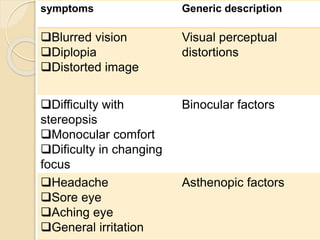
symptoms Generic description
Blurred vision
Diplopia
Distorted image
Visual perceptual
distortions
Difficulty with
stereopsis
Monocular comfort
Dificulty in changing
focus
Binocular factors
Headache
Sore eye
Aching eye
General irritation
Asthenopic factors
Refrences
 Pickwell’s binocular vision anomalies
 Binocular vision and orthoptics
 A.K Khurana
Heterophoria;Definiton,classification and etiology

Heterophoria;Definiton,classification and etiology

  • 1.
  • 2.
    DEFINITION • Condition whereintendency of the eyes to deviate is kept latent by fusional reflex • Both visual axes are directed towards the fixation point but deviate in dissociation • Also called latent strabismus
  • 3.
    CLASSIFICATION A)ON THE BASISOF DIRECTION OF DEVIATION 1)Esophoria  Convergence excess  Divergence excess  Non specific(basic)
  • 4.
    2)Exophoria  Convergence weakness Divergence excess  Non specific(basic) 3)Hyperphoria /hyophoria 4)Cyclophoria
  • 5.
    B)ON THE BASISOF SYMPTOMS 1)Compensated 2)Decompensated
  • 6.
    1)ESOPHORIA  Non deviatingeye becomes convergent i.e deviates nasally when fusion is interrupted  Less frequent than exophoria CLINICAL TYPES a)Convergrnce excess :esophoria greater on near fixation than on distance fixation
  • 7.
    b)Divergence weakness:eso greater ondistance than near  c)Non specific:doesnot vary in degree for any distance
  • 8.
    ETIOLOGY  Endopthalmos  NarrowIPD  Eom anomalies  Refractive causes:hypermetropia,anisometropi a, high AC/A ratio,weak divergent fusional reserve
  • 9.
    2)EXOPHORIA  Non fixitatingeye becomes divergent on dissociation  Commonest type of heterophoria CLINICAL TYPES a)Convergence weakness;exophoria greater on near than distant fixation b)Divergence excess:exo greater on distance than near fixation c)Non specific:no variation of degree for any distance
  • 10.
    ETIOLOGY  Anatomical anomalies:exopthalmos,wide IPD,EOM anomalies Refractive anomalies:myopia,presbyopia & anisometropia  Weak convergent fusional reserve  Passage of time
  • 11.
    3)HYPERPHORIA/HYPOPHORIA  Vertical deviationoccurring on dissociation in which one eye rotates upwards and the other downwards depending on the fixation ETIOLOGY  Refractive: High myopia (heavy eye syndrome)  Weak vertical fusional reserves  Anatomical: Displaced globes, abnormal extraocular muscles, ptosi
  • 12.
    4)CYCLOPHORIA  Either eyewheel rotates on dissociation, so that the upper end of the vertical axis is nasal (incyclophoria) or temporal (excyclophoria) ETIOLOGY  Oblique astigmatism
  • 13.
    B1)COMPENSATED HETEROPHORIA  Controlled heterophiawith no symptoms  Accounts for majority of population 2)DECOMPENSATED HETEROPHORIA  Occurs with the inability to control the angle of deviation through inadequate fusional amplitudes
  • 14.
    CAUSES OF DECOMPENSATION Optical: Under-, over- or uncorrected refractive errors. Wrongly prescribed spectacles. Ill- fitting spectacles. Aniseikonia.  Medical: Poor general health. Fatigue. Head injury affecting fusional abilities. Drugs affecting accommodation. Alcohol. Dissociative/monocular viewing
  • 15.
    symptoms Generic description Blurredvision Diplopia Distorted image Visual perceptual distortions Difficulty with stereopsis Monocular comfort Dificulty in changing focus Binocular factors Headache Sore eye Aching eye General irritation Asthenopic factors
  • 16.
    Refrences  Pickwell’s binocularvision anomalies  Binocular vision and orthoptics  A.K Khurana