Tuberculosis


  Robert L. Copeland, Jr., Ph.D. Brian Tracy .

               Hong Fan
 Department of Respiratory Diseases,
West China Hospital, Sichuan University
Introduction:
         Infects 1/3 to ½ of world population..!
         3 million deaths due to TB every year
         Under privileged population -
           Crowding, Poverty, malnutrition, single
           male..!
         Since 1985 incidence is increasing in west
           AIDS, Diabetes, Immunosuppressed
           patients, Diabetes, Drug resistance.

Fan H.
Tuberculosis (TB) remains the leading cause of death
         worldwide from a single infectious disease agent.
         Indeed up to 1/2 of the world's population is
         infected with TB. The registered number of new
         cases of TB worldwide roughly correlates with
         economic conditions: the highest incidences are seen
         in those countries of Africa, Asia, and Latin America
         with the lowest gross national products. WHO
         estimates that eight million people get TB every year,
         of whom 95% live in developing countries. An
         estimated 2 million people die from TB every year.

Fan H.
It is estimated that between 2000 and 2020, nearly
         one billion people will be newly infected, 200
         million people will get sick, and 35 million will die
         from TB - if control is not further strengthened. The
         mechanisms, pathogenesis, and prophylaxis
         knowledge is minimal. After a century of decline TB
         is increasing and there are strains emerging which
         are resistant to antibiotics. This excess of cases is
         attributable to the changes in the social structure in
         cities, the human immunodeficiency virus epidemic,
         and failure of most cities to improve public health
         programs, and the economic cost of treating.

Fan H.
With the increased incidence of AIDS, TB has
         become more a problem in the U.S., and the
         world.
         It is currently estimated that 1/2 of the world's
         population (3.1 billion) is infected with
         Mycobacterium tuberculosis. Mycobacterium
         avium complex is associated with AIDS
         related TB.


Fan H.
TB is an ancient infectious disease caused by
         Mycobacterium tuberculosis. It has been
         known since 1000 B.C., so it not a new
         disease. Since TB is a disease of respiratory
         transmission, optimal conditions for
         transmission include:
            overcrowding
            poor personal hygiene
            poor public hygiene

Fan H.
Transmission
         Pulmonary tuberculosis is a disease of
         respiratory transmission, Patients with the
         active disease (bacilli) expel them into the air
         by:
           coughing,
           sneezing,
           shouting,
           or any other way that will expel bacilli into the air


Fan H.
Once inhaled by a tuberculin free person, the
         bacilli multiply 4 -6 weeks and spreads
         throughout the body. The bacilli implant in
         areas of high partial pressure of oxygen:
         lung
         renal cortex
         reticuloendothelial system


Fan H.
This is known as the primary infection. The patient
         will heal and a scar will appear in the infected loci.
         There will also be a few viable bacilli/spores may
         remain in these areas (particularly in the lung). The
         bacteria at this time goes into a dormant state, as long
         as the person's immune system remains active and
         functions normally this person isn't bothered by the
         dormant bacillus.
         When a person's immune system is depressed., a
         secondary reactivation occurs. 85-90% of the cases
         seen which are of secondary reactivation type occurs
         in the lungs.

Fan H.
Fan H.
Pathogenesis of TB:

         Type IV hypersensitivity – T cells –
         Macrophages Granuloma
         Activated macrophages – epithelioid cells.
         Remain viable inside macrophages (Mycolic
         acid wax coat)
         Cord Factor - surface glycolipid Antigenic.
         Self destruction by lysosomal enzymes.

Fan H.
Fan H.
Hypersensitity – Immunity


Fan H.
Microbiology of TB:
         Mycobacteria – ‘fungus like..
         Bacilli, Aerobic, non motile, no toxins,
         no spore.
         Mycolic acid wax in cell wall
         Carbol dye - Acid & alcohol fast (AFB)
         M. tuberculosis & M. bovis
         M. avium, M.intracellulare in AIDS -
         Atypical TB

Fan H.
AFB - Ziehl-Nielson stain
Colony Morphology – LJ Slant
Classification of TB
     1. Primary Pulmonary TB
     2. Miliary TB (acute, subacute, chronic)
     3. Secondary TB
          (invasive, carvitary, caseation ,
           Tuberculous Granulomas …)
     4. Tuberculous Pleuritis
     5. Extra-pulmonary TB
          (bone, joints, renal, adrenal,skin… )

Fan H.
Primary tuberculosis
         In a non immunized individual – children* adult*
         Deep inhalation of airborne droplet ~ 3 microns.
         Bacilli locate in the subpleural mid zone of lung
         Localized "atypical" pneumonia
         Brief acute inflammation – neutrophils.
         5-6 days invoke granuloma formation.
         2 to 8 weeks – healing – single round -Ghon focus.
         If lymph node is also involved Ghon complex.


Fan H.
Primary or Ghon’s Complex

         Primary tuberculosis is
         the pattern seen with
         initial infection with
         tuberculosis in children.
         Reactivation, or
         secondary tuberculosis,
         is more typically seen in
         adults.


Fan H.
Primary Tuberculosis
         In Non Immunized individuals (Children)
         Primary Tuberculosis:
           Self Limited disease
           Ghons focus, complex or Primary complex.


         Primary Progressive TB ( in US. )
           Miliary TB and TB Meningitis.
           Common in malnourished children
           10% of adults, Immuno-suppressed individuals
Fan H.
Secondary Tuberculosis:

         Post Primary in immunized individuals.
         Cavitary Granulomatous response.
         Reactivation or Reinfection
         Apical lobes or upper part of lower lobes – O2
         Caseation, cavity - soft granuloma
         Pulmonary or extra-pulmonary
         Local or systemic spread / Miliary
           Vein – via left ventricle to whole body
           Artery – miliary spread within the lung

Fan H.
Secondary Tuberculosis:

         Reactivation occurs in 10-15% of patients.
         Most commonly males 30-50 y
         Slowly Progressive (several months)
         Cough, sputum, Low grade fever, night sweats,
         fatigue and weight loss.
         Hemoptysis or pleuritic pain = severe disease


Fan H.
Ghon Complex


Fan H.
Miliary TB
Miliary TB
Millet like – grain.
Extensive micro spread.
Through blood or
bronchial spread
Low immunity
Pulmonary or Systemic
types.
Miliary TB Lung
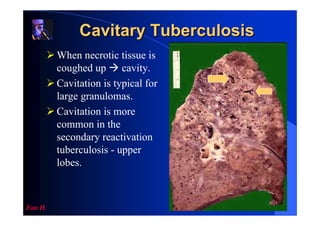
Cavitary Tuberculosis
         When necrotic tissue is
         coughed up cavity.
         Cavitation is typical for
         large granulomas.
         Cavitation is more
         common in the
         secondary reactivation
         tuberculosis - upper
         lobes.


Fan H.
Fan H.
Fan H.
Fan H.
Tuberculous Granulomas
Caseation Necrosis
Epitheloid cells in Granuloma
Cells in Granuloma
Morphology of Granuloma
    1. Rounded tight collection of chronic
       inflammatory cells.
    2. Central Caseous necrosis.
    3. Active macrophages - epithelioid cells.
    4. Outer layer of lymphocytes, plasma cells
       & fibroblasts.
    5. Langhans giant cells – joined epithelioid
       cells.

Fan H.
Tuberculous Granuloma
Cavitary Secondary TB
Systemic Miliary TB
Adrenal TB - Addison Disease
Spinal TB - Potts Disease
Diagnosis of TB
         Clinical features are not confirmatory.
         Zeil Nielson Stain - 1x10⁴/ml, 60% sensitivity
         Release of acid-fast bacilli from cavities intermittent.
         3 negative smears to assure low infectivity*
         Culture most sensitive and specific test.
           Conventional Lowenstein Jensen media 3-6 wks.
           Automated techniques within 9-16 days
         PCR is available, but should only be performed by
         experienced laboratories
         PPD for clinical activity / exposure sometime in life.
Fan H.
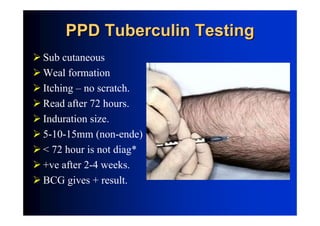
PPD Tuberculin Testing
Sub cutaneous
Weal formation
Itching – no scratch.
Read after 72 hours.
Induration size.
5-10-15mm (non-ende)
< 72 hour is not diag*
+ve after 2-4 weeks.
BCG gives + result.
PPD Testing
Granuloma or LH giant cell is not
         pathagnomonic of TB…!


Foreign body granuloma.
Fat necrosis.
Fungal infections.
Sarcoidosis.
Crohns disease.
"Troubles are often
the tools by which God
 fashions us for better
        things."

      - Henry Ward Beecher
Classification of Drugs
         3 Groups depending upon the degree of effectiveness and
         potential side effects
            First Line: (Primary agents)
               are the most effective and have lowest toxicity. Isoniazid
               (H), Rifampin(R)
            Second Line:
               Less effective and more toxic effects
               include (in no particular order): p-amino salicylic acid,
               Streptomycin(S), pyrazinamide(Z), Ethambutol(E),
            Third Line
               are least effective and most toxic. Amikacin, Kanamycin,
               Capreomycin, Viomycin, Kanamycin, Cycloserine

Fan H.
Isoniazid


         Considered the drug of choice for the
         chemotherapy of TB. discovered in 1945 a
         hydrazide of isonicotonic acid
           is bacteriostatic for resting bacilli,
           bactericidal for growing bacilli.


Fan H.
Treatment
   2HRZE/4HRE, 2HRSE/4HRE
                           ( 6---18months ) in China
    (in the U.S. ,Isoniazid, Ethambutol, & Rifampin are
   given for 2 months. Isoniazid & Rifampin are given for 4
   months. If you suspect resistance to isoniazid use
   (HRZE)Isoniazid, Ethambutol, Rifampin & Parazinamide.
   Incidence of drug resistance is 2-5% in the U.S. )
   Prolonged bed rest is not necessary or helpful in obtaining
   a speedy recovery. The patient must be seen at regular and
   frequent intervals to follow the course of the disease and
   treatment. Look for toxic effects
Fan H.
Chemoprophylaxis of TB
             Used only in high risk groups
         Household members and other close contacts
         of a patient with active TB.
         A positive skin test in persons less than 35
         years.
         A positive skin test reactive in the
         immunosuppressed, persons with leukemia,
         and Hodgkin's Disease,
         HIV + patients with a positive TB test,
         ( INH 300mg/d, 6—8m. )
Fan H.
The drug of choice for chemoprophylaxis is
           isoniazid. Prophylaxis uses only one drug.
           In patients who are HIV+ and TB+ and have
           the disease; they are treated for a minimum of
           9 months, 2HR/7HR?? ?
         (The first 2 months using HR(isoniazid and
           rifampin) and for the next 7 months or longer,
           use only 2 or 3 of the 2nd/3rd line drugs and
           Isoniazid/Rifampin. )

Fan H.
Conclusions:
         A chronic, common, infectious disease - Weight loss,
         fever, night sweats, lung damage.
         Commonest fatal infectious disease in the world.
         CXR – apical of upper lob, basal of lower lob lesions
         (CXR atypical AIDS)
         AIDS, Diabetes, malnutrition (poverty), crowding.
         Five / (Two forms Primary, Secondary in US.)
         Pulmonary,miliary,invasive,pleuritis,extrapulmonary,.
         AFB(sputum stain +) - infectiousness - isolation
          to prevent selection of resistance
         Prevention depends on PPD & INH prophylaxis
Fan H.
WARNING!

    Rifampin and Isoniazid are the most effective drugs for
    the treatment of TB, The drug enjoys high patient
    compliance and acceptability. But these 2 drugs should
    never be given alone! They are always used in
    combination because resistance occurs to one drug alone
    very rapidly. They are used in combination with each
    other initially as well as other drugs. Bacilli must become
    resistant to two drugs in order to remain viable.
    Statistically, the chances are verv small of the bacilli
    becoming resistant to both. . Prophylaxis is with one drug
    usually isoniazid.
Fan H.
What is New…?
         14-30% of TB patients also HIV infected.
         New drugs - Rifapentine, Interferons,
         Thalidomide.
         Immune therapy : Killed M. vaccine stimulates
         CD8 cells (increased INF and IL-12).
         The genome of TB has been identified (~4000
         genes) potential to develop new vaccines and
         tests.


Fan H.
"When you are faced by
the consequences of past
choices, You see the gift
of a lesson rather than a
curse of a fall.
Brian Tracy

Pulmonary Tuberculosis

  • 1.
    Tuberculosis RobertL. Copeland, Jr., Ph.D. Brian Tracy . Hong Fan Department of Respiratory Diseases, West China Hospital, Sichuan University
  • 2.
    Introduction: Infects 1/3 to ½ of world population..! 3 million deaths due to TB every year Under privileged population - Crowding, Poverty, malnutrition, single male..! Since 1985 incidence is increasing in west AIDS, Diabetes, Immunosuppressed patients, Diabetes, Drug resistance. Fan H.
  • 3.
    Tuberculosis (TB) remainsthe leading cause of death worldwide from a single infectious disease agent. Indeed up to 1/2 of the world's population is infected with TB. The registered number of new cases of TB worldwide roughly correlates with economic conditions: the highest incidences are seen in those countries of Africa, Asia, and Latin America with the lowest gross national products. WHO estimates that eight million people get TB every year, of whom 95% live in developing countries. An estimated 2 million people die from TB every year. Fan H.
  • 4.
    It is estimatedthat between 2000 and 2020, nearly one billion people will be newly infected, 200 million people will get sick, and 35 million will die from TB - if control is not further strengthened. The mechanisms, pathogenesis, and prophylaxis knowledge is minimal. After a century of decline TB is increasing and there are strains emerging which are resistant to antibiotics. This excess of cases is attributable to the changes in the social structure in cities, the human immunodeficiency virus epidemic, and failure of most cities to improve public health programs, and the economic cost of treating. Fan H.
  • 5.
    With the increasedincidence of AIDS, TB has become more a problem in the U.S., and the world. It is currently estimated that 1/2 of the world's population (3.1 billion) is infected with Mycobacterium tuberculosis. Mycobacterium avium complex is associated with AIDS related TB. Fan H.
  • 6.
    TB is anancient infectious disease caused by Mycobacterium tuberculosis. It has been known since 1000 B.C., so it not a new disease. Since TB is a disease of respiratory transmission, optimal conditions for transmission include: overcrowding poor personal hygiene poor public hygiene Fan H.
  • 7.
    Transmission Pulmonary tuberculosis is a disease of respiratory transmission, Patients with the active disease (bacilli) expel them into the air by: coughing, sneezing, shouting, or any other way that will expel bacilli into the air Fan H.
  • 8.
    Once inhaled bya tuberculin free person, the bacilli multiply 4 -6 weeks and spreads throughout the body. The bacilli implant in areas of high partial pressure of oxygen: lung renal cortex reticuloendothelial system Fan H.
  • 9.
    This is knownas the primary infection. The patient will heal and a scar will appear in the infected loci. There will also be a few viable bacilli/spores may remain in these areas (particularly in the lung). The bacteria at this time goes into a dormant state, as long as the person's immune system remains active and functions normally this person isn't bothered by the dormant bacillus. When a person's immune system is depressed., a secondary reactivation occurs. 85-90% of the cases seen which are of secondary reactivation type occurs in the lungs. Fan H.
  • 10.
  • 11.
    Pathogenesis of TB: Type IV hypersensitivity – T cells – Macrophages Granuloma Activated macrophages – epithelioid cells. Remain viable inside macrophages (Mycolic acid wax coat) Cord Factor - surface glycolipid Antigenic. Self destruction by lysosomal enzymes. Fan H.
  • 12.
  • 13.
  • 14.
    Microbiology of TB: Mycobacteria – ‘fungus like.. Bacilli, Aerobic, non motile, no toxins, no spore. Mycolic acid wax in cell wall Carbol dye - Acid & alcohol fast (AFB) M. tuberculosis & M. bovis M. avium, M.intracellulare in AIDS - Atypical TB Fan H.
  • 15.
  • 16.
  • 18.
    Classification of TB 1. Primary Pulmonary TB 2. Miliary TB (acute, subacute, chronic) 3. Secondary TB (invasive, carvitary, caseation , Tuberculous Granulomas …) 4. Tuberculous Pleuritis 5. Extra-pulmonary TB (bone, joints, renal, adrenal,skin… ) Fan H.
  • 19.
    Primary tuberculosis In a non immunized individual – children* adult* Deep inhalation of airborne droplet ~ 3 microns. Bacilli locate in the subpleural mid zone of lung Localized "atypical" pneumonia Brief acute inflammation – neutrophils. 5-6 days invoke granuloma formation. 2 to 8 weeks – healing – single round -Ghon focus. If lymph node is also involved Ghon complex. Fan H.
  • 20.
    Primary or Ghon’sComplex Primary tuberculosis is the pattern seen with initial infection with tuberculosis in children. Reactivation, or secondary tuberculosis, is more typically seen in adults. Fan H.
  • 21.
    Primary Tuberculosis In Non Immunized individuals (Children) Primary Tuberculosis: Self Limited disease Ghons focus, complex or Primary complex. Primary Progressive TB ( in US. ) Miliary TB and TB Meningitis. Common in malnourished children 10% of adults, Immuno-suppressed individuals Fan H.
  • 22.
    Secondary Tuberculosis: Post Primary in immunized individuals. Cavitary Granulomatous response. Reactivation or Reinfection Apical lobes or upper part of lower lobes – O2 Caseation, cavity - soft granuloma Pulmonary or extra-pulmonary Local or systemic spread / Miliary Vein – via left ventricle to whole body Artery – miliary spread within the lung Fan H.
  • 23.
    Secondary Tuberculosis: Reactivation occurs in 10-15% of patients. Most commonly males 30-50 y Slowly Progressive (several months) Cough, sputum, Low grade fever, night sweats, fatigue and weight loss. Hemoptysis or pleuritic pain = severe disease Fan H.
  • 25.
  • 26.
  • 27.
    Miliary TB Millet like– grain. Extensive micro spread. Through blood or bronchial spread Low immunity Pulmonary or Systemic types.
  • 28.
  • 29.
    Cavitary Tuberculosis When necrotic tissue is coughed up cavity. Cavitation is typical for large granulomas. Cavitation is more common in the secondary reactivation tuberculosis - upper lobes. Fan H.
  • 30.
  • 31.
  • 32.
  • 33.
  • 34.
  • 35.
  • 36.
  • 37.
    Morphology of Granuloma 1. Rounded tight collection of chronic inflammatory cells. 2. Central Caseous necrosis. 3. Active macrophages - epithelioid cells. 4. Outer layer of lymphocytes, plasma cells & fibroblasts. 5. Langhans giant cells – joined epithelioid cells. Fan H.
  • 38.
  • 39.
  • 40.
  • 41.
    Adrenal TB -Addison Disease
  • 42.
    Spinal TB -Potts Disease
  • 45.
    Diagnosis of TB Clinical features are not confirmatory. Zeil Nielson Stain - 1x10⁴/ml, 60% sensitivity Release of acid-fast bacilli from cavities intermittent. 3 negative smears to assure low infectivity* Culture most sensitive and specific test. Conventional Lowenstein Jensen media 3-6 wks. Automated techniques within 9-16 days PCR is available, but should only be performed by experienced laboratories PPD for clinical activity / exposure sometime in life. Fan H.
  • 46.
    PPD Tuberculin Testing Subcutaneous Weal formation Itching – no scratch. Read after 72 hours. Induration size. 5-10-15mm (non-ende) < 72 hour is not diag* +ve after 2-4 weeks. BCG gives + result.
  • 47.
  • 48.
    Granuloma or LHgiant cell is not pathagnomonic of TB…! Foreign body granuloma. Fat necrosis. Fungal infections. Sarcoidosis. Crohns disease.
  • 49.
    "Troubles are often thetools by which God fashions us for better things." - Henry Ward Beecher
  • 50.
    Classification of Drugs 3 Groups depending upon the degree of effectiveness and potential side effects First Line: (Primary agents) are the most effective and have lowest toxicity. Isoniazid (H), Rifampin(R) Second Line: Less effective and more toxic effects include (in no particular order): p-amino salicylic acid, Streptomycin(S), pyrazinamide(Z), Ethambutol(E), Third Line are least effective and most toxic. Amikacin, Kanamycin, Capreomycin, Viomycin, Kanamycin, Cycloserine Fan H.
  • 51.
    Isoniazid Considered the drug of choice for the chemotherapy of TB. discovered in 1945 a hydrazide of isonicotonic acid is bacteriostatic for resting bacilli, bactericidal for growing bacilli. Fan H.
  • 52.
    Treatment 2HRZE/4HRE, 2HRSE/4HRE ( 6---18months ) in China (in the U.S. ,Isoniazid, Ethambutol, & Rifampin are given for 2 months. Isoniazid & Rifampin are given for 4 months. If you suspect resistance to isoniazid use (HRZE)Isoniazid, Ethambutol, Rifampin & Parazinamide. Incidence of drug resistance is 2-5% in the U.S. ) Prolonged bed rest is not necessary or helpful in obtaining a speedy recovery. The patient must be seen at regular and frequent intervals to follow the course of the disease and treatment. Look for toxic effects Fan H.
  • 53.
    Chemoprophylaxis of TB Used only in high risk groups Household members and other close contacts of a patient with active TB. A positive skin test in persons less than 35 years. A positive skin test reactive in the immunosuppressed, persons with leukemia, and Hodgkin's Disease, HIV + patients with a positive TB test, ( INH 300mg/d, 6—8m. ) Fan H.
  • 54.
    The drug ofchoice for chemoprophylaxis is isoniazid. Prophylaxis uses only one drug. In patients who are HIV+ and TB+ and have the disease; they are treated for a minimum of 9 months, 2HR/7HR?? ? (The first 2 months using HR(isoniazid and rifampin) and for the next 7 months or longer, use only 2 or 3 of the 2nd/3rd line drugs and Isoniazid/Rifampin. ) Fan H.
  • 55.
    Conclusions: A chronic, common, infectious disease - Weight loss, fever, night sweats, lung damage. Commonest fatal infectious disease in the world. CXR – apical of upper lob, basal of lower lob lesions (CXR atypical AIDS) AIDS, Diabetes, malnutrition (poverty), crowding. Five / (Two forms Primary, Secondary in US.) Pulmonary,miliary,invasive,pleuritis,extrapulmonary,. AFB(sputum stain +) - infectiousness - isolation to prevent selection of resistance Prevention depends on PPD & INH prophylaxis Fan H.
  • 56.
    WARNING! Rifampin and Isoniazid are the most effective drugs for the treatment of TB, The drug enjoys high patient compliance and acceptability. But these 2 drugs should never be given alone! They are always used in combination because resistance occurs to one drug alone very rapidly. They are used in combination with each other initially as well as other drugs. Bacilli must become resistant to two drugs in order to remain viable. Statistically, the chances are verv small of the bacilli becoming resistant to both. . Prophylaxis is with one drug usually isoniazid. Fan H.
  • 57.
    What is New…? 14-30% of TB patients also HIV infected. New drugs - Rifapentine, Interferons, Thalidomide. Immune therapy : Killed M. vaccine stimulates CD8 cells (increased INF and IL-12). The genome of TB has been identified (~4000 genes) potential to develop new vaccines and tests. Fan H.
  • 58.
    "When you arefaced by the consequences of past choices, You see the gift of a lesson rather than a curse of a fall. Brian Tracy