LEUKEMIAS
Acute leukemias
What you will learn now?
๏ฎ Definition
๏ฎ Types
๏ฎ Differences between myloblasts and
lymphoblasts
๏ฎ Pathogenesis( leukemogenesis)
๏ฎ Morphology
๏ฎ Clinical features
๏ฎ Lab findings
Leukemias are the group of disorders
characterized by malignant transformation of
the blood forming cells
๏ฎ It may involve any of the cell lines or a stem cell
common to several cell lines.
๏ฎ Leukemias are classified into 2 major groups
Acute Onset is usually rapid,
The disease is very aggressive,
The cells involved are usually poorly
differentiated with many blasts.
Chronic Onset is insidious,
The disease is usually less aggressive,
The cells involved are usually more mature
cells
๏ฎ Both acute and chronic leukemias are further classified
according to the prominent cell line involved in the
expansion:
๏ฎ If the prominent cell line is of the myeloid series it is a
MYELOCYTIC LEUKEMIA (sometimes also
called granulocytic)
๏ฎ If the prominent cell line is of the lymphoid series it is
a LYMPHOCYTIC LEUKEMIA
๏ฎ Therefore, there are four basic types of
leukemia
๏ฎ Acute myelocytic leukemia โ€“ AML
๏ฎ Acute lymphocytic leukemia โ€“ ALL
๏ฎ Chronic myelocytic leukemia โ€“ CML
๏ฎ Chronic lymphocytic leukemia โ€“ CLL
Etiology
๏ฎ the exact cause is frequently not known, but
predisposing factors are known
๏ฎ Host factors
๏ฎ Environmental factors
Etiology
๏ฎ the exact cause is frequently not known, but
predisposing factors are known
๏ฎ Host factors
๏ฎ Some individuals have an inherited increased
predisposition to develop leukemia
๏ฎ There is an increased incidence in those with an
inherited tendency for chromosome fragility or
abnormality or those with increased numbers of
chromosomes (such as Downโ€™s syndrome). Many of
these diseases are characterized by chromosomal
translocations.
๏ฎ There is an increased incidence in those with
hereditary immunodeficiencies.
๏ฎ There is an increased incidence in those with
chronic marrow dysfunction such as those
with myeloproliferative diseases,
myelodysplastic syndromes, aplastic anemia, or
paroxsymal nocturnal hemoglobinuria.
๏ฎ Environmental factors:
๏ฎ Exposure to ionizing radiation
๏ฎ Exposure to mutagenic chemicals and drugs
๏ฎ Viral infections
Incidence
๏ฎ Acute leukemias can occur in all age groups
๏ฎ ALL is more common in children
๏ฎ AML is more common in adults
๏ฎ Chronic leukemias are usually a disease of
adults
๏ฎ CLL is extremely rare in children and unusual
before the age of 40
๏ฎ CML has a peak age of 30-50
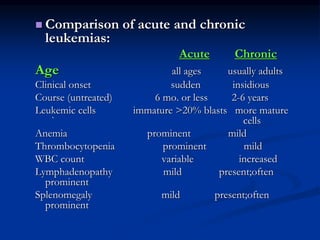
๏ฎ Comparison of acute and chronic
leukemias:
Acute Chronic
Age all ages usually adults
Clinical onset sudden insidious
Course (untreated) 6 mo. or less 2-6 years
Leukemic cells immature >20% blasts more mature
` cells
Anemia prominent mild
Thrombocytopenia prominent mild
WBC count variable increased
Lymphadenopathy mild present;often
prominent
Splenomegaly mild present;often
prominent
Acute leukemia - pathogenesis
๏ฎ Is a result of:
๏ฎ Malignant transformation of a stem cell leading to
unregulated proliferation and
๏ฎ Arrest in maturation at the primitive blast stage.
Remember that a blast is the most immature cell that can
be recognized as committed to a particular cell line.
๏ฎ Leukemic proliferation, accumulation, and invasion of
normal tissues, including the liver, spleen, lymph nodes,
central nervous system, and skin, cause lesions ranging
from rashes to tumors.
๏ฎ A humoral mediator from the leukemic cells may inhibit
proliferation of normal cells.
๏ฎ Failure of the bone marrow and normal hematopoiesis may
result in pancytopenia with death from hemorrhaging and
infections.
Acute leukemias
๏ฎ AML and ALL
๏ฎ FAB classification
AML( 8 subtypes M0 to M7 )
ALL ( L1 to L3 )
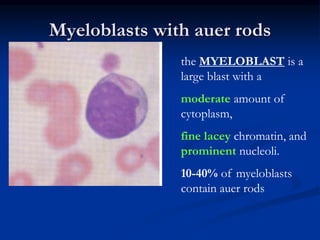
Myeloblasts with auer rods
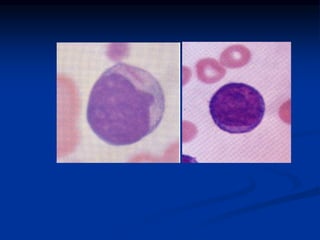
the MYELOBLAST is a
large blast with a
moderate amount of
cytoplasm,
fine lacey chromatin, and
prominent nucleoli.
10-40% of myeloblasts
contain auer rods
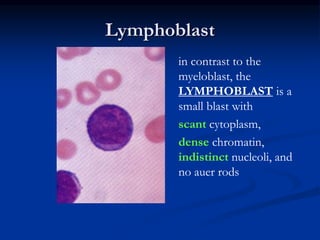
Lymphoblast
in contrast to the
myeloblast, the
LYMPHOBLAST is a
small blast with
scant cytoplasm,
dense chromatin,
indistinct nucleoli, and
no auer rods
Cytochemical stains
1. Myeloperoxidase
2. Sudan black
3. Periodic acid
schiff(PAS)
4. Non specific
esterase
5. Acid phosphatase
1. Myeloblasts( except M0)
2. Immature cells in AML
3. Lymphoblasts ,
erythroblasts
4. Monocytic ( M4 M 5)
5. Monocytic cells and
focally in lymphoblasts
FAB Acute Myeloid Leukemia
M0 Minimally differentiated AML 5% - 10%
Negative or < 3% blasts stain for MPO ,PAS and NSE
blasts are negative for B and T lymphoid antigens, platelet
glycoproteins and erythroid glycophorin A.
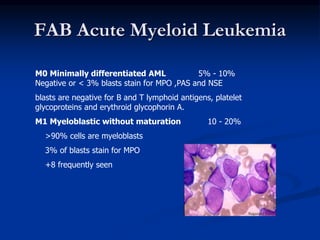
M1 Myeloblastic without maturation 10 - 20%
>90% cells are myeloblasts
3% of blasts stain for MPO
+8 frequently seen
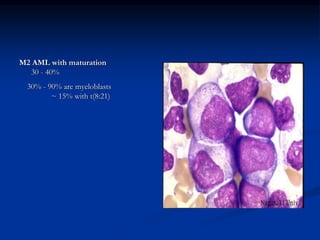
M2 AML with maturation
30 - 40%
30% - 90% are myeloblasts
~ 15% with t(8:21)
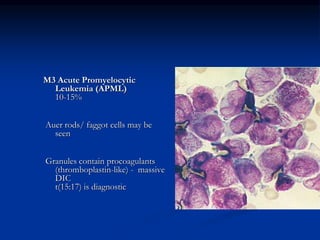
M3 Acute Promyelocytic
Leukemia (APML)
10-15%
Auer rods/ faggot cells may be
seen
Granules contain procoagulants
(thromboplastin-like) - massive
DIC
t(15:17) is diagnostic
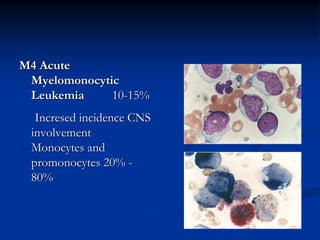
M4 Acute
Myelomonocytic
Leukemia 10-15%
Incresed incidence CNS
involvement
Monocytes and
promonocytes 20% -
80%
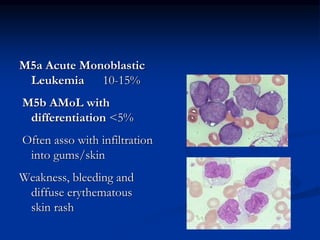
M5a Acute Monoblastic
Leukemia 10-15%
M5b AMoL with
differentiation <5%
Often asso with infiltration
into gums/skin
Weakness, bleeding and
diffuse erythematous
skin rash
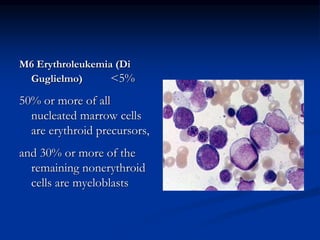
M6 Erythroleukemia (Di
Guglielmo) <5%
50% or more of all
nucleated marrow cells
are erythroid precursors,
and 30% or more of the
remaining nonerythroid
cells are myeloblasts
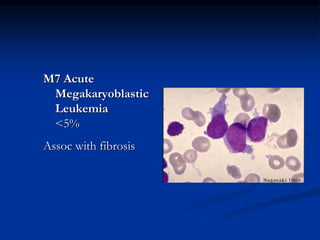
M7 Acute
Megakaryoblastic
Leukemia
<5%
Assoc with fibrosis
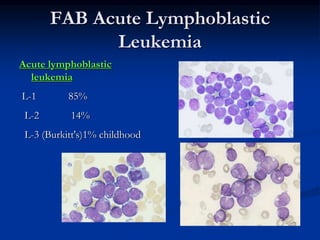
FAB Acute Lymphoblastic
Leukemia
Acute lymphoblastic
leukemia
L-1 85%
L-2 14%
L-3 (Burkitt's)1% childhood
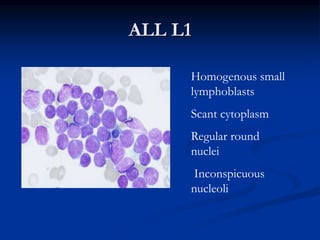
ALL L1
Homogenous small
lymphoblasts
Scant cytoplasm
Regular round
nuclei
Inconspicuous
nucleoli
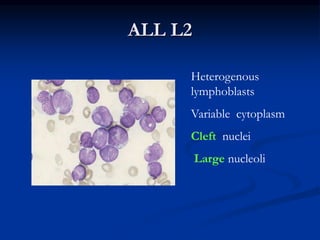
ALL L2
Heterogenous
lymphoblasts
Variable cytoplasm
Cleft nuclei
Large nucleoli
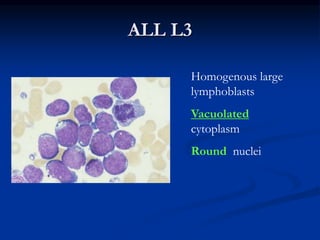
ALL L3
Homogenous large
lymphoblasts
Vacuolated
cytoplasm
Round nuclei
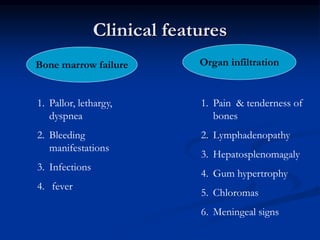
Clinical features
Bone marrow failure Organ infiltration
1. Pallor, lethargy,
dyspnea
2. Bleeding
manifestations
3. Infections
4. fever
1. Pain & tenderness of
bones
2. Lymphadenopathy
3. Hepatosplenomagaly
4. Gum hypertrophy
5. Chloromas
6. Meningeal signs
Lab findings
1. Blood picture
RBC
WBC
Platelets
2. Bone marrow
3. Cytochemistry
4. Cytogenetics
FAB vs WHO Classifications of
Hematologic Neoplasm
๏ฎ FAB criteria
๏ฎ Morphology
๏ฎ Cytochemistry
๏ฎ WHO criteria
๏ฎ Morphology
๏ฎ Immunophenotyping
๏ฎ Genetic features
๏ฎ Karyotyping
๏ฎ Molecular testing
๏ฎ Clinical features
WHO Classification of AML
๏ฎ AML with recurrent cytogenic translocations
๏ฎ AML with multi-lineage dysplasia
๏ฎ AML and myelodysplasia, therapy related
๏ฎ AML, not otherwise categorized
Summary
๏ฎ Definition
๏ฎ Types
๏ฎ Differences between myloblasts and
lymphoblasts
๏ฎ Pathogenesis( leukemogenesis)
๏ฎ Morphology
๏ฎ Clinical features
๏ฎ Lab findings
๏ฎ WHO classification
Thank you

Acute leukemias

  • 1.
  • 2.
    What you willlearn now? ๏ฎ Definition ๏ฎ Types ๏ฎ Differences between myloblasts and lymphoblasts ๏ฎ Pathogenesis( leukemogenesis) ๏ฎ Morphology ๏ฎ Clinical features ๏ฎ Lab findings
  • 3.
    Leukemias are thegroup of disorders characterized by malignant transformation of the blood forming cells ๏ฎ It may involve any of the cell lines or a stem cell common to several cell lines.
  • 4.
    ๏ฎ Leukemias areclassified into 2 major groups Acute Onset is usually rapid, The disease is very aggressive, The cells involved are usually poorly differentiated with many blasts. Chronic Onset is insidious, The disease is usually less aggressive, The cells involved are usually more mature cells
  • 5.
    ๏ฎ Both acuteand chronic leukemias are further classified according to the prominent cell line involved in the expansion: ๏ฎ If the prominent cell line is of the myeloid series it is a MYELOCYTIC LEUKEMIA (sometimes also called granulocytic) ๏ฎ If the prominent cell line is of the lymphoid series it is a LYMPHOCYTIC LEUKEMIA

  • 6.
    ๏ฎ Therefore, thereare four basic types of leukemia ๏ฎ Acute myelocytic leukemia โ€“ AML ๏ฎ Acute lymphocytic leukemia โ€“ ALL ๏ฎ Chronic myelocytic leukemia โ€“ CML ๏ฎ Chronic lymphocytic leukemia โ€“ CLL
  • 7.
    Etiology ๏ฎ the exactcause is frequently not known, but predisposing factors are known ๏ฎ Host factors ๏ฎ Environmental factors
  • 8.
    Etiology ๏ฎ the exactcause is frequently not known, but predisposing factors are known ๏ฎ Host factors ๏ฎ Some individuals have an inherited increased predisposition to develop leukemia ๏ฎ There is an increased incidence in those with an inherited tendency for chromosome fragility or abnormality or those with increased numbers of chromosomes (such as Downโ€™s syndrome). Many of these diseases are characterized by chromosomal translocations.

  • 9.
    ๏ฎ There isan increased incidence in those with hereditary immunodeficiencies. ๏ฎ There is an increased incidence in those with chronic marrow dysfunction such as those with myeloproliferative diseases, myelodysplastic syndromes, aplastic anemia, or paroxsymal nocturnal hemoglobinuria.
  • 10.
    ๏ฎ Environmental factors: ๏ฎExposure to ionizing radiation ๏ฎ Exposure to mutagenic chemicals and drugs ๏ฎ Viral infections
  • 11.
    Incidence ๏ฎ Acute leukemiascan occur in all age groups ๏ฎ ALL is more common in children ๏ฎ AML is more common in adults ๏ฎ Chronic leukemias are usually a disease of adults ๏ฎ CLL is extremely rare in children and unusual before the age of 40 ๏ฎ CML has a peak age of 30-50
  • 12.
    ๏ฎ Comparison ofacute and chronic leukemias: Acute Chronic Age all ages usually adults Clinical onset sudden insidious Course (untreated) 6 mo. or less 2-6 years Leukemic cells immature >20% blasts more mature ` cells Anemia prominent mild Thrombocytopenia prominent mild WBC count variable increased Lymphadenopathy mild present;often prominent Splenomegaly mild present;often prominent
  • 13.
    Acute leukemia -pathogenesis ๏ฎ Is a result of: ๏ฎ Malignant transformation of a stem cell leading to unregulated proliferation and ๏ฎ Arrest in maturation at the primitive blast stage. Remember that a blast is the most immature cell that can be recognized as committed to a particular cell line.
  • 14.
    ๏ฎ Leukemic proliferation,accumulation, and invasion of normal tissues, including the liver, spleen, lymph nodes, central nervous system, and skin, cause lesions ranging from rashes to tumors. ๏ฎ A humoral mediator from the leukemic cells may inhibit proliferation of normal cells. ๏ฎ Failure of the bone marrow and normal hematopoiesis may result in pancytopenia with death from hemorrhaging and infections.
  • 15.
    Acute leukemias ๏ฎ AMLand ALL ๏ฎ FAB classification AML( 8 subtypes M0 to M7 ) ALL ( L1 to L3 )
  • 16.
    Myeloblasts with auerrods the MYELOBLAST is a large blast with a moderate amount of cytoplasm, fine lacey chromatin, and prominent nucleoli. 10-40% of myeloblasts contain auer rods
  • 17.
    Lymphoblast in contrast tothe myeloblast, the LYMPHOBLAST is a small blast with scant cytoplasm, dense chromatin, indistinct nucleoli, and no auer rods
  • 19.
    Cytochemical stains 1. Myeloperoxidase 2.Sudan black 3. Periodic acid schiff(PAS) 4. Non specific esterase 5. Acid phosphatase 1. Myeloblasts( except M0) 2. Immature cells in AML 3. Lymphoblasts , erythroblasts 4. Monocytic ( M4 M 5) 5. Monocytic cells and focally in lymphoblasts
  • 20.
    FAB Acute MyeloidLeukemia M0 Minimally differentiated AML 5% - 10% Negative or < 3% blasts stain for MPO ,PAS and NSE blasts are negative for B and T lymphoid antigens, platelet glycoproteins and erythroid glycophorin A. M1 Myeloblastic without maturation 10 - 20% >90% cells are myeloblasts 3% of blasts stain for MPO +8 frequently seen
  • 21.
    M2 AML withmaturation 30 - 40% 30% - 90% are myeloblasts ~ 15% with t(8:21)
  • 22.
    M3 Acute Promyelocytic Leukemia(APML) 10-15% Auer rods/ faggot cells may be seen Granules contain procoagulants (thromboplastin-like) - massive DIC t(15:17) is diagnostic
  • 23.
    M4 Acute Myelomonocytic Leukemia 10-15% Incresedincidence CNS involvement Monocytes and promonocytes 20% - 80%
  • 24.
    M5a Acute Monoblastic Leukemia10-15% M5b AMoL with differentiation <5% Often asso with infiltration into gums/skin Weakness, bleeding and diffuse erythematous skin rash
  • 25.
    M6 Erythroleukemia (Di Guglielmo)<5% 50% or more of all nucleated marrow cells are erythroid precursors, and 30% or more of the remaining nonerythroid cells are myeloblasts
  • 26.
  • 27.
    FAB Acute Lymphoblastic Leukemia Acutelymphoblastic leukemia L-1 85% L-2 14% L-3 (Burkitt's)1% childhood
  • 28.
    ALL L1 Homogenous small lymphoblasts Scantcytoplasm Regular round nuclei Inconspicuous nucleoli
  • 29.
  • 30.
  • 31.
    Clinical features Bone marrowfailure Organ infiltration 1. Pallor, lethargy, dyspnea 2. Bleeding manifestations 3. Infections 4. fever 1. Pain & tenderness of bones 2. Lymphadenopathy 3. Hepatosplenomagaly 4. Gum hypertrophy 5. Chloromas 6. Meningeal signs
  • 32.
    Lab findings 1. Bloodpicture RBC WBC Platelets 2. Bone marrow 3. Cytochemistry 4. Cytogenetics
  • 33.
    FAB vs WHOClassifications of Hematologic Neoplasm ๏ฎ FAB criteria ๏ฎ Morphology ๏ฎ Cytochemistry ๏ฎ WHO criteria ๏ฎ Morphology ๏ฎ Immunophenotyping ๏ฎ Genetic features ๏ฎ Karyotyping ๏ฎ Molecular testing ๏ฎ Clinical features
  • 34.
    WHO Classification ofAML ๏ฎ AML with recurrent cytogenic translocations ๏ฎ AML with multi-lineage dysplasia ๏ฎ AML and myelodysplasia, therapy related ๏ฎ AML, not otherwise categorized
  • 36.
    Summary ๏ฎ Definition ๏ฎ Types ๏ฎDifferences between myloblasts and lymphoblasts ๏ฎ Pathogenesis( leukemogenesis) ๏ฎ Morphology ๏ฎ Clinical features ๏ฎ Lab findings ๏ฎ WHO classification
  • 37.