Genetic Diseases (Inherited Diseases) Zou Xiao-bing Department of Pediatrics 3rd Affiliated Hospital  Sun Yat-sen University
Great changes in medicine one of the biggest victories in medicine over the past 100 years  is that infectious diseases have decreased dramatically, for example,  smallpox  was eradicated,  poliomyelitis  will soon be eradicated and  pertusis ,  diphtheria ,  malaria ,  measles  are diminishing
The reasons of the changes in medicine Social progress planned immunization Advances in medical sciences better nutrition
Genetic diseases are increasing
Reasons  Environment pollution caused by development  : mutagenic substances come from  industrial wastes ,  nuclear wastes  and modern human life, drug abuse such as the use of  thalidomide . Improved diagnostic techniques  include biochemical techniques, cytogenetic techniques and more important, molecular genetic techniques.
Epidemiology of genetic diseases in China It is estimated that ,each year in China , there are 20,000,000 live birth neonates. 5% of them will suffer from inherited disorders or birth defects. it means that each year there are 1,000,000 new patients. Over 10,000 kind of inherited diseases are found by now.
 
Basic of genetics  Cell is the basic unit of human body .  Chromosome is the carrier of inheritance and gene. Normal cell contain  23 pairs chromosomes , with  about  30,000   structural genes
Basic of genetics chromosomes exist in pair, so genes exist in pair. Paired genes could be divided into dominant gene and recessive gene. traits are controlled by the genes  One gene one enzyme theory the abnormal chromosomes and genes result in genetic diseases.
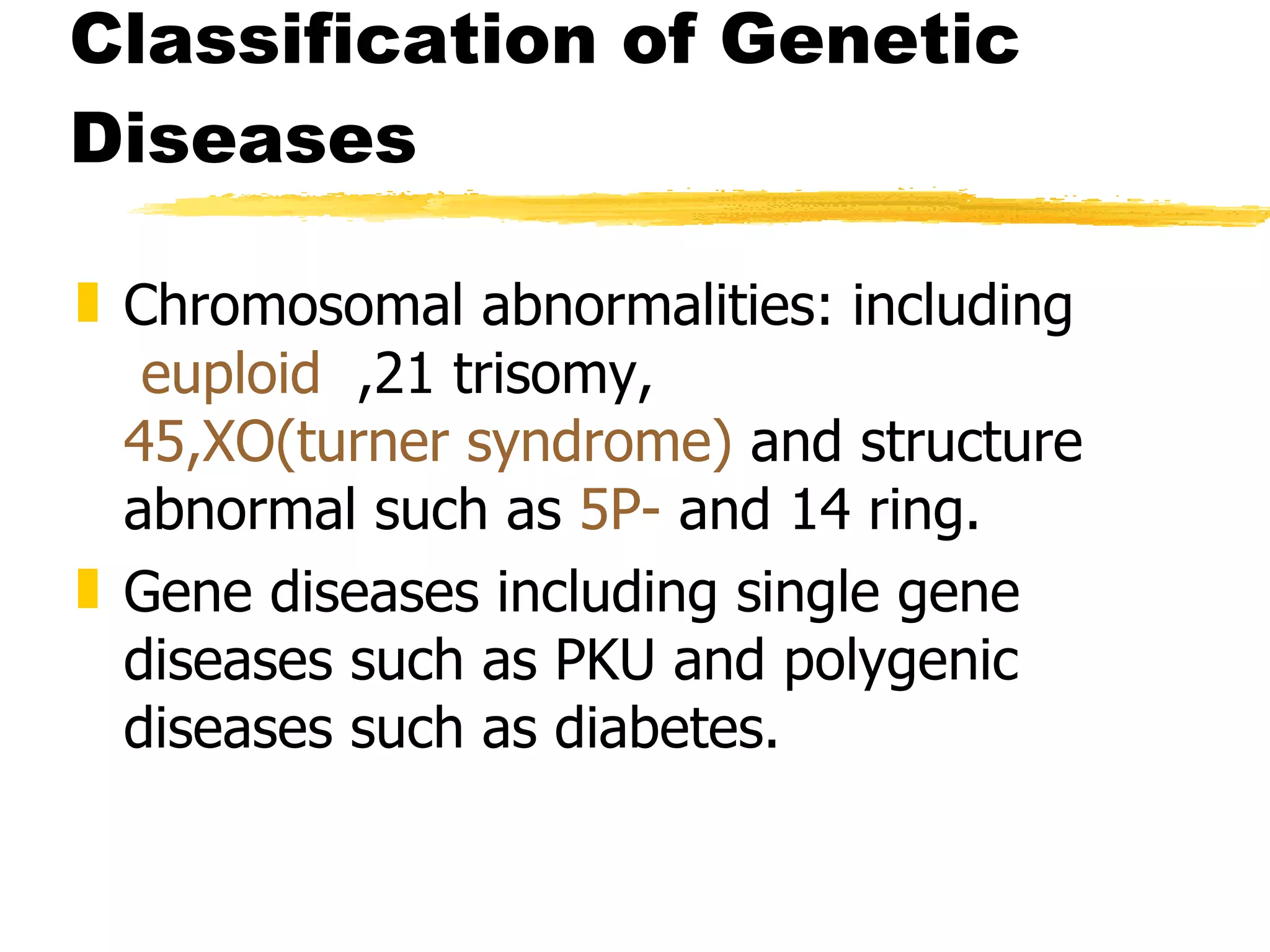
Classification of Genetic Diseases Chromosomal abnormalities: including   euploid   ,21 trisomy,  45,XO(turner syndrome)  and structure abnormal such as  5P-  and 14 ring. Gene diseases including single gene diseases such as PKU and polygenic diseases such as diabetes.
Classification of Genetic Diseases Chromosome diseases  :quantity or structure of chromosome  is abnormal autosomal chromosome diseases sex-linked chromosome diseases Gene diseases   single gene inherited diseases (mendel model) polygenic inherited diseases :diabetes, asthma, congenital cardiac abnormalities,  cleft lip, gastric ulcer, obesity, schizophrenia etc.
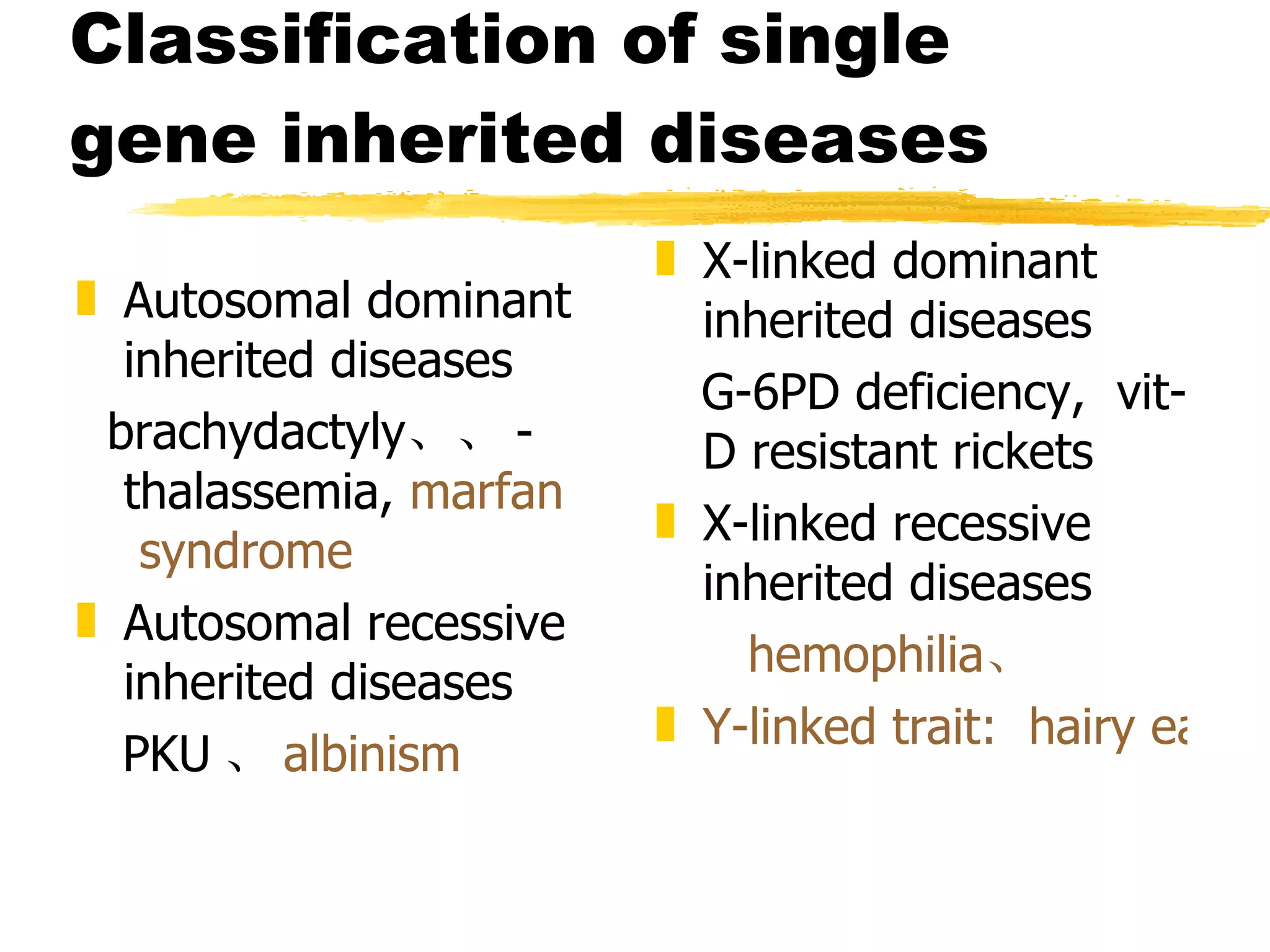
Classification of single gene inherited diseases Autosomal dominant inherited diseases     brachydactyly 、  -thalassemia,  marfan  syndrome Autosomal recessive inherited diseases PKU 、 albinism X-linked dominant inherited diseases G-6PD deficiency,  vit-D resistant rickets X-linked recessive inherited diseases hemophilia 、 Y-linked trait:  hairy ear syndrome
Manifestation  of genetic diseases Features in common:mental retardation 、 developmental delay, simian crease and  abnormal dermatoglyphics , microcephaly and macrocephaly ,abnormal of genital organs,malformation of limb and extremities, spine and anal abnormal  specific features:fair skin and unpleasant odor of PKU, White skin of albinsim, facial abnormalities of Down syndrome and thalassemia
Diagnosis approaches of genetic diseases Samples used blood amniotic fluid skin hair different kind of cells  approaches chromosome analysis biochemical test Enzyme analysis gene analysis pedigree analysis dermatoglyphics
Treatment of Genetic Diseases Most genetic diseases couldn’t be cured. better care from family  better welfare of the society function training gene therapy has show us a bright future, ADA(Adenosine Deaminase) deficiency, can be treated by gene therapy. (bone marrow transplantation and stem cell transplantation belong to gene therapy, ß- thalassemia can be treated by BMT)
Treatment of some single gene diseases  Restrict specific food (Dietary restriction) :  PKU-phenylalanine, G6PD deficiency-broad bean and aspirine Discharge harmful substances  ( wilson disease-copper, thalassemia-iron);  Supply lacking substances  (hemophilia A- factor 8)
Prevention of genetic diseases Genetic counseling, marriage guidance and risk assessment find the carrier of the parents with abnormal gene prenatal diagnosis by amniocentesis and  chorionic  villous biopsy
DOWN SYNDROME First described by John Langdon Down in 1866, the syndrome is named after him. in 1956, Tijo found human cell contained 46 chromosomes. In 1959, Lejeune identified the underlying chromosomal abnormality of affected individuals having a additional #21 chromosome. It is the commonest chromosomal disease.  Maternal age is linked to the syndrome.
Manifestation of  Down Syndrome Facial abnormalities:small head,recessed nose, small ears and mouth  mental retardation:IQ score less than 60 development delayed ,short statue , obesity, fingers are short and stubby,  simian crease  on the palm congenital heart disease and other malformations can be found in most cases.
 
Classification of Down Syndrome Trisomy 21 (account for 95% of the individuals). Translocation Down syndrome (4%) Mosaic Down syndrome (1%) translocation down syndrome don’t differ congnitively and medically from those with trisomy 21. but mosaic down syndrome is less severe because their trisomy cells are interspersed with normal cells.
Etiology of trisomy 21 Nondisjunction  of chromosome #21 in meiosis
 Etiology of translocation  down syndrome During prophase of meiosis in a parent,there  may be a transfer of a  portion of one  chromosome  to another
Etiology of mosaic down syndrome death Develop to a mosaic down syndrome Nondisjunction of zygote during early stage
TURNER SYNDROME Karyotype  of  turner syndrome is  45 XO affected individuals are female in appearance , ovarian dysgenesis causing inferity, short stature,  webbing of the neck,  wildly spread nipples,  cubitus valgus.
Klinefelter  Syndrome Karyotype is  47,XXY the typical clinical features include male in appearance, inferity, gynaecomastia in adolessence,  mental retardation,  high and thin stature  (usually over 180cm)
47 XYY Syndrome Karyotype is  47 XYY The affected individuals are male in appearance, high and thin with increased tendency  to be violent and so are more common in prison or to be a hero in wartime.  END
Phenylketouria (PKU) Autosomal recessive disease  inborn error of metabolism reason is the lack of phenylalanine hydroxylase or an essential co-factor(BH4) mental retardation and seizure  dietary phenylalanine restriction in early infant is very important for mental development.
Clinical manifestations of PKU Mental retardation  seizure, irritability abnormal EEG fair skin unpleasant odor of urine
Congenital hypothyroidism Result from deficient production of thyroid hormone. Clinical features include coarse facies,dry skin, hoarse cry, hypotonia, umblical hernia, constipation, prolonged jaundice, TSH↑ , thyroxine↓ need life long supplement of thyroxine.
THANK YOU
45, XO TURNER SYNDROME
5p- back


Mental retardation and autism-like symptom  Long face and big ears


back1 back2


back


B1 B2


15 Genetic Diseases

  • 1.
    Genetic Diseases (InheritedDiseases) Zou Xiao-bing Department of Pediatrics 3rd Affiliated Hospital Sun Yat-sen University
  • 2.
    Great changes inmedicine one of the biggest victories in medicine over the past 100 years is that infectious diseases have decreased dramatically, for example, smallpox was eradicated, poliomyelitis will soon be eradicated and pertusis , diphtheria , malaria , measles are diminishing
  • 3.
    The reasons ofthe changes in medicine Social progress planned immunization Advances in medical sciences better nutrition
  • 4.
  • 5.
    Reasons Environmentpollution caused by development : mutagenic substances come from industrial wastes , nuclear wastes and modern human life, drug abuse such as the use of thalidomide . Improved diagnostic techniques include biochemical techniques, cytogenetic techniques and more important, molecular genetic techniques.
  • 6.
    Epidemiology of geneticdiseases in China It is estimated that ,each year in China , there are 20,000,000 live birth neonates. 5% of them will suffer from inherited disorders or birth defects. it means that each year there are 1,000,000 new patients. Over 10,000 kind of inherited diseases are found by now.
  • 7.
  • 8.
    Basic of genetics Cell is the basic unit of human body . Chromosome is the carrier of inheritance and gene. Normal cell contain 23 pairs chromosomes , with about 30,000 structural genes
  • 9.
    Basic of geneticschromosomes exist in pair, so genes exist in pair. Paired genes could be divided into dominant gene and recessive gene. traits are controlled by the genes One gene one enzyme theory the abnormal chromosomes and genes result in genetic diseases.
  • 10.
    Classification of GeneticDiseases Chromosomal abnormalities: including euploid ,21 trisomy, 45,XO(turner syndrome) and structure abnormal such as 5P- and 14 ring. Gene diseases including single gene diseases such as PKU and polygenic diseases such as diabetes.
  • 11.
    Classification of GeneticDiseases Chromosome diseases :quantity or structure of chromosome is abnormal autosomal chromosome diseases sex-linked chromosome diseases Gene diseases single gene inherited diseases (mendel model) polygenic inherited diseases :diabetes, asthma, congenital cardiac abnormalities, cleft lip, gastric ulcer, obesity, schizophrenia etc.
  • 12.
    Classification of singlegene inherited diseases Autosomal dominant inherited diseases brachydactyly 、  -thalassemia, marfan syndrome Autosomal recessive inherited diseases PKU 、 albinism X-linked dominant inherited diseases G-6PD deficiency, vit-D resistant rickets X-linked recessive inherited diseases hemophilia 、 Y-linked trait: hairy ear syndrome
  • 13.
    Manifestation ofgenetic diseases Features in common:mental retardation 、 developmental delay, simian crease and abnormal dermatoglyphics , microcephaly and macrocephaly ,abnormal of genital organs,malformation of limb and extremities, spine and anal abnormal specific features:fair skin and unpleasant odor of PKU, White skin of albinsim, facial abnormalities of Down syndrome and thalassemia
  • 14.
    Diagnosis approaches ofgenetic diseases Samples used blood amniotic fluid skin hair different kind of cells approaches chromosome analysis biochemical test Enzyme analysis gene analysis pedigree analysis dermatoglyphics
  • 15.
    Treatment of GeneticDiseases Most genetic diseases couldn’t be cured. better care from family better welfare of the society function training gene therapy has show us a bright future, ADA(Adenosine Deaminase) deficiency, can be treated by gene therapy. (bone marrow transplantation and stem cell transplantation belong to gene therapy, ß- thalassemia can be treated by BMT)
  • 16.
    Treatment of somesingle gene diseases Restrict specific food (Dietary restriction) : PKU-phenylalanine, G6PD deficiency-broad bean and aspirine Discharge harmful substances ( wilson disease-copper, thalassemia-iron); Supply lacking substances (hemophilia A- factor 8)
  • 17.
    Prevention of geneticdiseases Genetic counseling, marriage guidance and risk assessment find the carrier of the parents with abnormal gene prenatal diagnosis by amniocentesis and chorionic villous biopsy
  • 18.
    DOWN SYNDROME Firstdescribed by John Langdon Down in 1866, the syndrome is named after him. in 1956, Tijo found human cell contained 46 chromosomes. In 1959, Lejeune identified the underlying chromosomal abnormality of affected individuals having a additional #21 chromosome. It is the commonest chromosomal disease. Maternal age is linked to the syndrome.
  • 19.
    Manifestation of Down Syndrome Facial abnormalities:small head,recessed nose, small ears and mouth mental retardation:IQ score less than 60 development delayed ,short statue , obesity, fingers are short and stubby, simian crease on the palm congenital heart disease and other malformations can be found in most cases.
  • 20.
  • 21.
    Classification of DownSyndrome Trisomy 21 (account for 95% of the individuals). Translocation Down syndrome (4%) Mosaic Down syndrome (1%) translocation down syndrome don’t differ congnitively and medically from those with trisomy 21. but mosaic down syndrome is less severe because their trisomy cells are interspersed with normal cells.
  • 22.
    Etiology of trisomy21 Nondisjunction of chromosome #21 in meiosis
  • 23.
    Etiology oftranslocation down syndrome During prophase of meiosis in a parent,there may be a transfer of a portion of one chromosome to another
  • 24.
    Etiology of mosaicdown syndrome death Develop to a mosaic down syndrome Nondisjunction of zygote during early stage
  • 25.
    TURNER SYNDROME Karyotype of turner syndrome is 45 XO affected individuals are female in appearance , ovarian dysgenesis causing inferity, short stature, webbing of the neck, wildly spread nipples, cubitus valgus.
  • 26.
    Klinefelter SyndromeKaryotype is 47,XXY the typical clinical features include male in appearance, inferity, gynaecomastia in adolessence, mental retardation, high and thin stature (usually over 180cm)
  • 27.
    47 XYY SyndromeKaryotype is 47 XYY The affected individuals are male in appearance, high and thin with increased tendency to be violent and so are more common in prison or to be a hero in wartime. END
  • 28.
    Phenylketouria (PKU) Autosomalrecessive disease inborn error of metabolism reason is the lack of phenylalanine hydroxylase or an essential co-factor(BH4) mental retardation and seizure dietary phenylalanine restriction in early infant is very important for mental development.
  • 29.
    Clinical manifestations ofPKU Mental retardation seizure, irritability abnormal EEG fair skin unpleasant odor of urine
  • 30.
    Congenital hypothyroidism Resultfrom deficient production of thyroid hormone. Clinical features include coarse facies,dry skin, hoarse cry, hypotonia, umblical hernia, constipation, prolonged jaundice, TSH↑ , thyroxine↓ need life long supplement of thyroxine.
  • 31.
  • 32.
    45, XO TURNERSYNDROME
  • 33.
  • 34.
  • 35.
  • 36.
  • 37.
  • 38.
  • 39.
    Mental retardation andautism-like symptom Long face and big ears
  • 40.
  • 41.
  • 42.
  • 43.
  • 44.
  • 45.
  • 46.
  • 47.
  • 48.
  • 49.
  • 50.
  • 51.
  • 52.
  • 53.
  • 54.
  • 55.
  • 56.
  • 57.
  • 58.
  • 59.
  • 60.
  • 61.
  • 62.
  • 63.
  • 64.
  • 65.
  • 66.
  • 67.
  • 68.
  • 69.
  • 70.
  • 71.
  • 72.
  • 73.
  • 74.
  • 75.
  • 76.