Idiopathic Thrombocytopenic Purpura ( ITP ) MBBS.weebly.com
Emphases of This Lesson Emphasis: Etiological factor Diagnosis and Therapeutic Principle General Introduction: Pathogenesis, Difference between aITP and cITP
Outline Idiopathic Thrombocytopenic Purpura ( ITP ):Also named immunologic thrombocytopenic purpura. The most common(4-8 /100,000) cause of thrombocytopenia in children and a result of immunologically mediated increased platelet destruction
Outline Acute and self-limiting but may be recurrent or chronic disorder.
Etiology and pathogenesis The etiology is still unknown and the pathogenesis is complex
Etiology a t present   Viral infection  (rubella,rubeola,etc,1 to 4 weeks interval) Immune factor  (foreign antigen,drug cross-react with platelet membrane) Spleen and other parts of reticuloendothelial system Genetics  (None described)
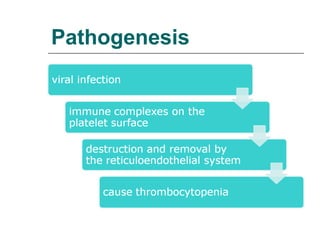
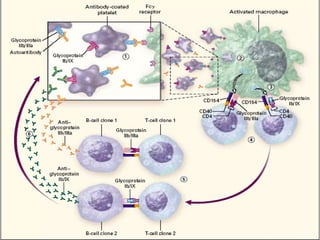
Pathogenesis Acute ITP is believed to be a consequence of a disordered  immune response  during recovery from a viral infection that  evokes the formation of antibodies  that cause platelet destruction. Platelet Ab specifically against glycoprotein Ⅱb/Ⅲa
Pathogenesis An alternative hypothesis implicates  immune complexes  derived from primary or underlying disease processes that nonspecifically adsorb to the surface of platelets,resulting in their opsonization and rapid destruction.
Pathogenesis
 
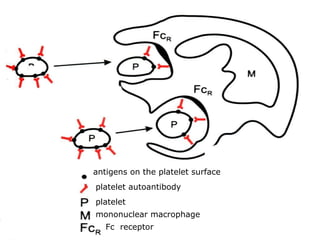
antigens on the platelet surface platelet autoantibody platelet mononuclear macrophage Fc  receptor
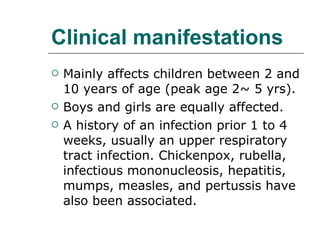
Clinical manifestations Mainly affects children between 2 and 10 years of age (peak age 2~ 5 yrs).  Boys and girls are equally affected. A history of an infection prior 1 to 4 weeks, usually an upper respiratory tract infection. Chickenpox, rubella, infectious mononucleosis, hepatitis, mumps, measles, and pertussis have also been associated.
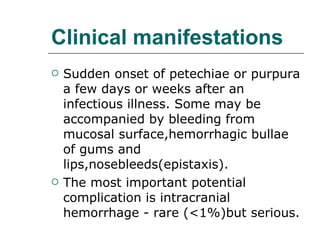
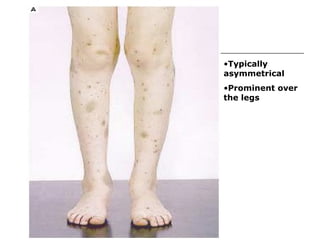
Clinical manifestations Sudden onset of petechiae or purpura a few days or weeks after an infectious illness. Some may be accompanied by bleeding from mucosal surface,hemorrhagic bullae of gums and lips,nosebleeds(epistaxis). The most important potential complication is intracranial hemorrhage - rare (<1%)but serious.
Typically asymmetrical Prominent over the legs
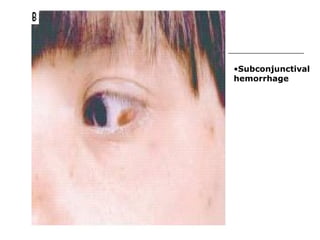
Subconjunctival hemorrhage
Clinical manifestations The liver and spleen  may be palpable in a minority patient.  May be anaemic if they were hemorrhagic severely.
Clinical manifestations 80%~90% of them have spontaneous recovery, the rest recover within 4~8 weeks.  10%~20% of them are chronic ITP. Case fatality is approximately 0.5~1%, the principal factor is  intracranial hemorrhage.
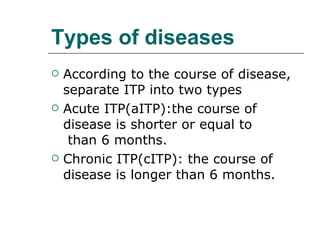
Types of diseases According to the course of disease, separate ITP into two types Acute ITP(aITP):the course of disease is shorter or equal to  than 6 months. Chronic ITP(cITP): the course of disease is longer than 6 months.
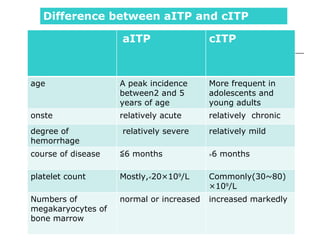
aITP cITP age A peak incidence between2 and 5 years of age More frequent in adolescents and young adults onste relatively acute relatively  chronic degree of  hemorrhage relatively severe  relatively mild course of disease ≦ 6 months ﹥ 6 months platelet count Mostly,﹤20×10 9 /L Commonly(30~80) ×10 9 /L Numbers of megakaryocytes of bone marrow normal or increased  increased markedly Difference between aITP and cITP
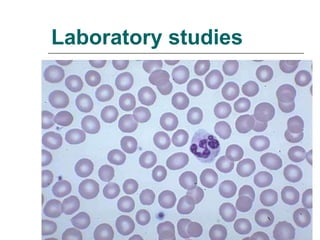
Laboratory studies Peripheral blood smear : an isolated thrombocytopenia with no other abnormalities. platelet count  < 100 ×10 9 /L,the few circulating platelet may be quite  large (megathrombocytes)
Laboratory studies
Laboratory studies White blood cell count and morphology are nomal Hemoglobin values are normal uneless there has been prolonged bleeding PT and PTT are normal,bleeding time would be prolonged,but testing is unnecessary
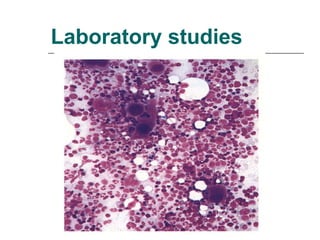
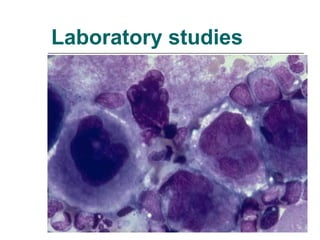
Laboratory studies Bone marrow:The bone marrow in patients with ITP contains normal or increased numbers of  megakaryocytes Indicating that platelet production is normal and that thrombocytopenia results from increased platelet destruction.
Laboratory studies
Laboratory studies
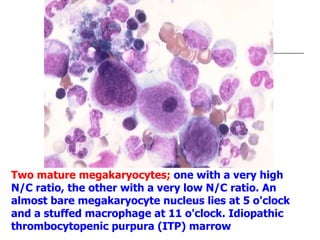
Two mature megakaryocytes;  one with a very high N/C ratio, the other with a very low N/C ratio. An almost bare megakaryocyte nucleus lies at 5 o'clock and a stuffed macrophage at 11 o'clock. Idiopathic thrombocytopenic purpura (ITP) marrow
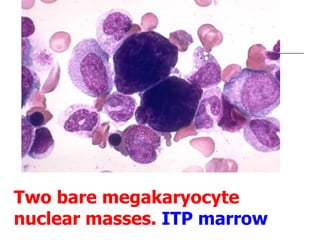
Two bare megakaryocyte nuclear masses.  ITP marrow
Laboratory studies Measuring antiplatelet antibodies Including the measurement of the amount of platelet-associated IgG(PAIgG) and direct assay of specific platelet antibodies. However,these tests lack both specificity and sensitivity in acute ITP of childhood.
Laboratory studies Related viral infection may be detected,such as EB virus(EBV), mycoplasma(MP), cytomegalovirus(CMV) and so on. Helicobacter pylori(HP) infection in cITP
Diagnosis Diagnosis should be based on the infection history clinical features physical examination laboratory tests.
Differential Dignosis Failure to perform a bone marrow examination may lead to diagnostic error and delay institution of correct therapy.
Differential Dignosis Acute leukemia :  Acute leukemia patients with normal white blood cell counts may be  to confuse,leukemic cell in blood smear or bone marrow can be to make a definite diagnosis.
Differential Dignosis Aplastic anemia:  febril, anaemic, hemorrhagic patients with normal liver and spleen are similar to ITP patients associated with anaemia.but anaemia in aplastic anemia patients are severity, white blood cell counts are decreased, megakaryocytes in bone marrow are also decreased.
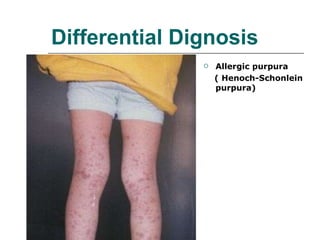
Differential Dignosis Allergic purpura:  hemorrhagic  erythra , symmetric distribution,always in both lower extremities and haunch.platelet count is normal, it’s easy to differentiate.
Differential Dignosis Allergic purpura ( Henoch-Schonlein purpura)
Treatment 1.General treatment. the disease is acute, benign, and self -limiting, and no therapy is required.  Patients should receive in - hospital treatment during acute bleeding.
Treatment 1.General treatment. salicylate-containing medications,antihistamines and nonsteroidal drugs that interfere with platelet function and increase the risk of bleeding and should be avoided.
Treatment 1.General treatment. Therapy is indicated if there is extensive cutaneous and particularly mucosal bleeding and a platlet count  < 20 × 10 9 /L No treatment is usually indicated for patients with platelet counts > 50 × 10 9 /L.
Treatment 2.Intravenous immunoglobulin ( IVIG) . Mechanisms:   Blocking Fc receptor of the RE (reticulo-endothelium) phagocytes Preventing them from binding and destroying IgG antibody-coated platelets.
Treatment Dose: safe dose is 400mg/( kg.d) , using 5 days continuously or 1 g/ (kg.d) for 2 days. Merit :IVIG appears preferable to corticosteroids because it results in faster elevation of the platelet count and may be indicated in severe disease.
Treatment Disadvantage:it is expensive,long infusion time of 6 to 8 hours,allergic reactions,aseptic meningitis with severe headache in 10% to 30%, 50% to 75% have headache,nausea,vomiting,or fever.
Treatment 3.Corticosteroids. Mechanisms: Reducing capillary fragility Inhibiting platelets destruction Have a rapid,dose-dependent action that reduce RE destruction of antibody-coated platelets Also more slowly reduces antibody production.
Treatment Dose:oral prednisone 2 to 4 mg/kg/d tapered over 2 to 4 weeks. Children with chronic ITP who have mild or recurrent bleeding are sometimes treated with intermittent courses of IVIG or highdose corticosteroids(intravenous methylprednisolone 20~30mg/kg/d for 3 days,then decrement).
Treatment Merit : cheap and convenient. Disadvantage:Long - term use of corticosteroids should be avoided because of potential toxicity(moodiness,weight gain,etc)
Treatment 4.Intravenous anti-Rh(D)  Immunoglobulin for Rh-positive patient. Mechanisms: Anti- Rh(D) immunoglobulin produces a mild hemolytic anemia that saturates the Fc receptors of the phagocytic elements of the RE system.
Treatment Permitting increased survival of antibody-coated platelets. The immediate goal of therapy is to increase the platelet count to a safe level, usually  > 20 × 10 9 /L ,in the hope of reducing the risk of severe hemorrhage. Dose:IV anti-Rh(D),50 μ g to 75ug/kg for 2 days.
Treatment Merit : less expansive than IVIG but more costly than steroids,lower rate  of allergic side effects(10%) than IVIG and does not cause aseptic meningitis. Disadvantage:Cause mild hemolysis with a transient hemoglobin decrease of 10 to 20g/L.
Treatment 5. Splenectomy. Beneficial in children with chronic,symptomatic ITP. About 70% of patient with chronic ITP achieve a complete remission following splenectomy,and most of the other show some improvement in platelet counts. Search for an accessory spleen,depends upon its location,the severity of the thrombocytopenia,the perceived risk of surgery ,and the response to alternative forms of therapy.
Treatment Disadvantage:Surgical mobidity and risk of postsplenectomy sepsis with encapsulated organisms.
Treatment 6.Other treatment.   α -interferon ,danazol(a synthetic androgen),ascorbic acid,cyclosporine,and a variety of immunosupperessive drugs including vincristine(VCR)   , azathioprine,and cyclophosphamide(CTX). No large study of these agent have been describe in  children with chronic ITP,and they may have immediate and long-term toxicities. Adsorption Ab removal have been used with limited success in refractory cases.
Treatment Life-Threatening Hemorrhage Stop Bleeding! Platelet infusions. Indication: platelets are less than 3 x 10 9 /L , intravenous platelet infusion is necessary to prevent severe hemorrhagic tendency. Platelet infusions have no role except in life - threatening emergencies.  Because there are a lot of PAIgGs in circulation of patients, infusion platelets will be destroyed quickly.
Treatment Life-Threatening Hemorrhage IVIG May be given concomitantly Multimodality Therapy Is frequently necessary Emergent Splenectomy Sometimes necessary Plasmapheresis May also be beneficial
Follow-Up Spontaneous recovery is the norm 60% by 3 months 80% by 6 months 90% by 12 months The incidence of significiant bleeding-related morbidity and mortality is extremely low less than 5% Of patients with cITP 20% will ultimately have spontaneous resolution of their thrombocytopenia
 

23 Ppt Itp

  • 1.
    Idiopathic Thrombocytopenic Purpura( ITP ) MBBS.weebly.com
  • 2.
    Emphases of ThisLesson Emphasis: Etiological factor Diagnosis and Therapeutic Principle General Introduction: Pathogenesis, Difference between aITP and cITP
  • 3.
    Outline Idiopathic ThrombocytopenicPurpura ( ITP ):Also named immunologic thrombocytopenic purpura. The most common(4-8 /100,000) cause of thrombocytopenia in children and a result of immunologically mediated increased platelet destruction
  • 4.
    Outline Acute andself-limiting but may be recurrent or chronic disorder.
  • 5.
    Etiology and pathogenesisThe etiology is still unknown and the pathogenesis is complex
  • 6.
    Etiology a tpresent Viral infection (rubella,rubeola,etc,1 to 4 weeks interval) Immune factor (foreign antigen,drug cross-react with platelet membrane) Spleen and other parts of reticuloendothelial system Genetics (None described)
  • 7.
    Pathogenesis Acute ITPis believed to be a consequence of a disordered immune response during recovery from a viral infection that evokes the formation of antibodies that cause platelet destruction. Platelet Ab specifically against glycoprotein Ⅱb/Ⅲa
  • 8.
    Pathogenesis An alternativehypothesis implicates immune complexes derived from primary or underlying disease processes that nonspecifically adsorb to the surface of platelets,resulting in their opsonization and rapid destruction.
  • 9.
  • 10.
  • 11.
    antigens on theplatelet surface platelet autoantibody platelet mononuclear macrophage Fc receptor
  • 12.
    Clinical manifestations Mainlyaffects children between 2 and 10 years of age (peak age 2~ 5 yrs). Boys and girls are equally affected. A history of an infection prior 1 to 4 weeks, usually an upper respiratory tract infection. Chickenpox, rubella, infectious mononucleosis, hepatitis, mumps, measles, and pertussis have also been associated.
  • 13.
    Clinical manifestations Suddenonset of petechiae or purpura a few days or weeks after an infectious illness. Some may be accompanied by bleeding from mucosal surface,hemorrhagic bullae of gums and lips,nosebleeds(epistaxis). The most important potential complication is intracranial hemorrhage - rare (<1%)but serious.
  • 14.
  • 15.
  • 16.
    Clinical manifestations Theliver and spleen may be palpable in a minority patient. May be anaemic if they were hemorrhagic severely.
  • 17.
    Clinical manifestations 80%~90%of them have spontaneous recovery, the rest recover within 4~8 weeks. 10%~20% of them are chronic ITP. Case fatality is approximately 0.5~1%, the principal factor is intracranial hemorrhage.
  • 18.
    Types of diseasesAccording to the course of disease, separate ITP into two types Acute ITP(aITP):the course of disease is shorter or equal to than 6 months. Chronic ITP(cITP): the course of disease is longer than 6 months.
  • 19.
    aITP cITP ageA peak incidence between2 and 5 years of age More frequent in adolescents and young adults onste relatively acute relatively chronic degree of hemorrhage relatively severe relatively mild course of disease ≦ 6 months ﹥ 6 months platelet count Mostly,﹤20×10 9 /L Commonly(30~80) ×10 9 /L Numbers of megakaryocytes of bone marrow normal or increased increased markedly Difference between aITP and cITP
  • 20.
    Laboratory studies Peripheralblood smear : an isolated thrombocytopenia with no other abnormalities. platelet count < 100 ×10 9 /L,the few circulating platelet may be quite large (megathrombocytes)
  • 21.
  • 22.
    Laboratory studies Whiteblood cell count and morphology are nomal Hemoglobin values are normal uneless there has been prolonged bleeding PT and PTT are normal,bleeding time would be prolonged,but testing is unnecessary
  • 23.
    Laboratory studies Bonemarrow:The bone marrow in patients with ITP contains normal or increased numbers of megakaryocytes Indicating that platelet production is normal and that thrombocytopenia results from increased platelet destruction.
  • 24.
  • 25.
  • 26.
    Two mature megakaryocytes; one with a very high N/C ratio, the other with a very low N/C ratio. An almost bare megakaryocyte nucleus lies at 5 o'clock and a stuffed macrophage at 11 o'clock. Idiopathic thrombocytopenic purpura (ITP) marrow
  • 27.
    Two bare megakaryocytenuclear masses. ITP marrow
  • 28.
    Laboratory studies Measuringantiplatelet antibodies Including the measurement of the amount of platelet-associated IgG(PAIgG) and direct assay of specific platelet antibodies. However,these tests lack both specificity and sensitivity in acute ITP of childhood.
  • 29.
    Laboratory studies Relatedviral infection may be detected,such as EB virus(EBV), mycoplasma(MP), cytomegalovirus(CMV) and so on. Helicobacter pylori(HP) infection in cITP
  • 30.
    Diagnosis Diagnosis shouldbe based on the infection history clinical features physical examination laboratory tests.
  • 31.
    Differential Dignosis Failureto perform a bone marrow examination may lead to diagnostic error and delay institution of correct therapy.
  • 32.
    Differential Dignosis Acuteleukemia : Acute leukemia patients with normal white blood cell counts may be to confuse,leukemic cell in blood smear or bone marrow can be to make a definite diagnosis.
  • 33.
    Differential Dignosis Aplasticanemia: febril, anaemic, hemorrhagic patients with normal liver and spleen are similar to ITP patients associated with anaemia.but anaemia in aplastic anemia patients are severity, white blood cell counts are decreased, megakaryocytes in bone marrow are also decreased.
  • 34.
    Differential Dignosis Allergicpurpura: hemorrhagic erythra , symmetric distribution,always in both lower extremities and haunch.platelet count is normal, it’s easy to differentiate.
  • 35.
    Differential Dignosis Allergicpurpura ( Henoch-Schonlein purpura)
  • 36.
    Treatment 1.General treatment.the disease is acute, benign, and self -limiting, and no therapy is required. Patients should receive in - hospital treatment during acute bleeding.
  • 37.
    Treatment 1.General treatment.salicylate-containing medications,antihistamines and nonsteroidal drugs that interfere with platelet function and increase the risk of bleeding and should be avoided.
  • 38.
    Treatment 1.General treatment.Therapy is indicated if there is extensive cutaneous and particularly mucosal bleeding and a platlet count < 20 × 10 9 /L No treatment is usually indicated for patients with platelet counts > 50 × 10 9 /L.
  • 39.
    Treatment 2.Intravenous immunoglobulin( IVIG) . Mechanisms: Blocking Fc receptor of the RE (reticulo-endothelium) phagocytes Preventing them from binding and destroying IgG antibody-coated platelets.
  • 40.
    Treatment Dose: safedose is 400mg/( kg.d) , using 5 days continuously or 1 g/ (kg.d) for 2 days. Merit :IVIG appears preferable to corticosteroids because it results in faster elevation of the platelet count and may be indicated in severe disease.
  • 41.
    Treatment Disadvantage:it isexpensive,long infusion time of 6 to 8 hours,allergic reactions,aseptic meningitis with severe headache in 10% to 30%, 50% to 75% have headache,nausea,vomiting,or fever.
  • 42.
    Treatment 3.Corticosteroids. Mechanisms:Reducing capillary fragility Inhibiting platelets destruction Have a rapid,dose-dependent action that reduce RE destruction of antibody-coated platelets Also more slowly reduces antibody production.
  • 43.
    Treatment Dose:oral prednisone2 to 4 mg/kg/d tapered over 2 to 4 weeks. Children with chronic ITP who have mild or recurrent bleeding are sometimes treated with intermittent courses of IVIG or highdose corticosteroids(intravenous methylprednisolone 20~30mg/kg/d for 3 days,then decrement).
  • 44.
    Treatment Merit :cheap and convenient. Disadvantage:Long - term use of corticosteroids should be avoided because of potential toxicity(moodiness,weight gain,etc)
  • 45.
    Treatment 4.Intravenous anti-Rh(D) Immunoglobulin for Rh-positive patient. Mechanisms: Anti- Rh(D) immunoglobulin produces a mild hemolytic anemia that saturates the Fc receptors of the phagocytic elements of the RE system.
  • 46.
    Treatment Permitting increasedsurvival of antibody-coated platelets. The immediate goal of therapy is to increase the platelet count to a safe level, usually > 20 × 10 9 /L ,in the hope of reducing the risk of severe hemorrhage. Dose:IV anti-Rh(D),50 μ g to 75ug/kg for 2 days.
  • 47.
    Treatment Merit :less expansive than IVIG but more costly than steroids,lower rate of allergic side effects(10%) than IVIG and does not cause aseptic meningitis. Disadvantage:Cause mild hemolysis with a transient hemoglobin decrease of 10 to 20g/L.
  • 48.
    Treatment 5. Splenectomy.Beneficial in children with chronic,symptomatic ITP. About 70% of patient with chronic ITP achieve a complete remission following splenectomy,and most of the other show some improvement in platelet counts. Search for an accessory spleen,depends upon its location,the severity of the thrombocytopenia,the perceived risk of surgery ,and the response to alternative forms of therapy.
  • 49.
    Treatment Disadvantage:Surgical mobidityand risk of postsplenectomy sepsis with encapsulated organisms.
  • 50.
    Treatment 6.Other treatment. α -interferon ,danazol(a synthetic androgen),ascorbic acid,cyclosporine,and a variety of immunosupperessive drugs including vincristine(VCR) , azathioprine,and cyclophosphamide(CTX). No large study of these agent have been describe in children with chronic ITP,and they may have immediate and long-term toxicities. Adsorption Ab removal have been used with limited success in refractory cases.
  • 51.
    Treatment Life-Threatening HemorrhageStop Bleeding! Platelet infusions. Indication: platelets are less than 3 x 10 9 /L , intravenous platelet infusion is necessary to prevent severe hemorrhagic tendency. Platelet infusions have no role except in life - threatening emergencies. Because there are a lot of PAIgGs in circulation of patients, infusion platelets will be destroyed quickly.
  • 52.
    Treatment Life-Threatening HemorrhageIVIG May be given concomitantly Multimodality Therapy Is frequently necessary Emergent Splenectomy Sometimes necessary Plasmapheresis May also be beneficial
  • 53.
    Follow-Up Spontaneous recoveryis the norm 60% by 3 months 80% by 6 months 90% by 12 months The incidence of significiant bleeding-related morbidity and mortality is extremely low less than 5% Of patients with cITP 20% will ultimately have spontaneous resolution of their thrombocytopenia
  • 54.