By: RIZWAN SHARIF
rizichat@yahoo.com
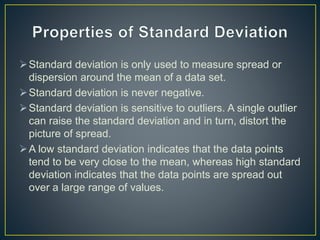
Standard deviation is only used to measure spread or
dispersion around the mean of a data set.
Standard deviation is never negative.
Standard deviation is sensitive to outliers. A single outlier
can raise the standard deviation and in turn, distort the
picture of spread.
A low standard deviation indicates that the data points
tend to be very close to the mean, whereas high standard
deviation indicates that the data points are spread out
over a large range of values.
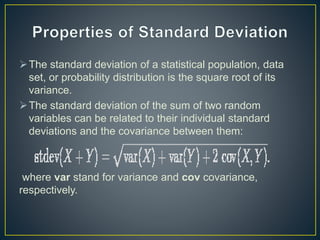
The standard deviation of a statistical population, data
set, or probability distribution is the square root of its
variance.
The standard deviation of the sum of two random
variables can be related to their individual standard
deviations and the covariance between them:
where var stand for variance and cov covariance,
respectively.
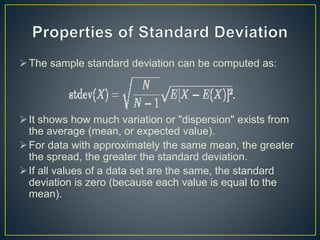
The sample standard deviation can be computed as:
It shows how much variation or "dispersion" exists from
the average (mean, or expected value).
For data with approximately the same mean, the greater
the spread, the greater the standard deviation.
If all values of a data set are the same, the standard
deviation is zero (because each value is equal to the
mean).
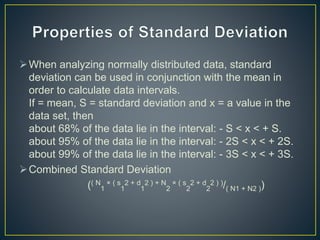
When analyzing normally distributed data, standard
deviation can be used in conjunction with the mean in
order to calculate data intervals.
If = mean, S = standard deviation and x = a value in the
data set, then
about 68% of the data lie in the interval: - S < x < + S.
about 95% of the data lie in the interval: - 2S < x < + 2S.
about 99% of the data lie in the interval: - 3S < x < + 3S.
Combined Standard Deviation
(( N
1
× ( s
1
2 + d
1
2 ) + N
2
× ( s
2
2 + d
2
2 ) )/( N1 + N2 ))
Properties of Standard Deviation

Properties of Standard Deviation

  • 1.
  • 2.
    Standard deviation isonly used to measure spread or dispersion around the mean of a data set. Standard deviation is never negative. Standard deviation is sensitive to outliers. A single outlier can raise the standard deviation and in turn, distort the picture of spread. A low standard deviation indicates that the data points tend to be very close to the mean, whereas high standard deviation indicates that the data points are spread out over a large range of values.
  • 3.
    The standard deviationof a statistical population, data set, or probability distribution is the square root of its variance. The standard deviation of the sum of two random variables can be related to their individual standard deviations and the covariance between them: where var stand for variance and cov covariance, respectively.
  • 4.
    The sample standarddeviation can be computed as: It shows how much variation or "dispersion" exists from the average (mean, or expected value). For data with approximately the same mean, the greater the spread, the greater the standard deviation. If all values of a data set are the same, the standard deviation is zero (because each value is equal to the mean).
  • 5.
    When analyzing normallydistributed data, standard deviation can be used in conjunction with the mean in order to calculate data intervals. If = mean, S = standard deviation and x = a value in the data set, then about 68% of the data lie in the interval: - S < x < + S. about 95% of the data lie in the interval: - 2S < x < + 2S. about 99% of the data lie in the interval: - 3S < x < + 3S. Combined Standard Deviation (( N 1 × ( s 1 2 + d 1 2 ) + N 2 × ( s 2 2 + d 2 2 ) )/( N1 + N2 ))