PROBABILITY! Notes Examples Sample Problems
Definition Probability is the measure of how likely something will occur. It is the ratio of desired outcomes to total outcomes.  (# desired) / (# total) Probabilities of all outcomes sums to 1.
Example If I roll a number cube, there are six total possibilities. (1,2,3,4,5,6) Each possibility only has one outcome, so each has a PROBABILITY of 1/6. For instance, the probability I roll a 2 is 1/6, since there is only a single 2 on the number cube.
Practice If I flip a coin, what is the probability I get heads? What is the probability I get tails? Remember, to think of how many possibilities there are.
Answer P(heads) = 1/2 P(tails) = 1/2 If you add these two up, you will get 1, which means the answers are probably right.
Two or more events If there are two or more events, you need to consider if it is happening at the same time or one after the other.
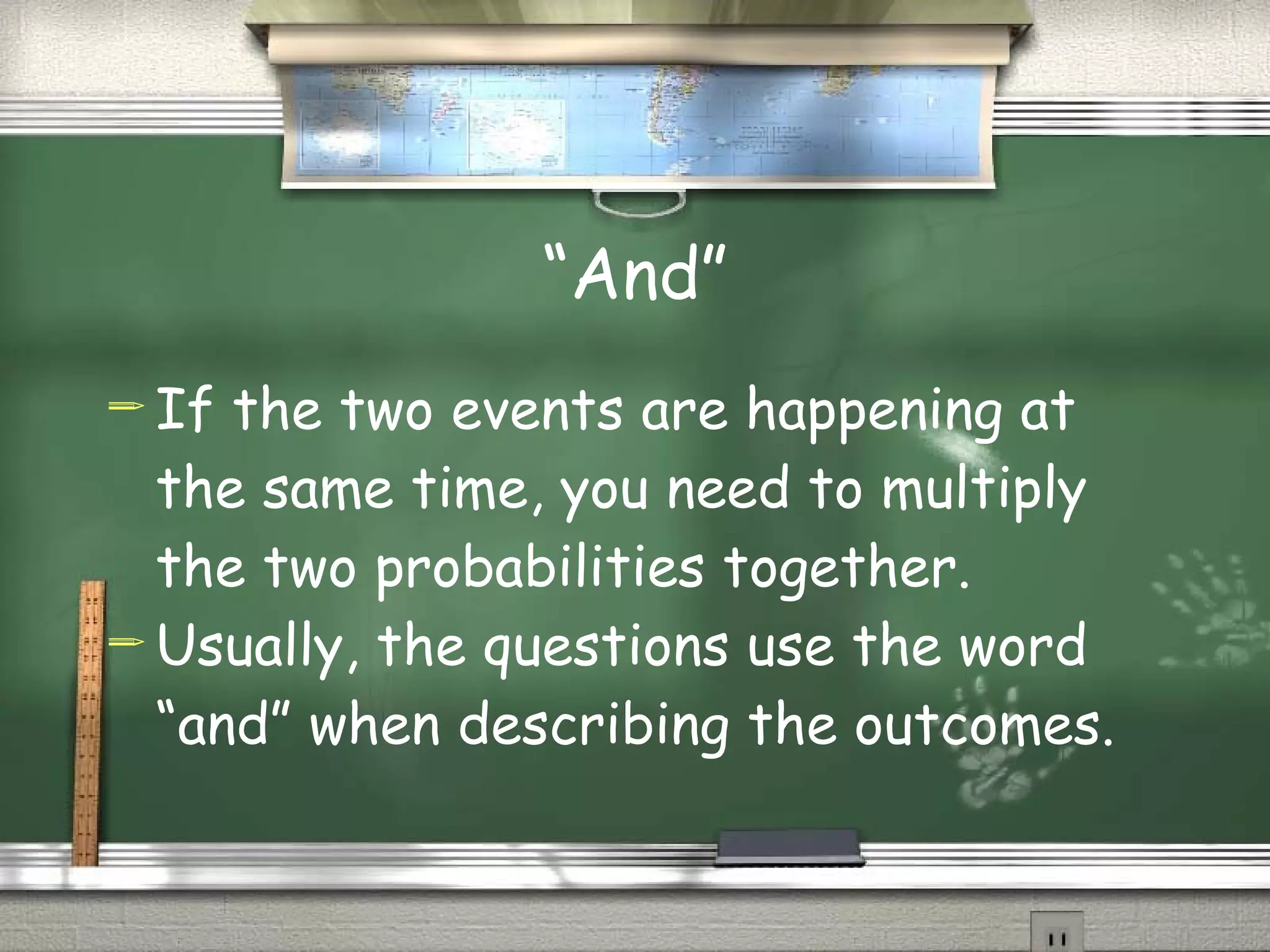
“And” If the two events are happening at the same time, you need to multiply the two probabilities together. Usually, the questions use the word “and” when describing the outcomes.
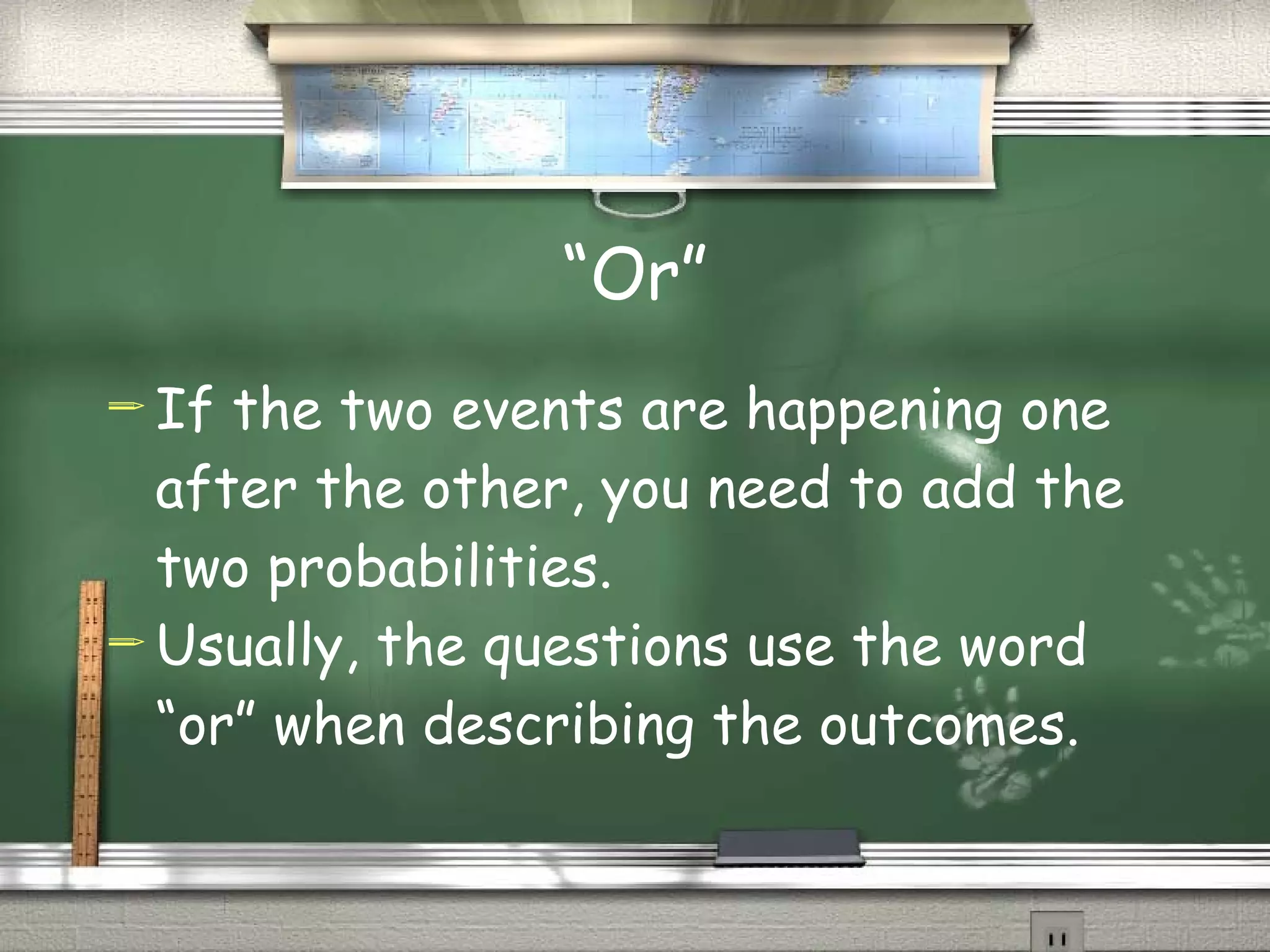
“Or” If the two events are happening one after the other, you need to add the two probabilities. Usually, the questions use the word “or” when describing the outcomes.
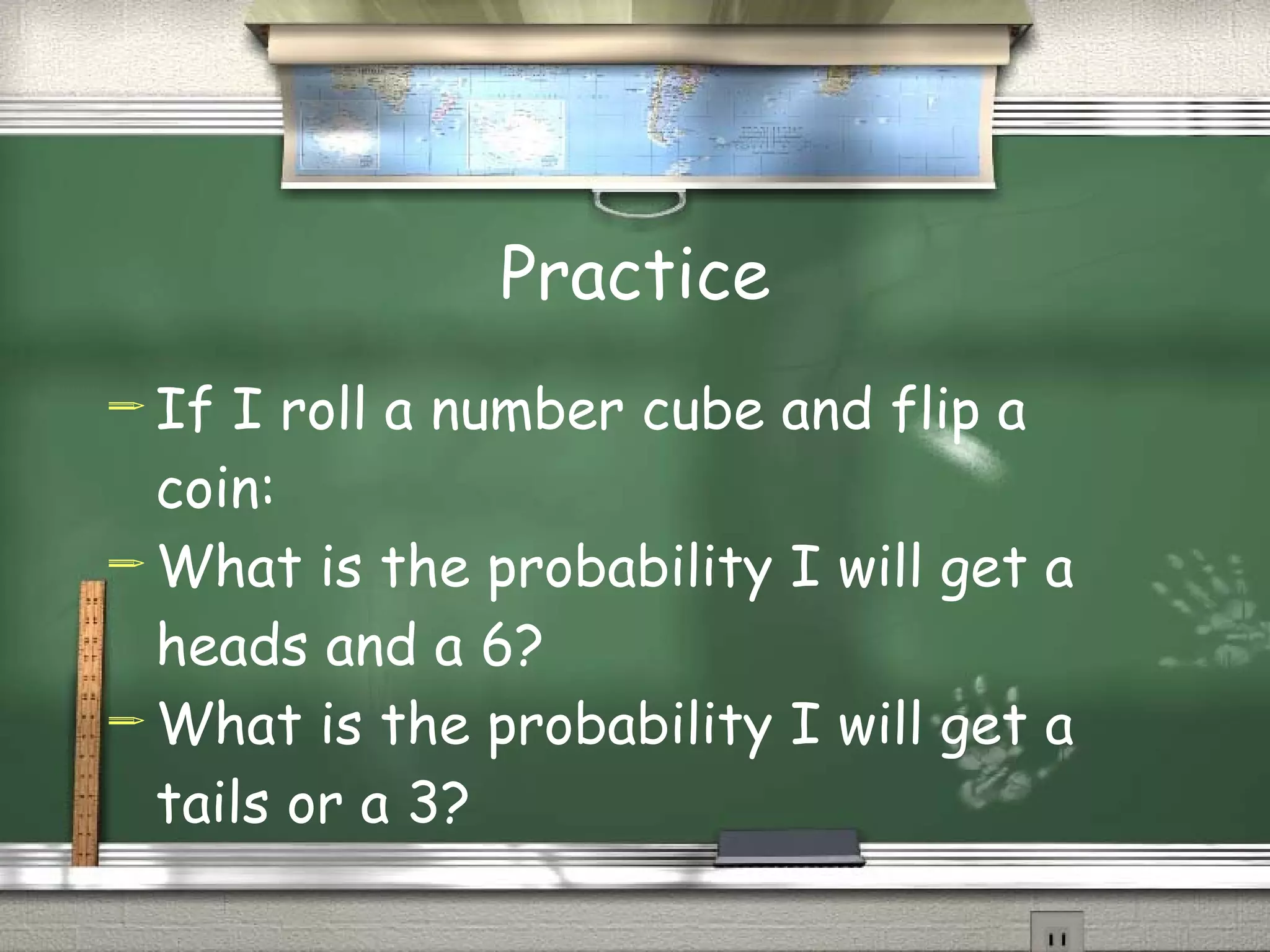
Practice If I roll a number cube and flip a coin: What is the probability I will get a heads and a 6? What is the probability I will get a tails or a 3?
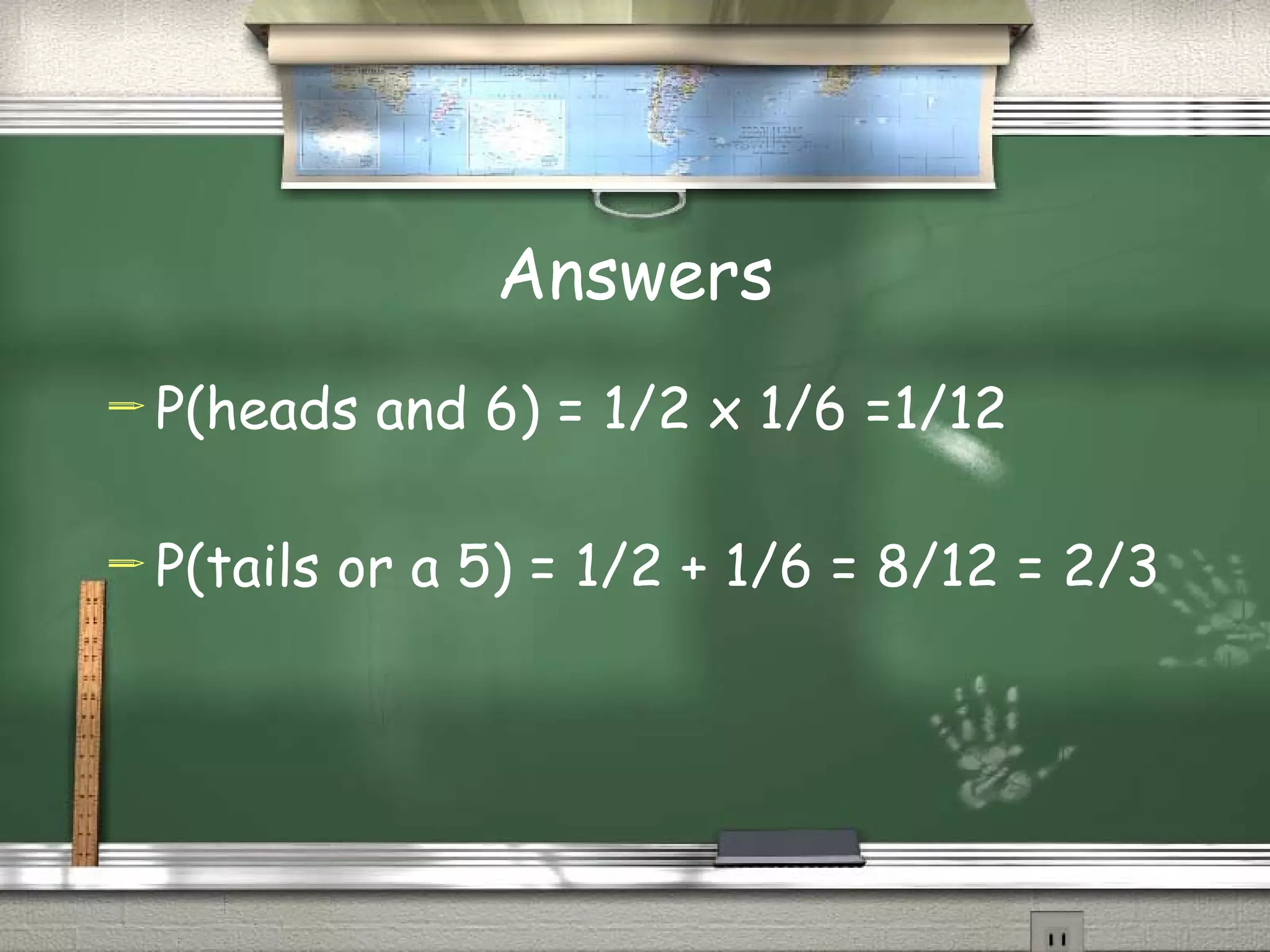
Answers P(heads and 6) = 1/2 x 1/6 =1/12 P(tails or a 5) = 1/2 + 1/6 = 8/12 = 2/3
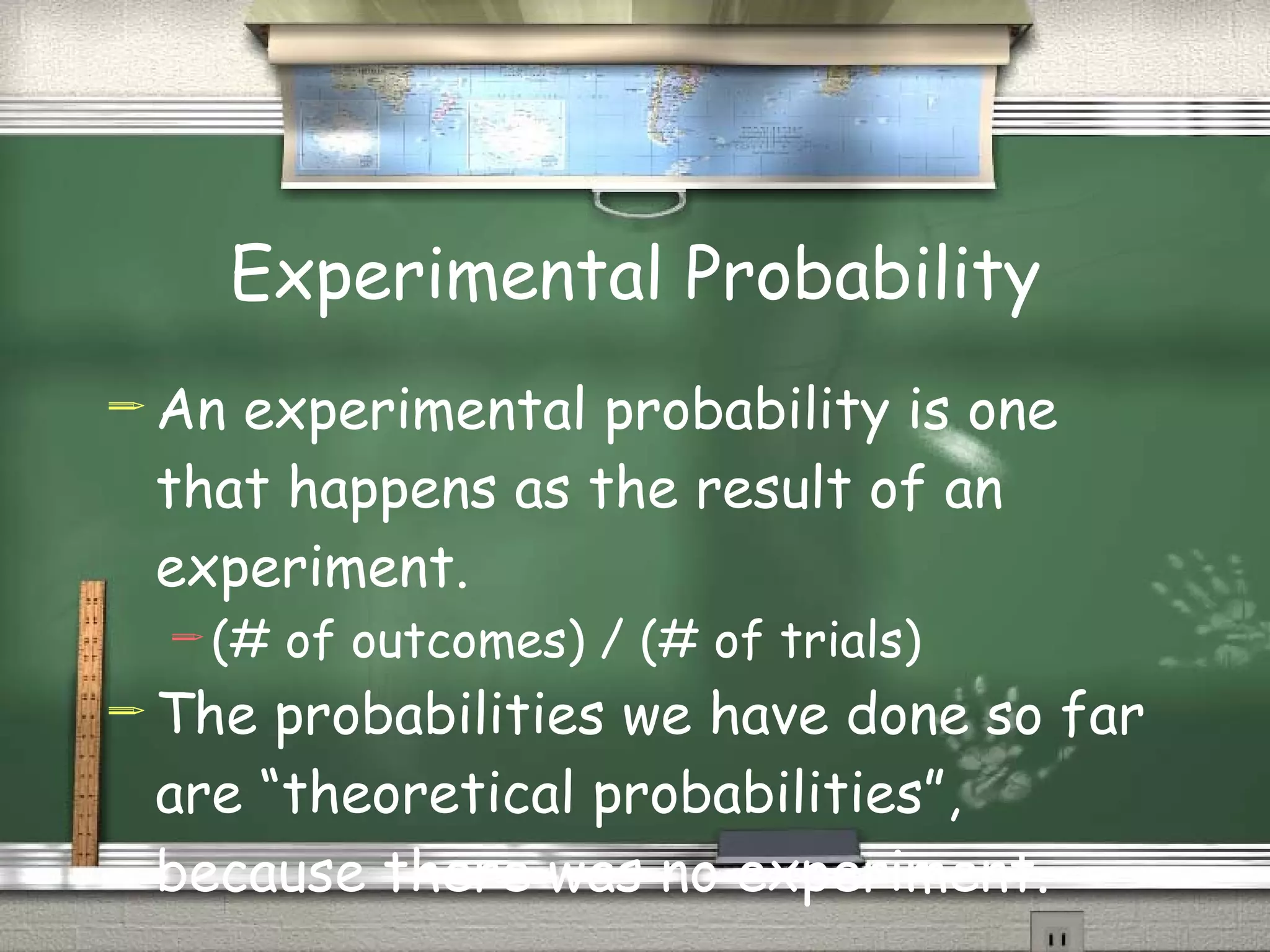
Experimental Probability An experimental probability is one that happens as the result of an experiment. (# of outcomes) / (# of trials) The probabilities we have done so far are “theoretical probabilities”, because there was no experiment.
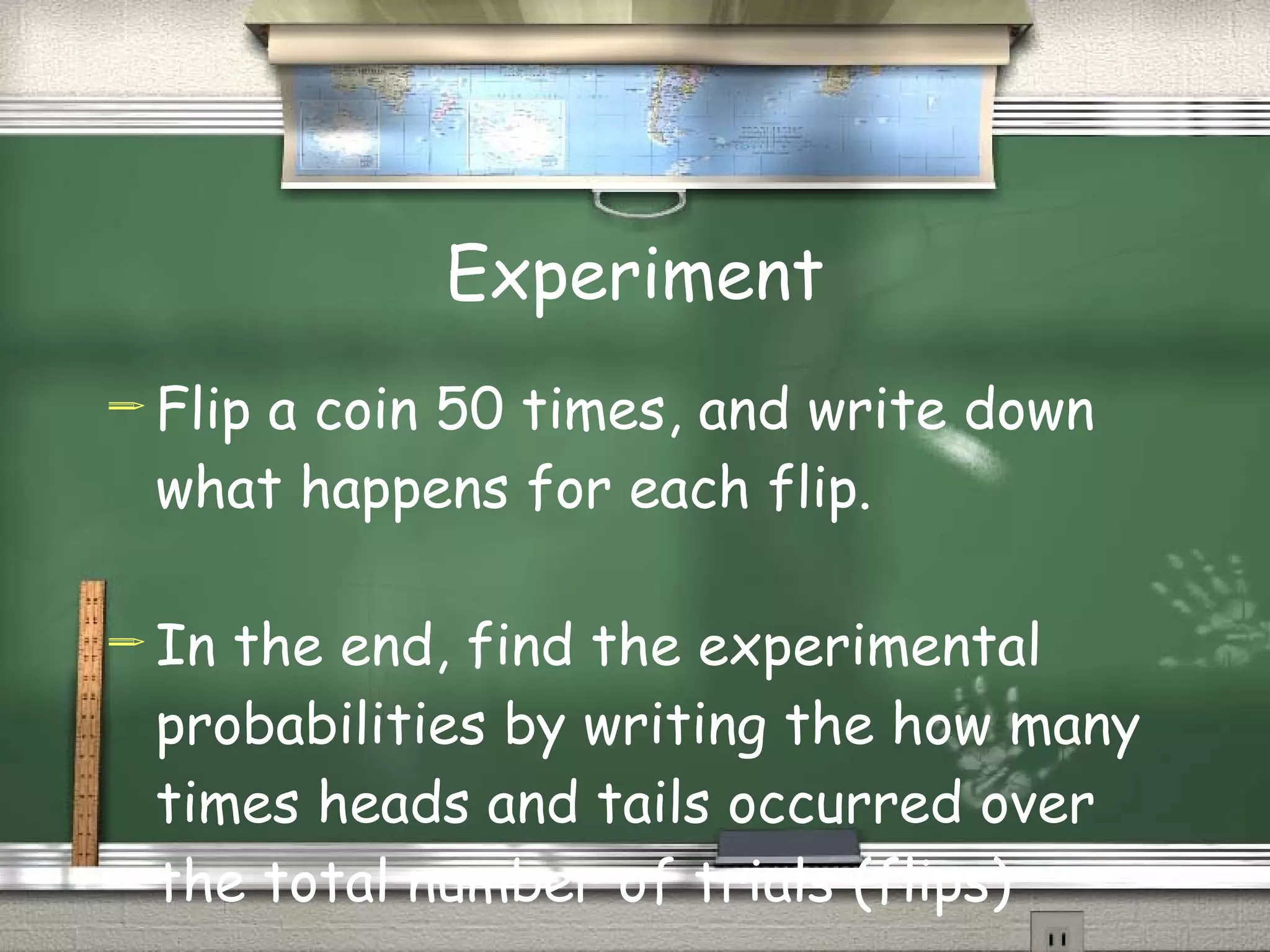
Experiment Flip a coin 50 times, and write down what happens for each flip. In the end, find the experimental probabilities by writing the how many times heads and tails occurred over the total number of trials (flips)

Probability Powerpoint

  • 1.
  • 2.
    Definition Probability isthe measure of how likely something will occur. It is the ratio of desired outcomes to total outcomes. (# desired) / (# total) Probabilities of all outcomes sums to 1.
  • 3.
    Example If Iroll a number cube, there are six total possibilities. (1,2,3,4,5,6) Each possibility only has one outcome, so each has a PROBABILITY of 1/6. For instance, the probability I roll a 2 is 1/6, since there is only a single 2 on the number cube.
  • 4.
    Practice If Iflip a coin, what is the probability I get heads? What is the probability I get tails? Remember, to think of how many possibilities there are.
  • 5.
    Answer P(heads) =1/2 P(tails) = 1/2 If you add these two up, you will get 1, which means the answers are probably right.
  • 6.
    Two or moreevents If there are two or more events, you need to consider if it is happening at the same time or one after the other.
  • 7.
    “And” If thetwo events are happening at the same time, you need to multiply the two probabilities together. Usually, the questions use the word “and” when describing the outcomes.
  • 8.
    “Or” If thetwo events are happening one after the other, you need to add the two probabilities. Usually, the questions use the word “or” when describing the outcomes.
  • 9.
    Practice If Iroll a number cube and flip a coin: What is the probability I will get a heads and a 6? What is the probability I will get a tails or a 3?
  • 10.
    Answers P(heads and6) = 1/2 x 1/6 =1/12 P(tails or a 5) = 1/2 + 1/6 = 8/12 = 2/3
  • 11.
    Experimental Probability Anexperimental probability is one that happens as the result of an experiment. (# of outcomes) / (# of trials) The probabilities we have done so far are “theoretical probabilities”, because there was no experiment.
  • 12.
    Experiment Flip acoin 50 times, and write down what happens for each flip. In the end, find the experimental probabilities by writing the how many times heads and tails occurred over the total number of trials (flips)