Time Series Analysis
A Time Series is a collection of observations made
sequentially in time.
According to Ya-lun Chou, “A Time Series may be
defined as a collection of readings belonging to
different time periods, of some economic variables
or composite of variables”
Examples: Financial time series, scientific time series,
Demographic time series, Meteorological time series
Time series data Vs. Cross Sectional data
Time series data Cross Sectional data
Time-series data is a set of observations
collected at usually equally spaced time
intervals.
Cross-sectional data are observations
that coming from different individuals or
groups at a single point in time
Time series data usually follows one
subject's changes over the course of time.
Cross-sectional data refers to data
collected by observing many subjects
(such as individuals, firms or
countries/regions) at the same point of
time.
It focuses on results gained over an
extended period of time, often within a
small area
It focuses on the information received
from surveys and opinions at a particular
time, in various locations, depending on
the information sought.
Example: The daily closing price of a
certain stock recorded over the last six
weeks is an example of time-series data
Example: The closing prices of a group of
20 different stocks on December 15, 1986
this would be an example of cross-
sectional data
Cont…
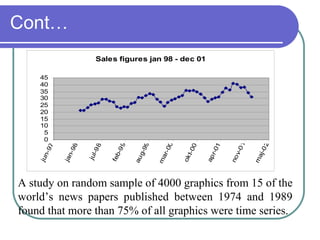
A study on random sample of 4000 graphics from 15 of the
world’s news papers published between 1974 and 1989
found that more than 75% of all graphics were time series.
Sales figures jan 98 - dec 01
0
5
10
15
20
25
30
35
40
45
jun-97
jan-98
jul-98
feb-99
aug-99
mar-00
okt-00
apr-01
nov-01
maj-02
Cont…
Tot-P ug/l, Råån, Helsingborg 1980-2001
0
100
200
300
400
500
600
700
800
900
1000
1980-01-15
1981-01-15
1982-01-15
1983-01-15
1984-01-15
1985-01-15
1986-01-15
1987-01-15
1988-01-15
1989-01-15
1990-01-15
1991-01-15
1992-01-15
1993-01-15
1994-01-15
1995-01-15
1996-01-15
1997-01-15
1998-01-15
1999-01-15
2000-01-15
2001-01-15
Cont…
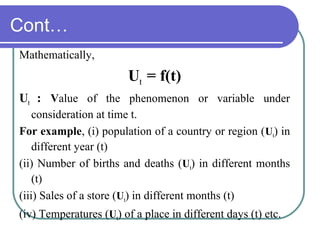
Mathematically,
Ut = f(t)
Ut : Value of the phenomenon or variable under
consideration at time t.
For example, (i) population of a country or region (Ut) in
different year (t)
(ii) Number of births and deaths (Ut) in different months
(t)
(iii) Sales of a store (Ut) in different months (t)
(iv) Temperatures (Ut) of a place in different days (t) etc.
Cont…
Time series gives a bi-variate distribution, one
of the variables being time (t) and the other
being the value (Ut)
 Time t may be yearly, monthly, weekly,
daily or even hourly
Usually equal interval
Components of a time series
 The pattern or behavior of the data in a time series
has several components.
 Theoretically, any time series can be decomposed
into:
Secular Trend or Long term movement
Periodic change or short term movement
(i) Seasonal (ii) Cyclical
Irregular or random components
 However, this decomposition is often not straight-
forward because these factors interact.
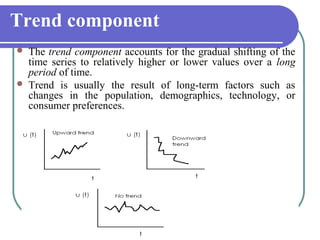
Trend component
 The trend component accounts for the gradual shifting of the
time series to relatively higher or lower values over a long
period of time.
 Trend is usually the result of long-term factors such as
changes in the population, demographics, technology, or
consumer preferences.
Cont…
 Downward trend: Declining birth or death rate
 Upward trend: Population growth, agricultural
production
 Mathematically trend may be Linear or non-linear
(curvi-linear)
 The term “long time period” is a relative term.
Periodic movements
Forces which prevent the smooth flow of
the series in a particular direction and
tend to repeat themselves over a period
of time
Seasonal variations or fluctuations
Cyclical variations or fluctuations
Seasonal Variations
The component responsible for the regular rise
or fall (fluctuations) in the time series during a
period not more than 1 year.
Fluctuations occur in regular sequence
(periodical)
The period being a month, a week, a day, or
even a fraction of the day, an hour etc.
Cont…
Cont…
Time series data depicted annually do not
represent seasonal variations. Seasonal
variations may be attributed to the following
reasons:
1. Natural forces : Weather or seasons
2. Man-made conventions: Habits, Fashions,
Customs or rituals etc.
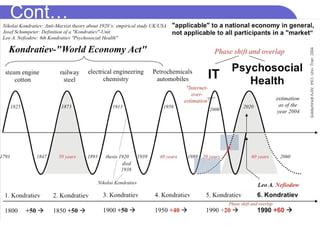
Cyclical Variations
Cycle refers to recurrent variations/oscillatory
movements in time series
Cyclical variations usually last longer than a
year
One complete period is called “Cycle”
Cont…
Business Cycle (Four phase Cycle)
ProsPerity (Period of Boom)
recovery recession
dePression
Cont…
Irregular or Random Variations
Random or irregular or residual fluctuations
Beyond the control of human (unpredictable)
Earthquakes, Wars, Floods, Revolutions etc.
Short duration and non-repeating
Cont…
Purpose of Time series
 To identify the components, the net effects of
whose interaction is exhibited by the
movement of a time series
 To isolate, study, analyze and measure them
independently i.e; holding the other things
constant
Uses of Time Series
To study the past behavior of the variable
To formulate policy decisions and planning of
future operations.
To predict or estimate or forecast the behavior
of the phenomenon in future which is very
essential for business planning
To compare the changes in the values of
different phenomenon at different times
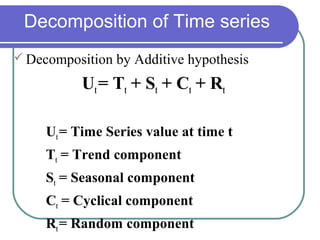
Decomposition of Time series
 Decomposition by Additive hypothesis
Ut= Tt + St + Ct + Rt
Ut= Time Series value at time t
Tt = Trend component
St = Seasonal component
Ct = Cyclical component
Rt= Random component
Cont…
 Decomposition by Multiplicative hypothesis
Ut= Tt x St x Ct x Rt
= logU˃ t= logTt + logSt + logCt + logRt
Measurement of Trend
The following methods are used to measure
“Trend”:
1. Graphic method
2. Method of Semi-Averages
3. Method of Curve fitting by principles of least
squares
4. Method of Moving average

Time series slideshare

  • 1.
  • 2.
    Time Series Analysis ATime Series is a collection of observations made sequentially in time. According to Ya-lun Chou, “A Time Series may be defined as a collection of readings belonging to different time periods, of some economic variables or composite of variables” Examples: Financial time series, scientific time series, Demographic time series, Meteorological time series
  • 3.
    Time series dataVs. Cross Sectional data Time series data Cross Sectional data Time-series data is a set of observations collected at usually equally spaced time intervals. Cross-sectional data are observations that coming from different individuals or groups at a single point in time Time series data usually follows one subject's changes over the course of time. Cross-sectional data refers to data collected by observing many subjects (such as individuals, firms or countries/regions) at the same point of time. It focuses on results gained over an extended period of time, often within a small area It focuses on the information received from surveys and opinions at a particular time, in various locations, depending on the information sought. Example: The daily closing price of a certain stock recorded over the last six weeks is an example of time-series data Example: The closing prices of a group of 20 different stocks on December 15, 1986 this would be an example of cross- sectional data
  • 4.
    Cont… A study onrandom sample of 4000 graphics from 15 of the world’s news papers published between 1974 and 1989 found that more than 75% of all graphics were time series. Sales figures jan 98 - dec 01 0 5 10 15 20 25 30 35 40 45 jun-97 jan-98 jul-98 feb-99 aug-99 mar-00 okt-00 apr-01 nov-01 maj-02
  • 5.
    Cont… Tot-P ug/l, Råån,Helsingborg 1980-2001 0 100 200 300 400 500 600 700 800 900 1000 1980-01-15 1981-01-15 1982-01-15 1983-01-15 1984-01-15 1985-01-15 1986-01-15 1987-01-15 1988-01-15 1989-01-15 1990-01-15 1991-01-15 1992-01-15 1993-01-15 1994-01-15 1995-01-15 1996-01-15 1997-01-15 1998-01-15 1999-01-15 2000-01-15 2001-01-15
  • 6.
    Cont… Mathematically, Ut = f(t) Ut: Value of the phenomenon or variable under consideration at time t. For example, (i) population of a country or region (Ut) in different year (t) (ii) Number of births and deaths (Ut) in different months (t) (iii) Sales of a store (Ut) in different months (t) (iv) Temperatures (Ut) of a place in different days (t) etc.
  • 7.
    Cont… Time series givesa bi-variate distribution, one of the variables being time (t) and the other being the value (Ut)  Time t may be yearly, monthly, weekly, daily or even hourly Usually equal interval
  • 8.
    Components of atime series  The pattern or behavior of the data in a time series has several components.  Theoretically, any time series can be decomposed into: Secular Trend or Long term movement Periodic change or short term movement (i) Seasonal (ii) Cyclical Irregular or random components  However, this decomposition is often not straight- forward because these factors interact.
  • 9.
    Trend component  Thetrend component accounts for the gradual shifting of the time series to relatively higher or lower values over a long period of time.  Trend is usually the result of long-term factors such as changes in the population, demographics, technology, or consumer preferences.
  • 10.
    Cont…  Downward trend:Declining birth or death rate  Upward trend: Population growth, agricultural production  Mathematically trend may be Linear or non-linear (curvi-linear)  The term “long time period” is a relative term.
  • 11.
    Periodic movements Forces whichprevent the smooth flow of the series in a particular direction and tend to repeat themselves over a period of time Seasonal variations or fluctuations Cyclical variations or fluctuations
  • 12.
    Seasonal Variations The componentresponsible for the regular rise or fall (fluctuations) in the time series during a period not more than 1 year. Fluctuations occur in regular sequence (periodical) The period being a month, a week, a day, or even a fraction of the day, an hour etc.
  • 13.
  • 14.
    Cont… Time series datadepicted annually do not represent seasonal variations. Seasonal variations may be attributed to the following reasons: 1. Natural forces : Weather or seasons 2. Man-made conventions: Habits, Fashions, Customs or rituals etc.
  • 15.
    Cyclical Variations Cycle refersto recurrent variations/oscillatory movements in time series Cyclical variations usually last longer than a year One complete period is called “Cycle”
  • 16.
    Cont… Business Cycle (Fourphase Cycle) ProsPerity (Period of Boom) recovery recession dePression
  • 17.
  • 18.
    Irregular or RandomVariations Random or irregular or residual fluctuations Beyond the control of human (unpredictable) Earthquakes, Wars, Floods, Revolutions etc. Short duration and non-repeating
  • 19.
  • 20.
    Purpose of Timeseries  To identify the components, the net effects of whose interaction is exhibited by the movement of a time series  To isolate, study, analyze and measure them independently i.e; holding the other things constant
  • 21.
    Uses of TimeSeries To study the past behavior of the variable To formulate policy decisions and planning of future operations. To predict or estimate or forecast the behavior of the phenomenon in future which is very essential for business planning To compare the changes in the values of different phenomenon at different times
  • 22.
    Decomposition of Timeseries  Decomposition by Additive hypothesis Ut= Tt + St + Ct + Rt Ut= Time Series value at time t Tt = Trend component St = Seasonal component Ct = Cyclical component Rt= Random component
  • 23.
    Cont…  Decomposition byMultiplicative hypothesis Ut= Tt x St x Ct x Rt = logU˃ t= logTt + logSt + logCt + logRt
  • 24.
    Measurement of Trend Thefollowing methods are used to measure “Trend”: 1. Graphic method 2. Method of Semi-Averages 3. Method of Curve fitting by principles of least squares 4. Method of Moving average