FACTOR ANALYSIS
FACTOR ANALYSIS
 A data reduction technique designed to represent
 a wide range of attributes on a smaller number of
 dimensions.

 DEFINITION
“ A statistical approach that can be used to analyze
      interrelationship among a large number of
   variables and a explain these variables in terms
    of their common underlying dimension(factor)”
What is factor analysis ?
    Factor analysis is a general name denoting a class of
     Procedures primarily used for data reduction and
     summarization.

    Variables are not classified as either dependent or
     independent. Instead, the whole set of interdependent
     relationships among variables is examined in order to
     define a set of common dimensions called Factors.
Purpose of Factor Analysis
 To identify underlying dimensions called Factors, that explain
  the correlations among a set of variables.
       -- lifestyle statements may be used to measure the
          psychographic profile of consumers.


   To identify a new, smaller set of uncorrelated variables to
    replace the original set of correlated variables for subsequent
    analysis such as Regression or Discriminant Analysis.
         -- psychographic factors may be used as independent
            variables to explain the difference between loyal and
            non loyal customers.
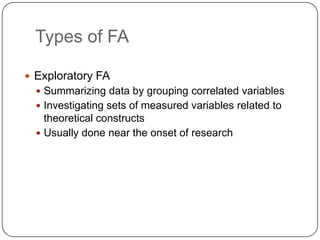
Types of FA

 Exploratory FA
   Summarizing data by grouping correlated variables
   Investigating sets of measured variables related to
    theoretical constructs
   Usually done near the onset of research
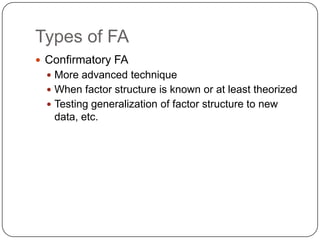
Types of FA
 Confirmatory FA
   More advanced technique
   When factor structure is known or at least theorized
   Testing generalization of factor structure to new
   data, etc.
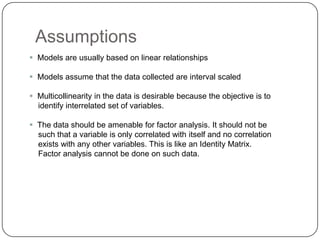
Assumptions
 Models are usually based on linear relationships

 Models assume that the data collected are interval scaled

 Multicollinearity in the data is desirable because the objective is to
  identify interrelated set of variables.

 The data should be amenable for factor analysis. It should not be
  such that a variable is only correlated with itself and no correlation
  exists with any other variables. This is like an Identity Matrix.
  Factor analysis cannot be done on such data.
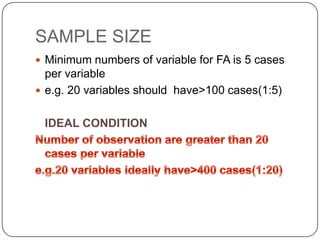
SAMPLE SIZE
 Minimum numbers of variable for FA is 5 cases
  per variable
 e.g. 20 variables should have>100 cases(1:5)


 IDEAL CONDITION
A few examples


   We can now take few examples
   with hypothetical data and run
   factor analysis using SPSS package.
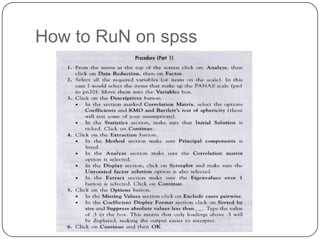
How to RuN on spss
Factor analysis

Factor analysis

  • 1.
  • 2.
    FACTOR ANALYSIS  Adata reduction technique designed to represent a wide range of attributes on a smaller number of dimensions. DEFINITION “ A statistical approach that can be used to analyze interrelationship among a large number of variables and a explain these variables in terms of their common underlying dimension(factor)”
  • 3.
    What is factoranalysis ?  Factor analysis is a general name denoting a class of Procedures primarily used for data reduction and summarization.  Variables are not classified as either dependent or independent. Instead, the whole set of interdependent relationships among variables is examined in order to define a set of common dimensions called Factors.
  • 4.
    Purpose of FactorAnalysis  To identify underlying dimensions called Factors, that explain the correlations among a set of variables. -- lifestyle statements may be used to measure the psychographic profile of consumers.  To identify a new, smaller set of uncorrelated variables to replace the original set of correlated variables for subsequent analysis such as Regression or Discriminant Analysis. -- psychographic factors may be used as independent variables to explain the difference between loyal and non loyal customers.
  • 5.
    Types of FA Exploratory FA  Summarizing data by grouping correlated variables  Investigating sets of measured variables related to theoretical constructs  Usually done near the onset of research
  • 6.
    Types of FA Confirmatory FA  More advanced technique  When factor structure is known or at least theorized  Testing generalization of factor structure to new data, etc.
  • 7.
    Assumptions  Models areusually based on linear relationships  Models assume that the data collected are interval scaled  Multicollinearity in the data is desirable because the objective is to identify interrelated set of variables.  The data should be amenable for factor analysis. It should not be such that a variable is only correlated with itself and no correlation exists with any other variables. This is like an Identity Matrix. Factor analysis cannot be done on such data.
  • 8.
    SAMPLE SIZE  Minimumnumbers of variable for FA is 5 cases per variable  e.g. 20 variables should have>100 cases(1:5) IDEAL CONDITION
  • 9.
    A few examples We can now take few examples with hypothetical data and run factor analysis using SPSS package.
  • 10.
    How to RuNon spss