Exploratory Data Analysis
Exploratory Data Analysis (EDA)
Descriptive Statistics
Graphical
Data driven
Confirmatory Data Analysis (CDA)
Inferential Statistics
EDA and theory driven
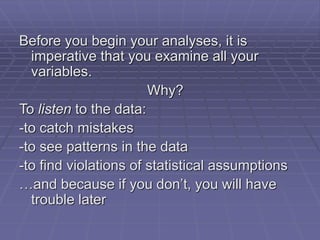
Before you begin your analyses, it is
imperative that you examine all your
variables.
Why?
To listen to the data:
-to catch mistakes
-to see patterns in the data
-to find violations of statistical assumptions
…and because if you don’t, you will have
trouble later
Overview
Part I:
The Basics
or
“I got mean and deviant and now I’m considered normal”
Part II:
Exploratory Data Analysis
or
“I ask Skew how to recover from kurtosis and only hear
‘Get out, liar!’”
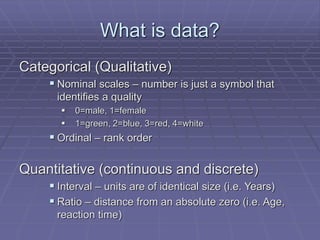
What is data?
Categorical (Qualitative)
 Nominal scales – number is just a symbol that
identifies a quality
 0=male, 1=female
 1=green, 2=blue, 3=red, 4=white
 Ordinal – rank order
Quantitative (continuous and discrete)
 Interval – units are of identical size (i.e. Years)
 Ratio – distance from an absolute zero (i.e. Age,
reaction time)
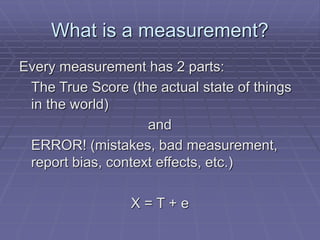
What is a measurement?
Every measurement has 2 parts:
The True Score (the actual state of things
in the world)
and
ERROR! (mistakes, bad measurement,
report bias, context effects, etc.)
X = T + e
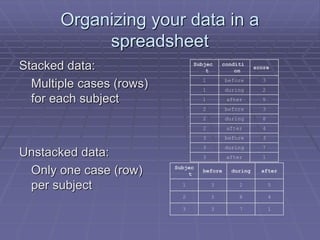
Organizing your data in a
spreadsheet
Stacked data:
Multiple cases (rows)
for each subject
Unstacked data:
Only one case (row)
per subject
Subjec
t
conditi
on
score
1 before 3
1 during 2
1 after 5
2 before 3
2 during 8
2 after 4
3 before 3
3 during 7
3 after 1
Subjec
t
before during after
1 3 2 5
2 3 8 4
3 3 7 1
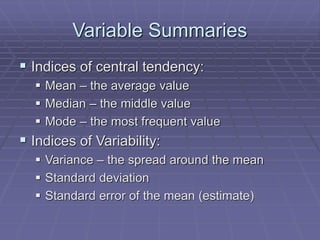
Variable Summaries
 Indices of central tendency:
 Mean – the average value
 Median – the middle value
 Mode – the most frequent value
 Indices of Variability:
 Variance – the spread around the mean
 Standard deviation
 Standard error of the mean (estimate)
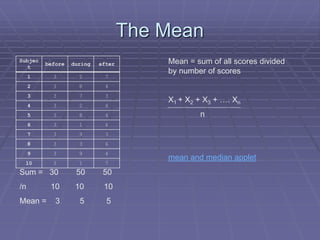
The Mean
Subjec
t
before during after
1 3 2 7
2 3 8 4
3 3 7 3
4 3 2 6
5 3 8 4
6 3 1 6
7 3 9 3
8 3 3 6
9 3 9 4
10 3 1 7
Sum = 30 50 50
/n 10 10 10
Mean = 3 5 5
Mean = sum of all scores divided
by number of scores
X1 + X2 + X3 + …. Xn
n
mean and median applet
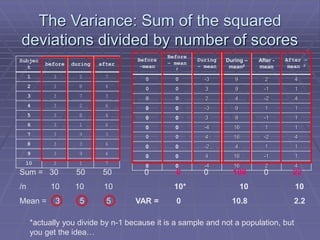
The Variance: Sum of the squared
deviations divided by number of scores
Subjec
t
before during after
1 3 2 7
2 3 8 4
3 3 7 3
4 3 2 6
5 3 8 4
6 3 1 6
7 3 9 3
8 3 3 6
9 3 9 4
10 3 1 7
Sum = 30 50 50
/n 10 10 10
Mean = 3 5 5
Before
-mean
Before
– mean
2
During
- mean
During –
mean2
After -
mean
After –
mean 2
0 0 -3 9 2 4
0 0 3 9 -1 1
0 0 2 4 -2 4
0 0 -3 9 1 1
0 0 3 9 -1 1
0 0 -4 16 1 1
0 0 4 16 -2 4
0 0 -2 4 1 1
0 0 4 16 -1 1
0 0 -4 16 2 4
0 0 0 108 0 22
10* 10 10
VAR = 0 10.8 2.2
*actually you divide by n-1 because it is a sample and not a population, but
you get the idea…
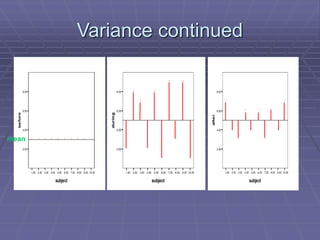
Variance continued
1.00 2.00 3.00 4.00 5.00 6.00 7.00 8.00 9.00 10.00
subject
2.00
4.00
6.00
8.00
before
         
1.00 2.00 3.00 4.00 5.00 6.00 7.00 8.00 9.00 10.00
subject
2.00
4.00
6.00
8.00
during










1.00 2.00 3.00 4.00 5.00 6.00 7.00 8.00 9.00 10.00
subject
2.00
4.00
6.00
8.00
after










mean
Distribution
 Means and variances are ways to describe a
distribution of scores.
 Knowing about your distributions is one of the
best ways to understand your data
 A NORMAL (aka Gaussian) distribution is the
most common assumption of statistics, thus it is
often important to check if your data are
normally distributed.
Normal Distribution applet normaldemo.html
sorry, these don’t work yet
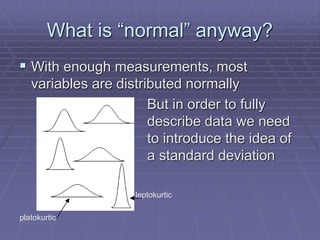
What is “normal” anyway?
 With enough measurements, most
variables are distributed normally
But in order to fully
describe data we need
to introduce the idea of
a standard deviation
leptokurtic
platokurtic
Standard deviation
Variance, as calculated earlier, is arbitrary.
What does it mean to have a variance of
10.8? Or 2.2? Or 1459.092? Or 0.000001?
Nothing. But if you could “standardize” that
value, you could talk about any variance
(i.e. deviation) in equivalent terms.
Standard Deviations are simply the square
root of the variance
Standard deviation
The process of standardizing deviations goes like
this:
1.Score (in the units that are meaningful)
2.Mean
3.Each score’s deviation from the mean
4.Square that deviation
5.Sum all the squared deviations (Sum of
Squares)
6.Divide by n (if population) or n-1 (if sample)
7.Square root – now the value is in the units we
started with!!!
Interpreting standard deviation
(SD)
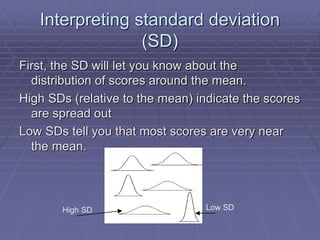
First, the SD will let you know about the
distribution of scores around the mean.
High SDs (relative to the mean) indicate the scores
are spread out
Low SDs tell you that most scores are very near
the mean.
Low SD
High SD
Interpreting standard deviation
(SD)
Second, you can then interpret any
individual score in terms of the SD.
For example: mean = 50, SD = 10
versus mean = 50, SD = 1
A score of 55 is:
0.5 Standard deviation units from the mean
(not much) OR
5 standard deviation units from mean (a lot!)
Standardized scores (Z)
Third, you can use SDs to create
standardized scores – that is, force the
scores onto a normal distribution by
putting each score into units of SD.
Subtract the mean from each score and
divide by SD
Z = (X – mean)/SD
This is truly an amazing thing
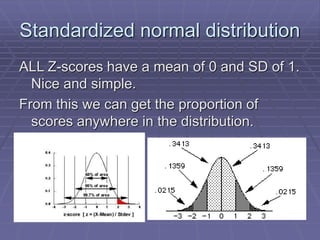
Standardized normal distribution
ALL Z-scores have a mean of 0 and SD of 1.
Nice and simple.
From this we can get the proportion of
scores anywhere in the distribution.
The trouble with normal
We violate assumptions about statistical
tests if the distributions of our variables
are not approximately normal.
Thus, we must first examine each variable’s
distribution and make adjustments when
necessary so that assumptions are met.
sample mean applet not working yet
Part II
Examine every variable for:
Out of range values
Normality
Outliers
Checking data
 In SPSS, you can get a table of each variable
with each value and its frequency of occurrence.
 You can also compute a checking variable using
the COMPUTE command. Create a new variable
that gives a 1 if a value is between minimum and
maximum, and a 0 if the value is outside that
range.
 Best way to examine categorical variables is by
checking their frequencies
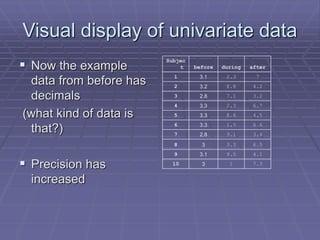
Visual display of univariate data
 Now the example
data from before has
decimals
(what kind of data is
that?)
 Precision has
increased
Subjec
t before during after
1 3.1 2.3 7
2 3.2 8.8 4.2
3 2.8 7.1 3.2
4 3.3 2.3 6.7
5 3.3 8.6 4.5
6 3.3 1.5 6.6
7 2.8 9.1 3.4
8 3 3.3 6.5
9 3.1 9.5 4.1
10 3 1 7.3
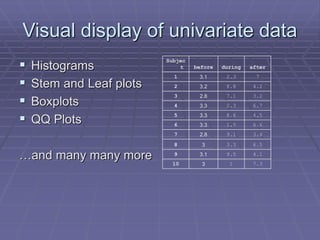
Visual display of univariate data
 Histograms
 Stem and Leaf plots
 Boxplots
 QQ Plots
…and many many more
Subjec
t before during after
1 3.1 2.3 7
2 3.2 8.8 4.2
3 2.8 7.1 3.2
4 3.3 2.3 6.7
5 3.3 8.6 4.5
6 3.3 1.5 6.6
7 2.8 9.1 3.4
8 3 3.3 6.5
9 3.1 9.5 4.1
10 3 1 7.3
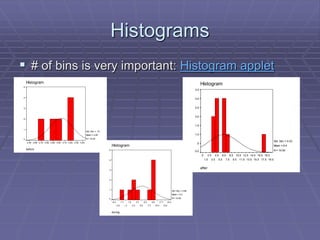
Histograms
 # of bins is very important: Histogram applet
before
3.45
3.35
3.25
3.15
3.05
2.95
2.85
2.75
2.65
2.55
Histogram
Frequency
5
4
3
2
1
0
Std. Dev = .19
Mean = 3.09
N = 10.00
during
14.3
13.0
11.7
10.3
9.0
7.7
6.3
5.0
3.7
2.3
1.0
-.3
-1.7
-3.0
-4.3
Histogram
Frequency
5
4
3
2
1
0
Std. Dev = 3.86
Mean = 5.2
N = 10.00
after
19.5
18.5
17.5
16.5
15.5
14.5
13.5
12.5
11.5
10.5
9.5
8.5
7.5
6.5
5.5
4.5
3.5
2.5
1.5
.5
Histogram
Frequency
3.5
3.0
2.5
2.0
1.5
1.0
.5
0.0
Std. Dev = 4.03
Mean = 6.4
N = 10.00
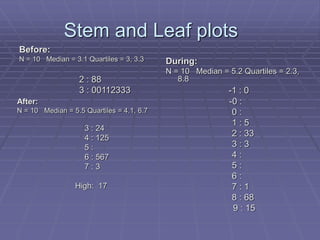
Stem and Leaf plots
Before:
N = 10 Median = 3.1 Quartiles = 3, 3.3
2 : 88
3 : 00112333
During:
N = 10 Median = 5.2 Quartiles = 2.3,
8.8
-1 : 0
-0 :
0 :
1 : 5
2 : 33
3 : 3
4 :
5 :
6 :
7 : 1
8 : 68
9 : 15
After:
N = 10 Median = 5.5 Quartiles = 4.1, 6.7
3 : 24
4 : 125
5 :
6 : 567
7 : 3
High: 17
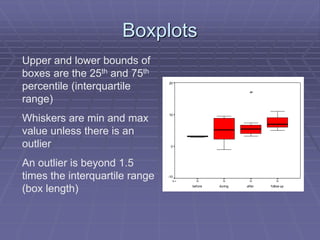
Boxplots
Upper and lower bounds of
boxes are the 25th and 75th
percentile (interquartile
range)
Whiskers are min and max
value unless there is an
outlier
An outlier is beyond 1.5
times the interquartile range
(box length)
10
10
10
10
N =
follow up
after
during
before
20
10
0
-10
1
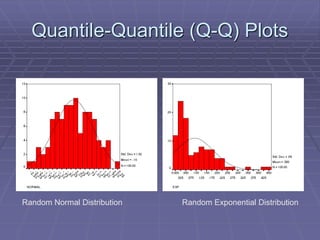
Quantile-Quantile (Q-Q) Plots
Random Normal Distribution Random Exponential Distribution
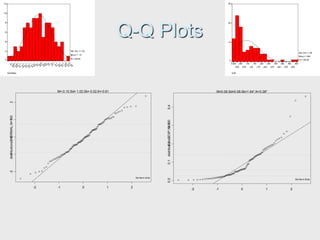
Q-Q Plots
-2 -1 0 1 2
-2
-1
0
1
2
M=-0.10,Sd= 1.02,Sk= 0.02,K=-0.61
distributions$NORMAL,N=100
Std Norm Qntls
-2 -1 0 1 2
0.0
0.1
0.2
0.3
0.4
M=0.09,Sd=0.09,Sk=1.64*,K=3.38*
distributions$EXP,N=100
Std Norm Qntls
So…what do you do?
If you find a mistake, fix it.
If you find an outlier, trim it or delete it.
If your distributions are askew, transform the
data.
Dealing with Outliers
First, try to explain it.
In a normal distribution 0.4% are outliers (>2.7 SD)
and 1 in a million is an extreme outlier (>4.72
SD).
For analyses you can:
Delete the value – crude but effective
Change the outlier to value ~3 SD from mean
“Winsorize” it (make = to next highest value)
“Trim” the mean – recalculate mean from data
within interquartile range
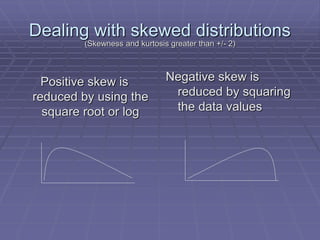
Dealing with skewed distributions
Positive skew is
reduced by using the
square root or log
Negative skew is
reduced by squaring
the data values
(Skewness and kurtosis greater than +/- 2)
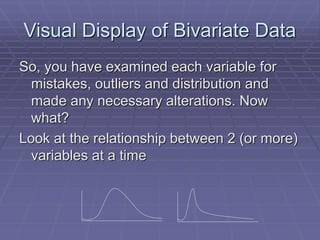
Visual Display of Bivariate Data
So, you have examined each variable for
mistakes, outliers and distribution and
made any necessary alterations. Now
what?
Look at the relationship between 2 (or more)
variables at a time
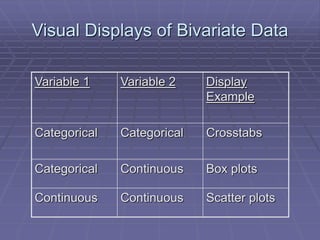
Visual Displays of Bivariate Data
Variable 1 Variable 2 Display
Example
Categorical Categorical Crosstabs
Categorical Continuous Box plots
Continuous Continuous Scatter plots
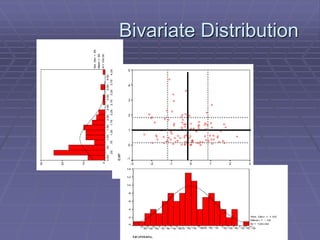
Bivariate Distribution
NORMAL
3
2
1
0
-1
-2
-3
EXP
5
4
3
2
1
0
-1
NORMAL
2.25
2.00
1.75
1.50
1.25
1.00
.75
.50
.25
0.00
-.25
-.50
-.75
-1.00
-1.25
-1.50
-1.75
-2.00
-2.25
-2.50
14
12
10
8
6
4
2
0
Std. Dev = 1.02
Mean = -.16
N = 100.00
EXP
4.25
4.00
3.75
3.50
3.25
3.00
2.75
2.50
2.25
2.00
1.75
1.50
1.25
1.00
.75
.50
.25
0.00
30
20
10
0
Std.
Dev
=
.85
Mean
=
.95
N
=
100.00
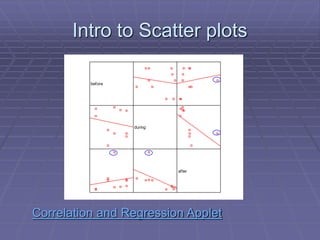
Intro to Scatter plots
Correlation and Regression Applet
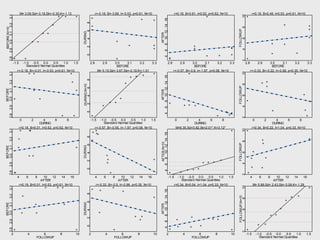
before
during
after
-1.5 -1.0 -0.5 0.0 0.5 1.0 1.5
2.8
2.9
3.0
3.1
3.2
3.3
M= 3.09,Sd= 0.18,Sk=-0.35,K=-1.13
BEFORE,N=10
Standard Normal Quantiles BEFORE
DURING
2.8 2.9 3.0 3.1 3.2 3.3
0
2
4
6
8
r=-0.18, B=-3.69, t=-0.53, p=0.61, N=10
BEFORE
AFTER
2.8 2.9 3.0 3.1 3.2 3.3
4
6
8
10
12
14
16
r=0.18, B=3.81, t=0.52, p=0.62, N=10
BEFORE
FOLLOWUP
2.8 2.9 3.0 3.1 3.2 3.3
2
4
6
8
10
r=0.19, B=2.49, t=0.53, p=0.61, N=10
DURING
BEFORE
0 2 4 6 8
2.8
2.9
3.0
3.1
3.2
3.3
r=-0.18, B=-0.01, t=-0.53, p=0.61, N=10
-1.5 -1.0 -0.5 0.0 0.5 1.0 1.5
0
2
4
6
8
M= 5.15,Sd= 3.67,Sk=-0.19,K=-1.51
DURING,N=10
Standard Normal Quantiles DURING
AFTER
0 2 4 6 8
4
6
8
10
12
14
16
r=-0.57, B=-0.6, t=-1.97, p=0.08, N=10
DURING
FOLLOWUP
0 2 4 6 8
2
4
6
8
10
r=-0.33, B=-0.22, t=-0.99, p=0.35, N=10
AFTER
BEFORE
4 6 8 10 12 14 16
2.8
2.9
3.0
3.1
3.2
3.3
r=0.18, B=0.01, t=0.52, p=0.62, N=10
AFTER
DURING
4 6 8 10 12 14 16
0
2
4
6
8
r=-0.57, B=-0.55, t=-1.97, p=0.08, N=10
-1.5 -1.0 -0.5 0.0 0.5 1.0 1.5
4
6
8
10
12
14
16
M=6.35,Sd=3.82,Sk=2.01*,K=3.12*
AFTER,N=10
Standard Normal Quantiles AFTER
FOLLOWUP
4 6 8 10 12 14 16
2
4
6
8
10
r=0.34, B=0.22, t=1.04, p=0.33, N=10
FOLLOWUP
BEFORE
2 4 6 8 10
2.8
2.9
3.0
3.1
3.2
3.3
r=0.19, B=0.01, t=0.53, p=0.61, N=10
FOLLOWUP
DURING
2 4 6 8 10
0
2
4
6
8
r=-0.33, B=-0.5, t=-0.99, p=0.35, N=10
FOLLOWUP
AFTER
2 4 6 8 10
4
6
8
10
12
14
16
r=0.34, B=0.54, t=1.04, p=0.33, N=10
-1.5 -1.0 -0.5 0.0 0.5 1.0 1.5
2
4
6
8
10
M= 5.89,Sd= 2.43,Sk= 0.09,K=-1.29
FOLLOWUP,N=10
Standard Normal Quantiles
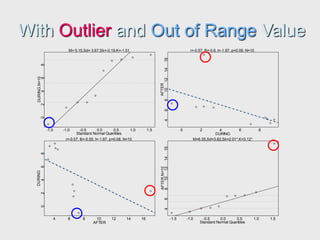
With Outlier and Out of Range Value
-1.5 -1.0 -0.5 0.0 0.5 1.0 1.5
0
2
4
6
8
M= 5.15,Sd= 3.67,Sk=-0.19,K=-1.51
DURING,N=10
Standard Normal Quantiles DURING
AFTER
0 2 4 6 8
4
6
8
10
12
14
16
r=-0.57, B=-0.6, t=-1.97, p=0.08, N=10
AFTER
DURING
4 6 8 10 12 14 16
0
2
4
6
8
r=-0.57, B=-0.55, t=-1.97, p=0.08, N=10
-1.5 -1.0 -0.5 0.0 0.5 1.0 1.5
4
6
8
10
12
14
16
M=6.35,Sd=3.82,Sk=2.01*,K=3.12*
AFTER,N=10
Standard Normal Quantiles
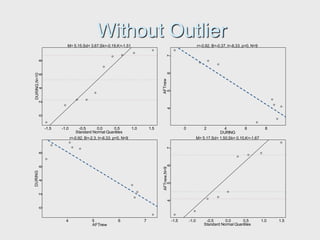
Without Outlier
-1.5 -1.0 -0.5 0.0 0.5 1.0 1.5
0
2
4
6
8
M= 5.15,Sd= 3.67,Sk=-0.19,K=-1.51
DURING,N=10
Standard Normal Quantiles DURING
AFTnew
0 2 4 6 8
4
5
6
7
r=-0.92, B=-0.37, t=-6.33, p=0, N=9
AFTnew
DURING
4 5 6 7
0
2
4
6
8
r=-0.92, B=-2.3, t=-6.33, p=0, N=9
-1.5 -1.0 -0.5 0.0 0.5 1.0 1.5
4
5
6
7
M= 5.17,Sd= 1.50,Sk= 0.10,K=-1.67
AFTnew,N=9
Standard Normal Quantiles
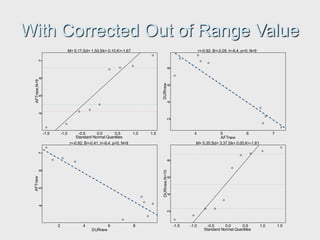
With Corrected Out of Range Value
-1.5 -1.0 -0.5 0.0 0.5 1.0 1.5
4
5
6
7
M= 5.17,Sd= 1.50,Sk= 0.10,K=-1.67
AFTnew,N=9
Standard Normal Quantiles AFTnew
DURnew
4 5 6 7
2
4
6
8
r=-0.92, B=-2.09, t=-6.4, p=0, N=9
DURnew
AFTnew
2 4 6 8
4
5
6
7
r=-0.92, B=-0.41, t=-6.4, p=0, N=9
-1.5 -1.0 -0.5 0.0 0.5 1.0 1.5
2
4
6
8
M= 5.35,Sd= 3.37,Sk= 0.00,K=-1.81
DURnew,N=10
Standard Normal Quantiles
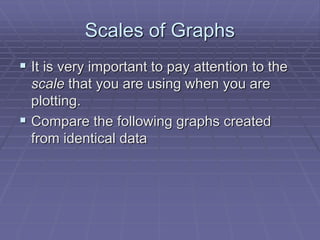
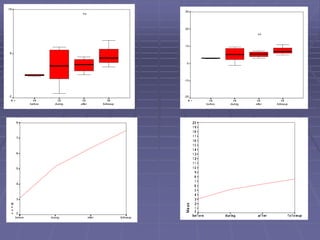
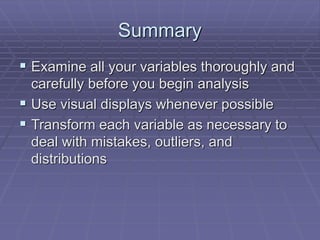
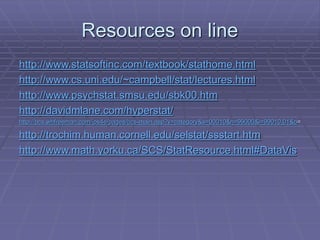
Scales of Graphs
 It is very important to pay attention to the
scale that you are using when you are
plotting.
 Compare the following graphs created
from identical data
Summary
 Examine all your variables thoroughly and
carefully before you begin analysis
 Use visual displays whenever possible
 Transform each variable as necessary to
deal with mistakes, outliers, and
distributions
Resources on line
http://www.statsoftinc.com/textbook/stathome.html
http://www.cs.uni.edu/~campbell/stat/lectures.html
http://www.psychstat.smsu.edu/sbk00.htm
http://davidmlane.com/hyperstat/
http://bcs.whfreeman.com/ips4e/pages/bcs-main.asp?v=category&s=00010&n=99000&i=99010.01&o=
http://trochim.human.cornell.edu/selstat/ssstart.htm
http://www.math.yorku.ca/SCS/StatResource.html#DataVis
Recommended Reading
 Anything by Tukey, especially Exploratory
Data Analysis (Tukey, 1997)
 Anything by Cleveland, especially
Visualizing Data (Cleveland, 1993)
 Visual Display of Quantitative Information
(Tufte, 1983)
 Anything on statistics by Jacob Cohen or
Paul Meehl.
for next time
 http://www.execpc.com/~helberg/pitfalls

Exploratory Data Analysis EFA Factor analysis

  • 1.
  • 2.
    Exploratory Data Analysis(EDA) Descriptive Statistics Graphical Data driven Confirmatory Data Analysis (CDA) Inferential Statistics EDA and theory driven
  • 3.
    Before you beginyour analyses, it is imperative that you examine all your variables. Why? To listen to the data: -to catch mistakes -to see patterns in the data -to find violations of statistical assumptions …and because if you don’t, you will have trouble later
  • 4.
    Overview Part I: The Basics or “Igot mean and deviant and now I’m considered normal” Part II: Exploratory Data Analysis or “I ask Skew how to recover from kurtosis and only hear ‘Get out, liar!’”
  • 5.
    What is data? Categorical(Qualitative)  Nominal scales – number is just a symbol that identifies a quality  0=male, 1=female  1=green, 2=blue, 3=red, 4=white  Ordinal – rank order Quantitative (continuous and discrete)  Interval – units are of identical size (i.e. Years)  Ratio – distance from an absolute zero (i.e. Age, reaction time)
  • 6.
    What is ameasurement? Every measurement has 2 parts: The True Score (the actual state of things in the world) and ERROR! (mistakes, bad measurement, report bias, context effects, etc.) X = T + e
  • 7.
    Organizing your datain a spreadsheet Stacked data: Multiple cases (rows) for each subject Unstacked data: Only one case (row) per subject Subjec t conditi on score 1 before 3 1 during 2 1 after 5 2 before 3 2 during 8 2 after 4 3 before 3 3 during 7 3 after 1 Subjec t before during after 1 3 2 5 2 3 8 4 3 3 7 1
  • 8.
    Variable Summaries  Indicesof central tendency:  Mean – the average value  Median – the middle value  Mode – the most frequent value  Indices of Variability:  Variance – the spread around the mean  Standard deviation  Standard error of the mean (estimate)
  • 9.
    The Mean Subjec t before duringafter 1 3 2 7 2 3 8 4 3 3 7 3 4 3 2 6 5 3 8 4 6 3 1 6 7 3 9 3 8 3 3 6 9 3 9 4 10 3 1 7 Sum = 30 50 50 /n 10 10 10 Mean = 3 5 5 Mean = sum of all scores divided by number of scores X1 + X2 + X3 + …. Xn n mean and median applet
  • 10.
    The Variance: Sumof the squared deviations divided by number of scores Subjec t before during after 1 3 2 7 2 3 8 4 3 3 7 3 4 3 2 6 5 3 8 4 6 3 1 6 7 3 9 3 8 3 3 6 9 3 9 4 10 3 1 7 Sum = 30 50 50 /n 10 10 10 Mean = 3 5 5 Before -mean Before – mean 2 During - mean During – mean2 After - mean After – mean 2 0 0 -3 9 2 4 0 0 3 9 -1 1 0 0 2 4 -2 4 0 0 -3 9 1 1 0 0 3 9 -1 1 0 0 -4 16 1 1 0 0 4 16 -2 4 0 0 -2 4 1 1 0 0 4 16 -1 1 0 0 -4 16 2 4 0 0 0 108 0 22 10* 10 10 VAR = 0 10.8 2.2 *actually you divide by n-1 because it is a sample and not a population, but you get the idea…
  • 11.
    Variance continued 1.00 2.003.00 4.00 5.00 6.00 7.00 8.00 9.00 10.00 subject 2.00 4.00 6.00 8.00 before           1.00 2.00 3.00 4.00 5.00 6.00 7.00 8.00 9.00 10.00 subject 2.00 4.00 6.00 8.00 during           1.00 2.00 3.00 4.00 5.00 6.00 7.00 8.00 9.00 10.00 subject 2.00 4.00 6.00 8.00 after           mean
  • 12.
    Distribution  Means andvariances are ways to describe a distribution of scores.  Knowing about your distributions is one of the best ways to understand your data  A NORMAL (aka Gaussian) distribution is the most common assumption of statistics, thus it is often important to check if your data are normally distributed. Normal Distribution applet normaldemo.html sorry, these don’t work yet
  • 13.
    What is “normal”anyway?  With enough measurements, most variables are distributed normally But in order to fully describe data we need to introduce the idea of a standard deviation leptokurtic platokurtic
  • 14.
    Standard deviation Variance, ascalculated earlier, is arbitrary. What does it mean to have a variance of 10.8? Or 2.2? Or 1459.092? Or 0.000001? Nothing. But if you could “standardize” that value, you could talk about any variance (i.e. deviation) in equivalent terms. Standard Deviations are simply the square root of the variance
  • 15.
    Standard deviation The processof standardizing deviations goes like this: 1.Score (in the units that are meaningful) 2.Mean 3.Each score’s deviation from the mean 4.Square that deviation 5.Sum all the squared deviations (Sum of Squares) 6.Divide by n (if population) or n-1 (if sample) 7.Square root – now the value is in the units we started with!!!
  • 16.
    Interpreting standard deviation (SD) First,the SD will let you know about the distribution of scores around the mean. High SDs (relative to the mean) indicate the scores are spread out Low SDs tell you that most scores are very near the mean. Low SD High SD
  • 17.
    Interpreting standard deviation (SD) Second,you can then interpret any individual score in terms of the SD. For example: mean = 50, SD = 10 versus mean = 50, SD = 1 A score of 55 is: 0.5 Standard deviation units from the mean (not much) OR 5 standard deviation units from mean (a lot!)
  • 18.
    Standardized scores (Z) Third,you can use SDs to create standardized scores – that is, force the scores onto a normal distribution by putting each score into units of SD. Subtract the mean from each score and divide by SD Z = (X – mean)/SD This is truly an amazing thing
  • 19.
    Standardized normal distribution ALLZ-scores have a mean of 0 and SD of 1. Nice and simple. From this we can get the proportion of scores anywhere in the distribution.
  • 20.
    The trouble withnormal We violate assumptions about statistical tests if the distributions of our variables are not approximately normal. Thus, we must first examine each variable’s distribution and make adjustments when necessary so that assumptions are met. sample mean applet not working yet
  • 21.
    Part II Examine everyvariable for: Out of range values Normality Outliers
  • 22.
    Checking data  InSPSS, you can get a table of each variable with each value and its frequency of occurrence.  You can also compute a checking variable using the COMPUTE command. Create a new variable that gives a 1 if a value is between minimum and maximum, and a 0 if the value is outside that range.  Best way to examine categorical variables is by checking their frequencies
  • 23.
    Visual display ofunivariate data  Now the example data from before has decimals (what kind of data is that?)  Precision has increased Subjec t before during after 1 3.1 2.3 7 2 3.2 8.8 4.2 3 2.8 7.1 3.2 4 3.3 2.3 6.7 5 3.3 8.6 4.5 6 3.3 1.5 6.6 7 2.8 9.1 3.4 8 3 3.3 6.5 9 3.1 9.5 4.1 10 3 1 7.3
  • 24.
    Visual display ofunivariate data  Histograms  Stem and Leaf plots  Boxplots  QQ Plots …and many many more Subjec t before during after 1 3.1 2.3 7 2 3.2 8.8 4.2 3 2.8 7.1 3.2 4 3.3 2.3 6.7 5 3.3 8.6 4.5 6 3.3 1.5 6.6 7 2.8 9.1 3.4 8 3 3.3 6.5 9 3.1 9.5 4.1 10 3 1 7.3
  • 25.
    Histograms  # ofbins is very important: Histogram applet before 3.45 3.35 3.25 3.15 3.05 2.95 2.85 2.75 2.65 2.55 Histogram Frequency 5 4 3 2 1 0 Std. Dev = .19 Mean = 3.09 N = 10.00 during 14.3 13.0 11.7 10.3 9.0 7.7 6.3 5.0 3.7 2.3 1.0 -.3 -1.7 -3.0 -4.3 Histogram Frequency 5 4 3 2 1 0 Std. Dev = 3.86 Mean = 5.2 N = 10.00 after 19.5 18.5 17.5 16.5 15.5 14.5 13.5 12.5 11.5 10.5 9.5 8.5 7.5 6.5 5.5 4.5 3.5 2.5 1.5 .5 Histogram Frequency 3.5 3.0 2.5 2.0 1.5 1.0 .5 0.0 Std. Dev = 4.03 Mean = 6.4 N = 10.00
  • 26.
    Stem and Leafplots Before: N = 10 Median = 3.1 Quartiles = 3, 3.3 2 : 88 3 : 00112333 During: N = 10 Median = 5.2 Quartiles = 2.3, 8.8 -1 : 0 -0 : 0 : 1 : 5 2 : 33 3 : 3 4 : 5 : 6 : 7 : 1 8 : 68 9 : 15 After: N = 10 Median = 5.5 Quartiles = 4.1, 6.7 3 : 24 4 : 125 5 : 6 : 567 7 : 3 High: 17
  • 27.
    Boxplots Upper and lowerbounds of boxes are the 25th and 75th percentile (interquartile range) Whiskers are min and max value unless there is an outlier An outlier is beyond 1.5 times the interquartile range (box length) 10 10 10 10 N = follow up after during before 20 10 0 -10 1
  • 28.
    Quantile-Quantile (Q-Q) Plots RandomNormal Distribution Random Exponential Distribution
  • 29.
    Q-Q Plots -2 -10 1 2 -2 -1 0 1 2 M=-0.10,Sd= 1.02,Sk= 0.02,K=-0.61 distributions$NORMAL,N=100 Std Norm Qntls -2 -1 0 1 2 0.0 0.1 0.2 0.3 0.4 M=0.09,Sd=0.09,Sk=1.64*,K=3.38* distributions$EXP,N=100 Std Norm Qntls
  • 30.
    So…what do youdo? If you find a mistake, fix it. If you find an outlier, trim it or delete it. If your distributions are askew, transform the data.
  • 31.
    Dealing with Outliers First,try to explain it. In a normal distribution 0.4% are outliers (>2.7 SD) and 1 in a million is an extreme outlier (>4.72 SD). For analyses you can: Delete the value – crude but effective Change the outlier to value ~3 SD from mean “Winsorize” it (make = to next highest value) “Trim” the mean – recalculate mean from data within interquartile range
  • 32.
    Dealing with skeweddistributions Positive skew is reduced by using the square root or log Negative skew is reduced by squaring the data values (Skewness and kurtosis greater than +/- 2)
  • 33.
    Visual Display ofBivariate Data So, you have examined each variable for mistakes, outliers and distribution and made any necessary alterations. Now what? Look at the relationship between 2 (or more) variables at a time
  • 34.
    Visual Displays ofBivariate Data Variable 1 Variable 2 Display Example Categorical Categorical Crosstabs Categorical Continuous Box plots Continuous Continuous Scatter plots
  • 35.
    Bivariate Distribution NORMAL 3 2 1 0 -1 -2 -3 EXP 5 4 3 2 1 0 -1 NORMAL 2.25 2.00 1.75 1.50 1.25 1.00 .75 .50 .25 0.00 -.25 -.50 -.75 -1.00 -1.25 -1.50 -1.75 -2.00 -2.25 -2.50 14 12 10 8 6 4 2 0 Std. Dev= 1.02 Mean = -.16 N = 100.00 EXP 4.25 4.00 3.75 3.50 3.25 3.00 2.75 2.50 2.25 2.00 1.75 1.50 1.25 1.00 .75 .50 .25 0.00 30 20 10 0 Std. Dev = .85 Mean = .95 N = 100.00
  • 36.
    Intro to Scatterplots Correlation and Regression Applet before during after
  • 37.
    -1.5 -1.0 -0.50.0 0.5 1.0 1.5 2.8 2.9 3.0 3.1 3.2 3.3 M= 3.09,Sd= 0.18,Sk=-0.35,K=-1.13 BEFORE,N=10 Standard Normal Quantiles BEFORE DURING 2.8 2.9 3.0 3.1 3.2 3.3 0 2 4 6 8 r=-0.18, B=-3.69, t=-0.53, p=0.61, N=10 BEFORE AFTER 2.8 2.9 3.0 3.1 3.2 3.3 4 6 8 10 12 14 16 r=0.18, B=3.81, t=0.52, p=0.62, N=10 BEFORE FOLLOWUP 2.8 2.9 3.0 3.1 3.2 3.3 2 4 6 8 10 r=0.19, B=2.49, t=0.53, p=0.61, N=10 DURING BEFORE 0 2 4 6 8 2.8 2.9 3.0 3.1 3.2 3.3 r=-0.18, B=-0.01, t=-0.53, p=0.61, N=10 -1.5 -1.0 -0.5 0.0 0.5 1.0 1.5 0 2 4 6 8 M= 5.15,Sd= 3.67,Sk=-0.19,K=-1.51 DURING,N=10 Standard Normal Quantiles DURING AFTER 0 2 4 6 8 4 6 8 10 12 14 16 r=-0.57, B=-0.6, t=-1.97, p=0.08, N=10 DURING FOLLOWUP 0 2 4 6 8 2 4 6 8 10 r=-0.33, B=-0.22, t=-0.99, p=0.35, N=10 AFTER BEFORE 4 6 8 10 12 14 16 2.8 2.9 3.0 3.1 3.2 3.3 r=0.18, B=0.01, t=0.52, p=0.62, N=10 AFTER DURING 4 6 8 10 12 14 16 0 2 4 6 8 r=-0.57, B=-0.55, t=-1.97, p=0.08, N=10 -1.5 -1.0 -0.5 0.0 0.5 1.0 1.5 4 6 8 10 12 14 16 M=6.35,Sd=3.82,Sk=2.01*,K=3.12* AFTER,N=10 Standard Normal Quantiles AFTER FOLLOWUP 4 6 8 10 12 14 16 2 4 6 8 10 r=0.34, B=0.22, t=1.04, p=0.33, N=10 FOLLOWUP BEFORE 2 4 6 8 10 2.8 2.9 3.0 3.1 3.2 3.3 r=0.19, B=0.01, t=0.53, p=0.61, N=10 FOLLOWUP DURING 2 4 6 8 10 0 2 4 6 8 r=-0.33, B=-0.5, t=-0.99, p=0.35, N=10 FOLLOWUP AFTER 2 4 6 8 10 4 6 8 10 12 14 16 r=0.34, B=0.54, t=1.04, p=0.33, N=10 -1.5 -1.0 -0.5 0.0 0.5 1.0 1.5 2 4 6 8 10 M= 5.89,Sd= 2.43,Sk= 0.09,K=-1.29 FOLLOWUP,N=10 Standard Normal Quantiles
  • 38.
    With Outlier andOut of Range Value -1.5 -1.0 -0.5 0.0 0.5 1.0 1.5 0 2 4 6 8 M= 5.15,Sd= 3.67,Sk=-0.19,K=-1.51 DURING,N=10 Standard Normal Quantiles DURING AFTER 0 2 4 6 8 4 6 8 10 12 14 16 r=-0.57, B=-0.6, t=-1.97, p=0.08, N=10 AFTER DURING 4 6 8 10 12 14 16 0 2 4 6 8 r=-0.57, B=-0.55, t=-1.97, p=0.08, N=10 -1.5 -1.0 -0.5 0.0 0.5 1.0 1.5 4 6 8 10 12 14 16 M=6.35,Sd=3.82,Sk=2.01*,K=3.12* AFTER,N=10 Standard Normal Quantiles
  • 39.
    Without Outlier -1.5 -1.0-0.5 0.0 0.5 1.0 1.5 0 2 4 6 8 M= 5.15,Sd= 3.67,Sk=-0.19,K=-1.51 DURING,N=10 Standard Normal Quantiles DURING AFTnew 0 2 4 6 8 4 5 6 7 r=-0.92, B=-0.37, t=-6.33, p=0, N=9 AFTnew DURING 4 5 6 7 0 2 4 6 8 r=-0.92, B=-2.3, t=-6.33, p=0, N=9 -1.5 -1.0 -0.5 0.0 0.5 1.0 1.5 4 5 6 7 M= 5.17,Sd= 1.50,Sk= 0.10,K=-1.67 AFTnew,N=9 Standard Normal Quantiles
  • 40.
    With Corrected Outof Range Value -1.5 -1.0 -0.5 0.0 0.5 1.0 1.5 4 5 6 7 M= 5.17,Sd= 1.50,Sk= 0.10,K=-1.67 AFTnew,N=9 Standard Normal Quantiles AFTnew DURnew 4 5 6 7 2 4 6 8 r=-0.92, B=-2.09, t=-6.4, p=0, N=9 DURnew AFTnew 2 4 6 8 4 5 6 7 r=-0.92, B=-0.41, t=-6.4, p=0, N=9 -1.5 -1.0 -0.5 0.0 0.5 1.0 1.5 2 4 6 8 M= 5.35,Sd= 3.37,Sk= 0.00,K=-1.81 DURnew,N=10 Standard Normal Quantiles
  • 41.
    Scales of Graphs It is very important to pay attention to the scale that you are using when you are plotting.  Compare the following graphs created from identical data
  • 43.
    Summary  Examine allyour variables thoroughly and carefully before you begin analysis  Use visual displays whenever possible  Transform each variable as necessary to deal with mistakes, outliers, and distributions
  • 44.
  • 45.
    Recommended Reading  Anythingby Tukey, especially Exploratory Data Analysis (Tukey, 1997)  Anything by Cleveland, especially Visualizing Data (Cleveland, 1993)  Visual Display of Quantitative Information (Tufte, 1983)  Anything on statistics by Jacob Cohen or Paul Meehl.
  • 46.
    for next time http://www.execpc.com/~helberg/pitfalls