PROGRAMMED
INSTRUCTION
maheswarijaikumar2103@gmail.com
PI ON LINE
DEFINITION
• "A Programmed Instruction is a
method of self instruction that
enlists machines or specially
prepared books to teach
information". CHRIS JORDAN
PURPOSE
• To manage human learning
under controlled conditions.
• To promote learning at the pace
of the learner.
• To present the material in small
pieces.
• To provide quicker response
CHARACTERISTICS
• The subject matter is broken
down in to small steps called
FRAMES and arranged
sequentially.
• Frequent response of the
student is required.
• There is an immediate
confirmation of the right answer
or correction of wrong answers
given by the learners (SELF
CORRECTING FEATURE).
• The content and the sequence
of the frames are subjected to
actual try out by students and
are revised on the basis of data
gathered by the programmer
(DIAGNOSTIC FEATURE)
• Each student progressess at
his own pace without any threat
of being exposed to any
humiliation in a heterogeneous
class.
• The assumption about the
learner is clearly stated in the
programmed learning
materials.
• The objectives underlying
programming instructions are
defined explicitly and in
operational terms so that the
terminal behaviour is made
observable and measurable.
• The interaction between the
learner and the programme is
emphasized in programmed
learning.
• Continuous evaluation is
possible by recording the
student's response.
• The strategy provides sufficient
situations for teaching the
students to discriminate
between a range of possibilities
and reduce generalizations.
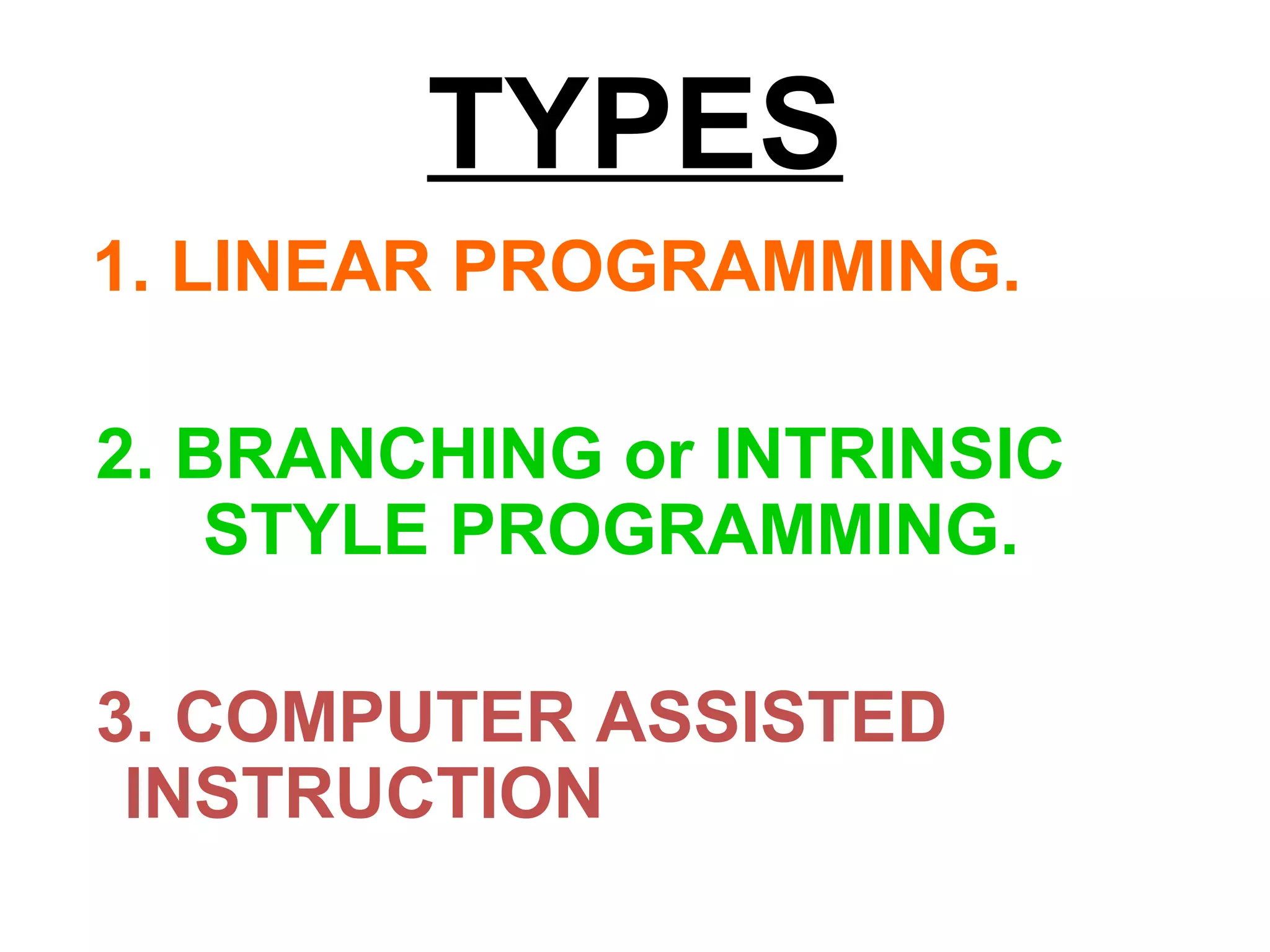
TYPES
1. LINEAR PROGRAMMING.
2. BRANCHING or INTRINSIC
STYLE PROGRAMMING.
3. COMPUTER ASSISTED
INSTRUCTION
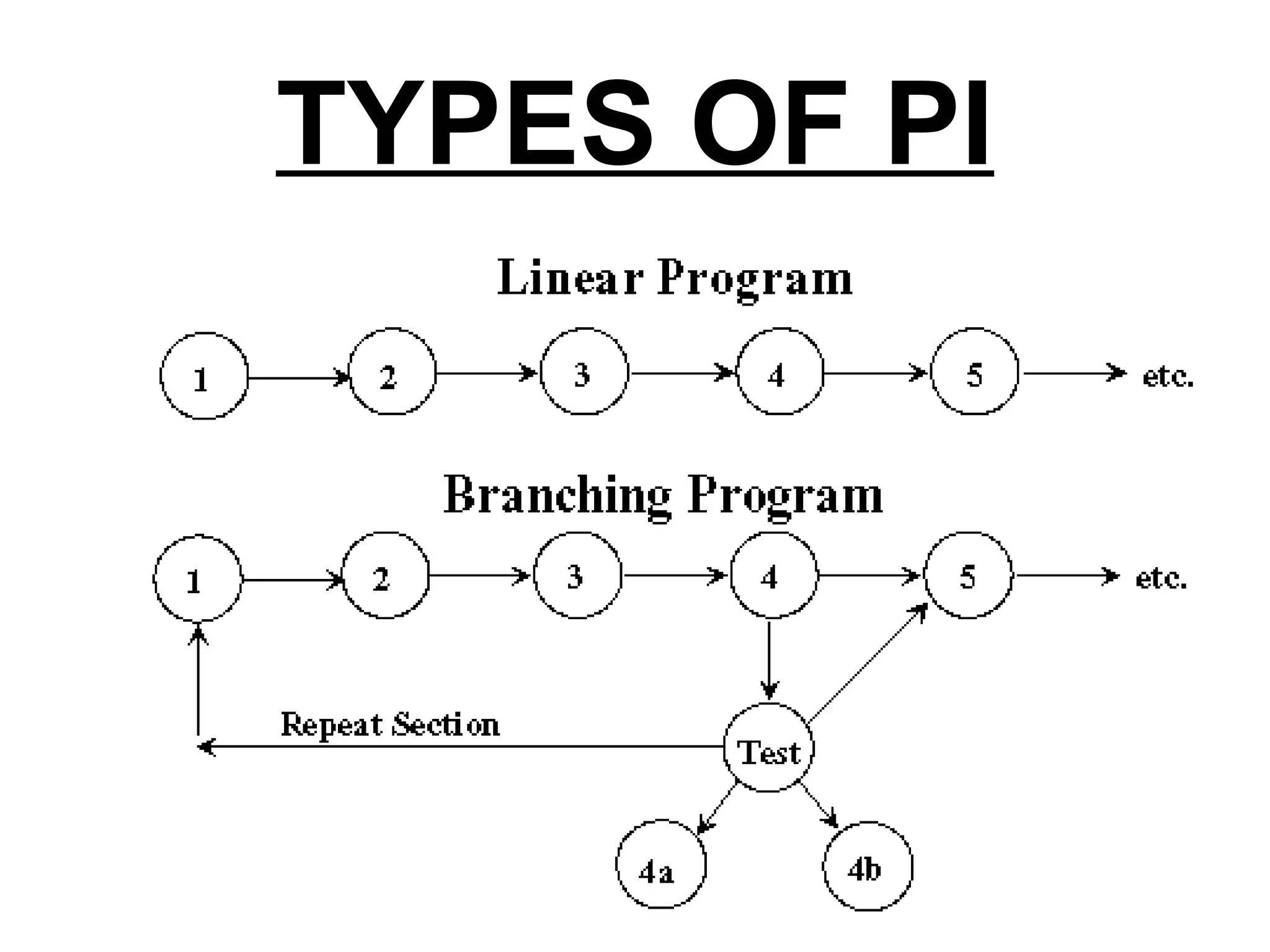
TYPES OF PI
LINEAR
PROGRAMMING
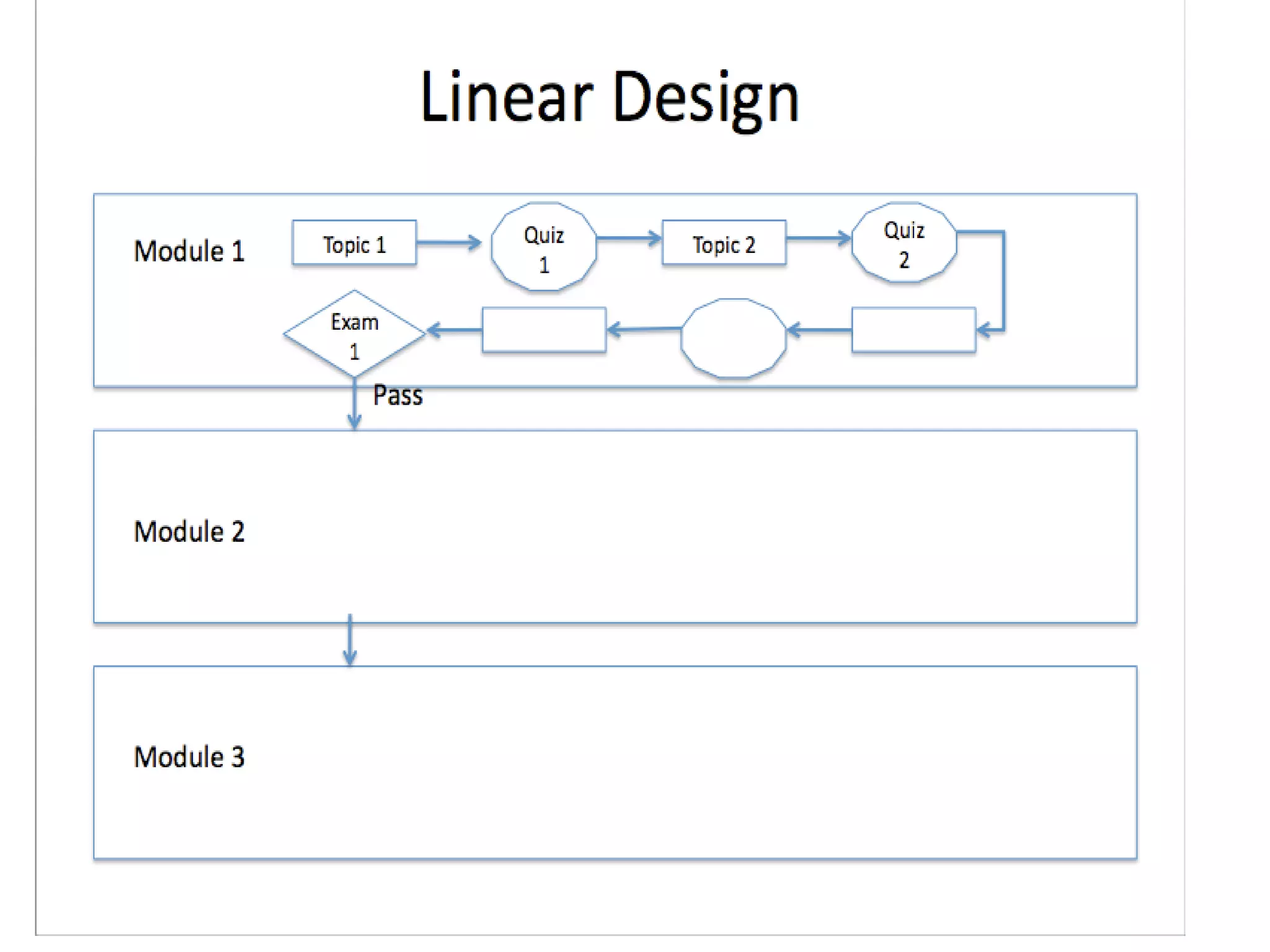
LINEAR PROGRAMMING (LP)
• In LP the learner's responses
are controlled externally by the
programmer sitting at a distant
place.
• A linear programme is called
"straight line programme".
• The learner starts from initial
behaviour to the terminal
behaviour following a straight
line.
• The student proceeds from one
frame to the next until he
completes the programme.
CHARACTERISTICS OF LP
• LP are exposed to a small
amount of information and
proceed from one frame or one
item of information to the next
in an orderly fashion.
• The learners respond overtly so
their correct responses can be
rewarded and incorrect
responses can be corrected.
• The learners are immediately
informed about weather or not
their response is correct
(feedback).
• The learners proceed at their
own pace (self pacing).
SCOPE OF LP
• ELEMENTARY EDUCATION :
Generally there are single
teacher in certain schools and
are required to teach all the
subjects. LP will help teachers
in such situations.
SECONDARY EDUCATION
• In secondary education
diversity if interest and
curriculum neccessitates this
method.
CORRESPONDENCE EDUCATION :
FOR HIGH SCHOOL STUDENTS :
Self instruction could be made
possible if the correspondence
lessons are programmed.
FOR SCHOOL TEACHERS
• When a new course is being
introduced, Programmed
instruction will equip them with
content and new mehtods of
teaching.
UNIVERSITY EDUCATION
• Standards of higher education
can be maintained.
• Can be applied for health
oriented courses (Health Care
Professional Education)
PRINCIPLES
OF LP
PRINCIPLE OF SMALL STEP
• A learner can proceed from
knowing very little about a
subject to mastry over the
subject by going through a
programme.
PINCIPLE OF
CONFORMATION
• In this kind of reinforcement to
work on the programme or to
learn, a learner need not wait
for a long time to proceed to
the next level.
PRINCIPLE OF SELF PACING
• The learner can work each step
as slowly or as quickly as he
chooses.
STUDENT TESTING &
EVALUATION
• LP provides a detailed record
of the student and is the basis
for revising the programme.
TYPES OF LP
CONSTRUCT RESPONSE
• This is a Skinnerian type of
learning process.
• The learner has to construct
responses while going through
such formats of programme
text.
MULTIPLE CHOICE QUESTIONS
• Sydney L. Pressy selected a
response on each frame and is
presented in the discrimination
frame sequence type of
programme.
CONVENTIONAL CHAINING
• John Barlow designed this
type.
• Here each frame is connected
to the second frame which
becomes a part of the stimulus
of the third and so on down the
line.
SKIP LINEAR
• Uses skipping device for
solving problems of review and
over review where a bright
student may skip the simple
programme.
CRITERION FRAMES
• This is used to direct the learner
along the linear path according
to their responses at those
critical situations.
• The creation frames decide
whether the student should go
through a particular sequence or
not.
RULEG SYSTEM
• The contents are organized in terms
of rules first and then the examples.
• The rule is given a complete form
and the examples are in an
incomplete form.
• A learner has to construct
responses to complete the example.
EGRULE SYSTEM
• This is opposite to the ruleg system.
• The contents are organized in terms
of examples and then the rules.
• The examples are given in complete
form and the rules in incomplete
form.
INTRINSIC
STYLE
PROGRAMMING
BRANCHING / INTRINSIC
TYPE
• NORMAN COWDER ( a
contemporary of B.F Skinner)
developed this model.
• His model focuses problem
solving from COMMUNICATION
POINT OF VIEW.
PRINCIPLES OF
BRANCHING PROGRAMME
• PRINCIPLE OF EXPOSITION.
• PRINCIPLE OF DIAGNOSIS.
• PRINCIPLE OF REMEDIATION.
PRINCIPLE OF EXPOSITION
• The whole concept is presented
to the students so that he can
learn the complete information
better which is provided in the
home page.
• It serves two purposes :
TEACHING & DIAGNOSIS.
PRINCIPLE OF DIAGNOSIS
• Here the weakness of the
learner is identified after
exposition and it is assessed
whether the learner could learn
what the causes are.
• And then it is modified.
PRINCIPLE OF REMEDIATION
• If a learner chooses the wrong
alternative, the learner has to
move to a wrong page where a
remedial instruction is provided.
• And the student is directed to
return to the home page and he /
she is asked to choose the right
answer.
STRUCTURE OF
BRANCHING PROGRAMME
• The programme text is called
SCRAMBLED TEXT.
• This consists of two types of pages :
1. HOME PAGE.
2. WRONG PAGE.
HOME PAGE
• This page consists of content or
concept and followed by
multuple choice questions which
involve four aspects :
1. TEACHING (The learner goes
through the instructions to
comprehend the concept or
information).
• 2. RESPONSE (At the end of
instruction, multiple choice is
given to the learner to choose
the correct response, which the
learner has to discriminate. The
response is intrinsic).
• 3. DIAGNOSIS (If the learner
chooses the wrong response,
he has to move to the wrong
page. If he chooses the right
response, he moves to the next
home page, where the next unit
is presented.)
• 4. REINFORCEMENT : The
response is reinforced by
confirming it at the begening of
the home page, hence the
learner is encouraged through
verbal approval or praise.
WRONG PAGE
• Wrong page or remedial frame
involves :
1. Repeating student response.
2. Negative confirmation.
3. Reason as to why he is wrong.
Cont....
Cont....
4. Further explanation in a single
language.
5. Direction as to where the learner
should go next.
TECHNIQUE OF
BRANCHING PROGRAMME
• There are two tenchniques :
1. BACKWARD BRANCHING.
2. FORWARD BRANCHING.
BACKWARD BRANCHING
• If the learner makes an error, he
has to take to the remedial
frame where;
• He is given some more help in
understanding the concept and
solving the problem.
• He is then directed to the
original frame number one.
• So the learner goes through the
same frame twice, once before
the remedial material is refered
by him.
FORWARD BRANCHING
• When the learner gives a
correct or wrong response, he
goes to the next or new page.
• If he makes a wrong choice, he
is directed to the remedial
frame where his mistakes are
fully explained.
• This is followed by another
parallel question from which he
goes to the next frame in the
main stream.
COMPUTER
ASSISTED
INSTRUCTION
COMPUTER ASSISTED
INSTRUCTION (CIA)
• CIA consists of individual
learning booths, each with a
console.
• It has a television screen for
displaying information.
• A complete package of
information is stored in the
system and is presented
sequentially.
• The learner may question the
computer and feed the answer
into it.
• It helps determine subsequent
activities in the learning
situations.
DEVELOPMENT
OF A
PROGRAMMED
INSTRUCTION
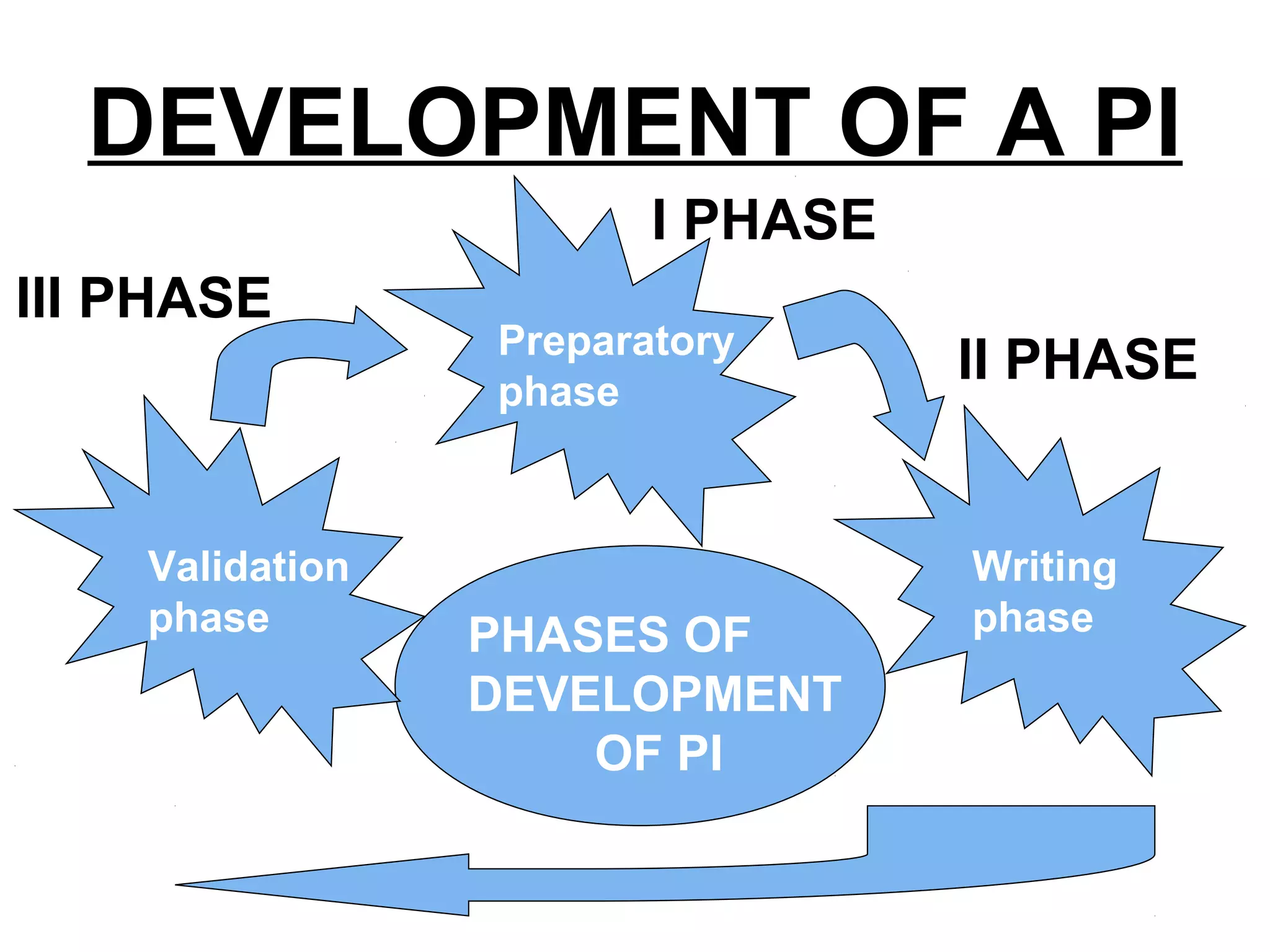
DEVELOPMENT OF A PI
PHASES OF
DEVELOPMENT
OF PI
I PHASE
II PHASE
III PHASE
Preparatory
phase
Writing
phase
Validation
phase
PREPARATORY PHASE
1. Involves viewing the
programme on any topic.
2. Deciding to prepare a
programme.
3. Selecting a topic.
4. Preparing a content outline.
5. Specification of objectives in
behavioural forms.
6. Specifications (Assumptions
about learner).
7. Entering behaviour (Pre requisite
skill).
8. Preparation of pre test.
9. Terminal behaviour. Expected
performance of the learner at
the end of a course.
10. Preparation of post test i.e.
preferably criterion test.
WRITING PHASE
• Involves the following activities:
1. PRESENTATION OF MATERIALS
IN FRAMES.
2. REQUIRES AN ACTIVE STUDENT
PARTICIPATION.
3. PROVE ANSWERS FOR
CONFIRMATION OR
CORRECTION OF STUDENT
RESPONSE.
4. USE PROMPTS TO GUIDE
STUDENT RESPONSE.
5. PROVIDE CAREFUL
SEQUENCING OF FRAMES.
PRESENTING THE
MATERIALS IN FRAMES
• A frame is a small segment of
information that calls for
particular student response.
• The task of a programmer is to
provide the stimulus necessary
to evoke student response.
• The acquisition of these
responses is a step towards
terminal behaviour.
• Be sure that each frame presents
a relatively small segment of
material.
• The programmer should
present only enough material to
elicit a single response
ACTIVE STUDENT
RESPONSE
• In every frame the response of
the student is elicited.
• The responses in programmed
material should be overt or
covert.
• Student who make overt
responses should write down
their answers on sheets of
paper.
• Student who make covert
responses should mentally
compose their own responses to
each blank in the frame before
turning the page to the correct
CONFIRMATION /
CORRECTION
• Providing the correct response
with which students can
compare their own responses is
a standard characteristic of
programmed instruction.
• Students come to know their
responses are correct or
incorrect.
USING PROMPTS
• Prompts are provided in the
programme frame to guide the
student to the correct
response.
• Prompts are supplementary
stimuli; they are added to a
frame to make the frame easier
but are not sufficient in
themselves to produce the
responses.
SEQUENCING OF
THE FRAME
• Sequencing depends on:
1. The description and analysis of
the behaviours the programme
intends to teach.
2. The conditions necessary for
the learning required by the
various tasks.
• All the basic learning conditions
- discrimination, generalization,
contiguity, practice and
reinforcement can be embodied
in the frame sequence.
• Frame sequence can also
provide for review and testing
whenever these are necessary.
VALIDATION PHASE
• Involves :
1. Try out and revision.
2. Individual tryout.
3. Small group try out.
4. Master validation.
5. Editing, reviewing, revising
and modifying the programme
for final preparation based on
fruits of tryout.
ADVANTAGES
• Programmed Instructions are
more successful in critical
sagacity (discernment) of the
logic or various subjects and
inspiring students' creative
thinking and judgement.
• Good teachers are freed from
the humdrum of routine
classroom activity and they are
in a position to devote their
time to more creative activities.
• The use of programed
instruction has potentials to
improve the quality of
education in general.
• It helps a teacher to diagose
the problems of the individual
learner.
• The use of programmed
learning has brought a
revolution in the social setting
of the classroom.
• Many emotional and social
problems have been eliminated
and problem of discipline have
been solved automatically.
• Programmed instruction is a
great thrust in the direction of
individualized instruction.
• A well organized programmed
instructional device is tailored
to cater to the needs of
individual students of the class.
• By presenting the learning
material in a small segments of
information (frames), it makes
learning an interesting game in
which the learner is challenged
by his own capabilities.
DISADVANTAGES
• Programmed instruction does
not eliminate competition of
grades as often claimed.
• Mere manipulation of the
machine is not rewarding. Once
novelty wears off, or if too
many errors appear, the
students loose interest and
motivation.
• Later reinforcements often do
not acclelarate learning.
• Programmed instruction
restricts the learner's freedom
of choice resulting in cramping
of his imagination and
initiative.
• Operant conditioning is found
sucessful only with some
students in some cases and not
in all.
• PI ignore or make inadequate
provisions for variables like
cognitive, personality and
motivational variables.
THANK YOU

Programmed Instruction

  • 2.
  • 3.
  • 4.
    DEFINITION • "A ProgrammedInstruction is a method of self instruction that enlists machines or specially prepared books to teach information". CHRIS JORDAN
  • 5.
    PURPOSE • To managehuman learning under controlled conditions. • To promote learning at the pace of the learner.
  • 6.
    • To presentthe material in small pieces. • To provide quicker response
  • 7.
    CHARACTERISTICS • The subjectmatter is broken down in to small steps called FRAMES and arranged sequentially. • Frequent response of the student is required.
  • 8.
    • There isan immediate confirmation of the right answer or correction of wrong answers given by the learners (SELF CORRECTING FEATURE).
  • 9.
    • The contentand the sequence of the frames are subjected to actual try out by students and are revised on the basis of data gathered by the programmer (DIAGNOSTIC FEATURE)
  • 10.
    • Each studentprogressess at his own pace without any threat of being exposed to any humiliation in a heterogeneous class. • The assumption about the learner is clearly stated in the programmed learning materials.
  • 11.
    • The objectivesunderlying programming instructions are defined explicitly and in operational terms so that the terminal behaviour is made observable and measurable.
  • 12.
    • The interactionbetween the learner and the programme is emphasized in programmed learning. • Continuous evaluation is possible by recording the student's response.
  • 13.
    • The strategyprovides sufficient situations for teaching the students to discriminate between a range of possibilities and reduce generalizations.
  • 14.
    TYPES 1. LINEAR PROGRAMMING. 2.BRANCHING or INTRINSIC STYLE PROGRAMMING. 3. COMPUTER ASSISTED INSTRUCTION
  • 15.
  • 16.
  • 17.
    LINEAR PROGRAMMING (LP) •In LP the learner's responses are controlled externally by the programmer sitting at a distant place. • A linear programme is called "straight line programme".
  • 19.
    • The learnerstarts from initial behaviour to the terminal behaviour following a straight line. • The student proceeds from one frame to the next until he completes the programme.
  • 20.
    CHARACTERISTICS OF LP •LP are exposed to a small amount of information and proceed from one frame or one item of information to the next in an orderly fashion.
  • 21.
    • The learnersrespond overtly so their correct responses can be rewarded and incorrect responses can be corrected. • The learners are immediately informed about weather or not their response is correct (feedback).
  • 22.
    • The learnersproceed at their own pace (self pacing).
  • 23.
    SCOPE OF LP •ELEMENTARY EDUCATION : Generally there are single teacher in certain schools and are required to teach all the subjects. LP will help teachers in such situations.
  • 24.
    SECONDARY EDUCATION • Insecondary education diversity if interest and curriculum neccessitates this method.
  • 25.
    CORRESPONDENCE EDUCATION : FORHIGH SCHOOL STUDENTS : Self instruction could be made possible if the correspondence lessons are programmed.
  • 26.
    FOR SCHOOL TEACHERS •When a new course is being introduced, Programmed instruction will equip them with content and new mehtods of teaching.
  • 27.
    UNIVERSITY EDUCATION • Standardsof higher education can be maintained. • Can be applied for health oriented courses (Health Care Professional Education)
  • 28.
  • 29.
    PRINCIPLE OF SMALLSTEP • A learner can proceed from knowing very little about a subject to mastry over the subject by going through a programme.
  • 30.
    PINCIPLE OF CONFORMATION • Inthis kind of reinforcement to work on the programme or to learn, a learner need not wait for a long time to proceed to the next level.
  • 31.
    PRINCIPLE OF SELFPACING • The learner can work each step as slowly or as quickly as he chooses.
  • 32.
    STUDENT TESTING & EVALUATION •LP provides a detailed record of the student and is the basis for revising the programme.
  • 33.
  • 34.
    CONSTRUCT RESPONSE • Thisis a Skinnerian type of learning process. • The learner has to construct responses while going through such formats of programme text.
  • 35.
    MULTIPLE CHOICE QUESTIONS •Sydney L. Pressy selected a response on each frame and is presented in the discrimination frame sequence type of programme.
  • 36.
    CONVENTIONAL CHAINING • JohnBarlow designed this type. • Here each frame is connected to the second frame which becomes a part of the stimulus of the third and so on down the line.
  • 37.
    SKIP LINEAR • Usesskipping device for solving problems of review and over review where a bright student may skip the simple programme.
  • 38.
    CRITERION FRAMES • Thisis used to direct the learner along the linear path according to their responses at those critical situations. • The creation frames decide whether the student should go through a particular sequence or not.
  • 39.
    RULEG SYSTEM • Thecontents are organized in terms of rules first and then the examples. • The rule is given a complete form and the examples are in an incomplete form. • A learner has to construct responses to complete the example.
  • 40.
    EGRULE SYSTEM • Thisis opposite to the ruleg system. • The contents are organized in terms of examples and then the rules. • The examples are given in complete form and the rules in incomplete form.
  • 41.
  • 42.
    BRANCHING / INTRINSIC TYPE •NORMAN COWDER ( a contemporary of B.F Skinner) developed this model. • His model focuses problem solving from COMMUNICATION POINT OF VIEW.
  • 43.
    PRINCIPLES OF BRANCHING PROGRAMME •PRINCIPLE OF EXPOSITION. • PRINCIPLE OF DIAGNOSIS. • PRINCIPLE OF REMEDIATION.
  • 44.
    PRINCIPLE OF EXPOSITION •The whole concept is presented to the students so that he can learn the complete information better which is provided in the home page. • It serves two purposes : TEACHING & DIAGNOSIS.
  • 45.
    PRINCIPLE OF DIAGNOSIS •Here the weakness of the learner is identified after exposition and it is assessed whether the learner could learn what the causes are. • And then it is modified.
  • 46.
    PRINCIPLE OF REMEDIATION •If a learner chooses the wrong alternative, the learner has to move to a wrong page where a remedial instruction is provided. • And the student is directed to return to the home page and he / she is asked to choose the right answer.
  • 47.
    STRUCTURE OF BRANCHING PROGRAMME •The programme text is called SCRAMBLED TEXT. • This consists of two types of pages : 1. HOME PAGE. 2. WRONG PAGE.
  • 48.
    HOME PAGE • Thispage consists of content or concept and followed by multuple choice questions which involve four aspects : 1. TEACHING (The learner goes through the instructions to comprehend the concept or information).
  • 49.
    • 2. RESPONSE(At the end of instruction, multiple choice is given to the learner to choose the correct response, which the learner has to discriminate. The response is intrinsic).
  • 50.
    • 3. DIAGNOSIS(If the learner chooses the wrong response, he has to move to the wrong page. If he chooses the right response, he moves to the next home page, where the next unit is presented.)
  • 51.
    • 4. REINFORCEMENT: The response is reinforced by confirming it at the begening of the home page, hence the learner is encouraged through verbal approval or praise.
  • 52.
    WRONG PAGE • Wrongpage or remedial frame involves : 1. Repeating student response. 2. Negative confirmation. 3. Reason as to why he is wrong. Cont....
  • 53.
    Cont.... 4. Further explanationin a single language. 5. Direction as to where the learner should go next.
  • 54.
    TECHNIQUE OF BRANCHING PROGRAMME •There are two tenchniques : 1. BACKWARD BRANCHING. 2. FORWARD BRANCHING.
  • 55.
    BACKWARD BRANCHING • Ifthe learner makes an error, he has to take to the remedial frame where; • He is given some more help in understanding the concept and solving the problem.
  • 56.
    • He isthen directed to the original frame number one. • So the learner goes through the same frame twice, once before the remedial material is refered by him.
  • 57.
    FORWARD BRANCHING • Whenthe learner gives a correct or wrong response, he goes to the next or new page. • If he makes a wrong choice, he is directed to the remedial frame where his mistakes are fully explained.
  • 58.
    • This isfollowed by another parallel question from which he goes to the next frame in the main stream.
  • 59.
  • 60.
    COMPUTER ASSISTED INSTRUCTION (CIA) •CIA consists of individual learning booths, each with a console. • It has a television screen for displaying information.
  • 61.
    • A completepackage of information is stored in the system and is presented sequentially.
  • 62.
    • The learnermay question the computer and feed the answer into it. • It helps determine subsequent activities in the learning situations.
  • 63.
  • 64.
    DEVELOPMENT OF API PHASES OF DEVELOPMENT OF PI I PHASE II PHASE III PHASE Preparatory phase Writing phase Validation phase
  • 65.
    PREPARATORY PHASE 1. Involvesviewing the programme on any topic. 2. Deciding to prepare a programme. 3. Selecting a topic.
  • 66.
    4. Preparing acontent outline. 5. Specification of objectives in behavioural forms. 6. Specifications (Assumptions about learner). 7. Entering behaviour (Pre requisite skill).
  • 67.
    8. Preparation ofpre test. 9. Terminal behaviour. Expected performance of the learner at the end of a course. 10. Preparation of post test i.e. preferably criterion test.
  • 68.
    WRITING PHASE • Involvesthe following activities: 1. PRESENTATION OF MATERIALS IN FRAMES. 2. REQUIRES AN ACTIVE STUDENT PARTICIPATION.
  • 69.
    3. PROVE ANSWERSFOR CONFIRMATION OR CORRECTION OF STUDENT RESPONSE. 4. USE PROMPTS TO GUIDE STUDENT RESPONSE. 5. PROVIDE CAREFUL SEQUENCING OF FRAMES.
  • 70.
    PRESENTING THE MATERIALS INFRAMES • A frame is a small segment of information that calls for particular student response. • The task of a programmer is to provide the stimulus necessary to evoke student response.
  • 71.
    • The acquisitionof these responses is a step towards terminal behaviour. • Be sure that each frame presents a relatively small segment of material.
  • 72.
    • The programmershould present only enough material to elicit a single response
  • 73.
    ACTIVE STUDENT RESPONSE • Inevery frame the response of the student is elicited. • The responses in programmed material should be overt or covert.
  • 74.
    • Student whomake overt responses should write down their answers on sheets of paper. • Student who make covert responses should mentally compose their own responses to each blank in the frame before turning the page to the correct
  • 75.
    CONFIRMATION / CORRECTION • Providingthe correct response with which students can compare their own responses is a standard characteristic of programmed instruction.
  • 76.
    • Students cometo know their responses are correct or incorrect.
  • 77.
    USING PROMPTS • Promptsare provided in the programme frame to guide the student to the correct response.
  • 78.
    • Prompts aresupplementary stimuli; they are added to a frame to make the frame easier but are not sufficient in themselves to produce the responses.
  • 79.
    SEQUENCING OF THE FRAME •Sequencing depends on: 1. The description and analysis of the behaviours the programme intends to teach. 2. The conditions necessary for the learning required by the various tasks.
  • 80.
    • All thebasic learning conditions - discrimination, generalization, contiguity, practice and reinforcement can be embodied in the frame sequence. • Frame sequence can also provide for review and testing whenever these are necessary.
  • 81.
    VALIDATION PHASE • Involves: 1. Try out and revision. 2. Individual tryout. 3. Small group try out.
  • 82.
    4. Master validation. 5.Editing, reviewing, revising and modifying the programme for final preparation based on fruits of tryout.
  • 83.
    ADVANTAGES • Programmed Instructionsare more successful in critical sagacity (discernment) of the logic or various subjects and inspiring students' creative thinking and judgement.
  • 84.
    • Good teachersare freed from the humdrum of routine classroom activity and they are in a position to devote their time to more creative activities.
  • 85.
    • The useof programed instruction has potentials to improve the quality of education in general. • It helps a teacher to diagose the problems of the individual learner.
  • 86.
    • The useof programmed learning has brought a revolution in the social setting of the classroom. • Many emotional and social problems have been eliminated and problem of discipline have been solved automatically.
  • 87.
    • Programmed instructionis a great thrust in the direction of individualized instruction. • A well organized programmed instructional device is tailored to cater to the needs of individual students of the class.
  • 88.
    • By presentingthe learning material in a small segments of information (frames), it makes learning an interesting game in which the learner is challenged by his own capabilities.
  • 89.
    DISADVANTAGES • Programmed instructiondoes not eliminate competition of grades as often claimed.
  • 90.
    • Mere manipulationof the machine is not rewarding. Once novelty wears off, or if too many errors appear, the students loose interest and motivation. • Later reinforcements often do not acclelarate learning.
  • 91.
    • Programmed instruction restrictsthe learner's freedom of choice resulting in cramping of his imagination and initiative.
  • 92.
    • Operant conditioningis found sucessful only with some students in some cases and not in all. • PI ignore or make inadequate provisions for variables like cognitive, personality and motivational variables.
  • 94.