




BY:- MR. PRAKASH YADAV
TOPIC-BLUEPRINT(GENERAL SCIENCE)
• A blueprint is generally something intended as a guide when making
something else
• It is a detailed plan of action or outline in a technical form.
MEANING OF BLUEPRINT IN EDUCATION
It provide students an interactive approach for education planning to meet
the curriculum expectations and learning objectives.
MEANING-BLUEPRINT
• A blueprint for test or examination is also known as the test specification
provides examination strategy of an institution at a glance ;A blueprint for
test or examination is also known as the test specification provides
examination strategy of an institution at a glance
• It is in the form of matrices i.e,tabular form
• “specifies all the elements of performance relevant to the assessment so that
appropriate samples of activity and corresponding methods can be selected
according to their relative importance to the overall assessment process”
Newbie and Dawson, 1994
BLUEPRINT FOR TEST
• For the assessment of test specification i.e., in examination.
• Evaluating time management and strategy to achieve the desired
outcome
• Education administrators for curriculum development;
• Curriculum developers to design comprehensive, sequenced career
development learning opportunities;
• Research and evaluators to design learning plans;
• It is a matrix or chart reporting the number and type of test questions;
The questions represent the topics in the content area
USES OF BLUEPRINT IN EDUCATION
• Provide conceptual map of examination format and the content area
• Type of measurement tool for assessing the items weighting the
respective column of learning objectives
• Blueprint is seen as readily available document, which contains the
list of topics covered under each module with its identified learning
objectives
• Content validity of assessment
PURPOSE OF BLUE PRINT
It provides a clear framework for the researchers to design items which
assess the important concept or thinking skill listed in the test
blueprint.
It also provide sources for the formative use of the summative
assessment
to satisfy the bloom’s taxonomy of educational objective
PURPOSE OF BLUE PRINT
• CONTENT ANALYSIS
It is a means to divide the whole content of the syllabus or course
into a systematic tabular form;
Example-
GUIDELINE / STEPS TO PREPARE BLUE
PRINT
Unit Sub-unit
Lesson-1 Topic1.1 Topic1.2
Topic 1.3
Topic 1.4
Lesson- 2 Topic2.1
Topic2.2
Topic2.3
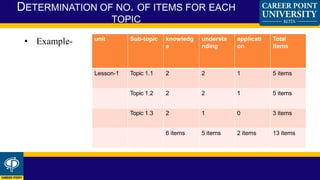
• Example-
DETERMINATION OF NO. OF ITEMS FOR EACH
TOPIC
unit Sub-topic knowledg
e
understa
nding
applicati
on
Total
items
Lesson-1 Topic 1.1 2 2 1 5 items
Topic 1.2 2 2 1 5 items
Topic 1.3 2 1 0 3 items
6 items 5 items 2 items 13 items
• Example-
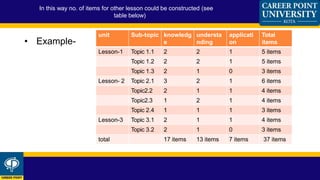
In this way no. of items for other lesson could be constructed (see
table below)
unit Sub-topic knowledg
e
understa
nding
applicati
on
Total
items
Lesson-1 Topic 1.1 2 2 1 5 items
Topic 1.2 2 2 1 5 items
Topic 1.3 2 1 0 3 items
Lesson- 2 Topic 2.1 3 2 1 6 items
Topic2.2 2 1 1 4 items
Topic2.3 1 2 1 4 items
Topic 2.4 1 1 1 3 items
Lesson-3 Topic 3.1 2 1 1 4 items
Topic 3.2 2 1 0 3 items
total 17 items 13 items 7 items 37 items
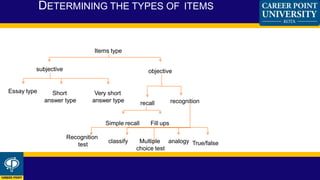
DETERMINING THE TYPES OF ITEMS
subjective objective
Essay type Short
answer type
Very short
answer type recall recognition
Simple recall Fill ups
Recognition
test
Multiple
choice test
True/falseclassify analogy
Items type
 Give feedback on student’s progress and teachers delivering the
curriculum
 From student’s point, how well they attain the objectives
 Provides a guide to both to students and teachers
 Determines the reliability and validity of the examination
 Bloom’s taxonomy helps in developing the entire written and
some aspect of practical questions
BENEFITS OF BLUE PRINT