B.P.S.I.T.T.R KHANPUR
KALAN SONIPAT
SUB-TECHNOLOGY OF LEARNER AND LEARNING
TOPIC-PROGRAMME
LEARNING(DEFINATION,TYPES,METHODS)
SUBMITTED TO –MS.SUSHILA SHARMA(TEACHING
ASSISTANT)
SUBMITTED BY-AARZOO TOMAR
ROLL NO-14060281
Introduction
The term Programmed learning has been coined from principles of
operant learning or conditioning developed at the psychological
laboratories on the basis of experimental studies conducted on
animals by B.F.Skinner of Harvard University. This concept was used
to development of self learning material or programmed learning and
teaching machines.
B.F.Skinner and his companions had first started ‘programmed
learning’ in 1943
 B.F.Skinner published a paper entitled ‘Science of Learning
and art of Teaching’ . This paper leads the way for the
programmed instruction. He claimed that desirable behavior
can be brought out by continuous feed back.
 Thereafter, Sidney L.Pressey designed a teaching machine
for teaching purpose.
Meaning of Programmed Learning
Programmed instruction is the process of arranging the material to be
learned into a series of sequential steps that is from known to unknown.
------ Smith and Moore
Programmed learning is a method of designing a reproducible sequence of
instructional events to produce a measurable and consistent effect on
behavior of each and every acceptable students.
------ Susan Markle
Principles of Programmed Learning
• Principle of Small Steps
• Principle of Active Response
• Principle of Immediate Reinforcement
• Principle of self –Pacing
• Principle of Self Evaluation
Individualized Instruction
Logical Sequence of material (Small Steps)
Interaction between the learner and the programmed
Immediate Knowledge of results
Organized nature of Knowledge
Learners Own Speed (Self Pacing)
Constant Evaluation
• To help the students for learning by doing.
• To provide the situation to learn at his/her own speed.
• To help the student to learn without the presence of teacher.
• To present the mater in a logical manner.
• To study himself.
• To evaluate himself.
• To compare his/her answer with the key .
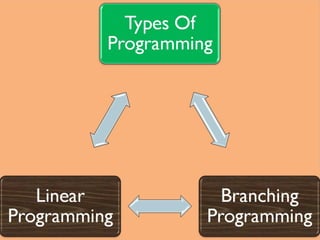
Linear Programming
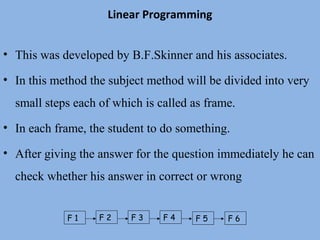
• This was developed by B.F.Skinner and his associates.
• In this method the subject method will be divided into very
small steps each of which is called as frame.
• In each frame, the student to do something.
• After giving the answer for the question immediately he can
check whether his answer in correct or wrong
F 1 F 2 F 3 F 4 F 5 F 6
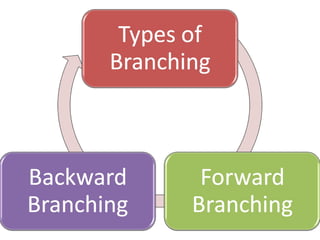
Branching Programming
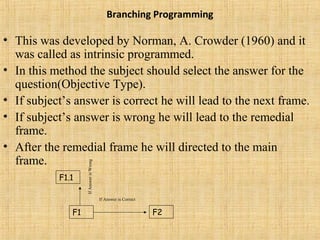
• This was developed by Norman, A. Crowder (1960) and it
was called as intrinsic programmed.
• In this method the subject should select the answer for the
question(Objective Type).
• If subject’s answer is correct he will lead to the next frame.
• If subject’s answer is wrong he will lead to the remedial
frame.
• After the remedial frame he will directed to the main
frame.
F1
IfAnswerisWrong
If Answer is Correct
F2
F1.1
Types of Linear Programming
• Construct response
• Multiple choice type
• Conventional chaining
• Skip linear
• Criterion Frames
• Egrule system
• Rulge system
Features of Linear Programming
• Linear Arrangement
• Small Steps
• Controlled Responses
• Active Responding
• Immediate Feedback
• Prompting
• Self- Pacing
• Simple Mechanism
• Minimum error
Limitation of Linear Programming
• Lack of Motivation
• No Freedom of choice
• No development of discriminative power
• No student centered
• No specific role of teacher
• Difficulty in finding background
Branching Programming
Basic Assumptions:-
 Needs of the learner
 Meaningful units
 New material
 Traditional Methods
 No hindrance by errors
 Multiple choice items
 Sufficient freedom
Features Of Branching Programming
A. Based on traditional tutorial method
B. Larger frame
C. Multiple choice questions
D. Alertness of learners
E. Easier to develop frames
F. Teaching and instruction
G. Psychological and social motivation
Limitations Of Branching Programming
Guessing
Difficulty in multiple choice questions
Difficulty in arranging the Branching Programme
 Not Suitable for small children
Costly
No suitable feedback
Programmer’s immagination
programmed learning

programmed learning

  • 1.
    B.P.S.I.T.T.R KHANPUR KALAN SONIPAT SUB-TECHNOLOGYOF LEARNER AND LEARNING TOPIC-PROGRAMME LEARNING(DEFINATION,TYPES,METHODS) SUBMITTED TO –MS.SUSHILA SHARMA(TEACHING ASSISTANT) SUBMITTED BY-AARZOO TOMAR ROLL NO-14060281
  • 2.
    Introduction The term Programmedlearning has been coined from principles of operant learning or conditioning developed at the psychological laboratories on the basis of experimental studies conducted on animals by B.F.Skinner of Harvard University. This concept was used to development of self learning material or programmed learning and teaching machines. B.F.Skinner and his companions had first started ‘programmed learning’ in 1943
  • 3.
     B.F.Skinner publisheda paper entitled ‘Science of Learning and art of Teaching’ . This paper leads the way for the programmed instruction. He claimed that desirable behavior can be brought out by continuous feed back.  Thereafter, Sidney L.Pressey designed a teaching machine for teaching purpose.
  • 4.
    Meaning of ProgrammedLearning Programmed instruction is the process of arranging the material to be learned into a series of sequential steps that is from known to unknown. ------ Smith and Moore Programmed learning is a method of designing a reproducible sequence of instructional events to produce a measurable and consistent effect on behavior of each and every acceptable students. ------ Susan Markle
  • 5.
    Principles of ProgrammedLearning • Principle of Small Steps • Principle of Active Response • Principle of Immediate Reinforcement • Principle of self –Pacing • Principle of Self Evaluation
  • 6.
    Individualized Instruction Logical Sequenceof material (Small Steps) Interaction between the learner and the programmed Immediate Knowledge of results Organized nature of Knowledge Learners Own Speed (Self Pacing) Constant Evaluation
  • 7.
    • To helpthe students for learning by doing. • To provide the situation to learn at his/her own speed. • To help the student to learn without the presence of teacher. • To present the mater in a logical manner. • To study himself. • To evaluate himself. • To compare his/her answer with the key .
  • 9.
    Linear Programming • Thiswas developed by B.F.Skinner and his associates. • In this method the subject method will be divided into very small steps each of which is called as frame. • In each frame, the student to do something. • After giving the answer for the question immediately he can check whether his answer in correct or wrong F 1 F 2 F 3 F 4 F 5 F 6
  • 10.
    Branching Programming • Thiswas developed by Norman, A. Crowder (1960) and it was called as intrinsic programmed. • In this method the subject should select the answer for the question(Objective Type). • If subject’s answer is correct he will lead to the next frame. • If subject’s answer is wrong he will lead to the remedial frame. • After the remedial frame he will directed to the main frame. F1 IfAnswerisWrong If Answer is Correct F2 F1.1
  • 11.
    Types of LinearProgramming • Construct response • Multiple choice type • Conventional chaining • Skip linear • Criterion Frames • Egrule system • Rulge system
  • 12.
    Features of LinearProgramming • Linear Arrangement • Small Steps • Controlled Responses • Active Responding • Immediate Feedback • Prompting • Self- Pacing • Simple Mechanism • Minimum error
  • 13.
    Limitation of LinearProgramming • Lack of Motivation • No Freedom of choice • No development of discriminative power • No student centered • No specific role of teacher • Difficulty in finding background
  • 14.
    Branching Programming Basic Assumptions:- Needs of the learner  Meaningful units  New material  Traditional Methods  No hindrance by errors  Multiple choice items  Sufficient freedom
  • 16.
    Features Of BranchingProgramming A. Based on traditional tutorial method B. Larger frame C. Multiple choice questions D. Alertness of learners E. Easier to develop frames F. Teaching and instruction G. Psychological and social motivation
  • 17.
    Limitations Of BranchingProgramming Guessing Difficulty in multiple choice questions Difficulty in arranging the Branching Programme  Not Suitable for small children Costly No suitable feedback Programmer’s immagination