This document discusses instructional aids, which are materials used to aid in transferring information from an instructor to students. It defines instructional aids as devices that assist teachers in the teaching and learning process. The document categorizes instructional aids into audio aids, visual aids, audiovisual aids, and activity aids. It discusses the importance, uses, selection, preparation, and advantages of using instructional aids to enhance the learning process.
Introduction to the seminar on instructional aids in teaching by Sakshi Rana, M.Sc. Nursing.
Definition and purpose of instructional aids as materials helping in knowledge transfer and concept understanding.
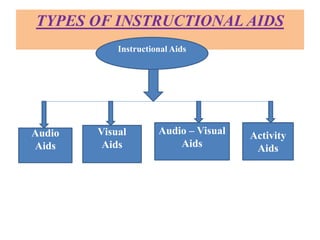
Categorization of instructional aids into Audio, Visual, Audio-Visual, and Activity aids for educational purposes.
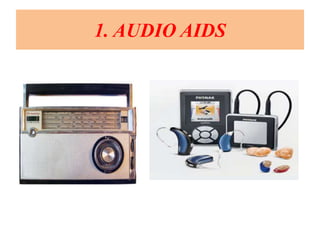
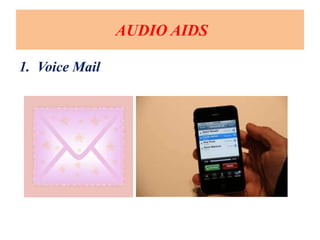
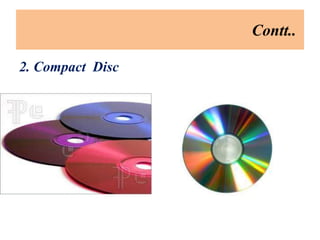
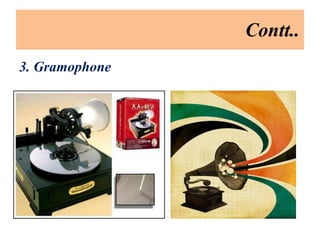
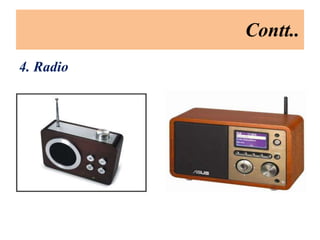
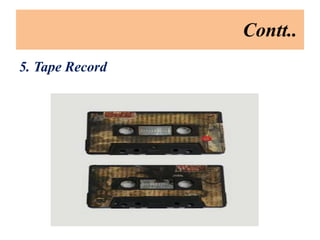
Detailed discussion on audio aids including voice mail, compact discs, gramophones, radios, and tape recordings.
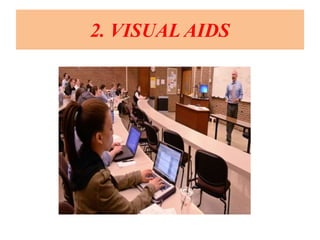
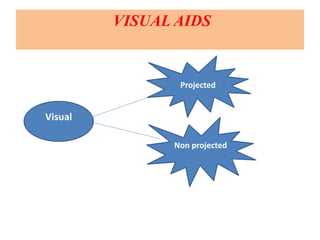
Introduction to visual aids classified as projected and non-projected for enhancing the learning experience.
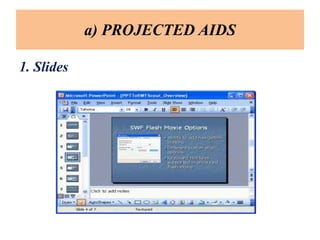
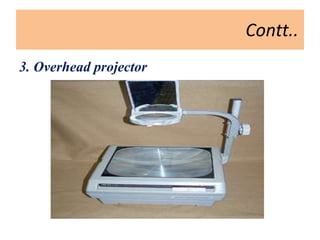
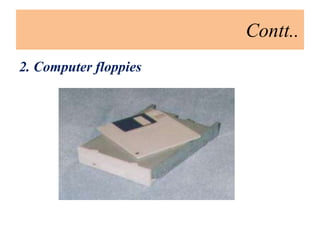
Examples of projected visual aids like slides, film strips, overhead projectors, and computers.
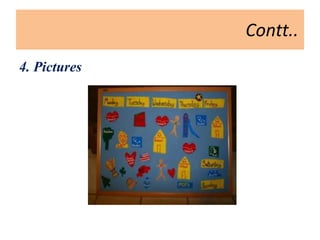
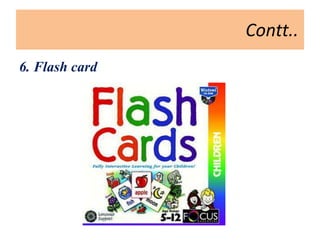
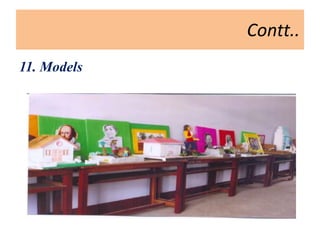
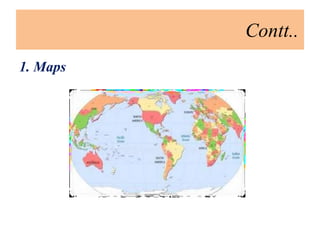
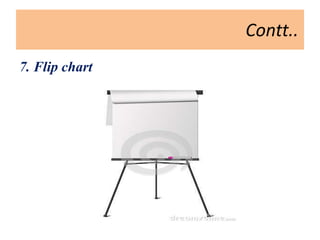
List of non-projected visual aids such as maps, cartoons, charts, pictures, posters, flash cards, and models.
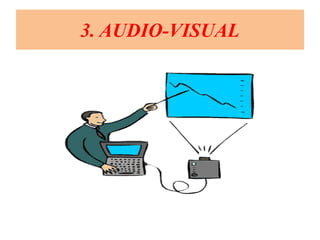
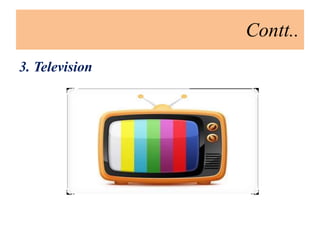
Examples of audio-visual aids including films and TVs to facilitate multimedia learning.
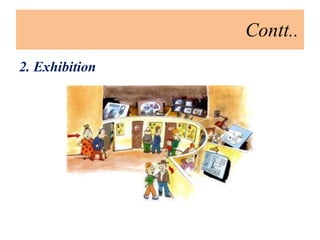
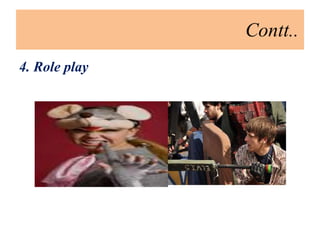
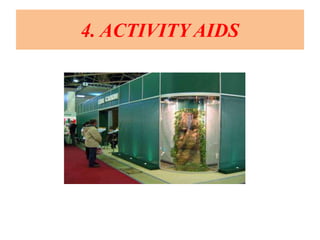
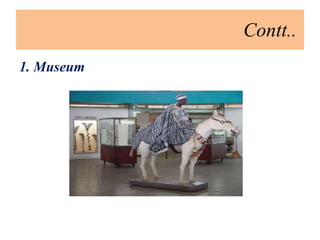
Different types of activity aids like museums, exhibitions, field trips, role play, and drama to engage learners.
Reasons why instructional aids are important, focusing on motivation, clarification, saving time, and enhancing engagement.
Utilization of instructional aids in schools and the necessity for teacher training and updating knowledge.
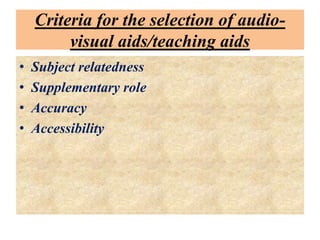
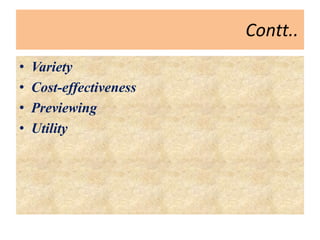
Criteria for selecting teaching aids including subject-relatedness, variety, and cost-effectiveness.
Steps for preparing instructional aids including personal preparation, environmental setup, and follow-up.
Strategies for effectively utilizing teaching aids in classrooms to enhance the learning process.
Basic guidelines for using instructional aids effectively, emphasizing lesson objectives, student engagement, and clarity.Benefits of using teaching aids such as problem-solving, increased attention, and positive classroom environments.
Challenges related to instructional aids including costs and over-reliance on technology affecting students.
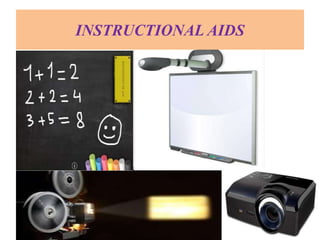
INSTRUCTIONAL AIDS
• Theseare materials that are use to aid in the
transference of information from one to
another.
• Instruction aids are devices that assist an
instructor in the teaching learning process.
5.
DEFINITION
Teaching aids arematerials that the
classroom teacher uses to help students
understand the concepts she/he introduces
during her/his lesson.
6.
TYPES OF INSTRUCTIONALAIDS
Instructional Aids
Audio
Aids
Visual
Aids
Audio – Visual
Aids
Activity
Aids
SELECTION
• When usedwithout proper selection and
preparation, the effective power of such aids
is lost.
• It is also true that in different situations,
certain teaching aids will be more effective
than other.
Contt..
• Utilization ofteaching aids is done by
improving the teaching process.
• By using the all advance technology for the
benefits of people.
• For the improvement of teaching.
60.
Contt..
• In theutilization of teaching resource in the
classroom setting there are some plans and
principles followed by the teacher which
include: -
Contt..
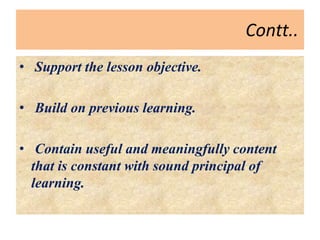
• Support thelesson objective.
• Build on previous learning.
• Contain useful and meaningfully content
that is constant with sound principal of
learning.
65.
Contt..
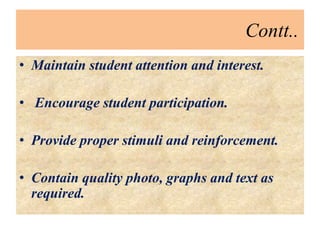
• Maintain studentattention and interest.
• Encourage student participation.
• Provide proper stimuli and reinforcement.
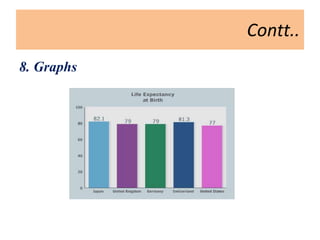
• Contain quality photo, graphs and text as
required.
66.
Contt..
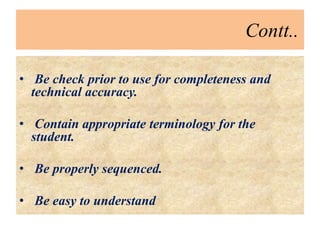
• Be checkprior to use for completeness and
technical accuracy.
• Contain appropriate terminology for the
student.
• Be properly sequenced.
• Be easy to understand
67.
Contt..
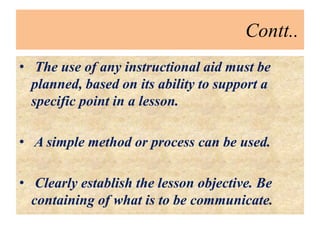
• The useof any instructional aid must be
planned, based on its ability to support a
specific point in a lesson.
• A simple method or process can be used.
• Clearly establish the lesson objective. Be
containing of what is to be communicate.
68.
Contt..
• Gather thenecessary data by researching for
support material.
• The plan should include important safety
consideration.
• Select the ideas to be supported with
instructional aids.
69.
Contt..
• The aidsshould be concentrated on the key
points.
• Aids are often appropriate when long
segments of technical description are
necessary.
70.
ADVANTAGES
• It canbe used by students for problem
solving.
• Teaching aids makes learning permanent.
• Teaching aids are helpful in attracting
attention of the students.
71.
Contt..
• Teaching aidssaves time and energy.
• Teaching aids encourages the healthy classroom
instruction.
• It is also helpful in creating positive environment for
discipline.
• Teaching aids helps in providing speech training to
the people.
72.
Contt..
• Teaching aidshelp in development of various
skills such as how to draw a diagram of the topic
among the students.
• Teaching aids provide variety.
• Teaching aids provide good substitutes for the
real object as they make learning equally
meaningful.