DR. MAHESWARI JAIKUMAR.
maheswarijaikumar2103@gmail.com
DEFINITION
• A simulation is a visual
representation of a process or
concept. Simulations can be
interactive, requiring user input.
DEFINITION
• Simulation is the imitation of the
operation of a real-world process or
system over time. The act of
simulating something first requires
that a model be developed; this
model represents the key
... Wikipedia
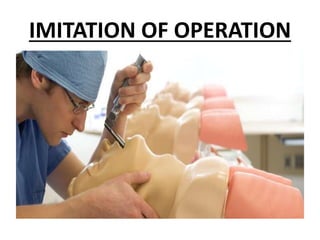
IMITATION OF OPERATION
• Is a role – playing where the process
of teaching is displayed artificially
and an efforts to practice some
important skills of communication is
made.
The teacher and students simulate
an actual life situation or a person’s
actual role.
PRINCIPLES
• Players take on
roles that are
representative
of the real
world and then
make decisions
in response to
their
assessment of
the setting
they find
themselves in.
• The experiences simulated are
consequences that relate to their
decisions and general performance.
• Monitoring the results of their
actions to reflect upon the
relationship between their own
decisions and the resultant
consequences.
VALUES OF SIMULATION
TECHNIQUE
• Enables the learner to learn directly
from experience.
• Promotes a high level of critical
thinking.
• Students understand the decision
making process easily.
• Simulation enables the learners to
empathize with the real life situation.
• Provides feedback to the learners on
the consequences of actions and
decisions made.
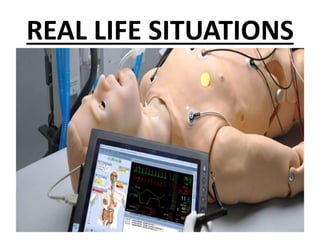
REAL LIFE SITUATIONS
• Simulation motivates the learners
by making real life situations
exciting and interesting.
• Simulation enables teachers and
learners to assess the realism of the
situation by uncovering
misconceptions.
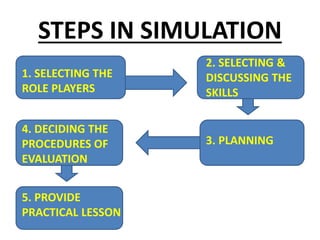
STEPS IN SIMULATION
1. SELECTING THE
ROLE PLAYERS
2. SELECTING &
DISCUSSING THE
SKILLS
3. PLANNING
4. DECIDING THE
PROCEDURES OF
EVALUATION
5. PROVIDE
PRACTICAL LESSON
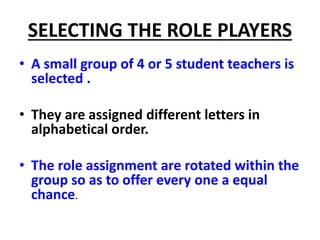
SELECTING THE ROLE PLAYERS
• A small group of 4 or 5 student teachers is
selected .
• They are assigned different letters in
alphabetical order.
• The role assignment are rotated within the
group so as to offer every one a equal
chance.
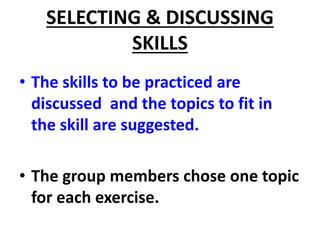
SELECTING & DISCUSSING
SKILLS
• The skills to be practiced are
discussed and the topics to fit in
the skill are suggested.
• The group members chose one topic
for each exercise.
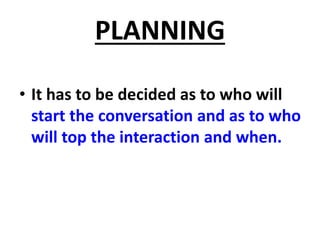
PLANNING
• It has to be decided as to who will
start the conversation and as to who
will top the interaction and when.
DECIDING ON EVALUATION
• In this step it is decided as to how to
record the interaction and how to
present it to an actor.
• This facilitates the process of giving
feedback.
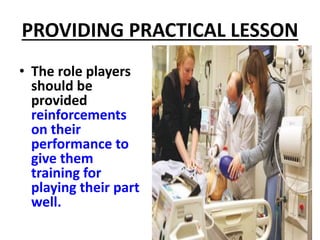
PROVIDING PRACTICAL LESSON
• The role players
should be
provided
reinforcements
on their
performance to
give them
training for
playing their part
well.
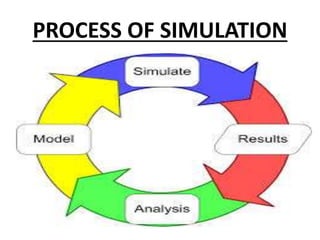
PROCESS OF SIMULATION
ACTIVITIES IN SIMULATION
• THE MAIN ACTIVITIES ARE :
1. ROLE PLAYING.
2. SOCIODRAMA.
3. GAMING.
ROLE PLAYING
• The role (false / actual) is performed
in an artificial environment.
• This gives the learners an
understanding of a situation or
relationship among real life
participants of the social process.
• The learner gains some perception
of the actions, attitudes and insight
of persons or situations.
SOCIO DRAMA
• Socio drama seeks to utilize role
playing as means of finding out the
solution to a problem situation
assigned to the role players.
• The problems may be false or based
on real life situations, and the actor is
required to find out an acceptable
solution.
GAMING
• Gaming involves outcomes affected
by decisions made by one or more
decisions
ADVANTAGES
• Simulation helps in the integration
of theory and practice.
• This method requires the teacher
to be an active participant in the
process.
• No risk is involved. The decisions are
made and carried out without physical
or psychological harm to the
stakeholders.
• Controlled teaching assignments are
possible.
• Learners can obtain experiences that
are real.
• Simulation motivates both the
teacher and the learner. It changes
the teacher’s behaviour and
introduces novelty in the whole
process.
• Every student is expected to have
experiences that are different from
the usual laboratory type
experiences common to all.
• It stimulates the learners towards
purposeful activities and hence they
are motivated and interested.
• It removes the student-teacher
polarization.
• Simulations are self monitoring.
• The learners have opportunity to
observe the consequences of their own
decision, which influences further
actions.
• Simulation is a universal behaviour
mode.
• Simulation sharpens decision making
skills.
• Simulation provides a dynamic
framework.
• Simulation works to bridge the gap
between the unreal and real.
• It allows the learners a greater
flexibility in addressing facets of
complexity.
DISADVANTAGES
• Simulation cannot be practiced in
the subjects in the curriculum.
• Simulation cannot be used in case of
small children because mechanism
is to difficult for them to follow.
• It requires a lot or preparation in the
part of the teachers, very few teachers
are ready to take up extra work.
• Learning is a serious activity which is
highly individualized and needs
concentration on the part of the
learners and simulation reduces the
seriousness of learning.
• Simulation is time consuming.
• Simulation has difficulty in using
analytical approach.
• Many simulators are needed, which
may not be practically possible.
THANK YOU

Simulation

  • 2.
  • 3.
    DEFINITION • A simulationis a visual representation of a process or concept. Simulations can be interactive, requiring user input.
  • 4.
    DEFINITION • Simulation isthe imitation of the operation of a real-world process or system over time. The act of simulating something first requires that a model be developed; this model represents the key ... Wikipedia
  • 5.
  • 6.
    • Is arole – playing where the process of teaching is displayed artificially and an efforts to practice some important skills of communication is made. The teacher and students simulate an actual life situation or a person’s actual role.
  • 7.
    PRINCIPLES • Players takeon roles that are representative of the real world and then make decisions in response to their assessment of the setting they find themselves in.
  • 8.
    • The experiencessimulated are consequences that relate to their decisions and general performance. • Monitoring the results of their actions to reflect upon the relationship between their own decisions and the resultant consequences.
  • 9.
    VALUES OF SIMULATION TECHNIQUE •Enables the learner to learn directly from experience. • Promotes a high level of critical thinking.
  • 10.
    • Students understandthe decision making process easily. • Simulation enables the learners to empathize with the real life situation. • Provides feedback to the learners on the consequences of actions and decisions made.
  • 11.
  • 12.
    • Simulation motivatesthe learners by making real life situations exciting and interesting. • Simulation enables teachers and learners to assess the realism of the situation by uncovering misconceptions.
  • 13.
    STEPS IN SIMULATION 1.SELECTING THE ROLE PLAYERS 2. SELECTING & DISCUSSING THE SKILLS 3. PLANNING 4. DECIDING THE PROCEDURES OF EVALUATION 5. PROVIDE PRACTICAL LESSON
  • 14.
    SELECTING THE ROLEPLAYERS • A small group of 4 or 5 student teachers is selected . • They are assigned different letters in alphabetical order. • The role assignment are rotated within the group so as to offer every one a equal chance.
  • 15.
    SELECTING & DISCUSSING SKILLS •The skills to be practiced are discussed and the topics to fit in the skill are suggested. • The group members chose one topic for each exercise.
  • 16.
    PLANNING • It hasto be decided as to who will start the conversation and as to who will top the interaction and when.
  • 17.
    DECIDING ON EVALUATION •In this step it is decided as to how to record the interaction and how to present it to an actor. • This facilitates the process of giving feedback.
  • 18.
    PROVIDING PRACTICAL LESSON •The role players should be provided reinforcements on their performance to give them training for playing their part well.
  • 19.
  • 20.
    ACTIVITIES IN SIMULATION •THE MAIN ACTIVITIES ARE : 1. ROLE PLAYING. 2. SOCIODRAMA. 3. GAMING.
  • 21.
    ROLE PLAYING • Therole (false / actual) is performed in an artificial environment. • This gives the learners an understanding of a situation or relationship among real life participants of the social process.
  • 22.
    • The learnergains some perception of the actions, attitudes and insight of persons or situations.
  • 23.
    SOCIO DRAMA • Sociodrama seeks to utilize role playing as means of finding out the solution to a problem situation assigned to the role players. • The problems may be false or based on real life situations, and the actor is required to find out an acceptable solution.
  • 24.
    GAMING • Gaming involvesoutcomes affected by decisions made by one or more decisions
  • 25.
    ADVANTAGES • Simulation helpsin the integration of theory and practice. • This method requires the teacher to be an active participant in the process.
  • 26.
    • No riskis involved. The decisions are made and carried out without physical or psychological harm to the stakeholders. • Controlled teaching assignments are possible. • Learners can obtain experiences that are real.
  • 27.
    • Simulation motivatesboth the teacher and the learner. It changes the teacher’s behaviour and introduces novelty in the whole process. • Every student is expected to have experiences that are different from the usual laboratory type experiences common to all.
  • 28.
    • It stimulatesthe learners towards purposeful activities and hence they are motivated and interested. • It removes the student-teacher polarization. • Simulations are self monitoring.
  • 29.
    • The learnershave opportunity to observe the consequences of their own decision, which influences further actions. • Simulation is a universal behaviour mode. • Simulation sharpens decision making skills.
  • 30.
    • Simulation providesa dynamic framework. • Simulation works to bridge the gap between the unreal and real. • It allows the learners a greater flexibility in addressing facets of complexity.
  • 31.
    DISADVANTAGES • Simulation cannotbe practiced in the subjects in the curriculum. • Simulation cannot be used in case of small children because mechanism is to difficult for them to follow.
  • 32.
    • It requiresa lot or preparation in the part of the teachers, very few teachers are ready to take up extra work. • Learning is a serious activity which is highly individualized and needs concentration on the part of the learners and simulation reduces the seriousness of learning.
  • 33.
    • Simulation istime consuming. • Simulation has difficulty in using analytical approach. • Many simulators are needed, which may not be practically possible.
  • 34.