
DIALYZER / ARTIFICIAL KIDNEY
DR (Mrs)MAHESWARI JAIKUMAR
maheswarijaikumar2103@gmail.com
DIALYZER/ARTIFICIAL KIDNEY
Dialyzer is a mechanical device that
operates outside the body and
substitutes for the kidney by
removing waste products from the
blood.
Also called hemodialyzer.
A dialyzer is an artificial filter
containing fine fibers.
The fibers are hollow with
microscopic pores in the wall,
also known as semi-permeable
dialysis membrane.
• Artificial kidney is also expected
to correct pH that is usually
acidic before treatment by
balancing electrolytes in addition
to removing waste products and
excess water
• All these functions are
dependent upon the
permeability of the membrane
used in a dialyzer and since the
quality of treatment is strongly
dependent on the performance
of the dialyzer, many materials
have been proposed as a
candidate of the membrane
• Currently there are several
commercial materials available,
including natural polymers and
synthetic polymeric ones.
• In hemodialysis, a dialysis machine
and a special filter called an artificial
kidney, or a dialyzer, are used to
clean the blood.
• To get the patient’s blood into the
dialyzer, the doctor needs to make
an access, or entrance, into the
paient’s blood vessels. This is done
with minor surgery, usually in the
arm of the patient
HISTORY
• The first successful artificial kidney
was developed by Willem Kolff in
the Netherlands during the early
1940s. Kolff was the first to
construct a working dialyzer in
1943.
MODERN DIALYZER
• Modern dialysers typically
consist of a cylindrical rigid
casing enclosing hollow fibers
cast or extruded from a polymer
or copolymer, which is usually a
proprietary formulation.
• The combined area of the hollow
fibers is typically between 1-2
square meters. Intensive
research has been conducted by
many groups to optimize blood
and dialysate flows within the
dialyser, in order to achieve
efficient transfer of wastes from
blood to dialysate.
TYPES OF ARTIFICIAL KIDNEY
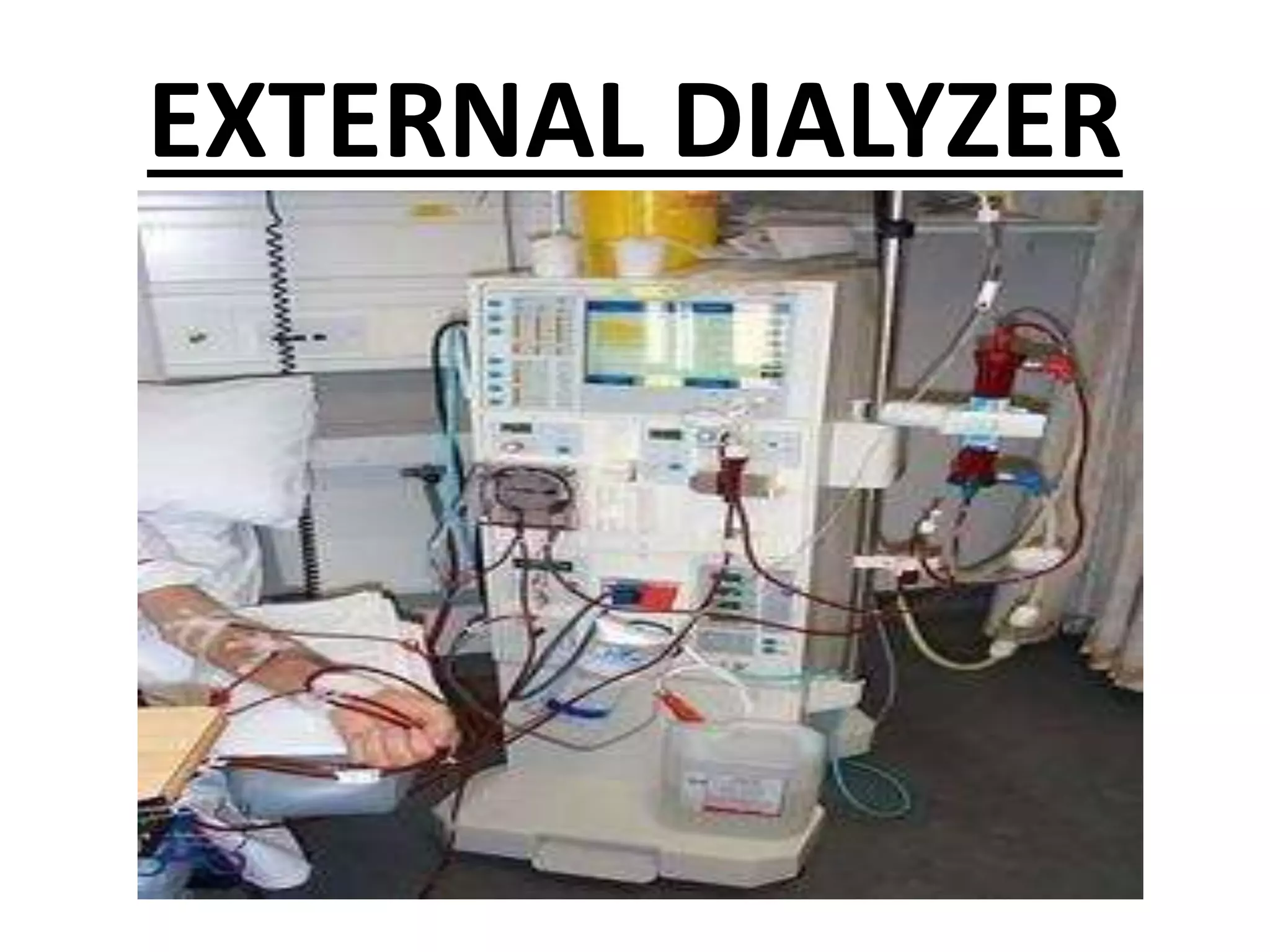
• EXTERNAL DIALYZER
• IMPLANTABLE ARTIFICIAL
KIDNEY
• WEARABLE ARTIFICIAL
KIDNEY
EXTERNAL DIALYZER
IMPLANTABLE ARTIFICIAL KIDNEY
Scientist are in the process of
developing implantable artificial kidney
that can be implanted inside the body
The implantable artificial kidney is a bio-
hybrid device that can imitate the
functions of a healthy kidney by
removing enough waste products to
keep a patient from needing dialysis
treatment.
• The key to the success of this device is
the use of silicon nanotechnology and
the microchip which is porous and can
act as a natural filter.
• The dialyzer is designed with pores
where each pore (of the filter) is
designed to perform a specific
function or task.
• The microchips will also act as a
platform for which living kidney
cells will reside and grow on and
around the filters with the goal of
imitating the natural functions of
the kidney.
• The bio-hybrid device will not be in
reach of the body’s immune response
which allows it to be protected against
being rejected by the patient's body.
• The device will be designed to be small
enough to fit inside a patient’s body
that will successfully operate with the
patient’s natural blood flow
WEARABLE ARTIFICIAL KIDNEY
• A wearable artificial kidney is a
wearable dialysis machine that a person
with end-stage kidney disease could use
daily or even continuously.
• A wearable artificial kidney (WAK) is not
available, but research teams are in the
process of developing such a device.
WEARABLE ARTIFICIAL KIDNEY
• The goal is to develop a portable device that
will be able to imitate the functions of the
regular kidney. This device would allow for a
patient to be treated twenty-four hours a
day.
• With the development of miniature pumps,
the hope of an effective wearable
hemodialysis device has become realizable.
Some patients already receive continuous
peritoneal dialysis treatment which allows
them to remain ambulatory.
• The treatment results in a lower
quality of life as well as a higher
mortality rate for patients with End
Stage Renal Disease (ESRD).
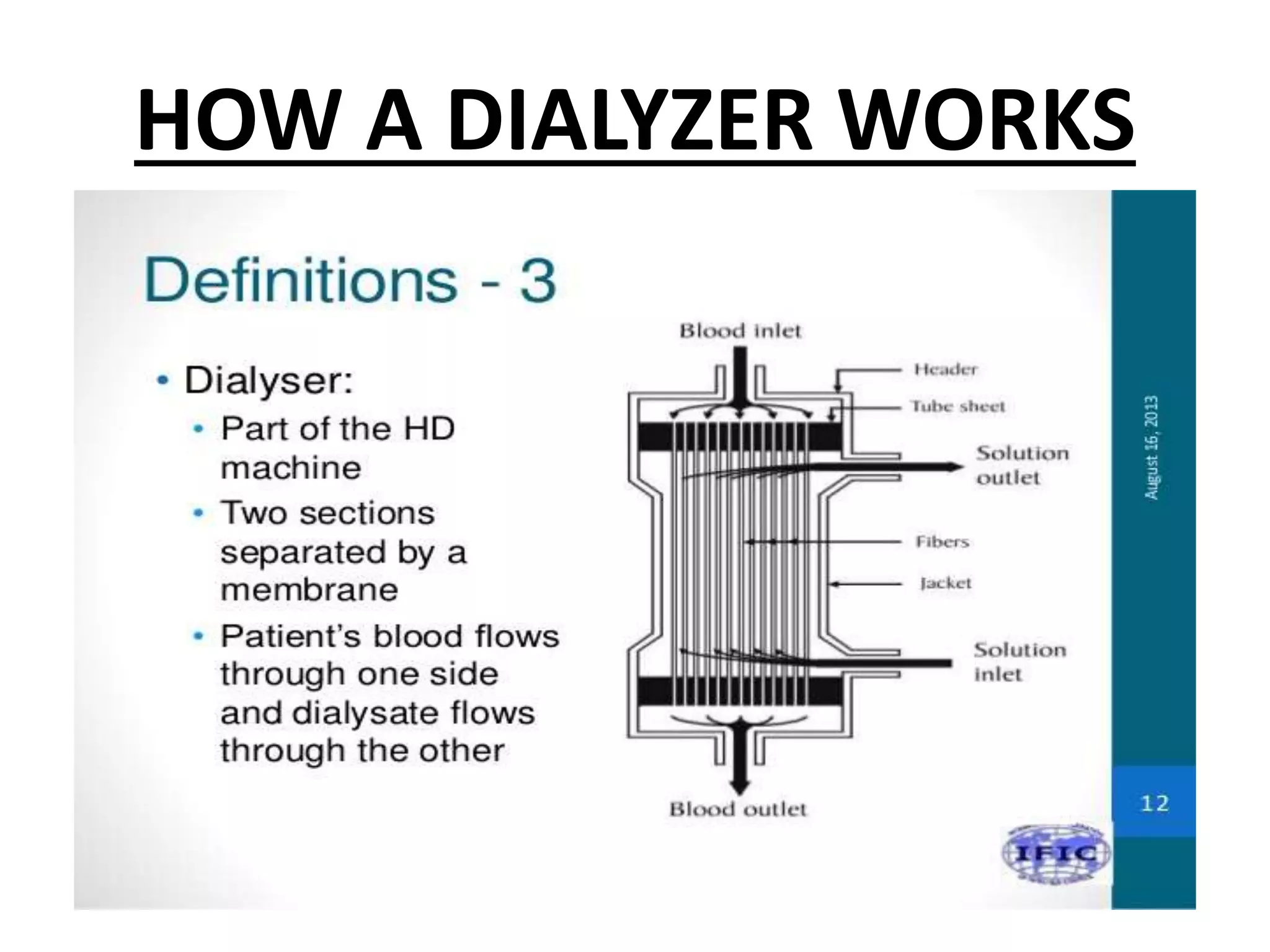
PARTS OF A DIALYZER
• The parts of the dialyzer are as follows:
• POTTING COMPOUND
• CAPILLARY MEMBRANES (dialyzer membrane)
• HOUSING POLYMERS
• HEADER CAP
• INLET FOR BLOOD
• OUTLET FOR BLOOD
• INLET FOR DIALYSATE FLOW
• OUTLET FOR DIALYSATE FLOW
MAJOR COMPONENT OF A
DIALYZER
• BLOOD COMPARTMENT
• DIALYSATE COMPARTMENT
• SEMI PERMIABLE MEMBRANE
• MEMBRANE SUPPORTING
STRUCTURE
PARTS OF A DIALYZER
PARTS OF DIALYZER
DIALYZER MEMBRANE
The membrane used in a dialyzer is called
dialysis membrane . Currently, both
artificial polymer and cellulosic
modified membranes are used dialysis ther
apy.
NATURAL DIALYZER MEMBRANE
Membrane materials commonly used
for dialyzers included natural
substituted cellulose (cellulose acetate,
diacetate, triacetate as by adding these
side groups reduces
bio‐incompatibility),
SYNTHETIC DIALYZER MEMBRANE
Synthetic membranes are made of
polysulfone, polyacrylonitrile,
polycarbonate, polyamide, and
polymethylmethacrylate
PURPOSE OF A DIALYSIS MEMBRANE
• Semi-permeable membrane, usually
made of cellulose acetate.
• It is used in dialysis, a process which
involves the removal of very small
molecular weight solutes from a
solution, along with equilibrating the
solution in a new buffer. This can also be
useful for concentrating a dilute
solution
TECHNIQUE USED BY DIALYZER
• Dialysis is a technique based on the
diffusion of small solutes from a
concentrated solution to a lower-
concentration solution of this solute
through a semipermeable
membrane until equilibrium is
reached
MECHANISM OF ACTION
How does the dialyzer clean the
blood?
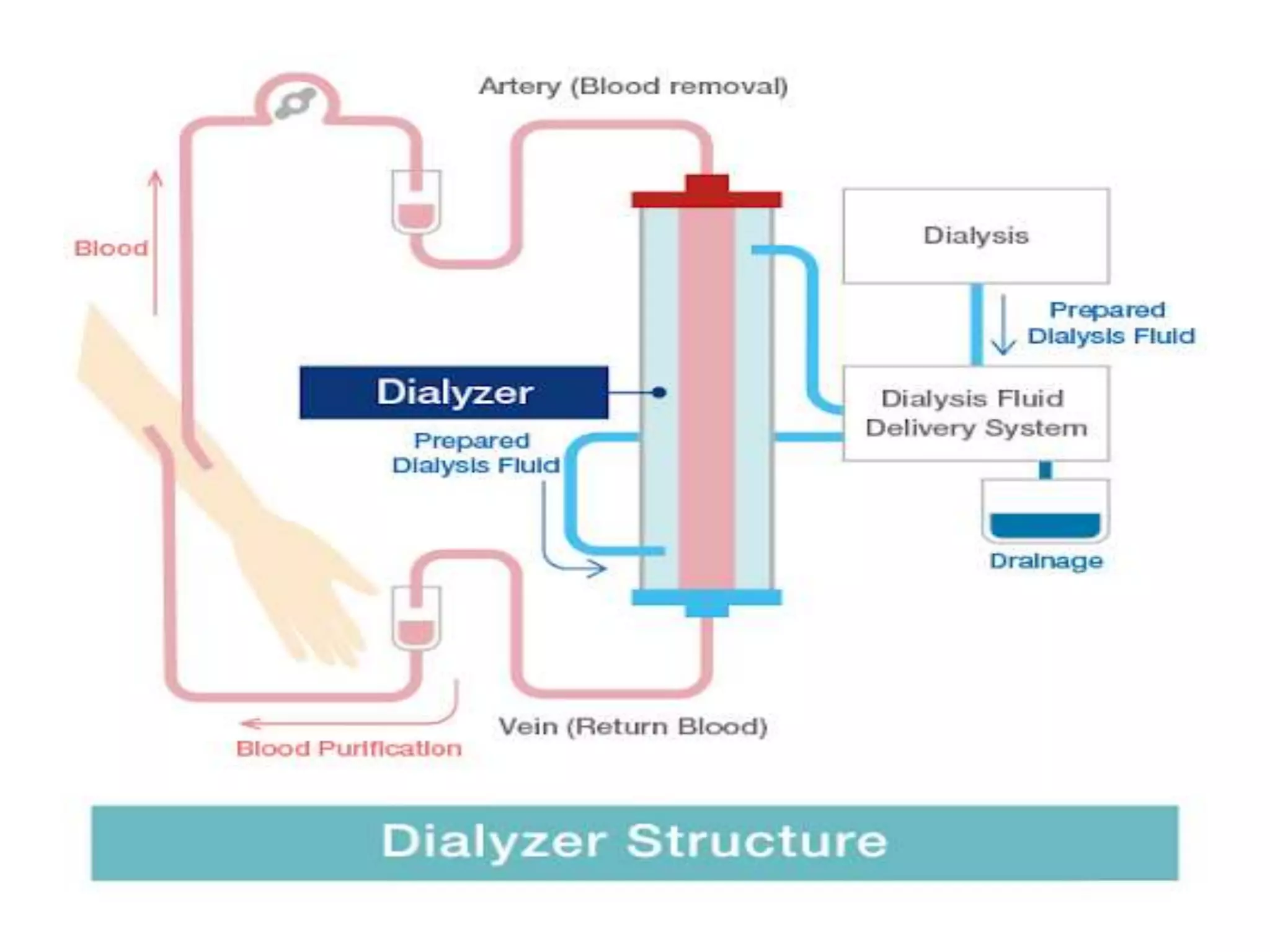
• The dialyzer, or filter, has two parts,
one for your blood and one for a
washing fluid called dialysate. A thin
membrane separates these two
parts.
• Blood cells, protein and other
important things remain in your
blood because they are too big to
pass through the membrane.
• Smaller waste products in the
blood, such as urea, creatinine,
potassium and extra fluid pass
through the membrane and are
washed away.
• Selective permeable
membranes only allows small
molecules such as glucose, amino
acids to readily pass through, and
inhibits larger molecules like
protein, starch, from passing
through it.
MECHANISM OF DIALYSIS
HOW A DIALYZER WORKS
REFERENCE
• ^ "Kidney Anatomy: Overview, Gross Anatomy, Microscopic Anatomy".
2017-08-29.
• ^ "The Kidneys and How They Work". www.niddk.nih.gov.
Retrieved 2015-11-30.
• ^ "Kidney Overview". WebMD. Retrieved 2015-12-02.
• ^ "Key Points: About Dialysis For Kidney Failure". www.kidney.org.
National Kidney Foundation. 2016.
• ^ Jump up to:a b c d e f Johnson, Steven (2014-10-11). "Dialysis Demand
Strong as Kidney Disease Grows". www.modernhealthcare.com. Modern
Healthcare.
• ^ Bywaters EGL, Beall D (1941). "Crush injuries with impairment of renal
function". British Medical Journal. 1 (4185): 427–
32. doi:10.1136/bmj.1.4185.427. PMC 2161734. PMID 20783577.
• ^ Jump up to:a b c "Fast Facts". The National Kidney Foundation. National
Kidney Foundation. 2014-08-12. Retrieved 2016-11-13 – via kidney.org.
THANK YOU

DIALYZER / ARTIFICIAL KIDNEY

  • 1.
    DIALYZER / ARTIFICIALKIDNEY DR (Mrs)MAHESWARI JAIKUMAR maheswarijaikumar2103@gmail.com
  • 2.
    DIALYZER/ARTIFICIAL KIDNEY Dialyzer isa mechanical device that operates outside the body and substitutes for the kidney by removing waste products from the blood. Also called hemodialyzer.
  • 3.
    A dialyzer isan artificial filter containing fine fibers. The fibers are hollow with microscopic pores in the wall, also known as semi-permeable dialysis membrane.
  • 4.
    • Artificial kidneyis also expected to correct pH that is usually acidic before treatment by balancing electrolytes in addition to removing waste products and excess water
  • 5.
    • All thesefunctions are dependent upon the permeability of the membrane used in a dialyzer and since the quality of treatment is strongly dependent on the performance of the dialyzer, many materials have been proposed as a candidate of the membrane
  • 6.
    • Currently thereare several commercial materials available, including natural polymers and synthetic polymeric ones.
  • 7.
    • In hemodialysis,a dialysis machine and a special filter called an artificial kidney, or a dialyzer, are used to clean the blood. • To get the patient’s blood into the dialyzer, the doctor needs to make an access, or entrance, into the paient’s blood vessels. This is done with minor surgery, usually in the arm of the patient
  • 8.
    HISTORY • The firstsuccessful artificial kidney was developed by Willem Kolff in the Netherlands during the early 1940s. Kolff was the first to construct a working dialyzer in 1943.
  • 9.
    MODERN DIALYZER • Moderndialysers typically consist of a cylindrical rigid casing enclosing hollow fibers cast or extruded from a polymer or copolymer, which is usually a proprietary formulation.
  • 10.
    • The combinedarea of the hollow fibers is typically between 1-2 square meters. Intensive research has been conducted by many groups to optimize blood and dialysate flows within the dialyser, in order to achieve efficient transfer of wastes from blood to dialysate.
  • 11.
    TYPES OF ARTIFICIALKIDNEY • EXTERNAL DIALYZER • IMPLANTABLE ARTIFICIAL KIDNEY • WEARABLE ARTIFICIAL KIDNEY
  • 12.
  • 13.
    IMPLANTABLE ARTIFICIAL KIDNEY Scientistare in the process of developing implantable artificial kidney that can be implanted inside the body The implantable artificial kidney is a bio- hybrid device that can imitate the functions of a healthy kidney by removing enough waste products to keep a patient from needing dialysis treatment.
  • 14.
    • The keyto the success of this device is the use of silicon nanotechnology and the microchip which is porous and can act as a natural filter.
  • 15.
    • The dialyzeris designed with pores where each pore (of the filter) is designed to perform a specific function or task. • The microchips will also act as a platform for which living kidney cells will reside and grow on and around the filters with the goal of imitating the natural functions of the kidney.
  • 16.
    • The bio-hybriddevice will not be in reach of the body’s immune response which allows it to be protected against being rejected by the patient's body. • The device will be designed to be small enough to fit inside a patient’s body that will successfully operate with the patient’s natural blood flow
  • 17.
    WEARABLE ARTIFICIAL KIDNEY •A wearable artificial kidney is a wearable dialysis machine that a person with end-stage kidney disease could use daily or even continuously. • A wearable artificial kidney (WAK) is not available, but research teams are in the process of developing such a device.
  • 18.
  • 19.
    • The goalis to develop a portable device that will be able to imitate the functions of the regular kidney. This device would allow for a patient to be treated twenty-four hours a day. • With the development of miniature pumps, the hope of an effective wearable hemodialysis device has become realizable. Some patients already receive continuous peritoneal dialysis treatment which allows them to remain ambulatory.
  • 20.
    • The treatmentresults in a lower quality of life as well as a higher mortality rate for patients with End Stage Renal Disease (ESRD).
  • 21.
    PARTS OF ADIALYZER • The parts of the dialyzer are as follows: • POTTING COMPOUND • CAPILLARY MEMBRANES (dialyzer membrane) • HOUSING POLYMERS • HEADER CAP • INLET FOR BLOOD • OUTLET FOR BLOOD • INLET FOR DIALYSATE FLOW • OUTLET FOR DIALYSATE FLOW
  • 22.
    MAJOR COMPONENT OFA DIALYZER • BLOOD COMPARTMENT • DIALYSATE COMPARTMENT • SEMI PERMIABLE MEMBRANE • MEMBRANE SUPPORTING STRUCTURE
  • 23.
    PARTS OF ADIALYZER
  • 24.
  • 28.
    DIALYZER MEMBRANE The membraneused in a dialyzer is called dialysis membrane . Currently, both artificial polymer and cellulosic modified membranes are used dialysis ther apy.
  • 29.
    NATURAL DIALYZER MEMBRANE Membranematerials commonly used for dialyzers included natural substituted cellulose (cellulose acetate, diacetate, triacetate as by adding these side groups reduces bio‐incompatibility),
  • 30.
    SYNTHETIC DIALYZER MEMBRANE Syntheticmembranes are made of polysulfone, polyacrylonitrile, polycarbonate, polyamide, and polymethylmethacrylate
  • 33.
    PURPOSE OF ADIALYSIS MEMBRANE • Semi-permeable membrane, usually made of cellulose acetate. • It is used in dialysis, a process which involves the removal of very small molecular weight solutes from a solution, along with equilibrating the solution in a new buffer. This can also be useful for concentrating a dilute solution
  • 34.
    TECHNIQUE USED BYDIALYZER • Dialysis is a technique based on the diffusion of small solutes from a concentrated solution to a lower- concentration solution of this solute through a semipermeable membrane until equilibrium is reached
  • 35.
    MECHANISM OF ACTION Howdoes the dialyzer clean the blood? • The dialyzer, or filter, has two parts, one for your blood and one for a washing fluid called dialysate. A thin membrane separates these two parts.
  • 36.
    • Blood cells,protein and other important things remain in your blood because they are too big to pass through the membrane. • Smaller waste products in the blood, such as urea, creatinine, potassium and extra fluid pass through the membrane and are washed away.
  • 37.
    • Selective permeable membranesonly allows small molecules such as glucose, amino acids to readily pass through, and inhibits larger molecules like protein, starch, from passing through it.
  • 38.
  • 40.
  • 41.
    REFERENCE • ^ "KidneyAnatomy: Overview, Gross Anatomy, Microscopic Anatomy". 2017-08-29. • ^ "The Kidneys and How They Work". www.niddk.nih.gov. Retrieved 2015-11-30. • ^ "Kidney Overview". WebMD. Retrieved 2015-12-02. • ^ "Key Points: About Dialysis For Kidney Failure". www.kidney.org. National Kidney Foundation. 2016. • ^ Jump up to:a b c d e f Johnson, Steven (2014-10-11). "Dialysis Demand Strong as Kidney Disease Grows". www.modernhealthcare.com. Modern Healthcare. • ^ Bywaters EGL, Beall D (1941). "Crush injuries with impairment of renal function". British Medical Journal. 1 (4185): 427– 32. doi:10.1136/bmj.1.4185.427. PMC 2161734. PMID 20783577. • ^ Jump up to:a b c "Fast Facts". The National Kidney Foundation. National Kidney Foundation. 2014-08-12. Retrieved 2016-11-13 – via kidney.org.
  • 42.