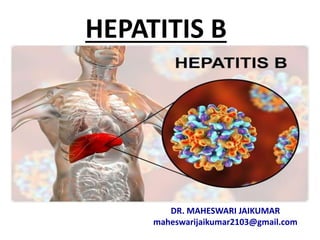
HEPATITIS B
DR. MAHESWARI JAIKUMAR
maheswarijaikumar2103@gmail.com
HEPATITIS “B”
• Hepatitis is formerly known as
SERUM HEPATITIS is an acute
systemic infection with major
pathology in the liver, caused by
Hepatitis “B” Virus (HBV)
• It is clinically characterized by a
long incubation period (6 weeks
to 6 months) and a protracted
illness with a variety of
outcomes
• Persistent HBV infection may
cause progressive liver disease
including chronic active hepatitis
and hepatocellular carcinoma
• Hepatitis B virus can form a
dangerous alliance with
Hepatitis D virus and produce a
new form of virulent hepatitis
which is considered to be a wide
spread threat
AGENT
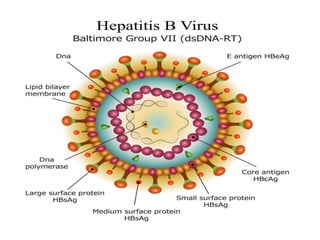
• HBV is a complex-nm, double-
shelled DN virus. It replicates in
the liver cells.
RESERVOIR OF INFECTION
• Man is the only reservoir of
infection. Hepatitis can spread
from either carriers or from case.
A PERSISTENT CARRIER
• A persistent carriers state is
defined as the presence of
HBAsg for more than six months.
Cases may range from
inapparent to symptomatic
cases.
INFECTIVE MATERIAL
• Contaminated blood is the main
source of infection (although the
virus is present in bodily
secretions such as saliva, vaginal
secretions, & semen)
RESISTANCE
• The virus is quite stable and
capable of for at least 7 days on
environment surfaces. It can be
readily destroyed by sodium
hypochlorite, heat sterilization in
an autoclave for 30-60 min
PERIOD OF COMMUNICABILITY
• The virus is present in the blood
during the incubation period and
during the acute phase of the
disease
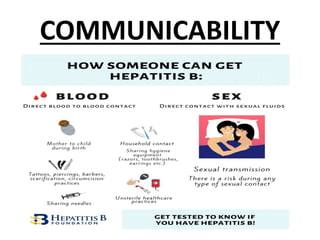
COMMUNICABILITY
HOST FACTORS
• AGE : The outcome of HBV
infection are age dependent
• Acute hepatitis occurs
approximately 1 percent of
perinatal, 10% in early childhood
(1-5 yrs) 30% in late (>5 yrs)
HIGH RISK GROUP
• Surgeons
• Recipients of blood transfusion
• Health care personnel
• Laboratory personnel
• Homosexuals
• Commercial Sex Workers
• Percutaneous drug abusers
• Infants of HBV carrier mothers
• Recipients of solid organ
transplants
• Immuno compromised patients
• SEROLOGICAL SCREENING &
VACCINATION OF
HIGH RISK GROUP IS HIGHLY
RECOMMENDED
HBV & HIV INFECTION
• Presence of HIV markedly
increases the risk of developing
HBV associated liver cirrhosis
and hepatocellular carcinoma
HUMORAL & CELLULAR
RESPONSE
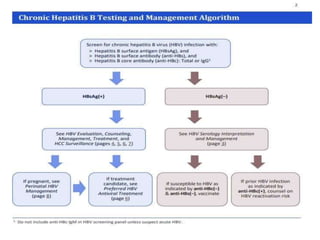
• Hepatitis B has three distinct
antigens
• 1.Surface antigen known as
Australian antigen (HBsAg)
• 2. Core antigen HBcAg
• 3.An “e” antigen HBeAg
• They stimulate the production of
corresponding antibodies
(ie:Surface antibody-anti HBs,
core antibody –anti-HBc and “e”
antibody –anti HBe
• These antibodies and their
antigens constitute very useful
markers of HBV infection
• Patients with HBV infection have
more than one markers
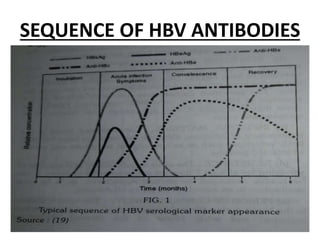
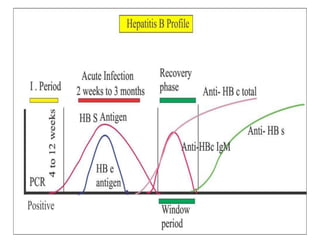
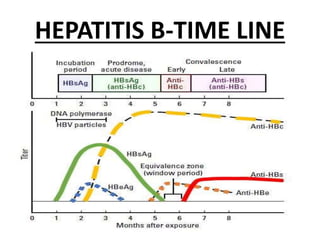
SEQUENCE OF HBV ANTIBODIES
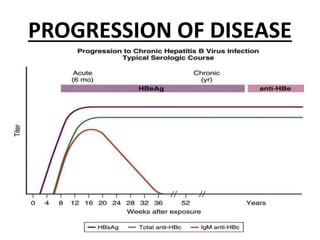
HBsAg
• The appearance of HBsAg is the
first marker of infection
appearing before the evidence of
liver disease and persists
throughout clinical infection
Anti-HBs
• Specific antibody to HBsAg (anti-
HBs) appears in most individuals
after clearance of HBsAg and after
sucessful vaccination of HBsAg.
• Appearance of anti-HBs signals
recovery from HBV infection, non
infectivity & immunity
Anti-HBc
• IgM anti HBc appears shortly
after HBsAg is detected. Its
presence indicates diagnosis of
acute hepatitis B
HBeAg
• HBeAg is a soluble protein found
only in HBsAg positive
serum.HBeAg indicates viral
replication and infectivity.HBeAg
in serum beyond 3 months
indicates an increassed
likelihood of chronic hepatitis B
infection
HBV DNA
• The presence of HBV DNA in the
serum generally parallels the
presence of HBeAg. HBV DNA is
a sensitive and a precise marker
of viral replication and infectivity
HEPATITIS B-TIME LINE
MODE OF TRANSMISSION
• Parenteral route
• Perinatal transmission
• Sexual transmission
• Other routes
PARENTERAL TRANSMISSION
• Hepatitis B is essentially a blood-
borne infection. It is transmitted
by infected blood and blood
products through transfusions,
dialysis, contaminated syringes
and needles, ............cont...
• pricks of skin, handling of infected
blood, accidental inoculation of
minute quantities of blood such as
may occur during surgicakl and
dental procedures, immunization ,
traditional tatooing,ear piercing,
nose piercing ritual circumscission,
acupuncture etc
• Accidental percutaneous
inoculations by shared razors
and tooth brushes have been
implicated as occasional causes
of hepatitis B
PERINATAL TRANSMISSION
• Spread of infection from HBV
mothers to their babies is an
important factor for the high
prevalence of HBV infection
• Infection of the baby is usually
anicteric and is recognized by the
appearance of surface antigen
between 60-120 days after birth
SEXUAL TRANSMISSION
• The sexually promiscuous
particularly male homosexuals
are at very high risk of infection
with Hepatitis B
OTHER ROUTES
• Transmission from child-to-child
(called horizontal transmission)
is reported. Transmission occurs
when children play to gather or
share the same bed
INCUBATION PERIOD
• 30 to 180 days
• Lower doses of virus often
results in longer incubation
period. The average incubation
period is 75 days
CLINICAL FEATURE
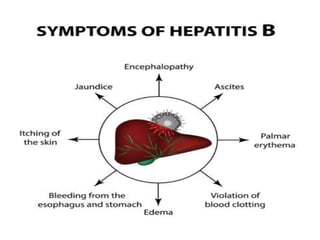
• The symptoms and
manifestations of HBV infection
are similar to those of the other
types of viral hepatitis
• The clinical manifestations are
complicated by the carrier state
and by chronic liver disease
• Chronic liver disease may be severe
and may progress ro primary liver
cancer
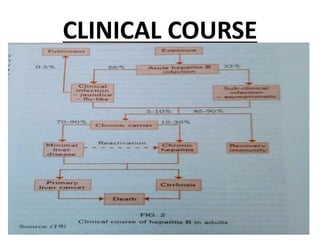
CLINICAL COURSE
PROGRESSION OF DISEASE
PREVENTION & CONTAINMENT
• The following measures are
recommended. Administration
of Hepatitis B vaccine is found to
be highly efficient in the
prevention
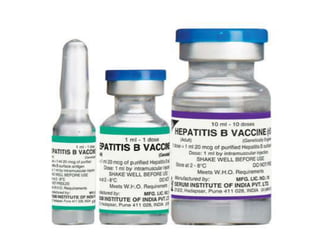
HEPATITIS B VACCINE
• Plasma derived hepatitis vaccine
is currently in use. Hepatitis B
vaccine is available as
monovalent formulation or in
fixed combination with other
vaccines (including DPT, Hib,
Hepatitis A)
• When immunizing against HBV at
birth, only monovalent hepatitis B
vaccine should be used
• The dose for adult is 10-20
microgramsinitially (depending on
formulation) and again at 1 and 6
months
• Children under 10 yrs of age should
be given half of the adult dose at
the same time intervals
• For greatest reliability of
absorption the deltoid muscle is
preferred for injection
• For infants and children under 2
years, antero- lateral aspect of
thigh is used as vaccination site
• Intradermal administration is not
recommended as immune
response is less reliable
particularly in children
• The hepatitis B vaccine does not
interfere with immune response to
any other vaccine and vice versa
• The birth dose of hepatitis b can be
given safely together with BCG
vaccine, however the vaccines
should be given at different sites
• The complete vaccine series
induces protective antibody
levels in more than 95% of
infants, children and young
adults
• After the age of 40 yrs,
protection following primary
vaccine drops below 90%
• The duration of protection is at
least 15yrs based on scientific
evidence
• All children aged less than 18 yrs
and not previously vaccinated
should receive vaccination
• Hepatitis B vaccine is
contraindicated for individuals
with history of allergic reactions
to any of the vaccine
components
• Neither pregnancy nor lactation
is a contraindication for the
vaccine
STORAGE OF VACCINE
• The vaccine should be stored at
2-80 degree C
• Freezing must be avoided ass it
dissociates antigen from the
alum adjuvant
HEPATITIS “B” IMMUNOGLOBULIN
• For immediate protection HBIG
is used for those acutely exposed
to HBsAg positive blood (eg:
surgeons, nurses, lab workers)
• HBIG should be given
immediately following accidental
inoculation (ideally within 6 hrs
and preferably not later than 48
hrs)
• At the same time the victim’s
blood should be sent for testing
• If the test is negative vaccination
should be started immediately and
a full course be given
• If the test is postive for surface
antibody, no further action is
required
• The recommended dose is 0.05
to 0.07 ml/kg body weight. Two
doses should be given 30 days
apart.
• HBIG provides short term
passive protection which lasts
for approximately 3 months
PASSIVE ACTIVE IMMUNIZATION
• The simultaneous administration of
HBIG and hepatitis B vaccine is more
efficacious than HBIG alone
• The combined procedure is ideal
both for prophylaxis of persons
accidently exposed to hepatitis +ve
blood and for prevention of carrier
state in the newborn babies of
carrier mothers
• HBIG (0.05-0.07ml/kg) should be
administered as soon as possible
and within 24 hrs)
• If possible Hepatitis b vaccine 1
ml (20mcg/1ml) should be given
IM within 7 days of exposure and
second and third doses should
be given one and six months,
respectively after the first dose
OTHER MEASURES
• All blood should be screened for
HBV infection. Voluntary blood
donation should be encourages
as purchase blood has shown a
higher risk of post transfusion
hepatitis
• Health personnel should be
alerted to the importance of
adequate sterilization of all
instruments and to practice
hygienic measures
• Carriers should be educated
not to donate blood, not to
share razors or tooth brushes
and use barrier methods of
contraception
THANK YOU

HEPATITIS "B"

  • 1.
    HEPATITIS B DR. MAHESWARIJAIKUMAR maheswarijaikumar2103@gmail.com
  • 2.
    HEPATITIS “B” • Hepatitisis formerly known as SERUM HEPATITIS is an acute systemic infection with major pathology in the liver, caused by Hepatitis “B” Virus (HBV)
  • 3.
    • It isclinically characterized by a long incubation period (6 weeks to 6 months) and a protracted illness with a variety of outcomes
  • 4.
    • Persistent HBVinfection may cause progressive liver disease including chronic active hepatitis and hepatocellular carcinoma
  • 5.
    • Hepatitis Bvirus can form a dangerous alliance with Hepatitis D virus and produce a new form of virulent hepatitis which is considered to be a wide spread threat
  • 6.
    AGENT • HBV isa complex-nm, double- shelled DN virus. It replicates in the liver cells.
  • 8.
    RESERVOIR OF INFECTION •Man is the only reservoir of infection. Hepatitis can spread from either carriers or from case.
  • 9.
    A PERSISTENT CARRIER •A persistent carriers state is defined as the presence of HBAsg for more than six months. Cases may range from inapparent to symptomatic cases.
  • 10.
    INFECTIVE MATERIAL • Contaminatedblood is the main source of infection (although the virus is present in bodily secretions such as saliva, vaginal secretions, & semen)
  • 11.
    RESISTANCE • The virusis quite stable and capable of for at least 7 days on environment surfaces. It can be readily destroyed by sodium hypochlorite, heat sterilization in an autoclave for 30-60 min
  • 12.
    PERIOD OF COMMUNICABILITY •The virus is present in the blood during the incubation period and during the acute phase of the disease
  • 13.
  • 14.
    HOST FACTORS • AGE: The outcome of HBV infection are age dependent • Acute hepatitis occurs approximately 1 percent of perinatal, 10% in early childhood (1-5 yrs) 30% in late (>5 yrs)
  • 15.
    HIGH RISK GROUP •Surgeons • Recipients of blood transfusion • Health care personnel • Laboratory personnel • Homosexuals
  • 16.
    • Commercial SexWorkers • Percutaneous drug abusers • Infants of HBV carrier mothers • Recipients of solid organ transplants • Immuno compromised patients
  • 17.
    • SEROLOGICAL SCREENING& VACCINATION OF HIGH RISK GROUP IS HIGHLY RECOMMENDED
  • 18.
    HBV & HIVINFECTION • Presence of HIV markedly increases the risk of developing HBV associated liver cirrhosis and hepatocellular carcinoma
  • 19.
    HUMORAL & CELLULAR RESPONSE •Hepatitis B has three distinct antigens • 1.Surface antigen known as Australian antigen (HBsAg) • 2. Core antigen HBcAg • 3.An “e” antigen HBeAg
  • 20.
    • They stimulatethe production of corresponding antibodies (ie:Surface antibody-anti HBs, core antibody –anti-HBc and “e” antibody –anti HBe
  • 21.
    • These antibodiesand their antigens constitute very useful markers of HBV infection • Patients with HBV infection have more than one markers
  • 22.
    SEQUENCE OF HBVANTIBODIES
  • 23.
    HBsAg • The appearanceof HBsAg is the first marker of infection appearing before the evidence of liver disease and persists throughout clinical infection
  • 24.
    Anti-HBs • Specific antibodyto HBsAg (anti- HBs) appears in most individuals after clearance of HBsAg and after sucessful vaccination of HBsAg. • Appearance of anti-HBs signals recovery from HBV infection, non infectivity & immunity
  • 25.
    Anti-HBc • IgM antiHBc appears shortly after HBsAg is detected. Its presence indicates diagnosis of acute hepatitis B
  • 26.
    HBeAg • HBeAg isa soluble protein found only in HBsAg positive serum.HBeAg indicates viral replication and infectivity.HBeAg in serum beyond 3 months indicates an increassed likelihood of chronic hepatitis B infection
  • 28.
    HBV DNA • Thepresence of HBV DNA in the serum generally parallels the presence of HBeAg. HBV DNA is a sensitive and a precise marker of viral replication and infectivity
  • 30.
  • 31.
    MODE OF TRANSMISSION •Parenteral route • Perinatal transmission • Sexual transmission • Other routes
  • 32.
    PARENTERAL TRANSMISSION • HepatitisB is essentially a blood- borne infection. It is transmitted by infected blood and blood products through transfusions, dialysis, contaminated syringes and needles, ............cont...
  • 33.
    • pricks ofskin, handling of infected blood, accidental inoculation of minute quantities of blood such as may occur during surgicakl and dental procedures, immunization , traditional tatooing,ear piercing, nose piercing ritual circumscission, acupuncture etc
  • 34.
    • Accidental percutaneous inoculationsby shared razors and tooth brushes have been implicated as occasional causes of hepatitis B
  • 35.
    PERINATAL TRANSMISSION • Spreadof infection from HBV mothers to their babies is an important factor for the high prevalence of HBV infection
  • 36.
    • Infection ofthe baby is usually anicteric and is recognized by the appearance of surface antigen between 60-120 days after birth
  • 37.
    SEXUAL TRANSMISSION • Thesexually promiscuous particularly male homosexuals are at very high risk of infection with Hepatitis B
  • 38.
    OTHER ROUTES • Transmissionfrom child-to-child (called horizontal transmission) is reported. Transmission occurs when children play to gather or share the same bed
  • 39.
    INCUBATION PERIOD • 30to 180 days • Lower doses of virus often results in longer incubation period. The average incubation period is 75 days
  • 41.
    CLINICAL FEATURE • Thesymptoms and manifestations of HBV infection are similar to those of the other types of viral hepatitis
  • 42.
    • The clinicalmanifestations are complicated by the carrier state and by chronic liver disease • Chronic liver disease may be severe and may progress ro primary liver cancer
  • 43.
  • 44.
  • 46.
    PREVENTION & CONTAINMENT •The following measures are recommended. Administration of Hepatitis B vaccine is found to be highly efficient in the prevention
  • 47.
    HEPATITIS B VACCINE •Plasma derived hepatitis vaccine is currently in use. Hepatitis B vaccine is available as monovalent formulation or in fixed combination with other vaccines (including DPT, Hib, Hepatitis A)
  • 49.
    • When immunizingagainst HBV at birth, only monovalent hepatitis B vaccine should be used • The dose for adult is 10-20 microgramsinitially (depending on formulation) and again at 1 and 6 months
  • 50.
    • Children under10 yrs of age should be given half of the adult dose at the same time intervals • For greatest reliability of absorption the deltoid muscle is preferred for injection
  • 51.
    • For infantsand children under 2 years, antero- lateral aspect of thigh is used as vaccination site • Intradermal administration is not recommended as immune response is less reliable particularly in children
  • 52.
    • The hepatitisB vaccine does not interfere with immune response to any other vaccine and vice versa • The birth dose of hepatitis b can be given safely together with BCG vaccine, however the vaccines should be given at different sites
  • 53.
    • The completevaccine series induces protective antibody levels in more than 95% of infants, children and young adults • After the age of 40 yrs, protection following primary vaccine drops below 90%
  • 54.
    • The durationof protection is at least 15yrs based on scientific evidence • All children aged less than 18 yrs and not previously vaccinated should receive vaccination
  • 55.
    • Hepatitis Bvaccine is contraindicated for individuals with history of allergic reactions to any of the vaccine components • Neither pregnancy nor lactation is a contraindication for the vaccine
  • 56.
    STORAGE OF VACCINE •The vaccine should be stored at 2-80 degree C • Freezing must be avoided ass it dissociates antigen from the alum adjuvant
  • 57.
    HEPATITIS “B” IMMUNOGLOBULIN •For immediate protection HBIG is used for those acutely exposed to HBsAg positive blood (eg: surgeons, nurses, lab workers)
  • 58.
    • HBIG shouldbe given immediately following accidental inoculation (ideally within 6 hrs and preferably not later than 48 hrs) • At the same time the victim’s blood should be sent for testing
  • 59.
    • If thetest is negative vaccination should be started immediately and a full course be given • If the test is postive for surface antibody, no further action is required
  • 60.
    • The recommendeddose is 0.05 to 0.07 ml/kg body weight. Two doses should be given 30 days apart. • HBIG provides short term passive protection which lasts for approximately 3 months
  • 61.
    PASSIVE ACTIVE IMMUNIZATION •The simultaneous administration of HBIG and hepatitis B vaccine is more efficacious than HBIG alone
  • 62.
    • The combinedprocedure is ideal both for prophylaxis of persons accidently exposed to hepatitis +ve blood and for prevention of carrier state in the newborn babies of carrier mothers • HBIG (0.05-0.07ml/kg) should be administered as soon as possible and within 24 hrs)
  • 63.
    • If possibleHepatitis b vaccine 1 ml (20mcg/1ml) should be given IM within 7 days of exposure and second and third doses should be given one and six months, respectively after the first dose
  • 64.
    OTHER MEASURES • Allblood should be screened for HBV infection. Voluntary blood donation should be encourages as purchase blood has shown a higher risk of post transfusion hepatitis
  • 65.
    • Health personnelshould be alerted to the importance of adequate sterilization of all instruments and to practice hygienic measures
  • 66.
    • Carriers shouldbe educated not to donate blood, not to share razors or tooth brushes and use barrier methods of contraception
  • 67.