PROGRAMMED
INSTRUCTION
JALA SUNITHA
M.SC NURSING 2ND YEAR
KIMS COLLEGE OF NURSING
➢Introduction:The method was originally popularized
by B.F. Skinner as a behavioural approach to
teaching.
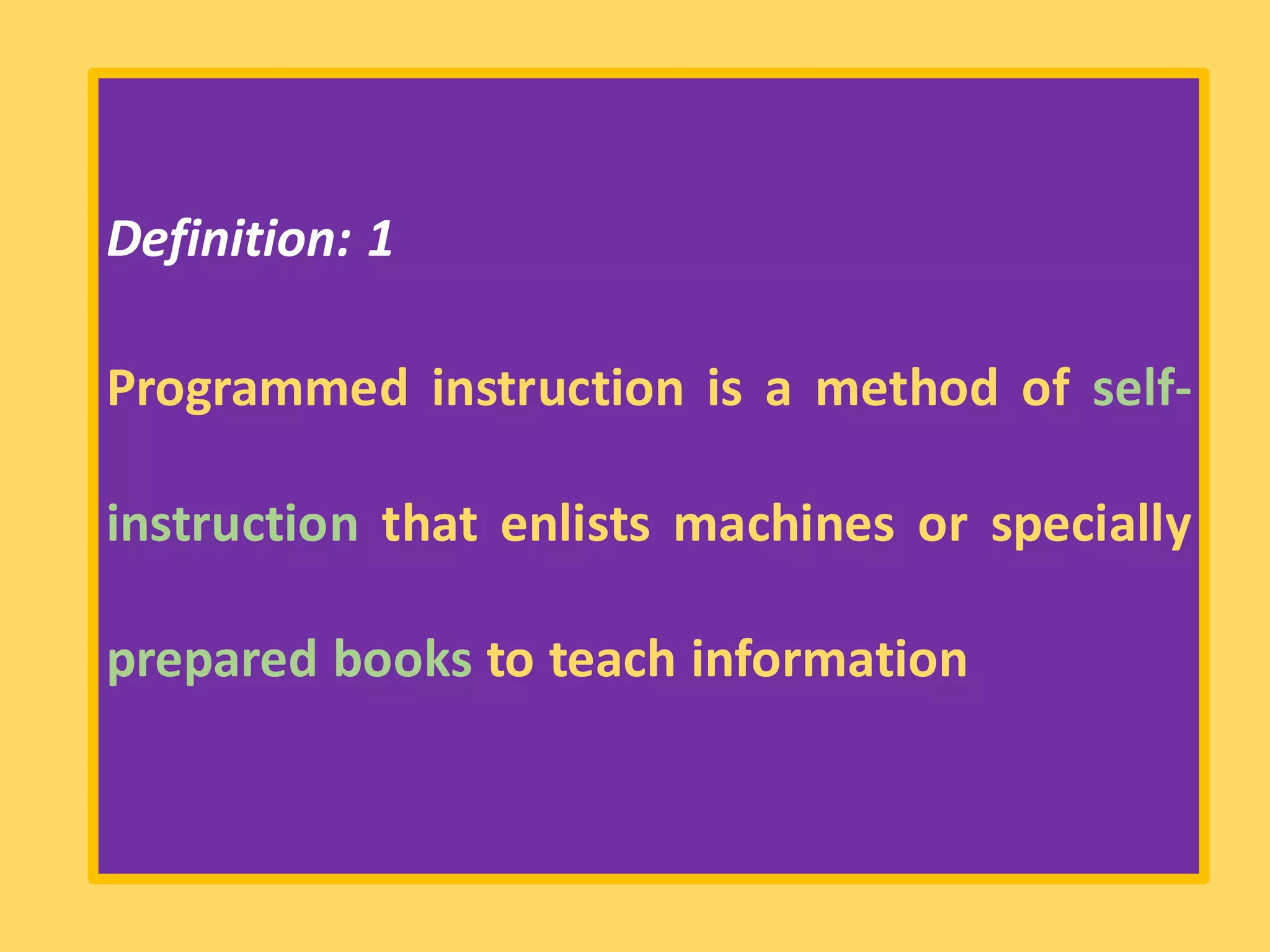
➢B.F. Skinner is considered by any to be the "father" of
programmed instruction. He popularized the approach in the
1950s
Continue……
➢At times, a single course may consist of thousands of
these chunks, or units, of instruction. It is thought that
presenting the material in small pieces improves
comprehension and retention.
➢Programmed instruction is a precise process. The
material a student learns is broken down into tiny
chunks to avoid overwhelming (enormous) the student
with too much at once.
Definition: 1
Programmed instruction is a method of self-
instruction that enlists machines or specially
prepared books to teach information
Definition: 2
Programmed instruction is an instructional
method in which the material to be learned
is presented to the student in small chunks
of information
Definition: 3
Instruction through information given in small steps
with each requiring a correct response by the
learner before going on to the next step
Definition: 4
Programmed instruction is an instructional
method in which the material to be learned is
presented to the student in small chunks of
information
Purpose:
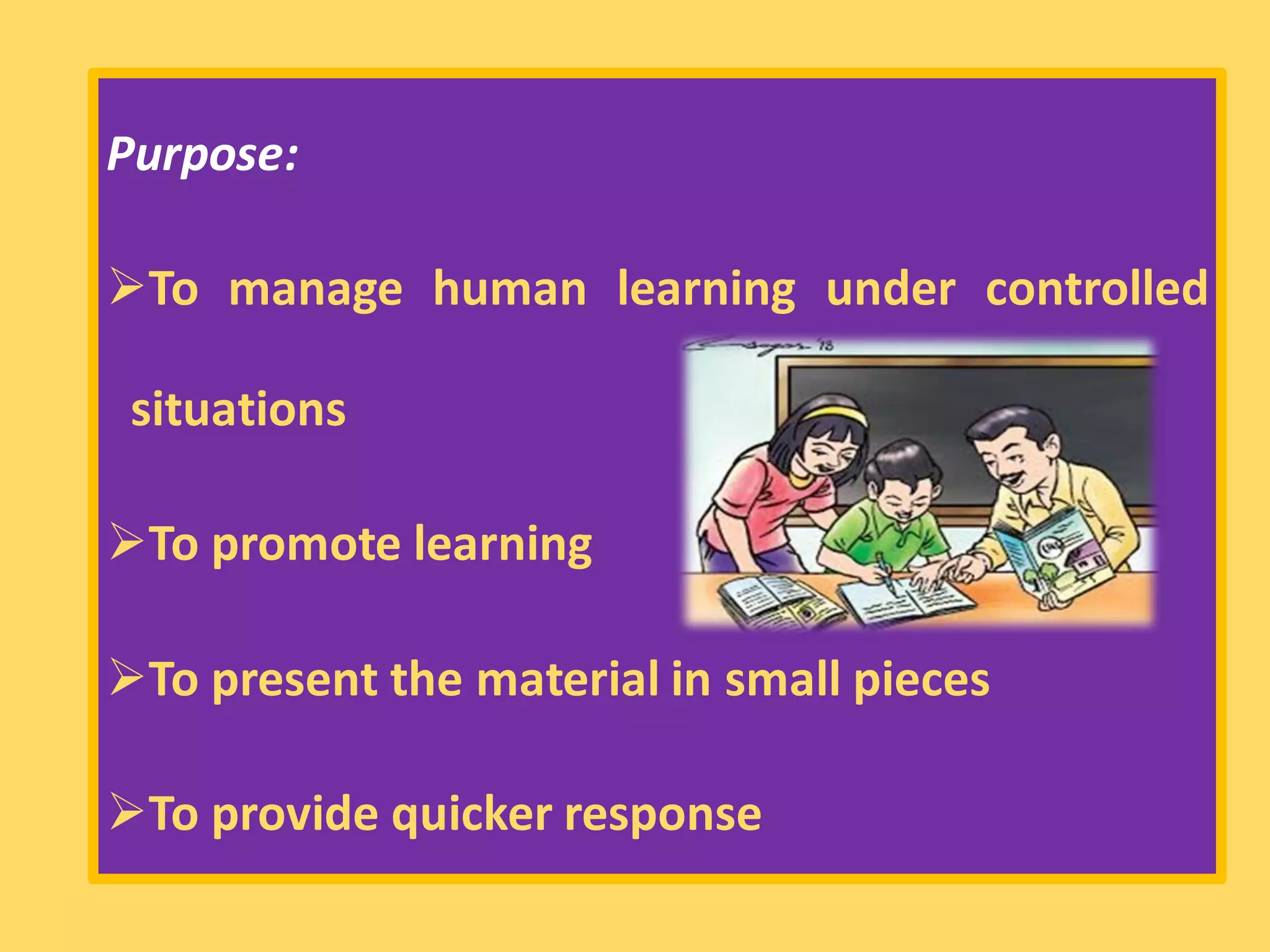
➢To manage human learning under controlled
situations
➢To promote learning
➢To present the material in small pieces
➢To provide quicker response
Characteristics:
➢Subject matter is broken down into small steps called
frames and arranged sequentially
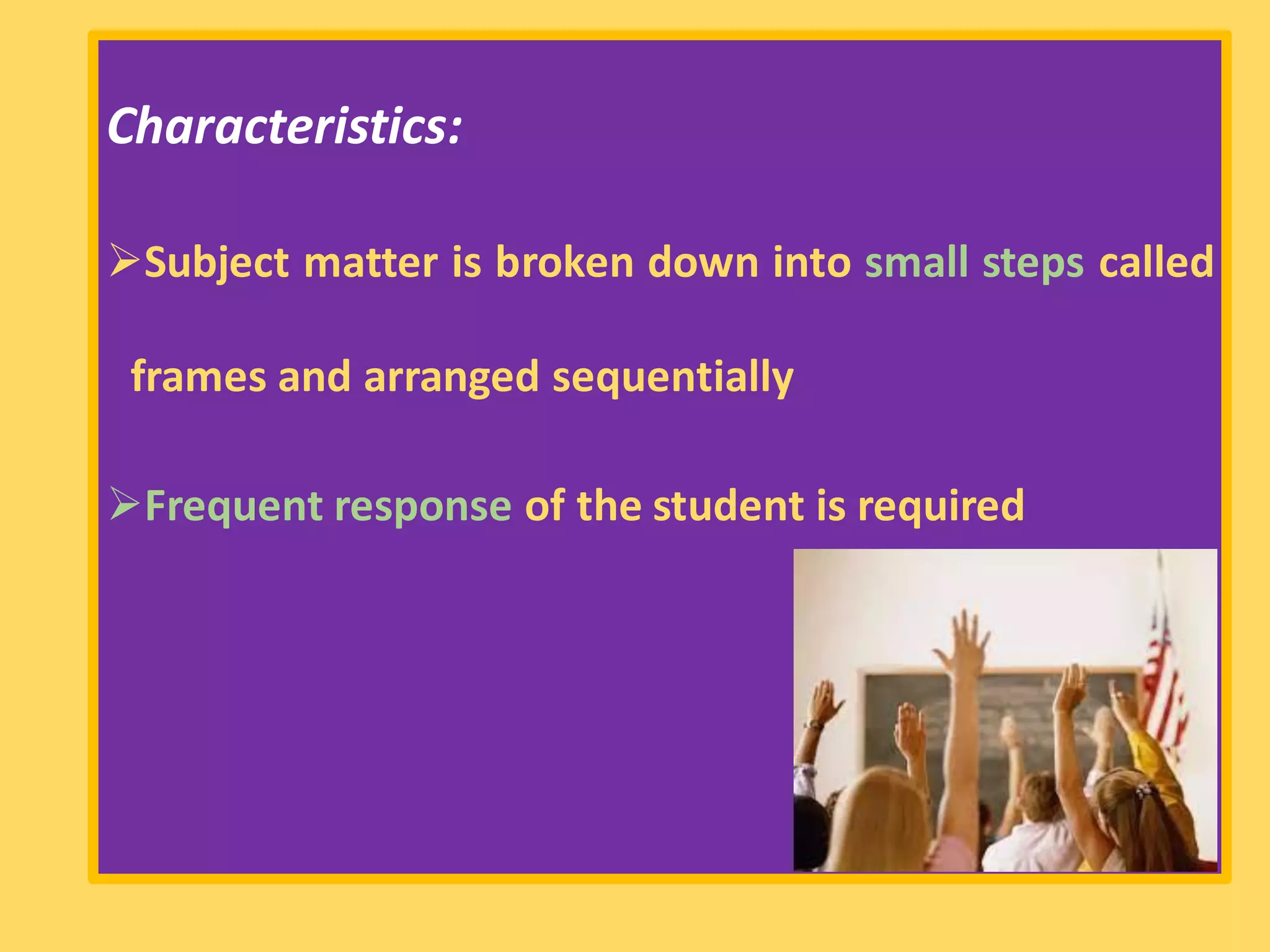
➢Frequent response of the student is required
Continue……..
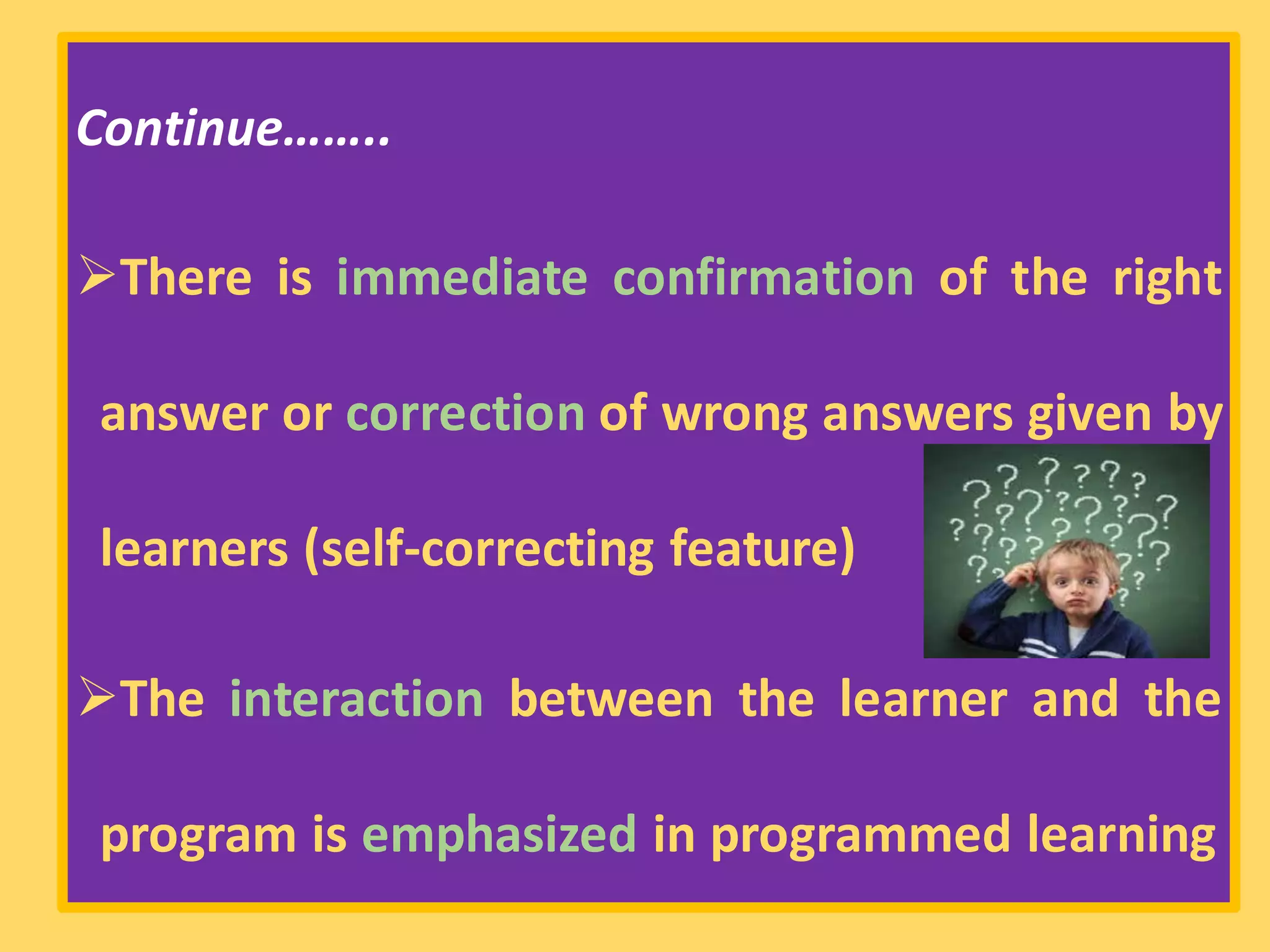
➢There is immediate confirmation of the right
answer or correction of wrong answers given by
learners (self-correcting feature)
➢The interaction between the learner and the
program is emphasized in programmed learning
Continue……..
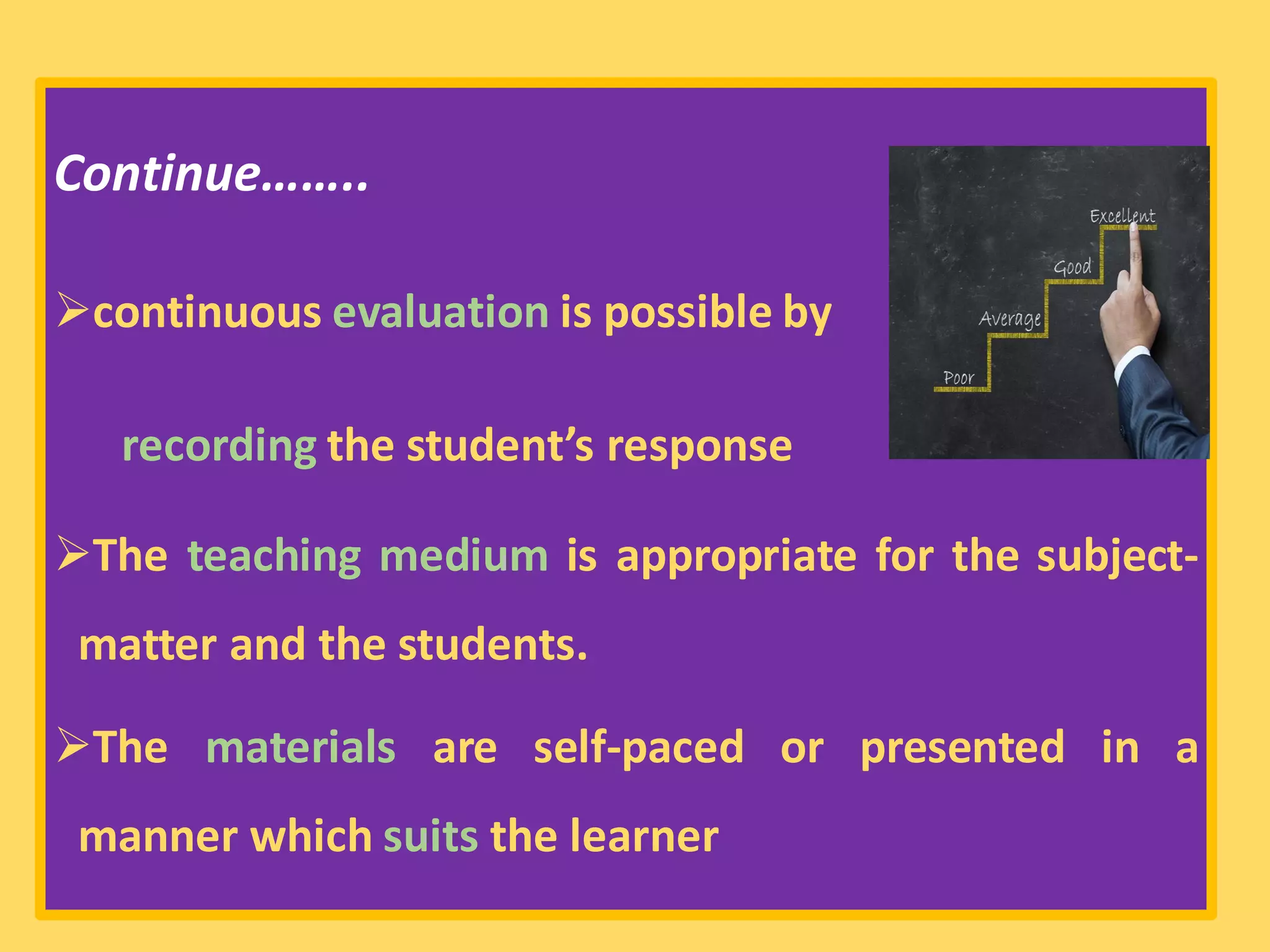
➢continuous evaluation is possible by
recording the student’s response
➢The teaching medium is appropriate for the subject-
matter and the students.
➢The materials are self-paced or presented in a
manner which suits the learner
Types of programmed instruction:
1. Linear programming
2. Branching or intrinsic style program
3. Computer assisted instruction
1. Linear programming:
➢This was developed by B.F Skinner and his
associates
➢In this the subject method will be divided into
very small steps each of which is called as frame
➢In each frame, the student to do something
continue…
➢Straight line- single track
➢Every learner follow the same path
➢A linear program is also called “straight line
program”
continue…
➢The learner starts from initial behavior to the
terminal behavior following straight line
➢The students proceeds one frame to the next
until he completes the program
continue…..
➢After giving the answer for the question
immediately he can check whether his answer
in correct or wrong
F1-F2-F3-F4-F5-F6
Characteristics
➢Information to the next is orderly fashion
➢The learners respond overtly so their correct response
can be rewarded and incorrect responses can be
corrected
➢The learners are immediately informed about weather
or not their response is correct (feedback)
Characteristics
➢The learners are immediately informed about
weather or not their response is correct
(feedback)
➢The learners proceed at their own pace (self-
pacing)
2. Branching programming
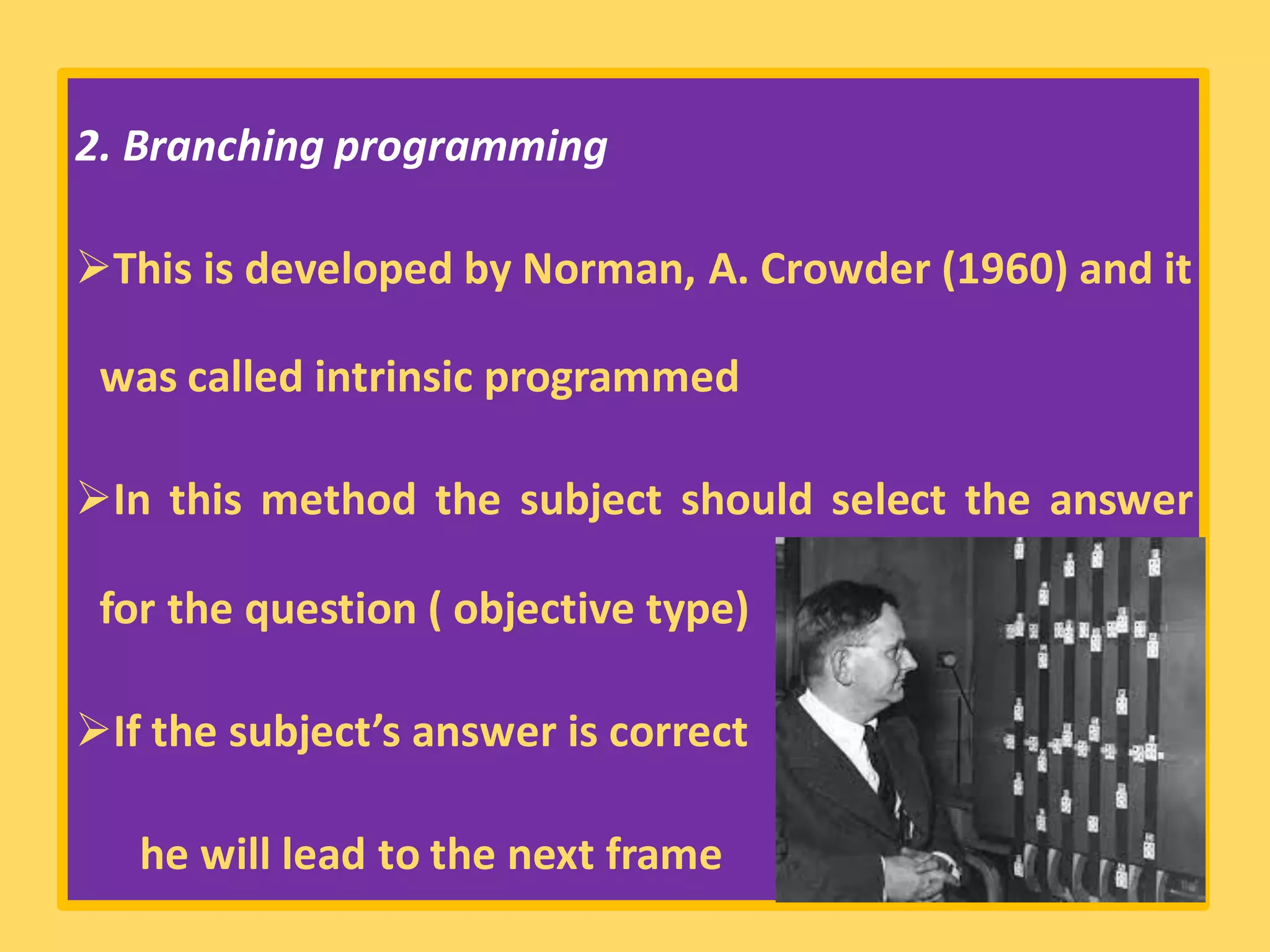
➢This is developed by Norman, A. Crowder (1960) and it
was called intrinsic programmed
➢In this method the subject should select the answer
for the question ( objective type)
➢If the subject’s answer is correct
he will lead to the next frame
Continue…….
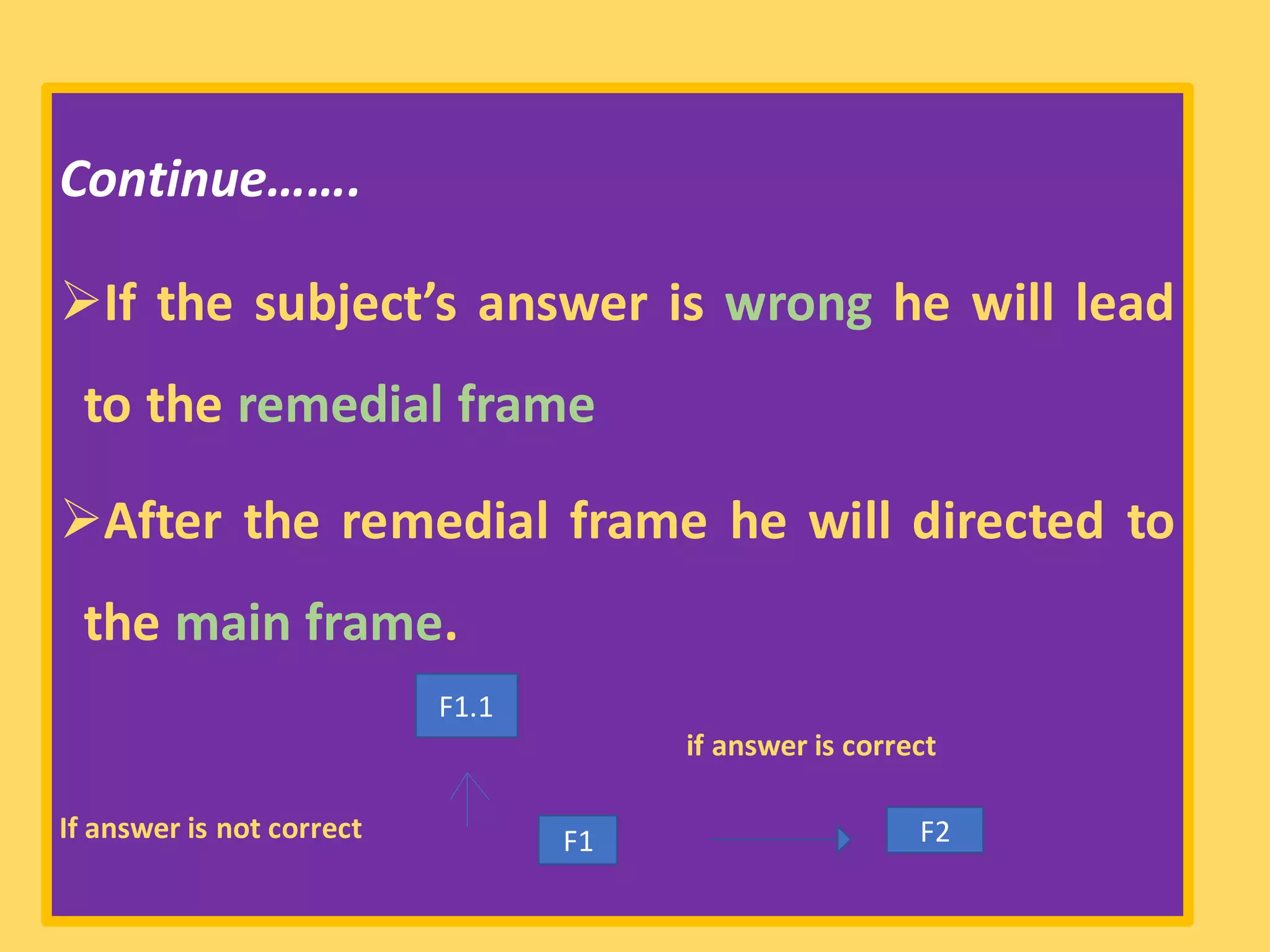
➢If the subject’s answer is wrong he will lead
to the remedial frame
➢After the remedial frame he will directed to
the main frame.
if answer is correct
If answer is not correct
F1.1
F1 F2
3. Computer assisted instruction
➢It has a television screen for displaying
information
➢A complete package of information is stored
in the system and is presented sequentially
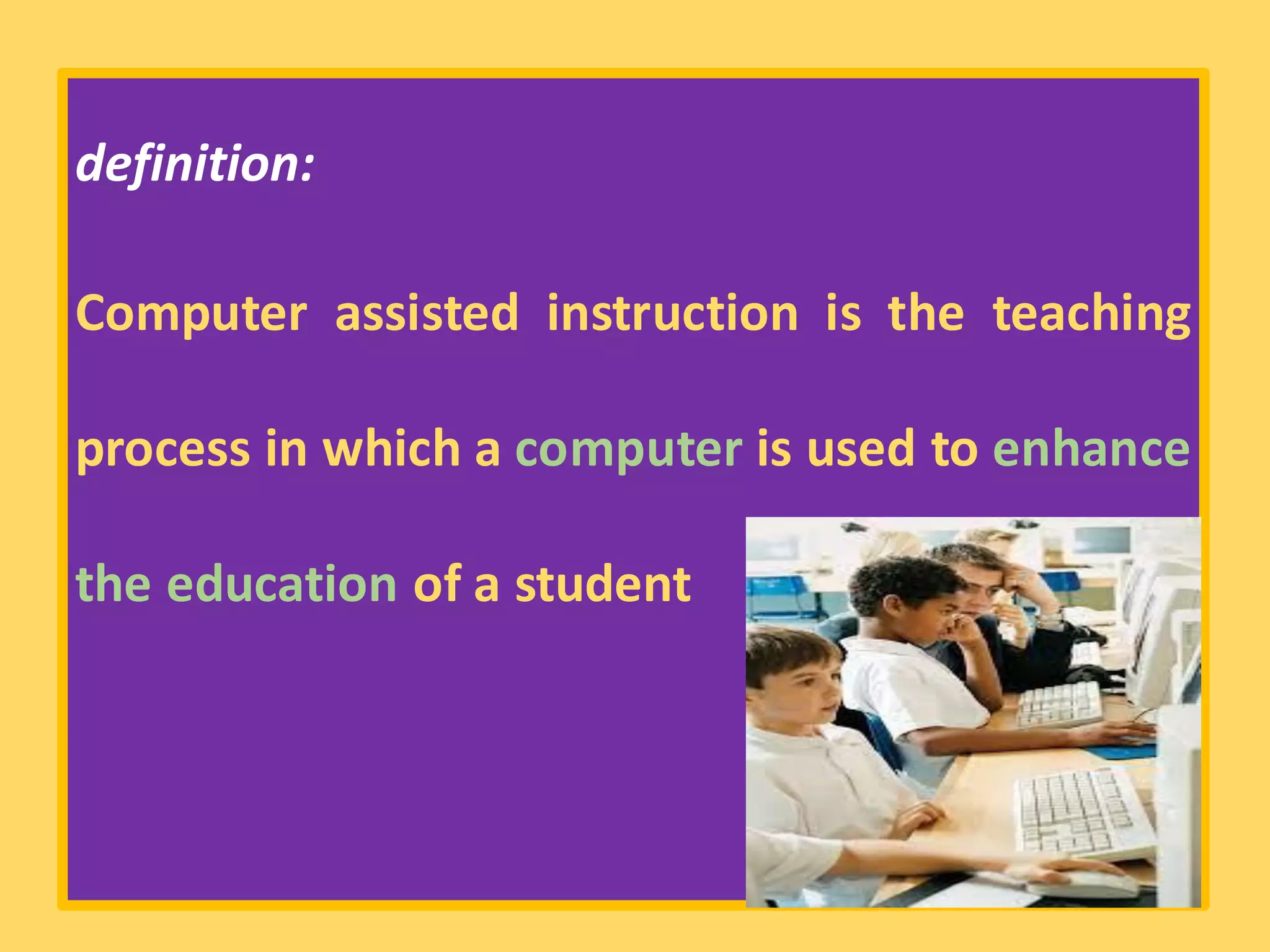
definition:
Computer assisted instruction is the teaching
process in which a computer is used to enhance
the education of a student
definition:2
Computer assisted instruction is an interactive
instructional technique where by a computer is
used to present the instructional material and
monitor the learning that takes place. CAI uses a
combination of text, graphics, sound and video in
enhancing the learning process
development of a programmed instruction:
1. Preparatory phase
2. Writing phase
3. Validation phase
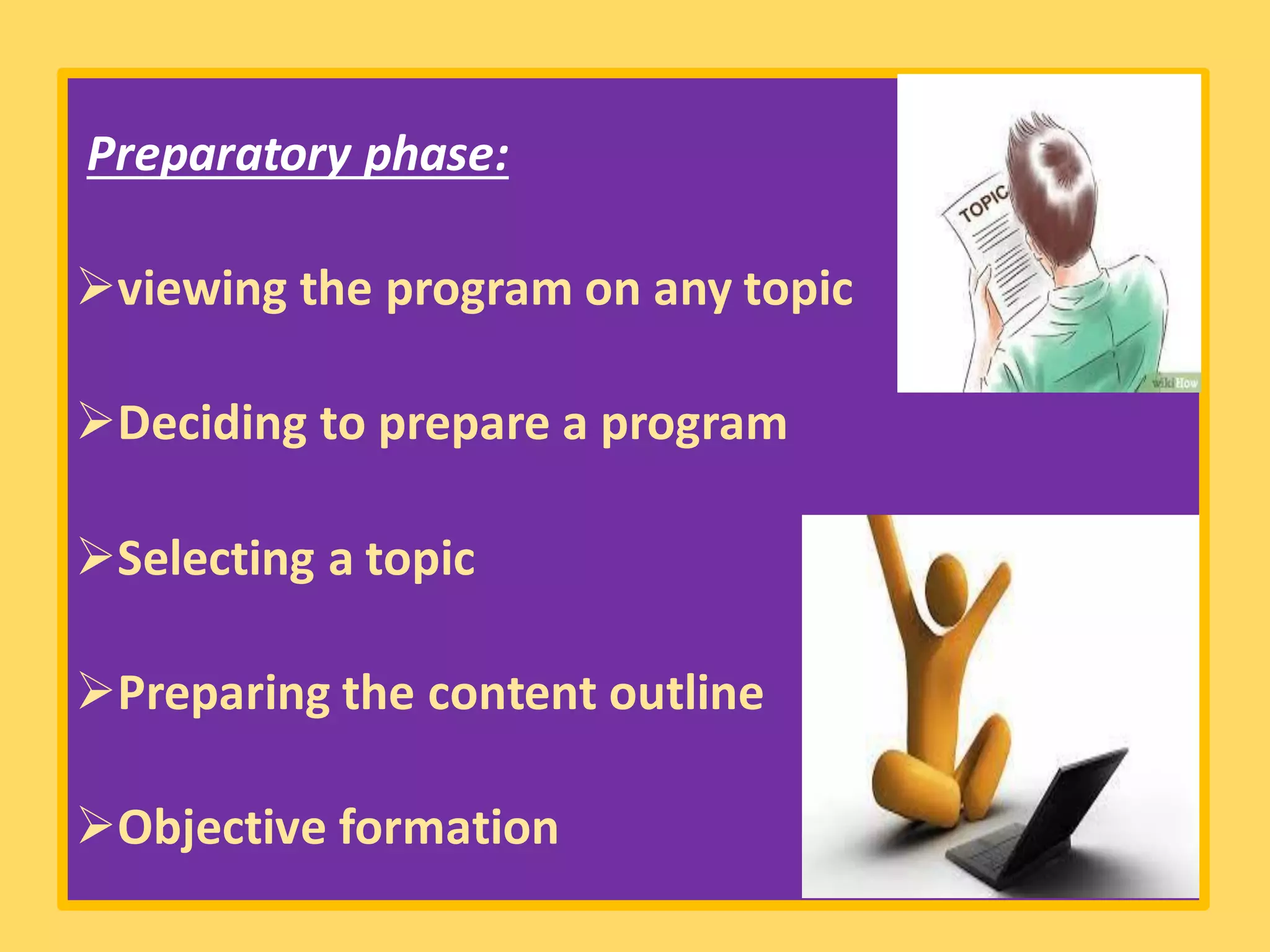
Preparatory phase:
➢viewing the program on any topic
➢Deciding to prepare a program
➢Selecting a topic
➢Preparing the content outline
➢Objective formation
continue:
➢Assumptions about learner
➢Preparation of pre-test
➢Terminal behavior. Expected performance of the
learner at the end of a course
➢Preparation of post test
writing phase
➢presentation of materials in frames
➢Requires an active student participation
➢Prove answer for confirmation or correction of
student response
➢Use prompts to guide students response
continue
➢Use prompts to guide students response
➢Provide careful sequencing of frames
Validation phase:
involves:
➢Try out and revision
➢Individual tryout
➢Small group try out
➢Master validation
➢Editing, reviewing, revising and modifying the program
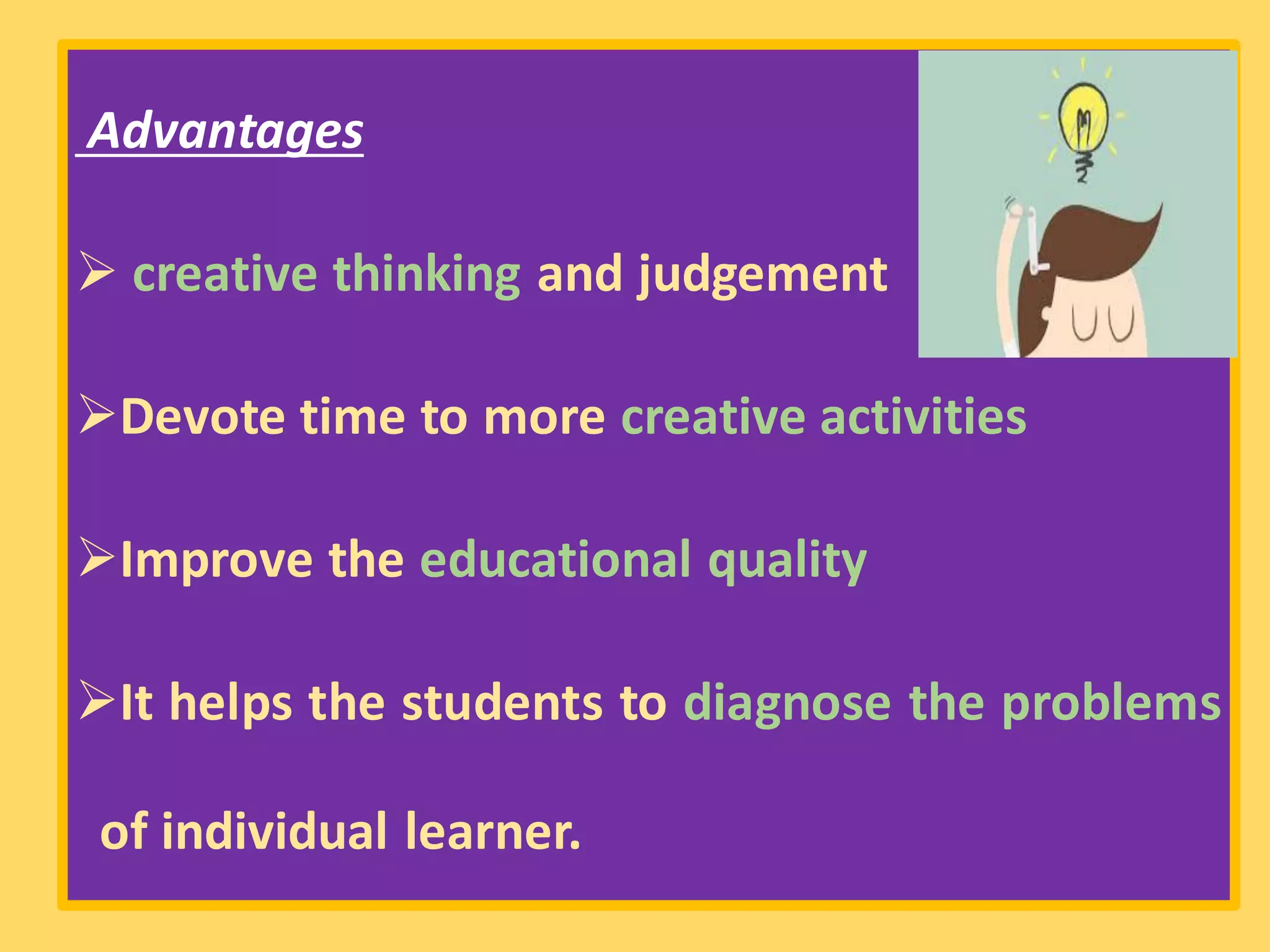
Advantages
➢ creative thinking and judgement
➢Devote time to more creative activities
➢Improve the educational quality
➢It helps the students to diagnose the problems
of individual learner.
Advantages
➢ Emotional and social problems are
eliminated
➢Problem of discipline have been solved
automatically
➢Learner is challenged by his own capabilites
disadvantages
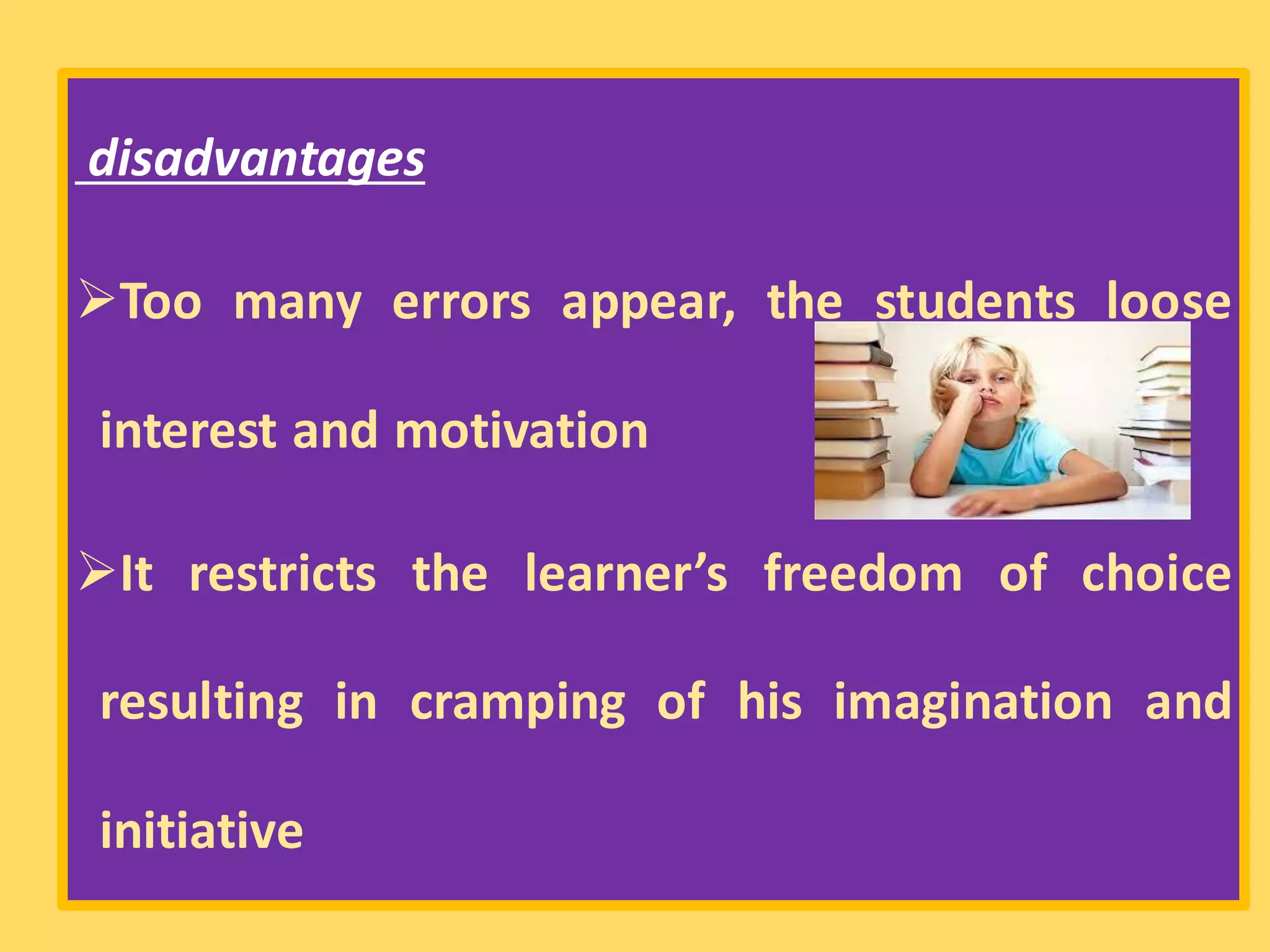
➢Too many errors appear, the students loose
interest and motivation
➢It restricts the learner’s freedom of choice
resulting in cramping of his imagination and
initiative
thankyou

Programmed instruction

  • 1.
    PROGRAMMED INSTRUCTION JALA SUNITHA M.SC NURSING2ND YEAR KIMS COLLEGE OF NURSING
  • 2.
    ➢Introduction:The method wasoriginally popularized by B.F. Skinner as a behavioural approach to teaching. ➢B.F. Skinner is considered by any to be the "father" of programmed instruction. He popularized the approach in the 1950s
  • 3.
    Continue…… ➢At times, asingle course may consist of thousands of these chunks, or units, of instruction. It is thought that presenting the material in small pieces improves comprehension and retention. ➢Programmed instruction is a precise process. The material a student learns is broken down into tiny chunks to avoid overwhelming (enormous) the student with too much at once.
  • 4.
    Definition: 1 Programmed instructionis a method of self- instruction that enlists machines or specially prepared books to teach information
  • 5.
    Definition: 2 Programmed instructionis an instructional method in which the material to be learned is presented to the student in small chunks of information
  • 6.
    Definition: 3 Instruction throughinformation given in small steps with each requiring a correct response by the learner before going on to the next step
  • 7.
    Definition: 4 Programmed instructionis an instructional method in which the material to be learned is presented to the student in small chunks of information
  • 8.
    Purpose: ➢To manage humanlearning under controlled situations ➢To promote learning ➢To present the material in small pieces ➢To provide quicker response
  • 9.
    Characteristics: ➢Subject matter isbroken down into small steps called frames and arranged sequentially ➢Frequent response of the student is required
  • 10.
    Continue…….. ➢There is immediateconfirmation of the right answer or correction of wrong answers given by learners (self-correcting feature) ➢The interaction between the learner and the program is emphasized in programmed learning
  • 11.
    Continue…….. ➢continuous evaluation ispossible by recording the student’s response ➢The teaching medium is appropriate for the subject- matter and the students. ➢The materials are self-paced or presented in a manner which suits the learner
  • 12.
    Types of programmedinstruction: 1. Linear programming 2. Branching or intrinsic style program 3. Computer assisted instruction
  • 13.
    1. Linear programming: ➢Thiswas developed by B.F Skinner and his associates ➢In this the subject method will be divided into very small steps each of which is called as frame ➢In each frame, the student to do something
  • 14.
    continue… ➢Straight line- singletrack ➢Every learner follow the same path ➢A linear program is also called “straight line program”
  • 15.
    continue… ➢The learner startsfrom initial behavior to the terminal behavior following straight line ➢The students proceeds one frame to the next until he completes the program
  • 16.
    continue….. ➢After giving theanswer for the question immediately he can check whether his answer in correct or wrong F1-F2-F3-F4-F5-F6
  • 17.
    Characteristics ➢Information to thenext is orderly fashion ➢The learners respond overtly so their correct response can be rewarded and incorrect responses can be corrected ➢The learners are immediately informed about weather or not their response is correct (feedback)
  • 18.
    Characteristics ➢The learners areimmediately informed about weather or not their response is correct (feedback) ➢The learners proceed at their own pace (self- pacing)
  • 19.
    2. Branching programming ➢Thisis developed by Norman, A. Crowder (1960) and it was called intrinsic programmed ➢In this method the subject should select the answer for the question ( objective type) ➢If the subject’s answer is correct he will lead to the next frame
  • 20.
    Continue……. ➢If the subject’sanswer is wrong he will lead to the remedial frame ➢After the remedial frame he will directed to the main frame. if answer is correct If answer is not correct F1.1 F1 F2
  • 21.
    3. Computer assistedinstruction ➢It has a television screen for displaying information ➢A complete package of information is stored in the system and is presented sequentially
  • 22.
    definition: Computer assisted instructionis the teaching process in which a computer is used to enhance the education of a student
  • 23.
    definition:2 Computer assisted instructionis an interactive instructional technique where by a computer is used to present the instructional material and monitor the learning that takes place. CAI uses a combination of text, graphics, sound and video in enhancing the learning process
  • 24.
    development of aprogrammed instruction: 1. Preparatory phase 2. Writing phase 3. Validation phase
  • 25.
    Preparatory phase: ➢viewing theprogram on any topic ➢Deciding to prepare a program ➢Selecting a topic ➢Preparing the content outline ➢Objective formation
  • 26.
    continue: ➢Assumptions about learner ➢Preparationof pre-test ➢Terminal behavior. Expected performance of the learner at the end of a course ➢Preparation of post test
  • 27.
    writing phase ➢presentation ofmaterials in frames ➢Requires an active student participation ➢Prove answer for confirmation or correction of student response ➢Use prompts to guide students response
  • 28.
    continue ➢Use prompts toguide students response ➢Provide careful sequencing of frames
  • 29.
    Validation phase: involves: ➢Try outand revision ➢Individual tryout ➢Small group try out ➢Master validation ➢Editing, reviewing, revising and modifying the program
  • 30.
    Advantages ➢ creative thinkingand judgement ➢Devote time to more creative activities ➢Improve the educational quality ➢It helps the students to diagnose the problems of individual learner.
  • 31.
    Advantages ➢ Emotional andsocial problems are eliminated ➢Problem of discipline have been solved automatically ➢Learner is challenged by his own capabilites
  • 32.
    disadvantages ➢Too many errorsappear, the students loose interest and motivation ➢It restricts the learner’s freedom of choice resulting in cramping of his imagination and initiative
  • 33.