T E A C H I N G A N D A S S E S S M E N T O F M A C R O
S K I L L S
PROGRAMMED
INSTRUCTION
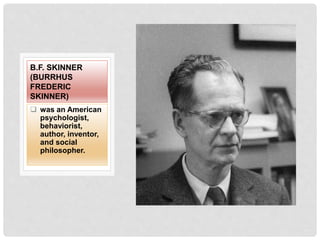
 was an American
psychologist,
behaviorist,
author, inventor,
and social
philosopher.
B.F. SKINNER
(BURRHUS
FREDERIC
SKINNER)
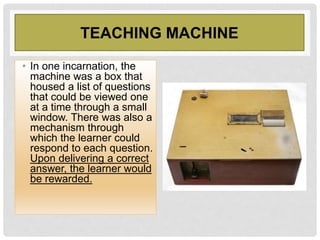
TEACHING MACHINE
• In one incarnation, the
machine was a box that
housed a list of questions
that could be viewed one
at a time through a small
window. There was also a
mechanism through
which the learner could
respond to each question.
Upon delivering a correct
answer, the learner would
be rewarded.
PROGRAMMED INSTRUCTION
PROGRAMME
• A programme is a device
to control the student’s
behaviour and help them
to learn without the direct
supervision of a teacher.
INSTRUCTION
• Instruction is the
purposeful, orderly,
controlled sequencing of
experiences to reach a
specified goal.
PROGRAMMED INSTRUCTION
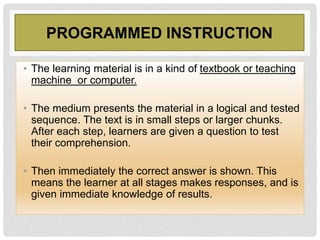
• The learning material is in a kind of textbook or teaching
machine or computer.
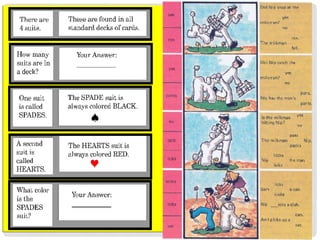
• The medium presents the material in a logical and tested
sequence. The text is in small steps or larger chunks.
After each step, learners are given a question to test
their comprehension.
• Then immediately the correct answer is shown. This
means the learner at all stages makes responses, and is
given immediate knowledge of results.
2 TYPES OF PROGRAMMED
INSTRUCTION
• Linear programming
• Branched programming
LINEAR PROGRAMMING
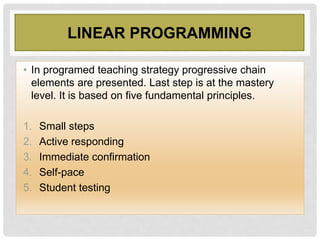
• In programed teaching strategy progressive chain
elements are presented. Last step is at the mastery
level. It is based on five fundamental principles.
1. Small steps
2. Active responding
3. Immediate confirmation
4. Self-pace
5. Student testing
PRINCIPLE OF SMALL STEPS
• Learning is better when the material is
presented in small steps. It also reduces the rate
of committing errors and encourages further
learning.
PRINCIPLES OF ACTIVE
RESPONDING
• The learner has to construct the response. It is
an integral part of learning. The frames of
program should also be designed logically that
the learner shows interest in responding the
frames.
PRINCIPLES OF IMMEDIATE
CONFIRMATION
• When learners response to the frames, they do not know
that these responses are correct or wrong.
• By providing immediate reinforcement or confirmation to
the response, the learner gets confidence. When the
learner is reinforced for a correct response, he/she
becomes repetitive for further learning.
• The learner learns best if his/her response is confirmed
immediately. The confirmation provides reinforcement to
the learner.
PRINCIPLES OF SELF-PACING
• This principle is based on the assumption that each
learner can work each step as slowly or as quickly,
depending upon his/her pace. Each learner is free to
move according to his/her own speed, slowly or quickly
as they like. Some can learn things at a quicker speed
and may skip one or more frames, whereas others can
go on slowly. It satisfies every learner’s need.
PRINCIPLE OF STUDENT TESTING
• The programmed instruction is based on continuous
evaluation by recording the response of the learner. The
learner leaves the record of his/her study for each step in
response sheet. It helps to improve the quality of
programmed material through checking the number of
errors at each step. Also, the learner’s progress can be
evaluated by looking into the various types of response
produced by the learner.
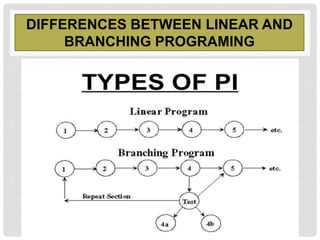
BRANCHED PROGRAMMING
• This technique provides the student a piece of
information, presents a situation requiring a multiple
choice or recognition response, and on the basis of
that choice instructs the student to proceed to
another frame, where he or she learns if the choice
was correct, and if not, why not.
• A student who responded incorrectly will either be
returned to the original frame, or routed through a
subprogram designed to remedy the deficiency
indicated by the wrong choice.
DIFFERENCES BETWEEN LINEAR AND
BRANCHING PROGRAMING
CHARACTERISTICS OF PROGRAMMED
INSTRUCTIONS:
It is a method of giving or receiving
individualized instructions. It keeps in view their
individual differences.
The learner moves at his/her own speed.
It is not the solution of educational problems. It
is a new instructional strategy for the
modification of behavior of learner.
It cannot replace the teacher.
It provides immediate feedback to the learners.
OBJECTIVES OF PROGRAMMED
INSTRUCTION
To help the student in learning by doing.
To provide the learners situation so that they can learn
at their own pace.
To help students learn in the absence of a teacher.
To present the content in a controlled manner and in
logically related steps.
To help students in assessing their own performance
themselves by comparing it with the given answers.
ADVANTAGES OF PROGRAMMED
INSTRUCTION
• There is not fixed time interval for learning. Students may
learn at their own pace.
• Immediate confirmation of the results provides reinforcement
to the learners and encourages the learners to proceed
further. Feedback is provided to wrong answers, so that
learner is able to develop mastery over the content.
DISADVANTAGES OF PROGRAMMED
INSTRUCTION
It is very difficult to develop an instructional programme
Only cognitive objectives can be achieved
There is no chance for students’ creativity
Development of programme is not economical in terms of
cost and time
In absence of the teacher, students may spoil the
disciplinary tone of the class, or they will be helpless
when any problem arises.
It cannot be applied at primary level of education or at
higher education
REFERENCES
http://www.edugyan.in/2017/03/programmed-
instruction.html?fbclid=IwAR1eAxRGLLLYFYS29bdr0GhxFtX97Cs-
fK4hkXnVyIolhjqXG5eAxdMVBQ0
http://www.studylecturenotes.com/curriculum-instructions/programmed-
instruction-method-meaning-advantages-
disadvantages?fbclid=IwAR1N6K0bbzSTnB1ke6xTKHWtie4rk1v8BzyhWFgcFR
RFcSUvGwRB9DmeSNI
https://en.wikipedia.org/wiki/Programmed_learning?fbclid=IwAR0RUk8cY0TSJZ
ZcCh0uowceLM63HoZLue9tblRYaOC7-ZTLvddHsDlDhFI
https://en.wikipedia.org/wiki/B._F._Skinner?fbclid=IwAR1GFvL9qtkYuIJmfi_agJ
MfpUmYdd-tNDILW0fPPHmxOGdBwTs_Fai6d6Y
https://www.youtube.com/watch?v=gaxx0E5IgH8&fbclid=IwAR2D7HioccTdt4MH
AOpnbnBNCie_UR4BiKGDc9I6fPapKKkSqZiTAc-_UDg
http://www.studylecturenotes.com/curriculum-instructions/programmed-
instruction-method-meaning-advantages-
disadvantages?fbclid=IwAR0iMu3ZzxVdiUwcPYKiO2QCgkQCtcd3CHWzVXY1E
OqCHtwOXYNsBONoJt8

Programmed instruction