PROGRAMMED INSTRUCTION
BY :
AMIT DAS
MSC NSG I ST YR
OUTLINE:
• INTRODUCTION
• DEFINITION
• OBJECTIVES
• PURPOSE
• PRINCIPLE
• TYPES
• LINEAR PROGRAMMING
• CHARACTERISTICS LINEAR PROGRAMMING
• TYPES OF LINEAR PROGRAMME
• FEATURES OF GOOD LINEAR PROGRAMME
• LIMITATIONS OF LINEAR PROGRAMMING
26-09-2017 TEERTHANKER MAHAVEER UNIVERSITY 2
OUTLINE: (cont.…)
• BRANCHING PROGRAMMING
• PRINCIPLES OF BRANCHING PROGRAMME
• STRUCTURE OF BRANCHING PROGRAMME FRAME
• FEATURES OF BRANCHING PROGRAMME
• CHARACTERISTIC OF GOOD BRANCHING PROGRAMMING
• ADVANTAGES OF BRANCHING PROGRAMMING
• ADVANTAGES OF PROGRAMMED INSTRUCTION
• DISADVANTAGES OF PROGRAMMED INSTRUCTION
26-09-2017 TEERTHANKER MAHAVEER UNIVERSITY 3
INTRODUCTION:
Programmed instruction method of teaching is an autocratic and individualized
Strategy. Its main focus is to bring desirable change in the cognitive domain of the
learner's Behavior. It got historical momentum only after the publication of “the science
of learning and art of teaching” articles by B.F. Skinner in 1954.Programmed
instruction is a highly individualised instructional strategy for the modification of
behaviour. Besides instructional purpose, it can also be employed as a mechanism of
feedback device for improving teaching efficiency.
26-09-2017 TEERTHANKER MAHAVEER UNIVERSITY 4
DEFINITION:
“a progressively monitored, step-by-step teaching method, employing small units of
information or learning material and frequent testing, whereby the student must complete or
pass one stage before moving on to the next. Also called programmed learning.
OR
“A method of teaching in which the information to be learned is presented in discrete units, wi
th a correct response to each unit required before the learner may advance to the next unit.”
-(DR. V K Maheshwari,2016)
26-09-2017 TEERTHANKER MAHAVEER UNIVERSITY 5
OBJECTIVES:
Major objectives of Programmed Instructions are:
• To help the student to learn by doing.
• To provide the situation to learn at his own pace.
• To help student to learn without the presence of a teacher.
• To present the content in a controlled manner and in logically related steps.
26-09-2017 TEERTHANKER MAHAVEER UNIVERSITY 6
PURPOSE:
Purpose of programmed instructions are:
• To manage human learning under controlled conditions.
• To promote learning at the pace of the learner.
• To present the material in small pieces.
• To provide quicker response
26-09-2017 TEERTHANKER MAHAVEER UNIVERSITY 7
PRINCIPLES:
• Principle of Small Step
• Principle of Active Responding
• Principle of Immediate confirmation
• Principle of Self - Pacing
• Principle of Student - Testing.
26-09-2017 TEERTHANKER MAHAVEER UNIVERSITY 8
TYPES OF PROGRAMMED
INSTRUCTION:
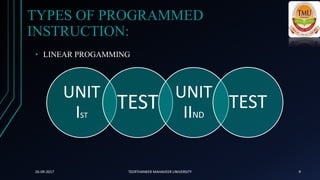
• LINEAR PROGAMMING
26-09-2017 TEERTHANKER MAHAVEER UNIVERSITY 9
UNIT
IST
TEST
UNIT
IIND
TEST
TYPES OF PROGRAMMED INSTRUCTION:
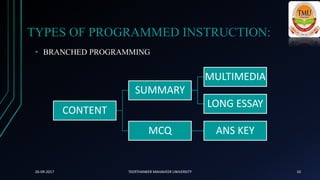
• BRANCHED PROGRAMMING
26-09-2017 TEERTHANKER MAHAVEER UNIVERSITY 10
CONTENT
SUMMARY
MULTIMEDIA
LONG ESSAY
MCQ ANS KEY
CHARACTERISTICS LINEAR
PROGRAMMING
• Programmed Instruction is individualized
• Teaching material is carefully ordered simple to complex
• Participants or students actively involved in each step of evaluation
• Self directed learning method.
26-09-2017 TEERTHANKER MAHAVEER UNIVERSITY 11
TYPES OF LINEAR PROGRAMME
• INTRODUCTORY FRAMES –
main function of introductory frame is to introduce the topic.
• TEACHING FRAMES –
main function of teaching frame is to impart new knowledge.
• PRACTICE FRAMES –
the purpose of practice frames is to practice the acquired new
behaviours through teaching frames.
• TESTING FRAMES –
the main focus of testing frames is to access as to how much have
the students learnt. these frames are related to terminal behaviours.
FEATURES OF GOOD LINEAR
PROGRAMME:
26-09-2017 TEERTHANKER MAHAVEER UNIVERSITY 13
• It is accompanied with a self-explained set of instructions.
• It controls the individual difference of the learners.
• It provides reinforcement to the learners.
• It provides “Learning by Doing” situation.
• It is designed in logical sequence of content structure.
Difficult concepts can be taught effectively.
LIMITATIONS OF LINEAR
PROGRAMMING:- (CONT….)
• Lack Of Motivation
• Freedom Of Choice Is Curtailed
• Costly
• Blanks And Key Terms Are Guessed
• It Can Be Used In Limited Areas
• Searching Of Material Is Not Permitted
LIMITATIONS OF LINEAR
PROGRAMMING:- (CONT….)
• Does Not Permit Differentiation Among Responses
• Students Follow A Rigid Line Prescribed By The
Programmers
• It Is Very Difficult To Find Out Exactly The Background Of
Each Learner
• In Book Form Presentation
BRANCHING PROGRAMMING:
Origin:
in 1954, Norman Crowder, a psychologist with united state air
force was
asked to investigate the training of aircraft maintenance men.
the technicians were being
taught to “trouble shoot” or repair faults, in a bomber
navigation system. and there lies the origin of branching
programming.
26-09-2017 TEERTHANKER MAHAVEER UNIVERSITY 16
BRANCHING PROGRAMMING (cont.…)
EDUCATIONAL PERSPECTIVE:
After exposure to the programmed material, the student has to
discriminate a correct answer from the given multiple-choice
questions. This process is within the learner. The major
rationale for the word “intrinsic” is that the student's response
is controlled by himself internally.
26-09-2017 TEERTHANKER MAHAVEER UNIVERSITY 17
PRINCIPLES OF BRANCHING PROGRAMME:
26-09-2017 TEERTHANKER MAHAVEER UNIVERSITY 18
• Principle of Exposition
ex. The learner should perceive the whole phenomena exposed to him.
• Principle of Diagnosis
ex. It refers to identifying the weakness of learner.
• Principle of Remediation
ex. Diagnosis provides the basis for remediation or Remedial Instructions.
STRUCTURE OF BRANCHING PROGRAMME
FRAME :
26-09-2017 TEERTHANKER MAHAVEER UNIVERSITY 19
• In this strategy, content is not presented in small steps but whole unit
or concept is presented.
• The size of step may be a paragraph or two or whole page.
• The learner perceives the whole concept and tries to comprehend.
• He has to follow the Sequence Pages.
• Therefore, branching programming text is known as Scrambled Text.
FEATURES OF BRANCHING
PROGRAMME:
• Material in a frame is larger; much information is presented at each step. A step
may consist of two or more paragraphs and sometimes a full page
• Learner has freedom to choose his own path of action according to the
background of subject matter. The learner controls the exact sequence that he will
follow.
• Student is more alert and concentrates on the subject
• The programmer has ample opportunity to exploit the literary style.
26-09-2017 TEERTHANKER MAHAVEER UNIVERSITY 20
CHARACTERISTICS OF GOOD
BRANCHING PROGRAMME:
• Individualized Instruction
• Freedom to respond
• Remedial
• Tutorial
• Branching Programmed has its roots in human training and techniques
• Branching Programming is mainly concerned with teaching and
instruction rather than learning.
26-09-2017 TEERTHANKER MAHAVEER UNIVERSITY 21
ADVANTAGES OF BRANCHING
PROGRAMMING :
• Teaching
• Diagnosis
• Remediation
• Reinforcement
• It is based on the principles of Problem Solving. It generates appropriate
situation of Learning.
• Scrambled text-book operates as tutorial strategy.
• The focus of scrambled text is to provide remedial instruction and teaching.
26-09-2017 TEERTHANKER MAHAVEER UNIVERSITY 22
LIMITATIONS OF BRANCHING
PROGRAMMING:-
• The learner may guess the correct response without understanding the subject
matter of the frame.
• Infinite branching cannot be provided. It cannot cater to the needs of the
individuals. It is very difficult to find out the total number of branches for each
individual.
• Cost of preparation is high, audio-visual equipment is costly.
• The programme needs revision after every two years which is a very costly
affair.
• Programme are the product of programmer‘s imagination and it is he who
decides diagnostic questions and level of content
26-09-2017 TEERTHANKER MAHAVEER UNIVERSITY 23
ADVANTAGES OF PROGRAMMED
INSTRUCTION:
• The main emphasis is on individual differences and student’s
involvement.
• Students may learn at their own pace.
• Students are exposed only to correct responses, therefore, possibility
to commit errors is reduced.
• Reinforcement and feedback helps students to develop mastery over
the content.
26-09-2017 TEERTHANKER MAHAVEER UNIVERSITY 24
DISADVANTAGES OF
PROGRAMMED INSTRUCTION:
• It is difficult to develop an instructional programme.
• There is no chance for student’s creativity.
• Development of programme is not economical.
• In the absence of teacher, students may spoil discipline of the class.
• It cannot be applied at primary level of education.
26-09-2017 TEERTHANKER MAHAVEER UNIVERSITY 25
SUMMARY:
• INTRODUCTION
• DEFINITION
• OBJECTIVES
• PURPOSE
• PRINCIPLE
• TYPES
• LINEAR PROGRAMMING
• CHARACTERISTICS LINEAR PROGRAMMING
• TYPES OF LINEAR PROGRAMME
• FEATURES OF GOOD LINEAR PROGRAMME
• LIMITATIONS OF LINEAR PROGRAMMING
•
26-09-2017 TEERTHANKER MAHAVEER UNIVERSITY 26
SUMMARY: (cont.….)
• BRANCHING PROGRAMMING
• PRINCIPLES OF BRANCHING PROGRAMME
• STRUCTURE OF BRANCHING PROGRAMME FRAME
• FEATURES OF BRANCHING PROGRAMME
• CHARACTERISTIC OF GOOD BRANCHING PROGRAMMING
• ADVANTAGES OF BRANCHING PROGRAMMING
• PROS OF PROGRAMMED INSTRUCTION
• CONS OF PROGRAMMED INSTRUCTION
26-09-2017 TEERTHANKER MAHAVEER UNIVERSITY 27
Reference:
• Brumfit, Problems and Principles in Language Teaching, Pergamon Institute of
English, 1980.
• Crystal, D. „The Cambridge Encyclopedia of the English Language‟,
Cambridge University Press, London 1995.
• Sharma, Dr. Praveen, „Teaching of English: Skills and Methods‟, Shipra
Publications, Delhi, 2011.
26-09-2017 TEERTHANKER MAHAVEER UNIVERSITY 28
Assignment time:
• Develop one interactive branched instruction learning material
according to specialty from one unit.
• Refer: learning and designing material for students.
• One pager(material)
• Deadline : 2/10/2017
26-09-2017 TEERTHANKER MAHAVEER UNIVERSITY 29
26-09-2017 TEERTHANKER MAHAVEER UNIVERSITY 30

Programmed instruction in education

  • 1.
  • 2.
    OUTLINE: • INTRODUCTION • DEFINITION •OBJECTIVES • PURPOSE • PRINCIPLE • TYPES • LINEAR PROGRAMMING • CHARACTERISTICS LINEAR PROGRAMMING • TYPES OF LINEAR PROGRAMME • FEATURES OF GOOD LINEAR PROGRAMME • LIMITATIONS OF LINEAR PROGRAMMING 26-09-2017 TEERTHANKER MAHAVEER UNIVERSITY 2
  • 3.
    OUTLINE: (cont.…) • BRANCHINGPROGRAMMING • PRINCIPLES OF BRANCHING PROGRAMME • STRUCTURE OF BRANCHING PROGRAMME FRAME • FEATURES OF BRANCHING PROGRAMME • CHARACTERISTIC OF GOOD BRANCHING PROGRAMMING • ADVANTAGES OF BRANCHING PROGRAMMING • ADVANTAGES OF PROGRAMMED INSTRUCTION • DISADVANTAGES OF PROGRAMMED INSTRUCTION 26-09-2017 TEERTHANKER MAHAVEER UNIVERSITY 3
  • 4.
    INTRODUCTION: Programmed instruction methodof teaching is an autocratic and individualized Strategy. Its main focus is to bring desirable change in the cognitive domain of the learner's Behavior. It got historical momentum only after the publication of “the science of learning and art of teaching” articles by B.F. Skinner in 1954.Programmed instruction is a highly individualised instructional strategy for the modification of behaviour. Besides instructional purpose, it can also be employed as a mechanism of feedback device for improving teaching efficiency. 26-09-2017 TEERTHANKER MAHAVEER UNIVERSITY 4
  • 5.
    DEFINITION: “a progressively monitored,step-by-step teaching method, employing small units of information or learning material and frequent testing, whereby the student must complete or pass one stage before moving on to the next. Also called programmed learning. OR “A method of teaching in which the information to be learned is presented in discrete units, wi th a correct response to each unit required before the learner may advance to the next unit.” -(DR. V K Maheshwari,2016) 26-09-2017 TEERTHANKER MAHAVEER UNIVERSITY 5
  • 6.
    OBJECTIVES: Major objectives ofProgrammed Instructions are: • To help the student to learn by doing. • To provide the situation to learn at his own pace. • To help student to learn without the presence of a teacher. • To present the content in a controlled manner and in logically related steps. 26-09-2017 TEERTHANKER MAHAVEER UNIVERSITY 6
  • 7.
    PURPOSE: Purpose of programmedinstructions are: • To manage human learning under controlled conditions. • To promote learning at the pace of the learner. • To present the material in small pieces. • To provide quicker response 26-09-2017 TEERTHANKER MAHAVEER UNIVERSITY 7
  • 8.
    PRINCIPLES: • Principle ofSmall Step • Principle of Active Responding • Principle of Immediate confirmation • Principle of Self - Pacing • Principle of Student - Testing. 26-09-2017 TEERTHANKER MAHAVEER UNIVERSITY 8
  • 9.
    TYPES OF PROGRAMMED INSTRUCTION: •LINEAR PROGAMMING 26-09-2017 TEERTHANKER MAHAVEER UNIVERSITY 9 UNIT IST TEST UNIT IIND TEST
  • 10.
    TYPES OF PROGRAMMEDINSTRUCTION: • BRANCHED PROGRAMMING 26-09-2017 TEERTHANKER MAHAVEER UNIVERSITY 10 CONTENT SUMMARY MULTIMEDIA LONG ESSAY MCQ ANS KEY
  • 11.
    CHARACTERISTICS LINEAR PROGRAMMING • ProgrammedInstruction is individualized • Teaching material is carefully ordered simple to complex • Participants or students actively involved in each step of evaluation • Self directed learning method. 26-09-2017 TEERTHANKER MAHAVEER UNIVERSITY 11
  • 12.
    TYPES OF LINEARPROGRAMME • INTRODUCTORY FRAMES – main function of introductory frame is to introduce the topic. • TEACHING FRAMES – main function of teaching frame is to impart new knowledge. • PRACTICE FRAMES – the purpose of practice frames is to practice the acquired new behaviours through teaching frames. • TESTING FRAMES – the main focus of testing frames is to access as to how much have the students learnt. these frames are related to terminal behaviours.
  • 13.
    FEATURES OF GOODLINEAR PROGRAMME: 26-09-2017 TEERTHANKER MAHAVEER UNIVERSITY 13 • It is accompanied with a self-explained set of instructions. • It controls the individual difference of the learners. • It provides reinforcement to the learners. • It provides “Learning by Doing” situation. • It is designed in logical sequence of content structure. Difficult concepts can be taught effectively.
  • 14.
    LIMITATIONS OF LINEAR PROGRAMMING:-(CONT….) • Lack Of Motivation • Freedom Of Choice Is Curtailed • Costly • Blanks And Key Terms Are Guessed • It Can Be Used In Limited Areas • Searching Of Material Is Not Permitted
  • 15.
    LIMITATIONS OF LINEAR PROGRAMMING:-(CONT….) • Does Not Permit Differentiation Among Responses • Students Follow A Rigid Line Prescribed By The Programmers • It Is Very Difficult To Find Out Exactly The Background Of Each Learner • In Book Form Presentation
  • 16.
    BRANCHING PROGRAMMING: Origin: in 1954,Norman Crowder, a psychologist with united state air force was asked to investigate the training of aircraft maintenance men. the technicians were being taught to “trouble shoot” or repair faults, in a bomber navigation system. and there lies the origin of branching programming. 26-09-2017 TEERTHANKER MAHAVEER UNIVERSITY 16
  • 17.
    BRANCHING PROGRAMMING (cont.…) EDUCATIONALPERSPECTIVE: After exposure to the programmed material, the student has to discriminate a correct answer from the given multiple-choice questions. This process is within the learner. The major rationale for the word “intrinsic” is that the student's response is controlled by himself internally. 26-09-2017 TEERTHANKER MAHAVEER UNIVERSITY 17
  • 18.
    PRINCIPLES OF BRANCHINGPROGRAMME: 26-09-2017 TEERTHANKER MAHAVEER UNIVERSITY 18 • Principle of Exposition ex. The learner should perceive the whole phenomena exposed to him. • Principle of Diagnosis ex. It refers to identifying the weakness of learner. • Principle of Remediation ex. Diagnosis provides the basis for remediation or Remedial Instructions.
  • 19.
    STRUCTURE OF BRANCHINGPROGRAMME FRAME : 26-09-2017 TEERTHANKER MAHAVEER UNIVERSITY 19 • In this strategy, content is not presented in small steps but whole unit or concept is presented. • The size of step may be a paragraph or two or whole page. • The learner perceives the whole concept and tries to comprehend. • He has to follow the Sequence Pages. • Therefore, branching programming text is known as Scrambled Text.
  • 20.
    FEATURES OF BRANCHING PROGRAMME: •Material in a frame is larger; much information is presented at each step. A step may consist of two or more paragraphs and sometimes a full page • Learner has freedom to choose his own path of action according to the background of subject matter. The learner controls the exact sequence that he will follow. • Student is more alert and concentrates on the subject • The programmer has ample opportunity to exploit the literary style. 26-09-2017 TEERTHANKER MAHAVEER UNIVERSITY 20
  • 21.
    CHARACTERISTICS OF GOOD BRANCHINGPROGRAMME: • Individualized Instruction • Freedom to respond • Remedial • Tutorial • Branching Programmed has its roots in human training and techniques • Branching Programming is mainly concerned with teaching and instruction rather than learning. 26-09-2017 TEERTHANKER MAHAVEER UNIVERSITY 21
  • 22.
    ADVANTAGES OF BRANCHING PROGRAMMING: • Teaching • Diagnosis • Remediation • Reinforcement • It is based on the principles of Problem Solving. It generates appropriate situation of Learning. • Scrambled text-book operates as tutorial strategy. • The focus of scrambled text is to provide remedial instruction and teaching. 26-09-2017 TEERTHANKER MAHAVEER UNIVERSITY 22
  • 23.
    LIMITATIONS OF BRANCHING PROGRAMMING:- •The learner may guess the correct response without understanding the subject matter of the frame. • Infinite branching cannot be provided. It cannot cater to the needs of the individuals. It is very difficult to find out the total number of branches for each individual. • Cost of preparation is high, audio-visual equipment is costly. • The programme needs revision after every two years which is a very costly affair. • Programme are the product of programmer‘s imagination and it is he who decides diagnostic questions and level of content 26-09-2017 TEERTHANKER MAHAVEER UNIVERSITY 23
  • 24.
    ADVANTAGES OF PROGRAMMED INSTRUCTION: •The main emphasis is on individual differences and student’s involvement. • Students may learn at their own pace. • Students are exposed only to correct responses, therefore, possibility to commit errors is reduced. • Reinforcement and feedback helps students to develop mastery over the content. 26-09-2017 TEERTHANKER MAHAVEER UNIVERSITY 24
  • 25.
    DISADVANTAGES OF PROGRAMMED INSTRUCTION: •It is difficult to develop an instructional programme. • There is no chance for student’s creativity. • Development of programme is not economical. • In the absence of teacher, students may spoil discipline of the class. • It cannot be applied at primary level of education. 26-09-2017 TEERTHANKER MAHAVEER UNIVERSITY 25
  • 26.
    SUMMARY: • INTRODUCTION • DEFINITION •OBJECTIVES • PURPOSE • PRINCIPLE • TYPES • LINEAR PROGRAMMING • CHARACTERISTICS LINEAR PROGRAMMING • TYPES OF LINEAR PROGRAMME • FEATURES OF GOOD LINEAR PROGRAMME • LIMITATIONS OF LINEAR PROGRAMMING • 26-09-2017 TEERTHANKER MAHAVEER UNIVERSITY 26
  • 27.
    SUMMARY: (cont.….) • BRANCHINGPROGRAMMING • PRINCIPLES OF BRANCHING PROGRAMME • STRUCTURE OF BRANCHING PROGRAMME FRAME • FEATURES OF BRANCHING PROGRAMME • CHARACTERISTIC OF GOOD BRANCHING PROGRAMMING • ADVANTAGES OF BRANCHING PROGRAMMING • PROS OF PROGRAMMED INSTRUCTION • CONS OF PROGRAMMED INSTRUCTION 26-09-2017 TEERTHANKER MAHAVEER UNIVERSITY 27
  • 28.
    Reference: • Brumfit, Problemsand Principles in Language Teaching, Pergamon Institute of English, 1980. • Crystal, D. „The Cambridge Encyclopedia of the English Language‟, Cambridge University Press, London 1995. • Sharma, Dr. Praveen, „Teaching of English: Skills and Methods‟, Shipra Publications, Delhi, 2011. 26-09-2017 TEERTHANKER MAHAVEER UNIVERSITY 28
  • 29.
    Assignment time: • Developone interactive branched instruction learning material according to specialty from one unit. • Refer: learning and designing material for students. • One pager(material) • Deadline : 2/10/2017 26-09-2017 TEERTHANKER MAHAVEER UNIVERSITY 29
  • 30.