
PROGRAMMED
INSTRUCTION
Mrs. Gayathri R
First year MSc Nursing
Upasana College Of
Nursing
DEFINITION
• A process of arranging material to be learned in a series of
small steps designed to lead a learner via self-instruction
from what he knows to the unknown of new & more complex
knowledge & principles.
• “Programmed instruction is planned sequence of
experiences, leading to proficiency in terms of stimulus
response relationship”
-James E Espich &Williams
HISTORY
• PI engaged out of experimental researches on operant
conditioning.
• PI instruction offers possibility of providing a conceptual
framework.
• Socrates' is the first programmer who developed program in
geometry.
• Gita is the first programmed text in the world.
• E L Thorndike in his law of effect used programmed instruction.
• Sydney L Prissy developed PI for testing the items, i.e., multiple
choice question.
CHARACTERISTICS
•Assumptions stated clearly in writing.
•Explicitly stated objectives.
•Logical sequence of small steps.
•Active Responding.
•Immediate feedback of information.
•Individual rate.
•Constant evaluation.
PRINCIPLES
•Objective specification.
•Empirical testing.
•Self pacing.
•Principles of active responding.
•Student testing.
DYNAMICS
• Selection of the subject to be programmed.
• The programmer list the objectives of the materials to be
programmed.
• Construct the item in accordance with established
learning technique.
• Short sequence.
• Sequence can be analyzed for errors & short comings.
T
Y P E S
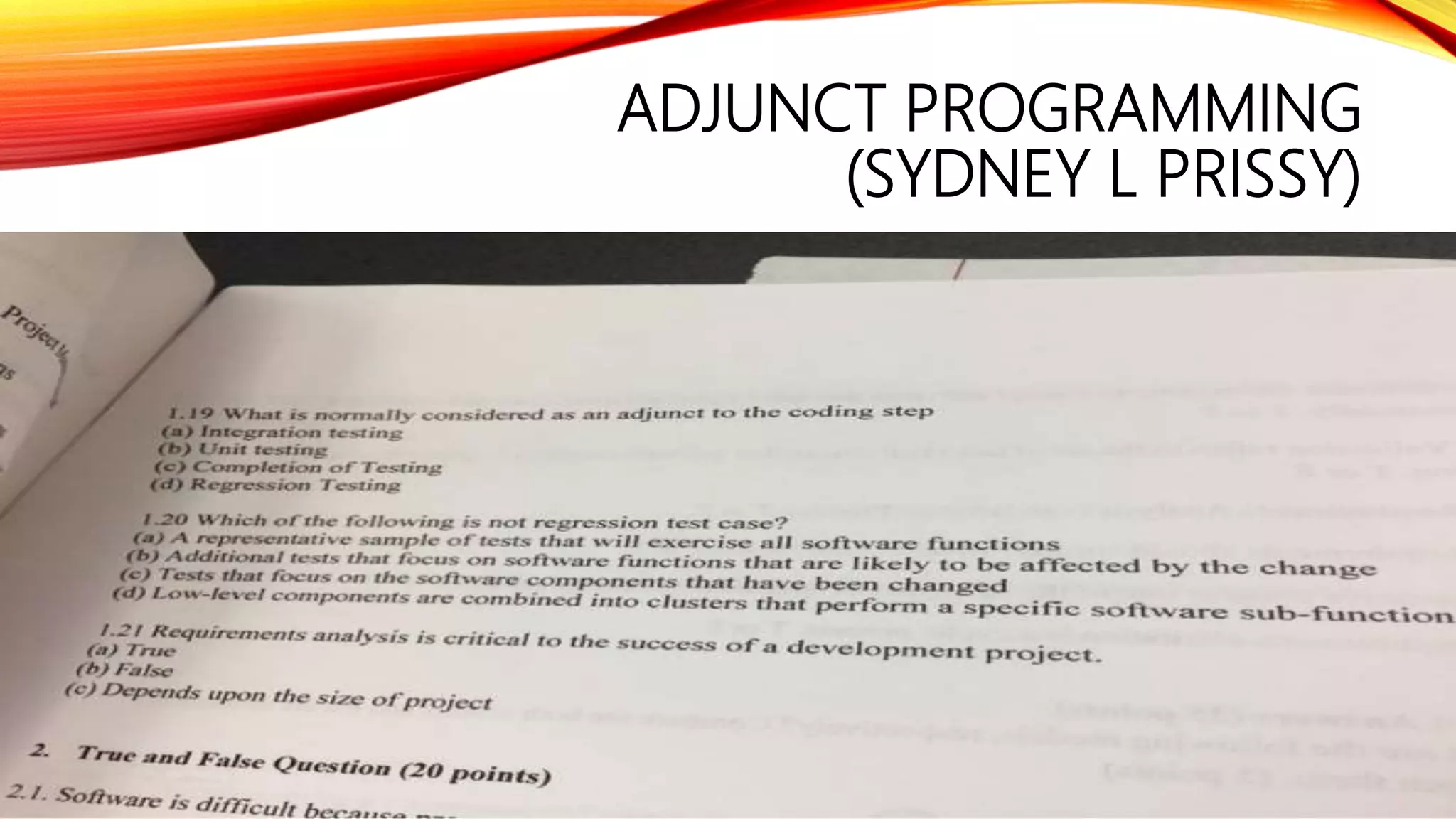
ADJUNCT PROGRAMMING
(SYDNEY L PRISSY)
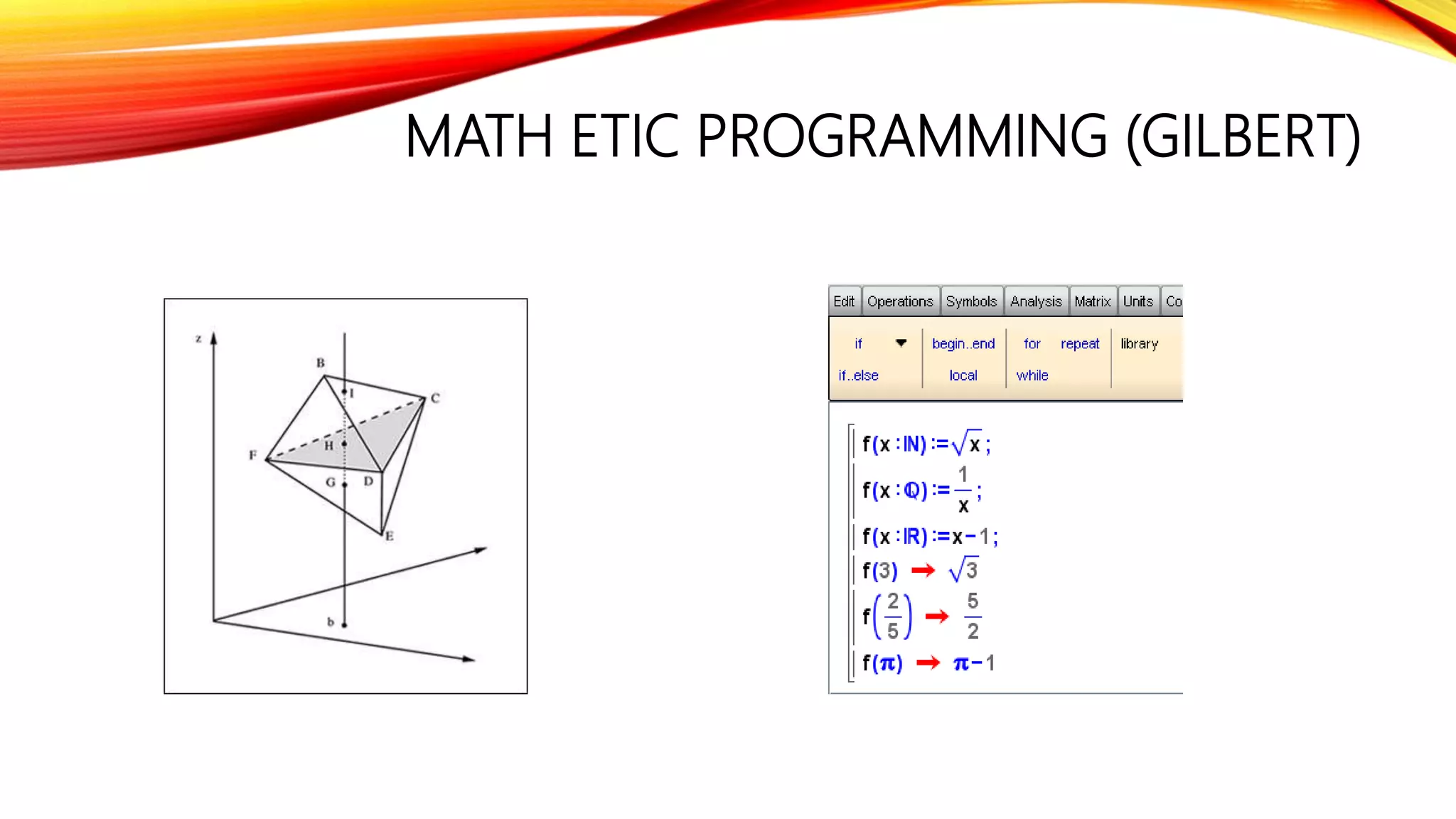
MATH ETIC PROGRAMMING (GILBERT)
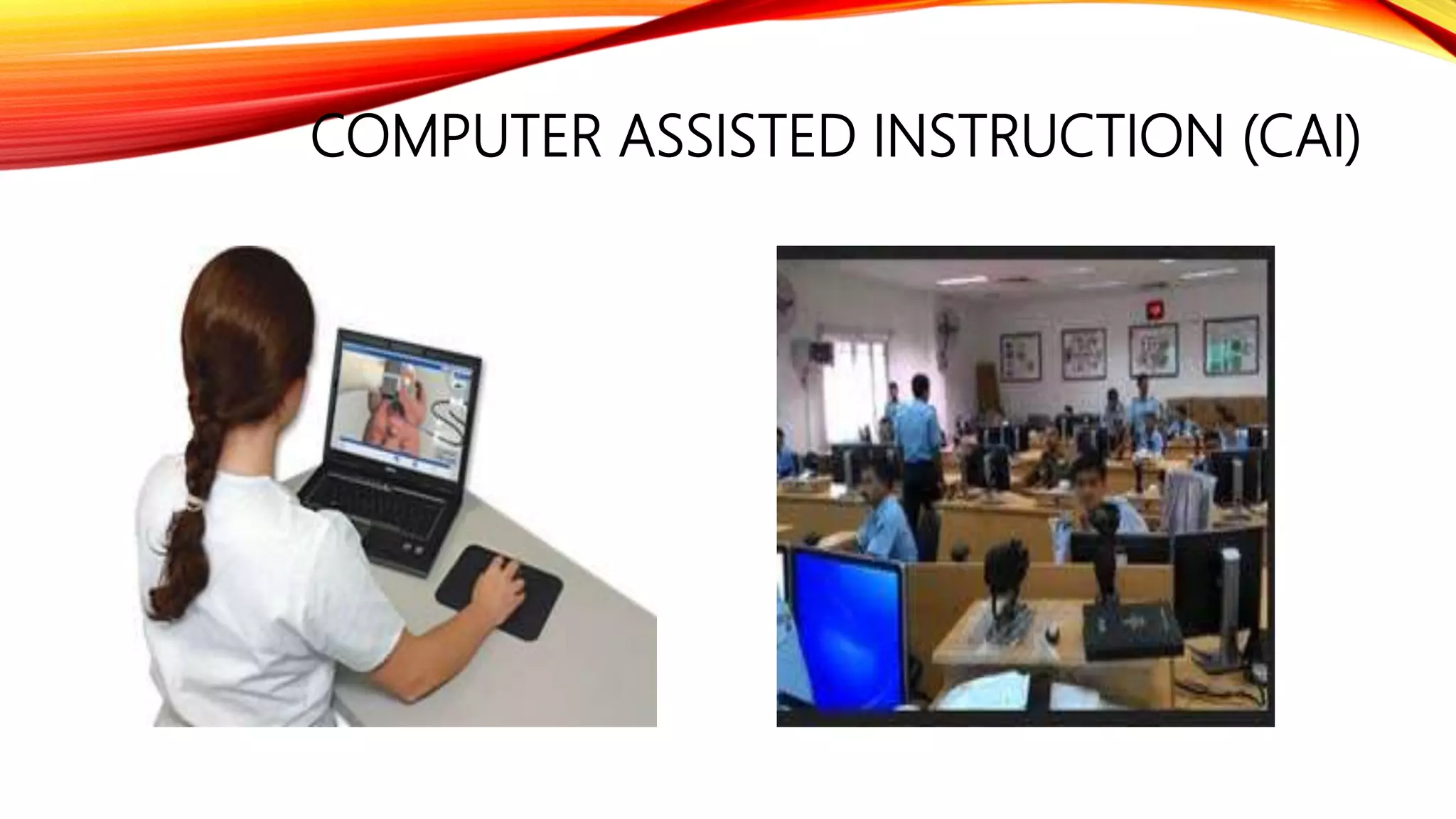
COMPUTER ASSISTED INSTRUCTION (CAI)
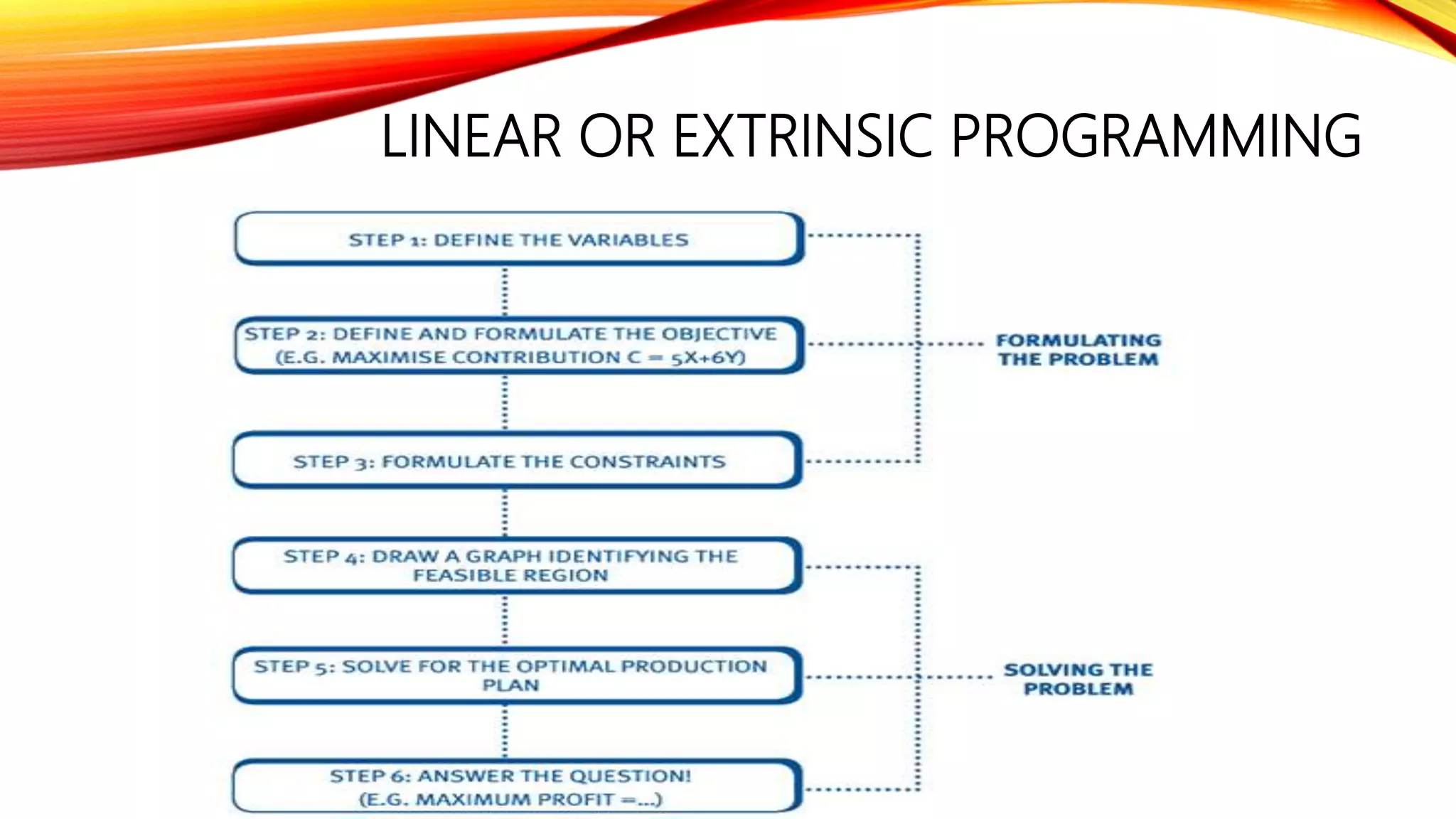
LINEAR OR EXTRINSIC PROGRAMMING
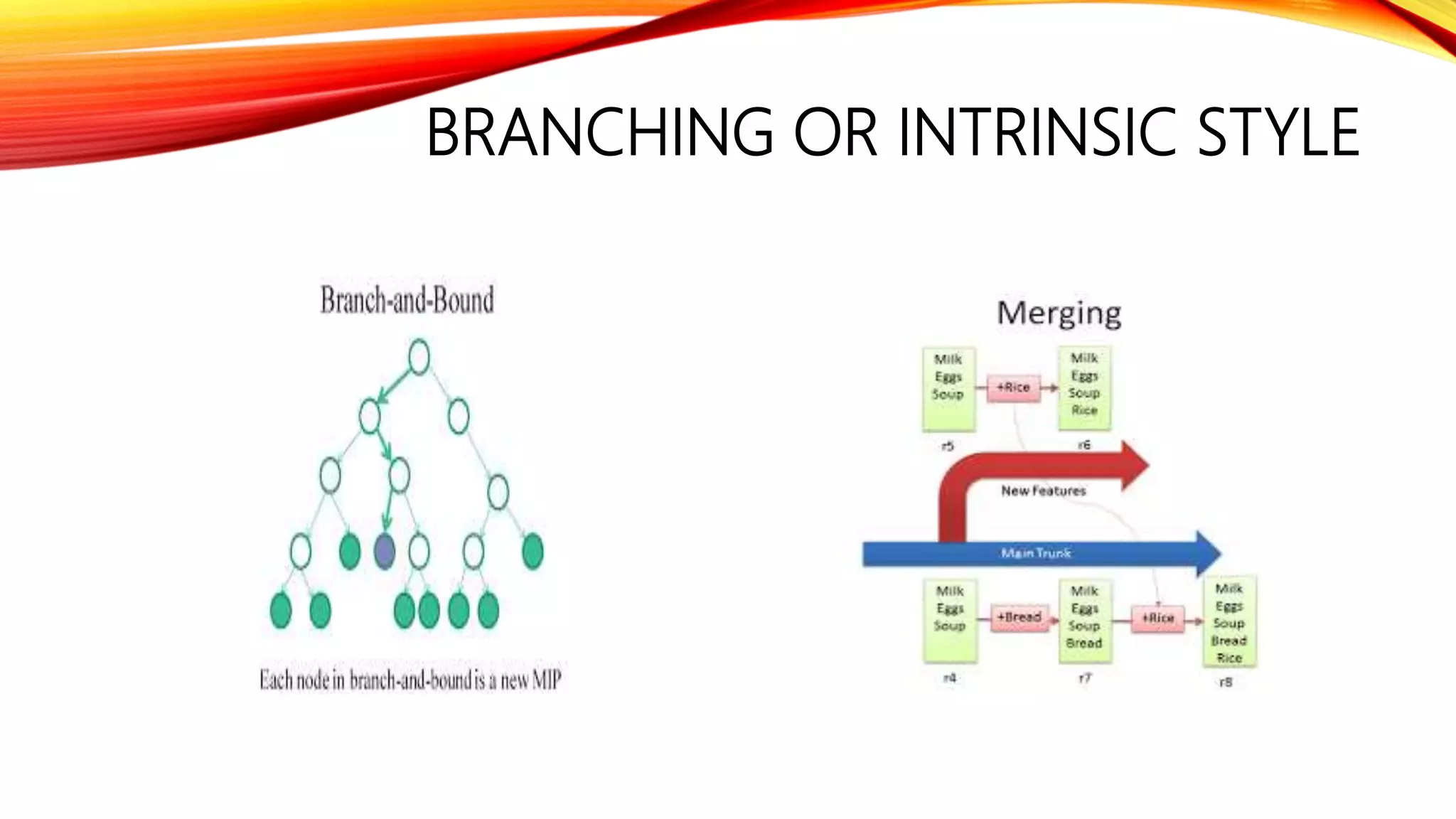
BRANCHING OR INTRINSIC STYLE
LIMITATIONS
• Guessing.
• Difficulty in praising branches.
• Diagnostic may not suit.
• Branching style can’t be used below 5th class.
• Cost effective.
• There is no guarantee that pupil has learned everything.
• The program is unable to control the student.
• Specific remedial measures is needed.
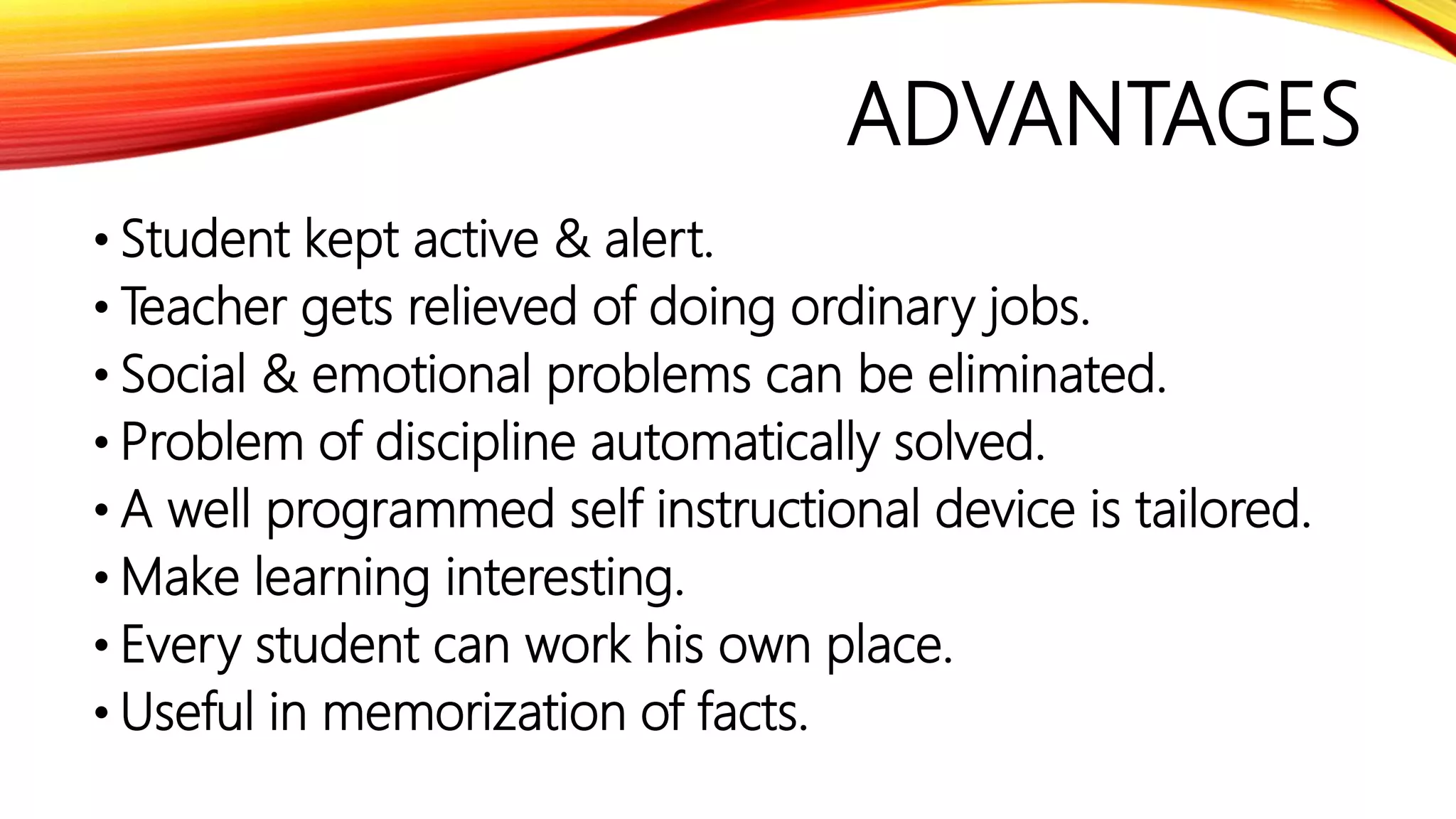
ADVANTAGES
• Student kept active & alert.
• Teacher gets relieved of doing ordinary jobs.
• Social & emotional problems can be eliminated.
• Problem of discipline automatically solved.
• A well programmed self instructional device is tailored.
• Make learning interesting.
• Every student can work his own place.
• Useful in memorization of facts.
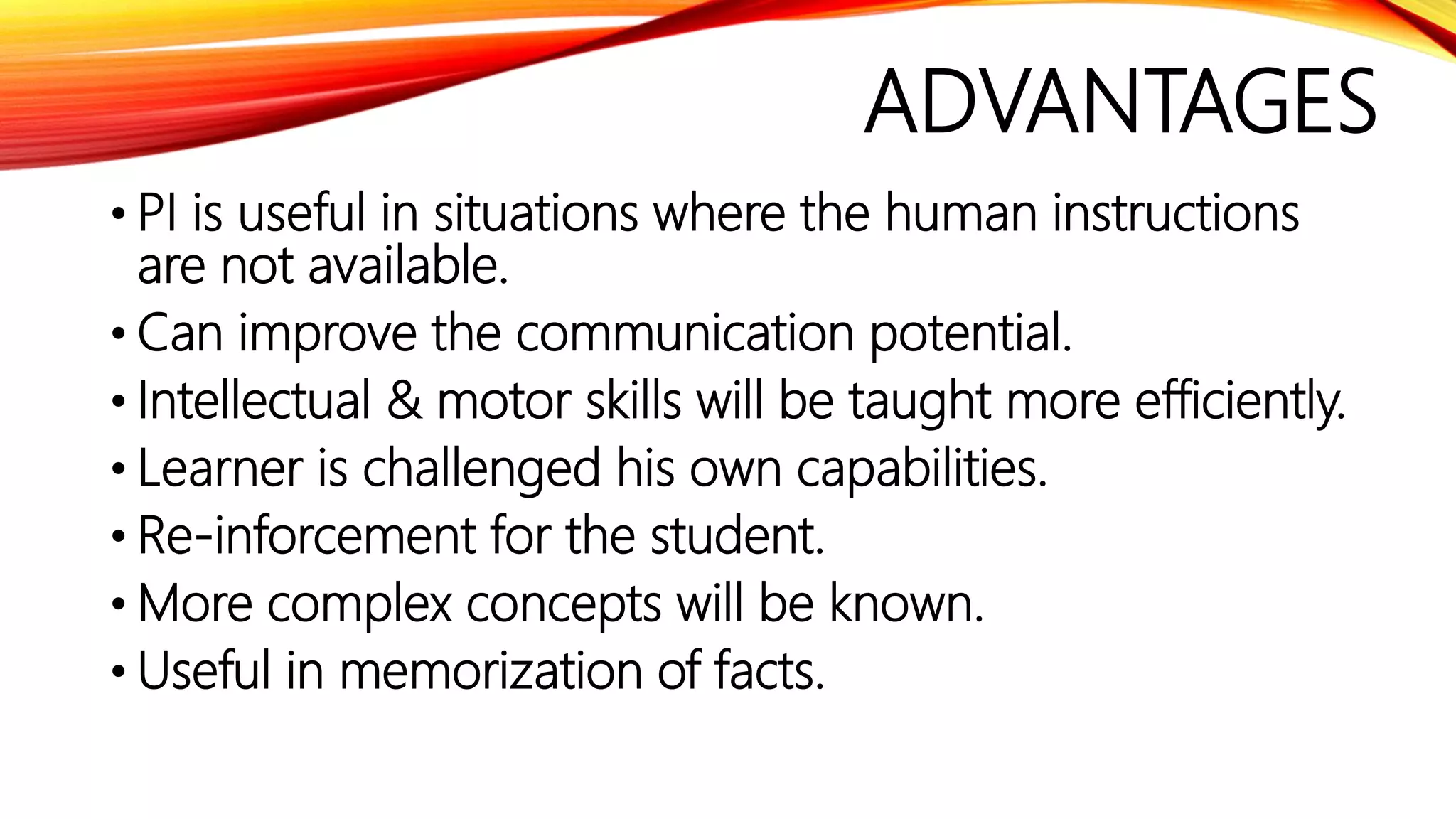
ADVANTAGES
• PI is useful in situations where the human instructions
are not available.
• Can improve the communication potential.
• Intellectual & motor skills will be taught more efficiently.
• Learner is challenged his own capabilities.
• Re-inforcement for the student.
• More complex concepts will be known.
• Useful in memorization of facts.
STEPS IN PROGRAM WRITING
• PREPARATION
• PROGRAM WRITING
• TRY OUT & REVISION
APPLICATION OF PROGRAMMED
INSTRUCTION IN EDUCATION
•Regular instruction
•Enrichment of curriculum
•Remedial instruction
•Industrial application
•Successfully introduced in certain jobs
•Correspondence course
APPLICATION OF PI IN EDUCATION
•Used in banks to train cashiers
•Modification of deviant behavior
•Vocational & Psychotherapy training
•Used to enrich the curriculum
•Improve sanitary habit of public
•Non formal education
PROBLEMS IN APPLICATION
•Quality & Quantity
•Shortage of good teachers
•Lack of good programmers
•Resistance
•Lack of funds & facilities
Programmed instruction

Programmed instruction

  • 1.
    PROGRAMMED INSTRUCTION Mrs. Gayathri R Firstyear MSc Nursing Upasana College Of Nursing
  • 2.
    DEFINITION • A processof arranging material to be learned in a series of small steps designed to lead a learner via self-instruction from what he knows to the unknown of new & more complex knowledge & principles. • “Programmed instruction is planned sequence of experiences, leading to proficiency in terms of stimulus response relationship” -James E Espich &Williams
  • 3.
    HISTORY • PI engagedout of experimental researches on operant conditioning. • PI instruction offers possibility of providing a conceptual framework. • Socrates' is the first programmer who developed program in geometry. • Gita is the first programmed text in the world. • E L Thorndike in his law of effect used programmed instruction. • Sydney L Prissy developed PI for testing the items, i.e., multiple choice question.
  • 4.
    CHARACTERISTICS •Assumptions stated clearlyin writing. •Explicitly stated objectives. •Logical sequence of small steps. •Active Responding. •Immediate feedback of information. •Individual rate. •Constant evaluation.
  • 5.
    PRINCIPLES •Objective specification. •Empirical testing. •Selfpacing. •Principles of active responding. •Student testing.
  • 6.
    DYNAMICS • Selection ofthe subject to be programmed. • The programmer list the objectives of the materials to be programmed. • Construct the item in accordance with established learning technique. • Short sequence. • Sequence can be analyzed for errors & short comings.
  • 7.
  • 8.
  • 9.
  • 10.
  • 11.
  • 12.
  • 13.
    LIMITATIONS • Guessing. • Difficultyin praising branches. • Diagnostic may not suit. • Branching style can’t be used below 5th class. • Cost effective. • There is no guarantee that pupil has learned everything. • The program is unable to control the student. • Specific remedial measures is needed.
  • 14.
    ADVANTAGES • Student keptactive & alert. • Teacher gets relieved of doing ordinary jobs. • Social & emotional problems can be eliminated. • Problem of discipline automatically solved. • A well programmed self instructional device is tailored. • Make learning interesting. • Every student can work his own place. • Useful in memorization of facts.
  • 15.
    ADVANTAGES • PI isuseful in situations where the human instructions are not available. • Can improve the communication potential. • Intellectual & motor skills will be taught more efficiently. • Learner is challenged his own capabilities. • Re-inforcement for the student. • More complex concepts will be known. • Useful in memorization of facts.
  • 16.
    STEPS IN PROGRAMWRITING • PREPARATION • PROGRAM WRITING • TRY OUT & REVISION
  • 17.
    APPLICATION OF PROGRAMMED INSTRUCTIONIN EDUCATION •Regular instruction •Enrichment of curriculum •Remedial instruction •Industrial application •Successfully introduced in certain jobs •Correspondence course
  • 18.
    APPLICATION OF PIIN EDUCATION •Used in banks to train cashiers •Modification of deviant behavior •Vocational & Psychotherapy training •Used to enrich the curriculum •Improve sanitary habit of public •Non formal education
  • 19.
    PROBLEMS IN APPLICATION •Quality& Quantity •Shortage of good teachers •Lack of good programmers •Resistance •Lack of funds & facilities