Type of programmed instruction,linear
programme instruction
meanning,assumption ,chareteristic
INTRODUCTION OF
PROGRAMMED INSTRUCTION
It was orginally introduced in the mid of 1950s by
behaviourist B.F skinnner,programmed instruction is
a system whereby the learner uses specially
prepared bookss or equipment to learn without a
teacher. It was intended to free teachers books or
burdensome drills and repetitive problem solving
inherent in teaching basic academic subject like
spelling ,arithmetic,and reading.
DEFINATION of Progrmmed
instruction
• Programmed instruction is a planned
sequene of experiences, leading to proficiency
in terms of stimulas-response relationship, that
have proven to be
effective —
J.E Espich and Bill Williams
• Programmed insruction is a method of
desighning a reproducible sequence of
instructional events to produce a measurable
and consistent effect on the behaviour of each
Characteristics of Programmed
Instruction
Programmed instruction has following
chareteristics:
1. Small steps: The subject matter is broken
down in to small steps called frames and
arranged sequentially.
2. Response: Frequent response is expected
from the student.
3. Immediate Confirmation:There is
immediate confirmation of right answer or
correction of wrong answer given by the
4) Diagnose:The content and sequence of the
frames are subjected to actual try out with
students and are revised on the basis of data
gathered by the programmer
5)Individual Pace:Each student progress at his
own pace without any threat exposed to any
humilitation in a hetrogeneous classs.
6)Clearly Stated Assumption:The assumption
about the learner is clearly stated in the
programmed learning materials
Principles of Programmed
Instruction
Fundamental principles of programmed instruction
are as follows :
1. Learners should be active: Instructors are
asking question to confirm learners
comprehension. The extent understanding is
reflected by the answers.
2. On the spot Feedbck:instructors are providing
immediate fedback to learners. As soon as they
Know if the response was right or wrong,they
proceed to the next question or they retest what
was not understood.
3. Gradual Steps: Learners should be examined
on small chunks of information, something that will
prevent them from failing a question.Learners
should feel they are making progress,something that
will encourage them.
4. SELF-Pacing:Each learnerr has his or her own
pace.Instructors should respect this diversity and
allow them to decide on the desirable speed of
learning.
5. Learner Verification: The purpose of this model
is to examine about whether learning was
established, not if the program was good based on a
specialist 's point of view .Learners should be
allowed to evaluate the instructional program under
development and instructors should modify
accordingly
Assumption of Programmed
Instruction
The programmed involves the following
assumptions:
1. Reinforcement can be provided contiously
by the use of instruction.
2. The content matter can be divided into its
elements and each element cn be
presented independently.
3. The externel learning conditions can be
created by arranging the elements in a
logical sequence.
4. The student can learn successfully without the
physical presence of a teacher.
5. The strategies and tactis of instruction can be
used for achieving certain well defned set of
instructional objectives.
6. The student can learn according to his needs and
rate of learning.
Objectives of programmed Instruction
The objectives of programmed instruction
can be listed as:
1. To help the students for learning by
doing.
2. To provide the situtaion to learn at
his/her own speed.
3. To help the student to learn without the
presence of teacher.
4. To present the matter in a logical
manner.
5. To study himself
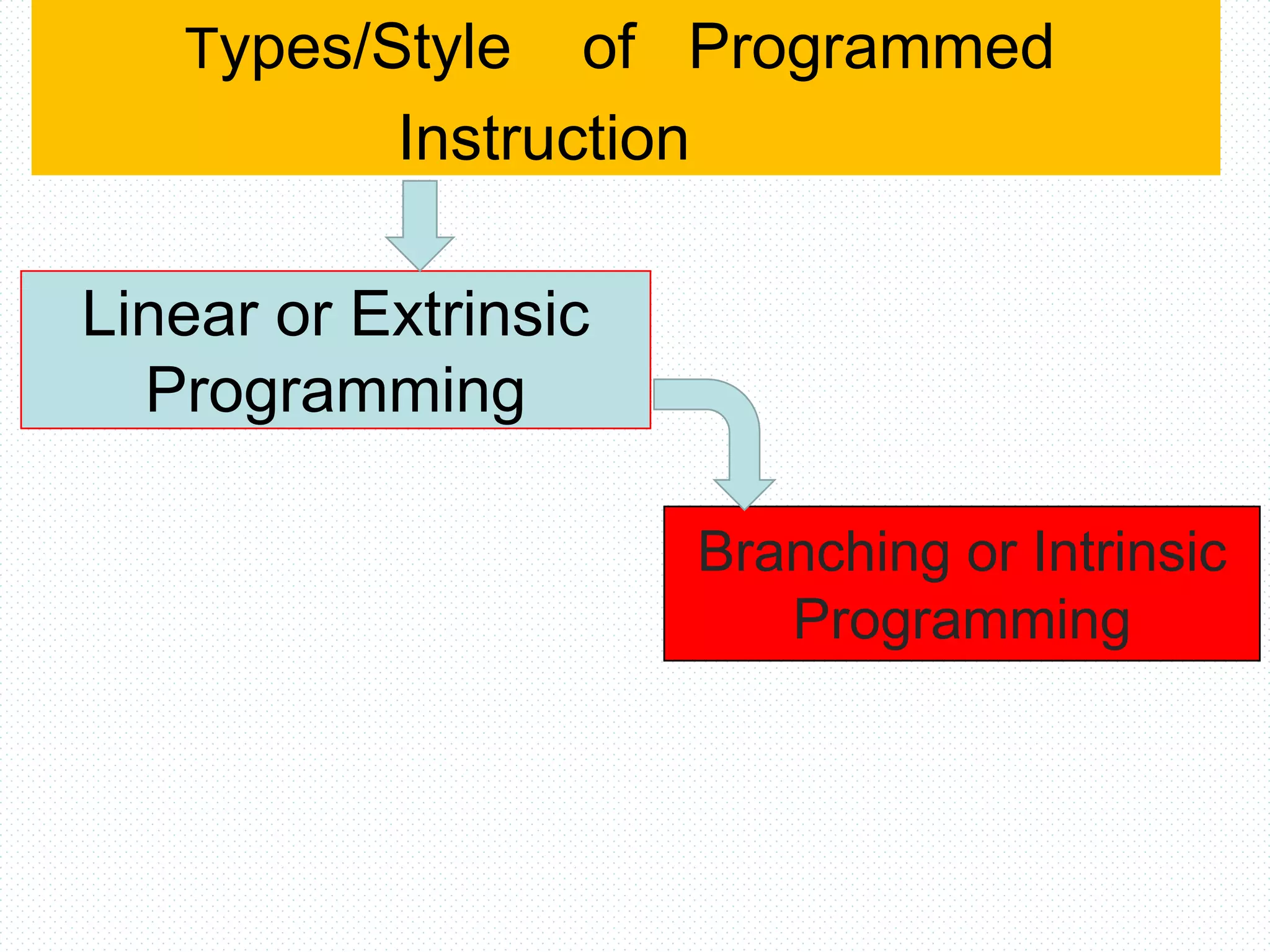
Types/Style of Programmed
Instruction
Linear or Extrinsic
Programming
Branching or Intrinsic
Programming
Charecteristic of Linear Programming
Learner are has the following charecteristics:
1. Learners are exposed to small amount of
information and proceed from one frame to
one item of information, to the next in an
orderly fashion
2. Learner responds overtly so that their correct
responses an be rewarded and heir incorrect
responses can be corrected.
3. Learners are informed immedietiely about
whether or not their response is correct
4. Learner proceeds at their self-pacing
Scope of linear Programming
Scopes are summarized below
1. Elementry Education:Generally there are
Single teacher schools there a techer is
required to tech all subjects. This strategy will
help the teachers.
2. Secondery Education:In secondary
education the diversity of interest and
curriculam necessitates this method.it may be
used as a remidial teaching.The class room
teaching may be helpful for non science
teachers to prepare for science up to high
3. Correspondence Education:
İ)For High school students:It is necessary to
realize that the self-instruction could be made
possible, if the correspondence lessons are
programmed
ii. For the School Teachers: When new course
is being introduced programmed instruction will
equip them content and new method of teaching.
Iii.For University Education: This will help the
student who are under correspondence to learn
and can be brought at the part of regular
students thus, they can maintain standard of
higher education .
THANK YOU
BRIJESH GUPTA
B.ED 1st YEAR
MODERN COLLEGE OF
PROFESSIONAL STUDIES

Type of programmed instruction, linear programmed instruction,meaning,assumption,charecteristic

  • 1.
    Type of programmedinstruction,linear programme instruction meanning,assumption ,chareteristic
  • 2.
    INTRODUCTION OF PROGRAMMED INSTRUCTION Itwas orginally introduced in the mid of 1950s by behaviourist B.F skinnner,programmed instruction is a system whereby the learner uses specially prepared bookss or equipment to learn without a teacher. It was intended to free teachers books or burdensome drills and repetitive problem solving inherent in teaching basic academic subject like spelling ,arithmetic,and reading.
  • 3.
    DEFINATION of Progrmmed instruction •Programmed instruction is a planned sequene of experiences, leading to proficiency in terms of stimulas-response relationship, that have proven to be effective — J.E Espich and Bill Williams • Programmed insruction is a method of desighning a reproducible sequence of instructional events to produce a measurable and consistent effect on the behaviour of each
  • 4.
    Characteristics of Programmed Instruction Programmedinstruction has following chareteristics: 1. Small steps: The subject matter is broken down in to small steps called frames and arranged sequentially. 2. Response: Frequent response is expected from the student. 3. Immediate Confirmation:There is immediate confirmation of right answer or correction of wrong answer given by the
  • 5.
    4) Diagnose:The contentand sequence of the frames are subjected to actual try out with students and are revised on the basis of data gathered by the programmer 5)Individual Pace:Each student progress at his own pace without any threat exposed to any humilitation in a hetrogeneous classs. 6)Clearly Stated Assumption:The assumption about the learner is clearly stated in the programmed learning materials
  • 6.
    Principles of Programmed Instruction Fundamentalprinciples of programmed instruction are as follows : 1. Learners should be active: Instructors are asking question to confirm learners comprehension. The extent understanding is reflected by the answers. 2. On the spot Feedbck:instructors are providing immediate fedback to learners. As soon as they Know if the response was right or wrong,they proceed to the next question or they retest what was not understood.
  • 7.
    3. Gradual Steps:Learners should be examined on small chunks of information, something that will prevent them from failing a question.Learners should feel they are making progress,something that will encourage them. 4. SELF-Pacing:Each learnerr has his or her own pace.Instructors should respect this diversity and allow them to decide on the desirable speed of learning. 5. Learner Verification: The purpose of this model is to examine about whether learning was established, not if the program was good based on a specialist 's point of view .Learners should be allowed to evaluate the instructional program under development and instructors should modify accordingly
  • 8.
    Assumption of Programmed Instruction Theprogrammed involves the following assumptions: 1. Reinforcement can be provided contiously by the use of instruction. 2. The content matter can be divided into its elements and each element cn be presented independently. 3. The externel learning conditions can be created by arranging the elements in a logical sequence.
  • 9.
    4. The studentcan learn successfully without the physical presence of a teacher. 5. The strategies and tactis of instruction can be used for achieving certain well defned set of instructional objectives. 6. The student can learn according to his needs and rate of learning.
  • 10.
    Objectives of programmedInstruction The objectives of programmed instruction can be listed as: 1. To help the students for learning by doing. 2. To provide the situtaion to learn at his/her own speed. 3. To help the student to learn without the presence of teacher. 4. To present the matter in a logical manner. 5. To study himself
  • 11.
    Types/Style of Programmed Instruction Linearor Extrinsic Programming Branching or Intrinsic Programming
  • 12.
    Charecteristic of LinearProgramming Learner are has the following charecteristics: 1. Learners are exposed to small amount of information and proceed from one frame to one item of information, to the next in an orderly fashion 2. Learner responds overtly so that their correct responses an be rewarded and heir incorrect responses can be corrected. 3. Learners are informed immedietiely about whether or not their response is correct 4. Learner proceeds at their self-pacing
  • 13.
    Scope of linearProgramming Scopes are summarized below 1. Elementry Education:Generally there are Single teacher schools there a techer is required to tech all subjects. This strategy will help the teachers. 2. Secondery Education:In secondary education the diversity of interest and curriculam necessitates this method.it may be used as a remidial teaching.The class room teaching may be helpful for non science teachers to prepare for science up to high
  • 14.
    3. Correspondence Education: İ)ForHigh school students:It is necessary to realize that the self-instruction could be made possible, if the correspondence lessons are programmed ii. For the School Teachers: When new course is being introduced programmed instruction will equip them content and new method of teaching. Iii.For University Education: This will help the student who are under correspondence to learn and can be brought at the part of regular students thus, they can maintain standard of higher education .
  • 15.
    THANK YOU BRIJESH GUPTA B.ED1st YEAR MODERN COLLEGE OF PROFESSIONAL STUDIES