Shallu Rana, PhD HDFS
2016HS05D
 Programmed Instruction is a research based
system which helps learners work successfully.
The method is guided by research done by a
variety of applied psychologists & educators.
 It is an educational technique characterized by
self-paced, self-administered instruction
presented in logical sequence and with much
repetition of concepts.
 Programmed instruction is based on theory that
learning in many areas is best accomplished by
small, incremental steps with immediate
reinforcement or reward for the learner.
 A method of presenting new subject matters to students
in a graded sequence of controlled steps. Students work
through the programmed material by themselves at
their own speed and after each step test their
comprehension by answering an examination question
or filling in a diagram. They are then immediately
shown the correct answer or given additional
information. Computers and other types of teaching
machines are often used to present the material,
although books may be used.
(The Columbia Encyclopedia, 6th edition)
 Smith and Moore (1962) “Programmed Instruction is a
process of arranging the material to be learned into a
series of sequential steps, usually it moves from a
familiar background into complex and set of concepts,
principles and understanding.”
 Skinner (1954) “Programmed instruction is the first
application of laboratory techniques utilized in the
study of the learning process to the practical problems
of education.”
 Conclusion: Programmed instruction is an auto-
instructional technique. The information is provided in
small steps and each learner progress at his/her own
speed.
 The main focus of programmed instruction is to
bring desirable change in cognitive domain of
learner’s behaviour. The main objectives of
programmed instruction are:
 To help the students in learning by doing.
 To provide the learners situation, so that they can
learn at their own pace.
 To help students to learn in the absence of a
teacher.
 To help students in assessing their own
performance themselves, by comparing it with
the given answers.
 Selected content is analyzed and broken into
smaller elements. Each element is independent
and complete in itself.
 The programmer develops frames based on
each element. Responses are also provided to
learner, correct response of the learner is the
new knowledge or new behaviour.
 It is not an audio visual device. It is a part of
instructional technology.
 It is a method of giving or receiving
individualized instructions. It keeps in view
their individual differences. The learner moves
at his/her own speed.
 It clearly defines the entering and terminal
behaviour of learners.
 It is systematic and sequenced.
 It provides immediate feedback to learners.
 Principle of small steps
 Principle of active responding
 Principle of immediate reinforcement
 Principle of Self-Pacing
 Principle of Continuous Evaluation
 Software based-
a. Linear
b. Branching
c. Mathetics
 Hardware based-
a. Learner Controlled Instruction
b. Computer Assisted Instruction
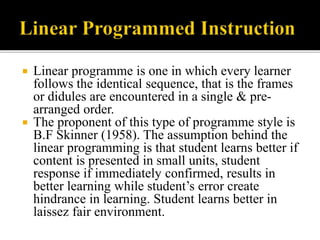
 Linear programme is one in which every learner
follows the identical sequence, that is the frames
or didules are encountered in a single & pre-
arranged order.
 The proponent of this type of programme style is
B.F Skinner (1958). The assumption behind the
linear programming is that student learns better if
content is presented in small units, student
response if immediately confirmed, results in
better learning while student’s error create
hindrance in learning. Student learns better in
laissez fair environment.
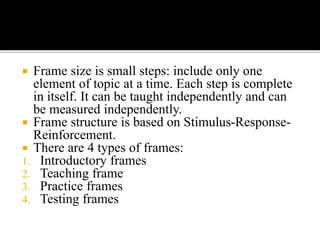
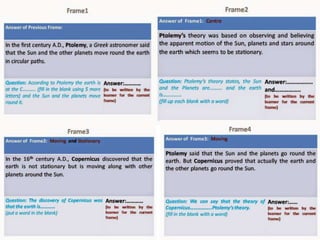
 Frame size is small steps: include only one
element of topic at a time. Each step is complete
in itself. It can be taught independently and can
be measured independently.
 Frame structure is based on Stimulus-Response-
Reinforcement.
 There are 4 types of frames:
1. Introductory frames
2. Teaching frame
3. Practice frames
4. Testing frames
 Founded by Norman A Crowder
 Based on “Configuration theory of learning”
 Branching means “subdivision of stem or
trunk”
 It is similar to linear programmed learning
except that it is more complicated because it
attempts to diagnose the learner’s response.
It usually involves the multi-choice format.
 After the learners have been presented a
certain amount of information, they are given
a multiple-choice questions. If they answer
correctly they branch to the next body of
information. If incorrect, they are directed to
additional information, depending on the
mistake they made.
 Principle of Exposition
 Principle of diagnosis
 Principle of remediation
 Thomas F. Gilbert (1962) is the originator of the
concept of mathematics programmed instruction.
 It is defined as a systematic application of
reinforcement theory to the analysis and construction
of complex repertoires which represent the mastery in
subject matter.
 It is based on “Connectivist theory of Learning”
 It is a reverse chaining approach based on chaining,
discrimination and generalization.
 E.g. if 3X4=12, 12 is product then 3&4 are called=?,
page-15(quotients), page-29(factors), page-
43(powers)
 Main emphasis is on change in cognitive
domain not in behavioral change.
 It doesn’t consider learning process whether
learning is taking place or not. Main emphasis
is on diagnosing the weakness of learners &
providing remedy to them.
 More emphasis is on remediation rather than
teaching. Hence, it is only tutorial approach.

Programmed instruction

  • 1.
    Shallu Rana, PhDHDFS 2016HS05D
  • 2.
     Programmed Instructionis a research based system which helps learners work successfully. The method is guided by research done by a variety of applied psychologists & educators.  It is an educational technique characterized by self-paced, self-administered instruction presented in logical sequence and with much repetition of concepts.  Programmed instruction is based on theory that learning in many areas is best accomplished by small, incremental steps with immediate reinforcement or reward for the learner.
  • 3.
     A methodof presenting new subject matters to students in a graded sequence of controlled steps. Students work through the programmed material by themselves at their own speed and after each step test their comprehension by answering an examination question or filling in a diagram. They are then immediately shown the correct answer or given additional information. Computers and other types of teaching machines are often used to present the material, although books may be used. (The Columbia Encyclopedia, 6th edition)
  • 4.
     Smith andMoore (1962) “Programmed Instruction is a process of arranging the material to be learned into a series of sequential steps, usually it moves from a familiar background into complex and set of concepts, principles and understanding.”  Skinner (1954) “Programmed instruction is the first application of laboratory techniques utilized in the study of the learning process to the practical problems of education.”  Conclusion: Programmed instruction is an auto- instructional technique. The information is provided in small steps and each learner progress at his/her own speed.
  • 5.
     The mainfocus of programmed instruction is to bring desirable change in cognitive domain of learner’s behaviour. The main objectives of programmed instruction are:  To help the students in learning by doing.  To provide the learners situation, so that they can learn at their own pace.  To help students to learn in the absence of a teacher.  To help students in assessing their own performance themselves, by comparing it with the given answers.
  • 6.
     Selected contentis analyzed and broken into smaller elements. Each element is independent and complete in itself.  The programmer develops frames based on each element. Responses are also provided to learner, correct response of the learner is the new knowledge or new behaviour.
  • 7.
     It isnot an audio visual device. It is a part of instructional technology.  It is a method of giving or receiving individualized instructions. It keeps in view their individual differences. The learner moves at his/her own speed.  It clearly defines the entering and terminal behaviour of learners.  It is systematic and sequenced.  It provides immediate feedback to learners.
  • 8.
     Principle ofsmall steps  Principle of active responding  Principle of immediate reinforcement  Principle of Self-Pacing  Principle of Continuous Evaluation
  • 9.
     Software based- a.Linear b. Branching c. Mathetics  Hardware based- a. Learner Controlled Instruction b. Computer Assisted Instruction
  • 10.
     Linear programmeis one in which every learner follows the identical sequence, that is the frames or didules are encountered in a single & pre- arranged order.  The proponent of this type of programme style is B.F Skinner (1958). The assumption behind the linear programming is that student learns better if content is presented in small units, student response if immediately confirmed, results in better learning while student’s error create hindrance in learning. Student learns better in laissez fair environment.
  • 11.
     Frame sizeis small steps: include only one element of topic at a time. Each step is complete in itself. It can be taught independently and can be measured independently.  Frame structure is based on Stimulus-Response- Reinforcement.  There are 4 types of frames: 1. Introductory frames 2. Teaching frame 3. Practice frames 4. Testing frames
  • 13.
     Founded byNorman A Crowder  Based on “Configuration theory of learning”  Branching means “subdivision of stem or trunk”  It is similar to linear programmed learning except that it is more complicated because it attempts to diagnose the learner’s response. It usually involves the multi-choice format.
  • 14.
     After thelearners have been presented a certain amount of information, they are given a multiple-choice questions. If they answer correctly they branch to the next body of information. If incorrect, they are directed to additional information, depending on the mistake they made.
  • 15.
     Principle ofExposition  Principle of diagnosis  Principle of remediation
  • 16.
     Thomas F.Gilbert (1962) is the originator of the concept of mathematics programmed instruction.  It is defined as a systematic application of reinforcement theory to the analysis and construction of complex repertoires which represent the mastery in subject matter.  It is based on “Connectivist theory of Learning”  It is a reverse chaining approach based on chaining, discrimination and generalization.  E.g. if 3X4=12, 12 is product then 3&4 are called=?, page-15(quotients), page-29(factors), page- 43(powers)
  • 17.
     Main emphasisis on change in cognitive domain not in behavioral change.  It doesn’t consider learning process whether learning is taking place or not. Main emphasis is on diagnosing the weakness of learners & providing remedy to them.  More emphasis is on remediation rather than teaching. Hence, it is only tutorial approach.