UNIT: TWO
PROCESS PLANNING METHODS
Outlines
 Introduction
 Approaches to process planning
 Manual process planning
 Computer-aided process planning
 Manufacturing processes and selection
 Process and operation sequencing
By:- zelalem Girmaw
Email:- zgirmaw19@gmail.com
Brain storming
What are the approaches to process planning?
 When manual process planning is preferable?, Why?
How process and operation sequencing is performed?
Introduction approaches to process planning
 Process planning is also called: manufacturing planning, process planning,
material processing, process engineering, and machine routing.
The act of preparing detailed work instructions to produce a part.
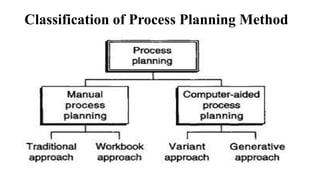
There are two basic methods employed in process planning and these are manual
process planning and computer-aided process planning (CAPP).
Manual process planning can be broken down further into two distinct
approaches
 Traditional approach
 Workbook approach
Computer aided process planning can be divide into two
variant CAPP
generative CAPP
Classification of Process Planning Method
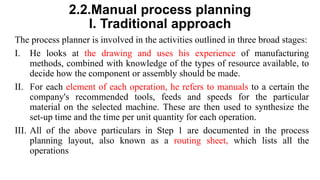
2.2.Manual process planning
I. Traditional approach
The process planner is involved in the activities outlined in three broad stages:
I. He looks at the drawing and uses his experience of manufacturing
methods, combined with knowledge of the types of resource available, to
decide how the component or assembly should be made.
II. For each element of each operation, he refers to manuals to a certain the
company's recommended tools, feeds and speeds for the particular
material on the selected machine. These are then used to synthesize the
set-up time and the time per unit quantity for each operation.
III. All of the above particulars in Step 1 are documented in the process
planning layout, also known as a routing sheet, which lists all the
operations
II. Workbook approach
 Derivative of the traditional approach is the workbook approach. This is
considered a more efficient approach to process planning. It involves
developing workbooks of pre-determined sequences of operations for
given types of work pieces. After having carried out the drawing
interpretation and identified the manufacturing processes required, the pre-
determined sequence of operations can be selected from the workbook and
incorporated into the process plan.
Bill of document
Product structure tree
Bicycle(1)
P/N 1000
Handle Bars (1)
P/N 1001
Frame Assembly (1)
P/N 1002
Wheels (2)
P/N 1003
Frame (1)
P/N 1004
General guidelines for manual process planning
• In a conventional manufacturing environment, process planning is carried out
manually. As detailed previously, the first step is the analysis of the
engineering drawings of the part in order to determine the appropriate
processes required to produce it. The previous experience of the planner is
crucial to the success of the planning. Manual planning can be considered as
much an art as it is a formal procedure.
The general guidelines…
1.Establish one datum as soon as processing common and using this as a
reference for all subsequent operations;
2. Create as many surfaces as possible at the same setting (i.e. without
clamping and unclamping) to maximize dimensional accuracy;
3. Avoid the use of secondary surface data as much as possible;
4. Precision operations, for example, those producing high-quality surface
finishes, should be carried out last to reduce the possibility of damage;
5. Inspection operations should be included at appropriate intervals to
minimize scrap and rework.
6.Adhering to these general guidelines should ensure that the process plan is
constructed in a logical manner.
Advantages and disadvantages of manual
process planning
The only real advantages of manual process planning are that it is a low-cost task
and is flexible, in terms that the system can be changed easily.
 However, there are a number of distinct disadvantages:
• Excessive clerical content- the paperwork generated by manual process planning is
excessive. It is also very labor intensive due to the excessive paperwork.
• Lack of consistency in planning - there are many ways to manufacture even the
simplest of components. The plan developed for any given component will reflect
the process planner's knowledge and experience, and different planners might
manufacture the same part completely differently.
• Late design modifications - increasing, design changes are required late in the
design and manufacture cycle and manual process planning is not very responsive
to these changes.
• Changing technology- in the rapidly changing manufacturing environment, new
processes, tooling and materials are being introduced more frequently. Again,
manual process planning is not very responsive to these changes.
Computer-aided process planning
Considering the disadvantages listed above for manual process planning,
some advantages of a CAPP systems are considered to be;
1. Less time spent on process planning;
2. Less reliance on the knowledge and experience of the process planner;
3. More efficient use of manufacturing resources leading to improvements in
costs;
4. Improved productivity;
5. Improved accuracy and consistency of process plans there are two basic
approaches to CAPP, namely variant and generative.
I. Variant approach
• This approach to CAPP is similar to the manual approach as it retrieves a
standard plan and modifies it to suit for a given part. The standard plan is
usually for a composite part that incorporates all the features for a particular
group or family of parts. The parts are usually grouped according to how they
are made using a GT classification and coding system. The process plan for the
part under consideration is compiled by retrieving those parts of the standard
plan that are relevant. Thus, the variant approach is also known as the retrieval
method. Although popular in industry due to their relative ease of
implementation and use, the major disadvantage of variant systems is that plans
can be developed only for parts that have previously been classified as one of
the part families.
II. Generative approach
This approach to CAPP is based on developing a completely new plan for every
part. These plans are produced by the computer by means of decision logic,
formulae, algorithms and geometric analysis.
1.A part description that defines the geometry including geometric and dimensional
tolerances and surface finish specifications;
2. A subsystem that defines the process parameters based on reference data and
process analysis;
3. A subsystem that identifies and sequences the individual operations using the means
described above;
4. A database of information on the production equipment available;
5. A report generator to produce the process plan.
The first three components are, generally, the areas that require human intervention as
existing means of part representation require additional information input and because
the other two are such complex tasks. Finally, the implementation and development of
such systems tends to be time consuming and expensive.
Process selection
Factors that are common to both the material and process selection decisions:
1. Number of components to be made;
2. Component size;
3. Component weight;
4. Precision required;
5. Surface finish and appearance required
Thus, the combination of material and process will have a significant bearing on
the quality of the part and thus the process selected must be appropriate for the
material.
General guidelines for process selection
1. Select a process capable of providing the specified dimensional/
geometric accuracy and surface finish.
2. Specify the widest possible tolerances and surface finish variation for
products to allow the widest possible choice of manufacturing processes.
3. Use prototypes as much as possible, taking into consideration the
variation in performance of methods used to manufacture a one-off
compared with volume manufacturing.
4. Carry out a detailed comparison of candidate processes early in the design
process, paying particular attention to the variation in assembly costs for
different processes
Process selection method
process selection method is required to help make the approach to process
selection more systematic.
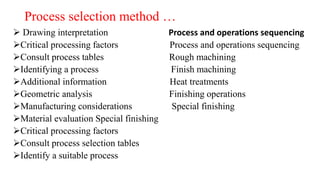
Process selection method …
 Drawing interpretation Process and operations sequencing
Critical processing factors Process and operations sequencing
Consult process tables Rough machining
Identifying a process Finish machining
Additional information Heat treatments
Geometric analysis Finishing operations
Manufacturing considerations Special finishing
Material evaluation Special finishing
Critical processing factors
Consult process selection tables
Identify a suitable process
UNIT THREE: PRODUCT COST ESTIMATION
AND COSTING
Quiz -2-
1.What is process planning approach?
2. Define process approach method
3.What is the advantage and disadvantage of traditional and capp?

Process planning unit two

  • 1.
    UNIT: TWO PROCESS PLANNINGMETHODS Outlines  Introduction  Approaches to process planning  Manual process planning  Computer-aided process planning  Manufacturing processes and selection  Process and operation sequencing By:- zelalem Girmaw Email:- zgirmaw19@gmail.com
  • 2.
    Brain storming What arethe approaches to process planning?  When manual process planning is preferable?, Why? How process and operation sequencing is performed?
  • 3.
    Introduction approaches toprocess planning  Process planning is also called: manufacturing planning, process planning, material processing, process engineering, and machine routing. The act of preparing detailed work instructions to produce a part. There are two basic methods employed in process planning and these are manual process planning and computer-aided process planning (CAPP). Manual process planning can be broken down further into two distinct approaches  Traditional approach  Workbook approach Computer aided process planning can be divide into two variant CAPP generative CAPP
  • 4.
  • 5.
    2.2.Manual process planning I.Traditional approach The process planner is involved in the activities outlined in three broad stages: I. He looks at the drawing and uses his experience of manufacturing methods, combined with knowledge of the types of resource available, to decide how the component or assembly should be made. II. For each element of each operation, he refers to manuals to a certain the company's recommended tools, feeds and speeds for the particular material on the selected machine. These are then used to synthesize the set-up time and the time per unit quantity for each operation. III. All of the above particulars in Step 1 are documented in the process planning layout, also known as a routing sheet, which lists all the operations
  • 6.
    II. Workbook approach Derivative of the traditional approach is the workbook approach. This is considered a more efficient approach to process planning. It involves developing workbooks of pre-determined sequences of operations for given types of work pieces. After having carried out the drawing interpretation and identified the manufacturing processes required, the pre- determined sequence of operations can be selected from the workbook and incorporated into the process plan.
  • 7.
    Bill of document Productstructure tree Bicycle(1) P/N 1000 Handle Bars (1) P/N 1001 Frame Assembly (1) P/N 1002 Wheels (2) P/N 1003 Frame (1) P/N 1004
  • 8.
    General guidelines formanual process planning • In a conventional manufacturing environment, process planning is carried out manually. As detailed previously, the first step is the analysis of the engineering drawings of the part in order to determine the appropriate processes required to produce it. The previous experience of the planner is crucial to the success of the planning. Manual planning can be considered as much an art as it is a formal procedure.
  • 9.
    The general guidelines… 1.Establishone datum as soon as processing common and using this as a reference for all subsequent operations; 2. Create as many surfaces as possible at the same setting (i.e. without clamping and unclamping) to maximize dimensional accuracy; 3. Avoid the use of secondary surface data as much as possible; 4. Precision operations, for example, those producing high-quality surface finishes, should be carried out last to reduce the possibility of damage; 5. Inspection operations should be included at appropriate intervals to minimize scrap and rework. 6.Adhering to these general guidelines should ensure that the process plan is constructed in a logical manner.
  • 10.
    Advantages and disadvantagesof manual process planning The only real advantages of manual process planning are that it is a low-cost task and is flexible, in terms that the system can be changed easily.  However, there are a number of distinct disadvantages: • Excessive clerical content- the paperwork generated by manual process planning is excessive. It is also very labor intensive due to the excessive paperwork. • Lack of consistency in planning - there are many ways to manufacture even the simplest of components. The plan developed for any given component will reflect the process planner's knowledge and experience, and different planners might manufacture the same part completely differently. • Late design modifications - increasing, design changes are required late in the design and manufacture cycle and manual process planning is not very responsive to these changes. • Changing technology- in the rapidly changing manufacturing environment, new processes, tooling and materials are being introduced more frequently. Again, manual process planning is not very responsive to these changes.
  • 11.
    Computer-aided process planning Consideringthe disadvantages listed above for manual process planning, some advantages of a CAPP systems are considered to be; 1. Less time spent on process planning; 2. Less reliance on the knowledge and experience of the process planner; 3. More efficient use of manufacturing resources leading to improvements in costs; 4. Improved productivity; 5. Improved accuracy and consistency of process plans there are two basic approaches to CAPP, namely variant and generative.
  • 12.
    I. Variant approach •This approach to CAPP is similar to the manual approach as it retrieves a standard plan and modifies it to suit for a given part. The standard plan is usually for a composite part that incorporates all the features for a particular group or family of parts. The parts are usually grouped according to how they are made using a GT classification and coding system. The process plan for the part under consideration is compiled by retrieving those parts of the standard plan that are relevant. Thus, the variant approach is also known as the retrieval method. Although popular in industry due to their relative ease of implementation and use, the major disadvantage of variant systems is that plans can be developed only for parts that have previously been classified as one of the part families.
  • 13.
    II. Generative approach Thisapproach to CAPP is based on developing a completely new plan for every part. These plans are produced by the computer by means of decision logic, formulae, algorithms and geometric analysis. 1.A part description that defines the geometry including geometric and dimensional tolerances and surface finish specifications; 2. A subsystem that defines the process parameters based on reference data and process analysis; 3. A subsystem that identifies and sequences the individual operations using the means described above; 4. A database of information on the production equipment available; 5. A report generator to produce the process plan. The first three components are, generally, the areas that require human intervention as existing means of part representation require additional information input and because the other two are such complex tasks. Finally, the implementation and development of such systems tends to be time consuming and expensive.
  • 14.
    Process selection Factors thatare common to both the material and process selection decisions: 1. Number of components to be made; 2. Component size; 3. Component weight; 4. Precision required; 5. Surface finish and appearance required Thus, the combination of material and process will have a significant bearing on the quality of the part and thus the process selected must be appropriate for the material.
  • 15.
    General guidelines forprocess selection 1. Select a process capable of providing the specified dimensional/ geometric accuracy and surface finish. 2. Specify the widest possible tolerances and surface finish variation for products to allow the widest possible choice of manufacturing processes. 3. Use prototypes as much as possible, taking into consideration the variation in performance of methods used to manufacture a one-off compared with volume manufacturing. 4. Carry out a detailed comparison of candidate processes early in the design process, paying particular attention to the variation in assembly costs for different processes Process selection method process selection method is required to help make the approach to process selection more systematic.
  • 17.
    Process selection method…  Drawing interpretation Process and operations sequencing Critical processing factors Process and operations sequencing Consult process tables Rough machining Identifying a process Finish machining Additional information Heat treatments Geometric analysis Finishing operations Manufacturing considerations Special finishing Material evaluation Special finishing Critical processing factors Consult process selection tables Identify a suitable process
  • 18.
    UNIT THREE: PRODUCTCOST ESTIMATION AND COSTING Quiz -2- 1.What is process planning approach? 2. Define process approach method 3.What is the advantage and disadvantage of traditional and capp?