CHIPS
CONTENTS
• Introduction
• Mechanism of chip formation
• Factors for chip types
• Types of chips
• Chip Breakers
INTRODUCTION
 Metal cutting or machining is the process of producing workpiece by
removing unwanted material from a block of metal, in the form of
chips.
 This process is most important because almost all products get their
final shape and size directly or indirectly by machining.
 Its major drawback is that in this process there is a lot of material lost
in the form of chips.
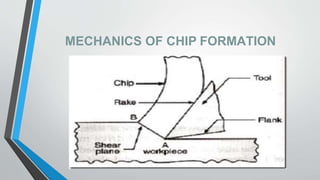
MECHANICS OF CHIP FORMATION
 A wedge shaped tool is made to move relative to theworkpiece.
 As the tool makes contact with the workpiece it exerts pressure on it
resulting in compression of the metal near the tool tip.
 This induces shear – type deformation within the metal and it starts
moving upward along the face of the tool.
 As the tool advances this process of shearing goes on increasing and
material is removed.
MECHANICS OF CHIP FORMATION
CHIP FORMATION IN DUCTILE MATERIALS
• As the tool makes contact with the workpiece it
Results in exerting pressure on the
material in front of it.
CHIP FORMATION IN BRITTLE MATERIALS
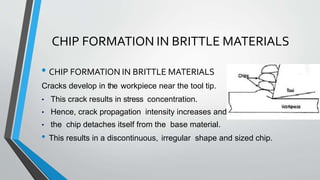
• CHIP FORMATION IN BRITTLE MATERIALS
Cracks develop in the workpiece near the tool tip.
• This crack results in stress concentration.
• Hence, crack propagation intensity increases and
• the chip detaches itself from the base material.
• This results in a discontinuous, irregular shape and sized chip.
FACTORS FOR CHIPTYPES
• Nature of work piece
• Nature of tool
• Dimension of tool
• Feed rate
• Cutting speed
• Cutting environment like temperature, friction, etc
• Friction between tool and work piece.
CHIPS TYPES
 Continuous chips
 Discontinuous chips
 Continuous chips with built up edges (BUE)
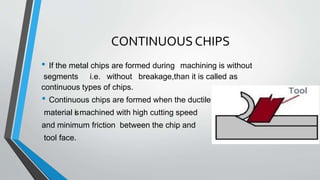
CONTINUOUSCHIPS
• If the metal chips are formed during machining is without
segments i.e. without breakage,than it is called as
continuous types of chips.
• Continuous chips are formed when the ductile
material ismachined with high cutting speed
and minimum friction between the chip and
tool face.
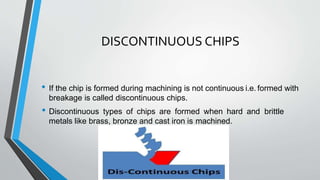
DISCONTINUOUS CHIPS
• If the chip is formed during machining is not continuous i.e. formed with
breakage is called discontinuous chips.
• Discontinuous types of chips are formed when hard and brittle
metals like brass, bronze and cast iron is machined.
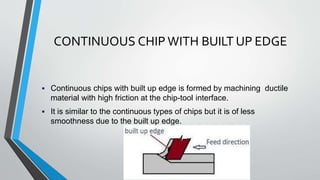
CONTINUOUS CHIP WITH BUILT UP EDGE
 Continuous chips with built up edge is formed by machining ductile
material with high friction at the chip-tool interface.
 It is similar to the continuous types of chips but it is of less
smoothness due to the built up edge.

Chips formation

  • 1.
  • 2.
    CONTENTS • Introduction • Mechanismof chip formation • Factors for chip types • Types of chips • Chip Breakers
  • 3.
    INTRODUCTION  Metal cuttingor machining is the process of producing workpiece by removing unwanted material from a block of metal, in the form of chips.  This process is most important because almost all products get their final shape and size directly or indirectly by machining.  Its major drawback is that in this process there is a lot of material lost in the form of chips.
  • 4.
    MECHANICS OF CHIPFORMATION  A wedge shaped tool is made to move relative to theworkpiece.  As the tool makes contact with the workpiece it exerts pressure on it resulting in compression of the metal near the tool tip.  This induces shear – type deformation within the metal and it starts moving upward along the face of the tool.  As the tool advances this process of shearing goes on increasing and material is removed.
  • 5.
  • 6.
    CHIP FORMATION INDUCTILE MATERIALS • As the tool makes contact with the workpiece it Results in exerting pressure on the material in front of it.
  • 7.
    CHIP FORMATION INBRITTLE MATERIALS • CHIP FORMATION IN BRITTLE MATERIALS Cracks develop in the workpiece near the tool tip. • This crack results in stress concentration. • Hence, crack propagation intensity increases and • the chip detaches itself from the base material. • This results in a discontinuous, irregular shape and sized chip.
  • 8.
    FACTORS FOR CHIPTYPES •Nature of work piece • Nature of tool • Dimension of tool • Feed rate • Cutting speed • Cutting environment like temperature, friction, etc • Friction between tool and work piece.
  • 9.
    CHIPS TYPES  Continuouschips  Discontinuous chips  Continuous chips with built up edges (BUE)
  • 10.
    CONTINUOUSCHIPS • If themetal chips are formed during machining is without segments i.e. without breakage,than it is called as continuous types of chips. • Continuous chips are formed when the ductile material ismachined with high cutting speed and minimum friction between the chip and tool face.
  • 11.
    DISCONTINUOUS CHIPS • Ifthe chip is formed during machining is not continuous i.e. formed with breakage is called discontinuous chips. • Discontinuous types of chips are formed when hard and brittle metals like brass, bronze and cast iron is machined.
  • 12.
    CONTINUOUS CHIP WITHBUILT UP EDGE  Continuous chips with built up edge is formed by machining ductile material with high friction at the chip-tool interface.  It is similar to the continuous types of chips but it is of less smoothness due to the built up edge.