Computer aided process planning
Submitted to- Amit Pancharya
(Associate Professor, MNIT)
Submitted by- Maheshvar Nath Trivedi
(2019PPE5070)
Rajendra Prasad
(2019PPE5002)
Introduction
• A process is described as a set of steps that result in specific
outcome.
– It converts input into output.
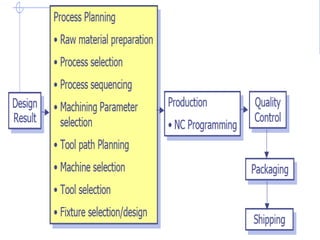
• Process Planning is a complete description of specific stages
in the production process.
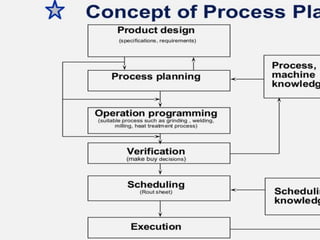
• Process planning converts design information into the
process steps and instructions to powerfully and effectively
manufacture products.
• All the specifications and conditions of operations are included
in the process plan.
• Process planning influences time to market and productions
cost
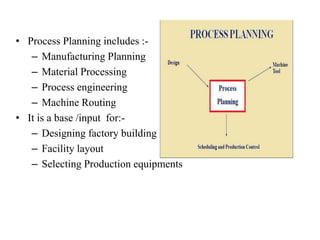
• Process Planning includes :-
– Manufacturing Planning
– Material Processing
– Process engineering
– Machine Routing
• It is a base /input for:-
– Designing factory building
– Facility layout
– Selecting Production equipments
26/04/2020
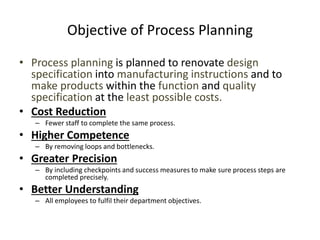
Objective of Process Planning
• Process planning is planned to renovate design
specification into manufacturing instructions and to
make products within the function and quality
specification at the least possible costs.
• Cost Reduction
– Fewer staff to complete the same process.
• Higher Competence
– By removing loops and bottlenecks.
• Greater Precision
– By including checkpoints and success measures to make sure process steps are
completed precisely.
• Better Understanding
– All employees to fulfil their department objectives.
Objective of Process Planning
• Process planning is planned to renovate design
specification into manufacturing instructions and to
make products within the function and quality
specification at the least possible costs.
• Cost Reduction
– Fewer staff to complete the same process.
• Higher Competence
– By removing loops and bottlenecks.
• Greater Precision
– By including checkpoints and success measures to make sure process steps are
completed precisely.
• Better Understanding
– All employees to fulfil their department objectives.
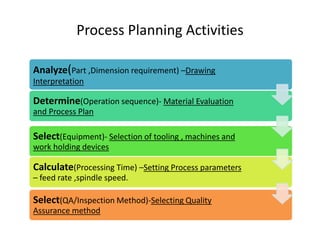
Process Planning Activities
Analyze(Part ,Dimension requirement) –Drawing
Interpretation
Determine(Operation sequence)- Material Evaluation
and Process Plan
Select(Equipment)- Selection of tooling , machines and
work holding devices
Calculate(Processing Time) –Setting Process parameters
– feed rate ,spindle speed.
Select(QA/Inspection Method)-Selecting Quality
Assurance method
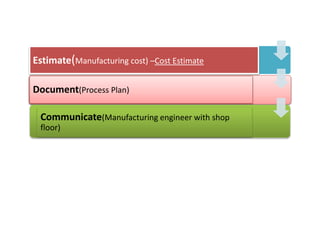
Estimate(Manufacturing cost) –Cost Estimate
Document(Process Plan)
Communicate(Manufacturing engineer with shop
floor)
• Drawing Interpretation
– The Part and Product design must be analyzed .
• Starting material
• Dimensions
• Tolerances
• Process Sequences
– Describe all processing steps used to produce the work
unit.
– The order or sequence in which they will be performed.
• Equipment Selection
– The process planner tries to develop process plans
that utilizes existing plant equipment.
– Otherwise part must be purchased or new
equipment must be installed
• Methods analysis
– Hand and body motions, workplace layout, small
tools, hoists for lifting heavy parts
– Methods must be specified for manual operations
(e.g., assembly) and manual portions of machine
cycles (e.g., loading and unloading a production
machine).
• Work standards
– Time standards set by work measurement
techniques.
PROCESS PLANNING APPROACHES
1. Manual Process Plan
2. Computer Aided Process Plan
– Variant (Retrieval) Approach
– Generative Approach
1. MANUAL PROCESS PLAN
• Manual process planning is based on a manufacturing
engineer’s experience and knowledge of production facilities,
equipment, their capabilities, processes, and tooling.
• It is very time-consuming and the results vary based on the
person doing the planning.
Steps
• Study the overall shape of the part.
• Thoroughly study the drawing.
• If raw stock is not given, determine the best raw material
shape to use.
• Select machines for each setup.
• Sequence the operations determined.
• Select tools for each operation .
• Select or design fixtures for each setup.
• Evaluate the plan generate thus far and make necessary
modifications.
• Select cutting parameters for each operation.
• Prepare the final process plan document.
Result/outcome
• Routing sheet which specify operations, operation sequences,
work centres, standards, tooling and fixtures.
COMPUTER AIDED PROCESS
PLANNING
• Computer-aided process planning (CAPP) is the use of
computer technology to aid in the process planning of a part or
product, in manufacturing.
• CAPP is the link between CAD and CAM
• It is capable of analyzing and understanding the part
characteristics.
• It possess the capabilities of analyzing the inter- dependencies
between part, machining process, quality and cost.
Various approaches to CAPP
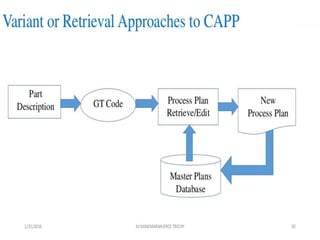
Variant CAPP
• It is based on group technology and parts classification and
coding
• A standard process plan is stored in a computer files for each
part code number
• For each new part , an standard plan is identified, retrieved
and edited if modification are needed.
• Computer search for existing process plan.
26/04/2020
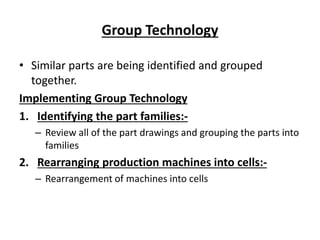
Group Technology
• Similar parts are being identified and grouped
together.
Implementing Group Technology
1. Identifying the part families:-
– Review all of the part drawings and grouping the parts into
families
2. Rearranging production machines into cells:-
– Rearrangement of machines into cells
Part Classification and Coding Method
• Two categories :-
1. Design attributes :- It is concerned with the part
characteristics such as geometry size and material.
2. Manufacturing attributes :- It is concerned with the
sequence of processing steps required to make a part
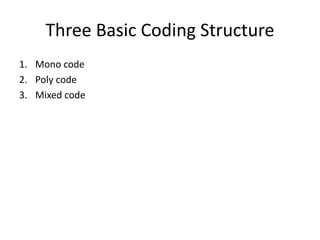
Three Basic Coding Structure
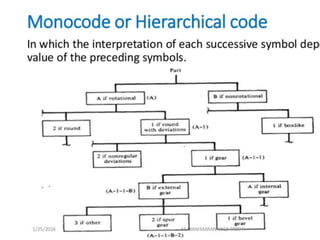
1. Mono code
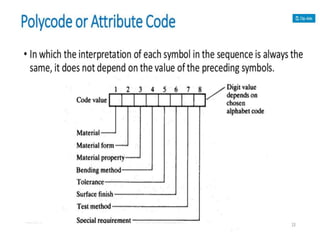
2. Poly code
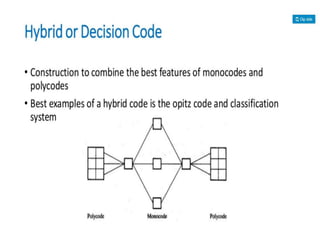
3. Mixed code
Three Basic Coding Structure
1. Mono code
2. Poly code
3. Mixed code
26/04/2020
26/04/2020
Advantages:
• Reduction of time.
• Labor requirement.
• Reduced Development and hardware cost.
• Shorter development time.
Disadvantages
• Difficult to maintain consistency
• The quality of process plan depends on experience of process
planner
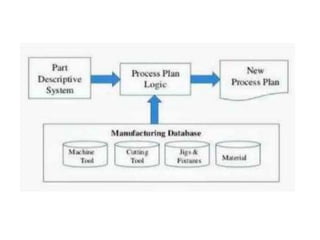
Generative CAPP
• Computer generates new process plan every time when a new plan
is needed.
• The process sequence is planned without human assistance and
without predefined standard plans.
• It is generated by decision logic, formulas ,technology algorithm etc.
Two Major components
• Geometry based coding scheme:- Define all geometric feature like
dimensions ,tolerances ,locations, desired surface finish.
• Process knowledge in the form of decision logic and data:-
Matching of part geometry to manufacturing capabilities using
process knowledge in the form of logic and data.
All steps are automatically carried out:-
• Like process selection ,machine tools ,tools ,jigs
fixtures ,materials ,inspection equipments and
sequencing of operations.
• Setup and machining time calculation.
• Operation instruction sheets.
• If the machines are numerically controlled, NC
codes are being generated automatically.
THANK YOU

Cim presentation (1)

  • 1.
    Computer aided processplanning Submitted to- Amit Pancharya (Associate Professor, MNIT) Submitted by- Maheshvar Nath Trivedi (2019PPE5070) Rajendra Prasad (2019PPE5002)
  • 2.
    Introduction • A processis described as a set of steps that result in specific outcome. – It converts input into output. • Process Planning is a complete description of specific stages in the production process. • Process planning converts design information into the process steps and instructions to powerfully and effectively manufacture products. • All the specifications and conditions of operations are included in the process plan. • Process planning influences time to market and productions cost
  • 3.
    • Process Planningincludes :- – Manufacturing Planning – Material Processing – Process engineering – Machine Routing • It is a base /input for:- – Designing factory building – Facility layout – Selecting Production equipments
  • 4.
  • 5.
    Objective of ProcessPlanning • Process planning is planned to renovate design specification into manufacturing instructions and to make products within the function and quality specification at the least possible costs. • Cost Reduction – Fewer staff to complete the same process. • Higher Competence – By removing loops and bottlenecks. • Greater Precision – By including checkpoints and success measures to make sure process steps are completed precisely. • Better Understanding – All employees to fulfil their department objectives.
  • 6.
    Objective of ProcessPlanning • Process planning is planned to renovate design specification into manufacturing instructions and to make products within the function and quality specification at the least possible costs. • Cost Reduction – Fewer staff to complete the same process. • Higher Competence – By removing loops and bottlenecks. • Greater Precision – By including checkpoints and success measures to make sure process steps are completed precisely. • Better Understanding – All employees to fulfil their department objectives.
  • 7.
    Process Planning Activities Analyze(Part,Dimension requirement) –Drawing Interpretation Determine(Operation sequence)- Material Evaluation and Process Plan Select(Equipment)- Selection of tooling , machines and work holding devices Calculate(Processing Time) –Setting Process parameters – feed rate ,spindle speed. Select(QA/Inspection Method)-Selecting Quality Assurance method
  • 8.
    Estimate(Manufacturing cost) –CostEstimate Document(Process Plan) Communicate(Manufacturing engineer with shop floor)
  • 9.
    • Drawing Interpretation –The Part and Product design must be analyzed . • Starting material • Dimensions • Tolerances • Process Sequences – Describe all processing steps used to produce the work unit. – The order or sequence in which they will be performed.
  • 10.
    • Equipment Selection –The process planner tries to develop process plans that utilizes existing plant equipment. – Otherwise part must be purchased or new equipment must be installed • Methods analysis – Hand and body motions, workplace layout, small tools, hoists for lifting heavy parts – Methods must be specified for manual operations (e.g., assembly) and manual portions of machine cycles (e.g., loading and unloading a production machine). • Work standards – Time standards set by work measurement techniques.
  • 11.
    PROCESS PLANNING APPROACHES 1.Manual Process Plan 2. Computer Aided Process Plan – Variant (Retrieval) Approach – Generative Approach
  • 12.
    1. MANUAL PROCESSPLAN • Manual process planning is based on a manufacturing engineer’s experience and knowledge of production facilities, equipment, their capabilities, processes, and tooling. • It is very time-consuming and the results vary based on the person doing the planning.
  • 13.
    Steps • Study theoverall shape of the part. • Thoroughly study the drawing. • If raw stock is not given, determine the best raw material shape to use. • Select machines for each setup. • Sequence the operations determined. • Select tools for each operation . • Select or design fixtures for each setup. • Evaluate the plan generate thus far and make necessary modifications. • Select cutting parameters for each operation. • Prepare the final process plan document.
  • 14.
    Result/outcome • Routing sheetwhich specify operations, operation sequences, work centres, standards, tooling and fixtures.
  • 15.
    COMPUTER AIDED PROCESS PLANNING •Computer-aided process planning (CAPP) is the use of computer technology to aid in the process planning of a part or product, in manufacturing. • CAPP is the link between CAD and CAM • It is capable of analyzing and understanding the part characteristics. • It possess the capabilities of analyzing the inter- dependencies between part, machining process, quality and cost.
  • 16.
    Various approaches toCAPP Variant CAPP • It is based on group technology and parts classification and coding • A standard process plan is stored in a computer files for each part code number • For each new part , an standard plan is identified, retrieved and edited if modification are needed. • Computer search for existing process plan.
  • 17.
  • 18.
    Group Technology • Similarparts are being identified and grouped together. Implementing Group Technology 1. Identifying the part families:- – Review all of the part drawings and grouping the parts into families 2. Rearranging production machines into cells:- – Rearrangement of machines into cells
  • 19.
    Part Classification andCoding Method • Two categories :- 1. Design attributes :- It is concerned with the part characteristics such as geometry size and material. 2. Manufacturing attributes :- It is concerned with the sequence of processing steps required to make a part
  • 20.
    Three Basic CodingStructure 1. Mono code 2. Poly code 3. Mixed code
  • 21.
    Three Basic CodingStructure 1. Mono code 2. Poly code 3. Mixed code
  • 22.
  • 23.
  • 24.
    Advantages: • Reduction oftime. • Labor requirement. • Reduced Development and hardware cost. • Shorter development time. Disadvantages • Difficult to maintain consistency • The quality of process plan depends on experience of process planner
  • 25.
    Generative CAPP • Computergenerates new process plan every time when a new plan is needed. • The process sequence is planned without human assistance and without predefined standard plans. • It is generated by decision logic, formulas ,technology algorithm etc. Two Major components • Geometry based coding scheme:- Define all geometric feature like dimensions ,tolerances ,locations, desired surface finish. • Process knowledge in the form of decision logic and data:- Matching of part geometry to manufacturing capabilities using process knowledge in the form of logic and data.
  • 27.
    All steps areautomatically carried out:- • Like process selection ,machine tools ,tools ,jigs fixtures ,materials ,inspection equipments and sequencing of operations. • Setup and machining time calculation. • Operation instruction sheets. • If the machines are numerically controlled, NC codes are being generated automatically.
  • 28.