Process planning – Computer Aided Process Planning
(CAPP) – Logical steps in Computer Aided Process
Planning – Aggregate Production Planning and the Master
Production Schedule
Material Requirement planning – Capacity Planning-
Control Systems-Shop Floor Control-Inventory Control
Brief on Manufacturing Resource Planning-II (MRP-II) &
Enterprise Resource Planning (ERP)

 The design is developed and done by design
department
 To convert the product design into a product, a
manufacturing plan is required
 The activity of developing a such plan is called
process planning
 It consists of set of instructions that describes how to
manufacture the product and its parts
Process Planning

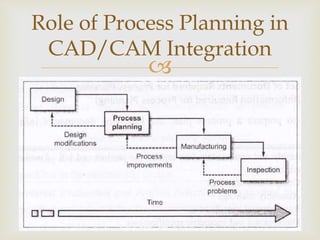
Role of Process Planning in
CAD/CAM Integration

 Interpreting part print analysis & symbols
 Gathering the fundamental details of product design
 Selecting the machining process
 Selecting proper machining with allied tooling
 Sequencing the operations
 Inspecting equipment in order to meet quality
 Determining the tolerance, cutting tool, cutting
conditions
 Time study & work study
Responsibility of Process
Planning Engineer

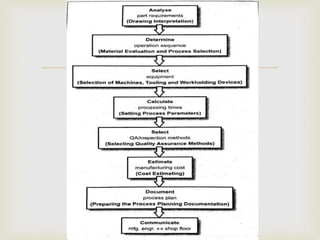
 Drawing interpretation
 Material Evaluation & Process Selection
 Selection of Machine, Tooling & Work holding
devices
 Setting process parameters
 Selection of Quality Assurance Methods
 Cost Estimating
 Preparing the Process Planning Documentation
 Communicating the Knowledge in shop floor
Process Planning
Activities


Here the component drawings should be
analyzed in detail to identify its features,
dimensions, geometric tolerances, surface
finish specifications, the material
specification and the number of parts
required
Drawing interpretation

 This step is to determine the type of processing
operation that has the capability to generate the
various type of features, given the tolerance
requirements.
 The sequence of operations required to transform the
features , dimensions and tolerances on the part from
a rough(initial) to a finished state is determined.
Material Evaluation &
Process Selection

 When type of manufacturing has been determined ,
the next step in process planning is to select
appropriate Machine, Tooling & Work holding
devices
 Machine selection requires how the part would be
processed on each of the alternative so that the best
machine can be selected
Selection of Machine, Tooling
& Work holding devices

 The next step in process planning is to calculate the
specific operation setup time and the cycle times on
each machine.
 Determination of setup time requires knowledge of
available tooling and the sequence of steps necessary
to prepare the machine for processing the given
work piece
Setting process parameters

 Here the tools and techniques to be used for Quality
Assurance inspection are specified clearly.
 Inspection criteria has to be specified by the process
planner for the critical processing factors (such a s
dimensional and geometric tolerances and surface
finish specifications)
Selection of Quality
Assurance Methods

 The probable cost of the product before the start of
its manufacture
 With the available cost and time data, the material
cost, labour cost and overheads are estimated.
Cost Estimating

 The next step in process planning is to document
clearly all the information in detail
 It is generally documented as a job routing or
operation sheet.
 Operation sheet is also called route sheet or
instruction sheet or traveller or planner
Process Planning
Documentation

 The Major and Final step in process planning is to
communicate the manufacturing knowledge to the
shop floor
 Communication is essential to ensure that the part
will be processed accordingly to the most
economically possible way through process
planning.
Communicate Process
Knowledge

 In order to overcome the drawbacks of manual
process planning, the computer aided process
planning is used.
 With the use of computers in the process planning,
one can reduce the routine clerical work of
manufacturing engineers.
 Also it provides the opportunity to generate rational,
consistent and optimal plans.
COMPUTER AIDED PROCESS
PLANNING (CAPP)

 Process rationalization and standardization.
 Productivity improvement
 Product cost reduction
 Elimination of human error
 Reduction in time
 Reduced clerical effort and paper work
 Improved legibility
 Faster response to engineering changes
 Incorporation of other application programs
Benefits of CAPP

 The two basic approaches of CAPP system are
 Retrieval CAPP system
 Generative CAPP system
Approaches of CAPP

 The basic idea behind the retrieval CAPP is that
similar parts will have similar process plans.
 In this system, a process plan for a new part is
created by recalling, identifying and retrieving an
existing plan for a similar part, and making the
necessary modifications for the new part.
Retrieval CAPP system

Unit 2 cim

  • 1.
    Process planning –Computer Aided Process Planning (CAPP) – Logical steps in Computer Aided Process Planning – Aggregate Production Planning and the Master Production Schedule Material Requirement planning – Capacity Planning- Control Systems-Shop Floor Control-Inventory Control Brief on Manufacturing Resource Planning-II (MRP-II) & Enterprise Resource Planning (ERP)
  • 2.
      The designis developed and done by design department  To convert the product design into a product, a manufacturing plan is required  The activity of developing a such plan is called process planning  It consists of set of instructions that describes how to manufacture the product and its parts Process Planning
  • 3.
     Role of ProcessPlanning in CAD/CAM Integration
  • 4.
      Interpreting partprint analysis & symbols  Gathering the fundamental details of product design  Selecting the machining process  Selecting proper machining with allied tooling  Sequencing the operations  Inspecting equipment in order to meet quality  Determining the tolerance, cutting tool, cutting conditions  Time study & work study Responsibility of Process Planning Engineer
  • 5.
      Drawing interpretation Material Evaluation & Process Selection  Selection of Machine, Tooling & Work holding devices  Setting process parameters  Selection of Quality Assurance Methods  Cost Estimating  Preparing the Process Planning Documentation  Communicating the Knowledge in shop floor Process Planning Activities
  • 6.
  • 7.
     Here the componentdrawings should be analyzed in detail to identify its features, dimensions, geometric tolerances, surface finish specifications, the material specification and the number of parts required Drawing interpretation
  • 8.
      This stepis to determine the type of processing operation that has the capability to generate the various type of features, given the tolerance requirements.  The sequence of operations required to transform the features , dimensions and tolerances on the part from a rough(initial) to a finished state is determined. Material Evaluation & Process Selection
  • 9.
      When typeof manufacturing has been determined , the next step in process planning is to select appropriate Machine, Tooling & Work holding devices  Machine selection requires how the part would be processed on each of the alternative so that the best machine can be selected Selection of Machine, Tooling & Work holding devices
  • 10.
      The nextstep in process planning is to calculate the specific operation setup time and the cycle times on each machine.  Determination of setup time requires knowledge of available tooling and the sequence of steps necessary to prepare the machine for processing the given work piece Setting process parameters
  • 11.
      Here thetools and techniques to be used for Quality Assurance inspection are specified clearly.  Inspection criteria has to be specified by the process planner for the critical processing factors (such a s dimensional and geometric tolerances and surface finish specifications) Selection of Quality Assurance Methods
  • 12.
      The probablecost of the product before the start of its manufacture  With the available cost and time data, the material cost, labour cost and overheads are estimated. Cost Estimating
  • 13.
      The nextstep in process planning is to document clearly all the information in detail  It is generally documented as a job routing or operation sheet.  Operation sheet is also called route sheet or instruction sheet or traveller or planner Process Planning Documentation
  • 14.
      The Majorand Final step in process planning is to communicate the manufacturing knowledge to the shop floor  Communication is essential to ensure that the part will be processed accordingly to the most economically possible way through process planning. Communicate Process Knowledge
  • 15.
      In orderto overcome the drawbacks of manual process planning, the computer aided process planning is used.  With the use of computers in the process planning, one can reduce the routine clerical work of manufacturing engineers.  Also it provides the opportunity to generate rational, consistent and optimal plans. COMPUTER AIDED PROCESS PLANNING (CAPP)
  • 16.
      Process rationalizationand standardization.  Productivity improvement  Product cost reduction  Elimination of human error  Reduction in time  Reduced clerical effort and paper work  Improved legibility  Faster response to engineering changes  Incorporation of other application programs Benefits of CAPP
  • 17.
      The twobasic approaches of CAPP system are  Retrieval CAPP system  Generative CAPP system Approaches of CAPP
  • 18.
      The basicidea behind the retrieval CAPP is that similar parts will have similar process plans.  In this system, a process plan for a new part is created by recalling, identifying and retrieving an existing plan for a similar part, and making the necessary modifications for the new part. Retrieval CAPP system