Jigs & Fixtures
Jigs & Fixtures
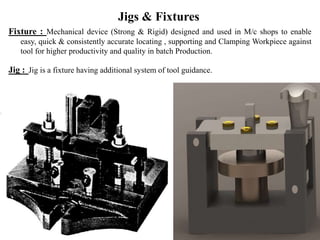
Fixture : Mechanical device (Strong & Rigid) designed and used in M/c shops to enable
easy, quick & consistently accurate locating , supporting and Clamping Workpiece against
tool for higher productivity and quality in batch Production.
Jig : Jig is a fixture having additional system of tool guidance.
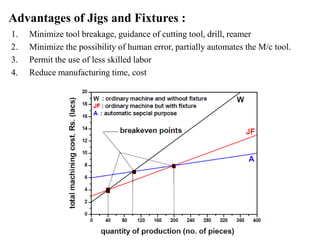
Advantages of Jigs and Fixtures :
1. Minimize tool breakage, guidance of cutting tool, drill, reamer
2. Minimize the possibility of human error, partially automates the M/c tool.
3. Permit the use of less skilled labor
4. Reduce manufacturing time, cost
Design of Jigs & Fixtures :
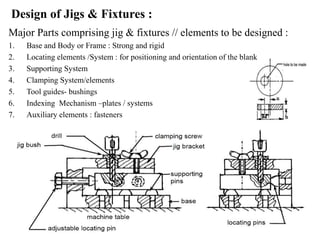
Major Parts comprising jig & fixtures // elements to be designed :
1. Base and Body or Frame : Strong and rigid
2. Locating elements /System : for positioning and orientation of the blank
3. Supporting System
4. Clamping System/elements
5. Tool guides- bushings
6. Indexing Mechanism –plates / systems
7. Auxiliary elements : fasteners
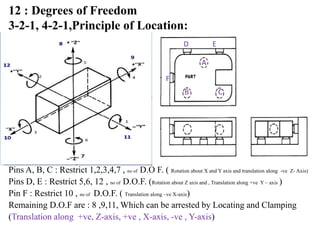
12 : Degrees of Freedom
3-2-1, 4-2-1,Principle of Location:
Pins A, B, C : Restrict 1,2,3,4,7 , no of D.O F. ( Rotation about X and Y axis and translation along -ve Z- Axis)
Pins D, E : Restrict 5,6, 12 , no of D.O.F. (Rotation about Z axis and , Translation along +ve Y – axis )
Pin F : Restrict 10 , no of D.O.F. ( Translation along –ve X-axis)
Remaining D.O.F are : 8 ,9,11, Which can be arrested by Locating and Clamping
(Translation along +ve, Z-axis, +ve , X-axis, -ve , Y-axis)
F
8
D E
A
B C
F
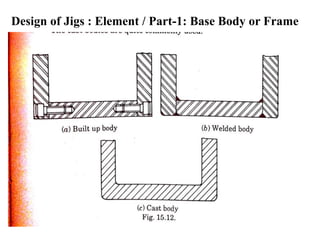
Design of Jigs : Element / Part-1: Base Body or Frame
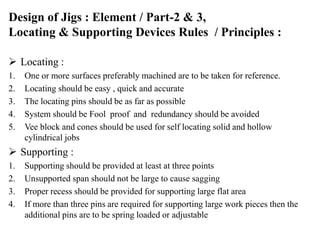
Design of Jigs : Element / Part-2 & 3,
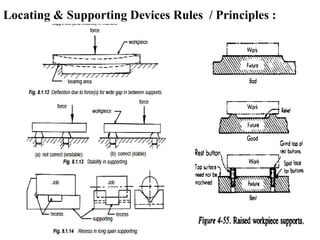
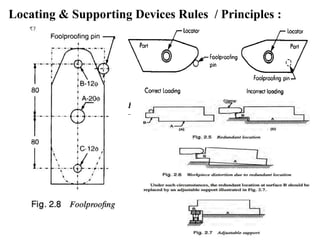
Locating & Supporting Devices Rules / Principles :
 Locating :
1. One or more surfaces preferably machined are to be taken for reference.
2. Locating should be easy , quick and accurate
3. The locating pins should be as far as possible
4. System should be Fool proof and redundancy should be avoided
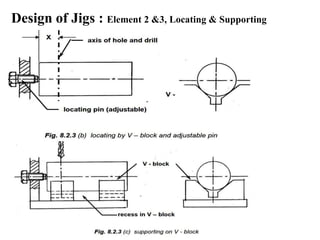
5. Vee block and cones should be used for self locating solid and hollow
cylindrical jobs
 Supporting :
1. Supporting should be provided at least at three points
2. Unsupported span should not be large to cause sagging
3. Proper recess should be provided for supporting large flat area
4. If more than three pins are required for supporting large work pieces then the
additional pins are to be spring loaded or adjustable
Locating & Supporting Devices Rules / Principles :
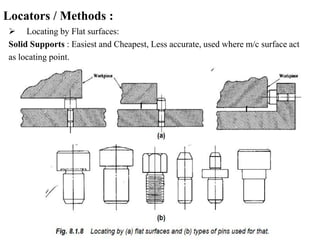
Locators / Methods :
 Locating by Flat surfaces:
Solid Supports : Easiest and Cheapest, Less accurate, used where m/c surface act
as locating point.
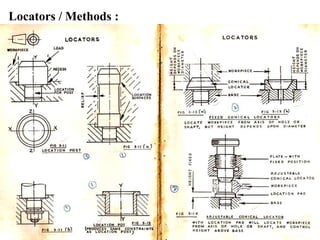
Locators / Methods :
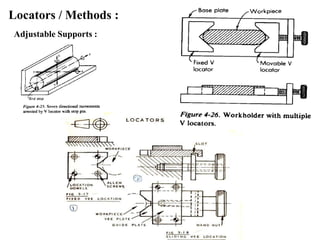
Adjustable Supports :
Locators / Methods :
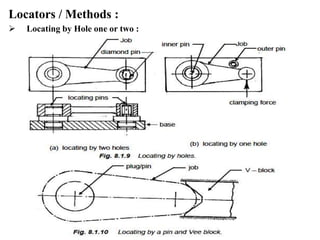
 Locating by Hole one or two :
Locators / Methods :
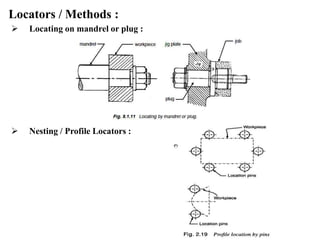
 Locating on mandrel or plug :
 Nesting / Profile Locators :
Locators / Methods :
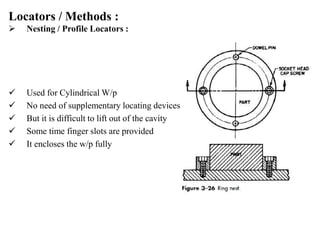
 Nesting / Profile Locators :
 Used for Cylindrical W/p
 No need of supplementary locating devices
 But it is difficult to lift out of the cavity
 Some time finger slots are provided
 It encloses the w/p fully
Locators / Methods :
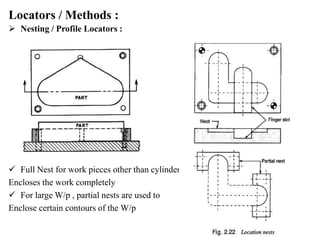
 Nesting / Profile Locators :
 Full Nest for work pieces other than cylinders
Encloses the work completely
 For large W/p , partial nests are used to
Enclose certain contours of the W/p
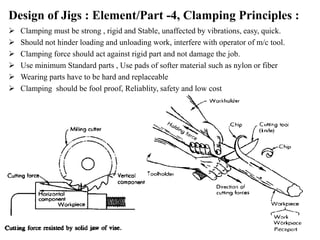
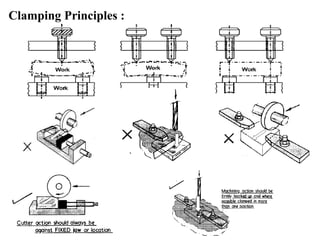
Design of Jigs : Element/Part -4, Clamping Principles :
 Clamping must be strong , rigid and Stable, unaffected by vibrations, easy, quick.
 Should not hinder loading and unloading work, interfere with operator of m/c tool.
 Clamping force should act against rigid part and not damage the job.
 Use minimum Standard parts , Use pads of softer material such as nylon or fiber
 Wearing parts have to be hard and replaceable
 Clamping should be fool proof, Reliablity, safety and low cost
Clamping Principles :
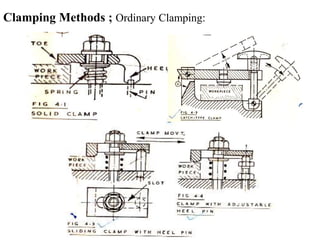
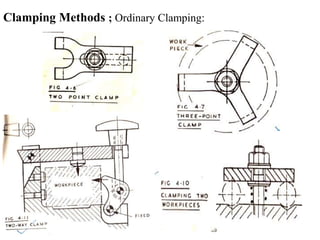
Clamping Methods ; Ordinary Clamping:
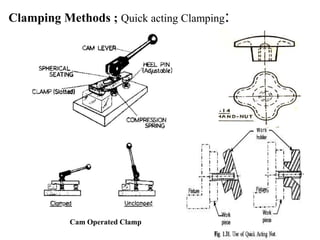
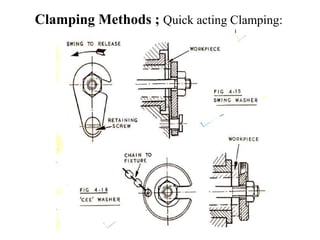
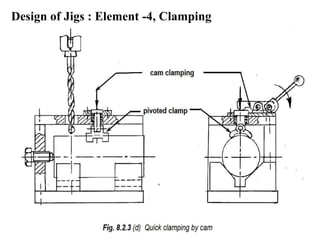
Clamping Methods ; Quick acting Clamping:
Cam Operated Clamp
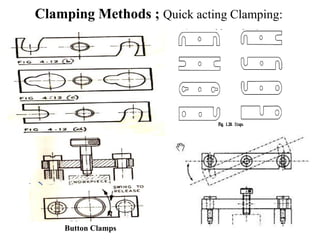
Clamping Methods ; Quick acting Clamping:
Button Clamps
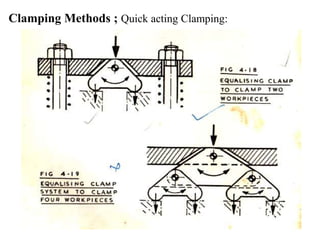
Clamping Methods ; Quick acting Clamping:
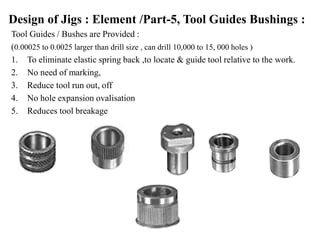
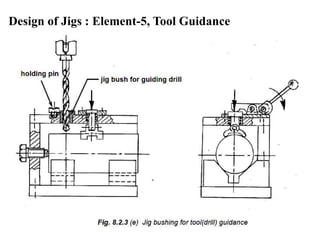
Design of Jigs : Element /Part-5, Tool Guides Bushings :
Tool Guides / Bushes are Provided :
(0.00025 to 0.0025 larger than drill size , can drill 10,000 to 15, 000 holes )
1. To eliminate elastic spring back ,to locate & guide tool relative to the work.
2. No need of marking,
3. Reduce tool run out, off
4. No hole expansion ovalisation
5. Reduces tool breakage
Types of Bushes :
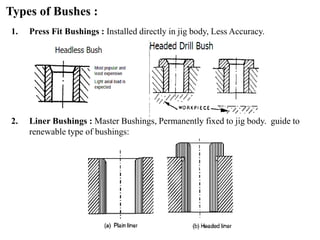
1. Press Fit Bushings : Installed directly in jig body, Less Accuracy.
2. Liner Bushings : Master Bushings, Permanently fixed to jig body. guide to
renewable type of bushings:
Types of Bushes :
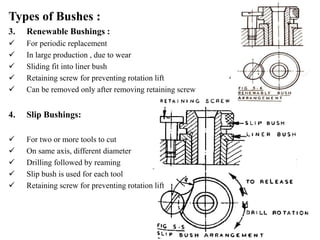
3. Renewable Bushings :
 For periodic replacement
 In large production , due to wear
 Sliding fit into liner bush
 Retaining screw for preventing rotation lift
 Can be removed only after removing retaining screw
4. Slip Bushings:
 For two or more tools to cut
 On same axis, different diameter
 Drilling followed by reaming
 Slip bush is used for each tool
 Retaining screw for preventing rotation lift
Types of Bushes :
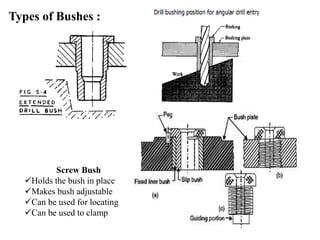
Screw Bush
Holds the bush in place
Makes bush adjustable
Can be used for locating
Can be used to clamp
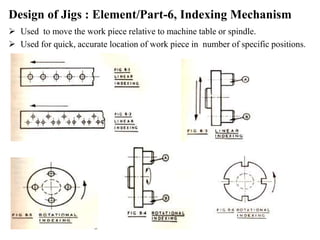
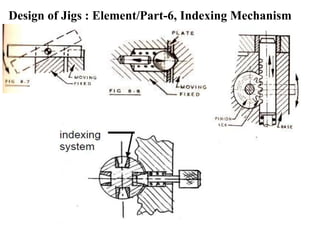
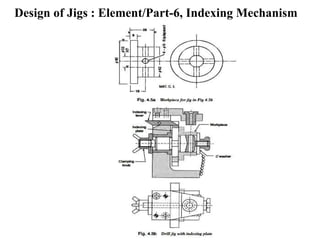
Design of Jigs : Element/Part-6, Indexing Mechanism
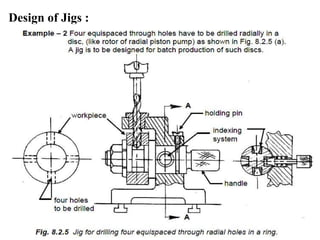
 Used to move the work piece relative to machine table or spindle.
 Used for quick, accurate location of work piece in number of specific positions.
Design of Jigs : Element/Part-6, Indexing Mechanism
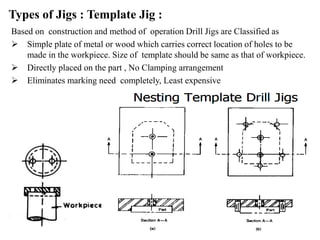
Types of Jigs : Template Jig :
Based on construction and method of operation Drill Jigs are Classified as
 Simple plate of metal or wood which carries correct location of holes to be
made in the workpiece. Size of template should be same as that of workpiece.
 Directly placed on the part , No Clamping arrangement
 Eliminates marking need completely, Least expensive
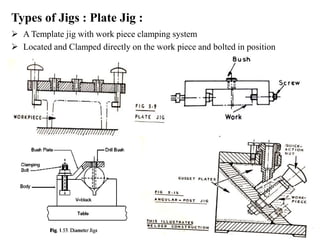
Types of Jigs : Plate Jig :
 A Template jig with work piece clamping system
 Located and Clamped directly on the work piece and bolted in position
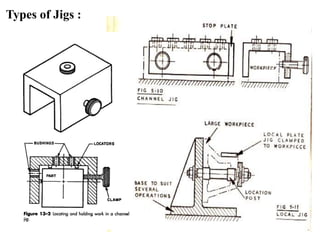
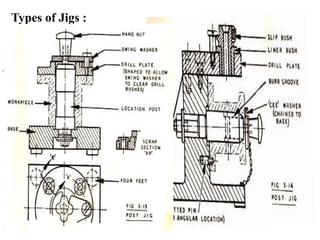
Types of Jigs :
Types of Jigs :
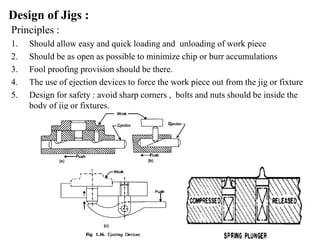
Design of Jigs :
Principles :
1. Should allow easy and quick loading and unloading of work piece
2. Should be as open as possible to minimize chip or burr accumulations
3. Fool proofing provision should be there.
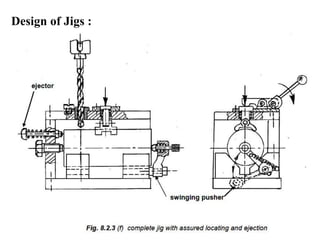
4. The use of ejection devices to force the work piece out from the jig or fixture
5. Design for safety : avoid sharp corners , bolts and nuts should be inside the
body of jig or fixtures.
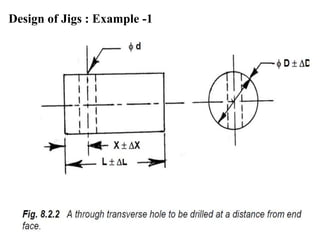
Design of Jigs : Example -1
Design of Jigs : Element 2 &3, Locating & Supporting
Design of Jigs : Element -4, Clamping
Design of Jigs : Element-5, Tool Guidance
Design of Jigs :
Design of Jigs :
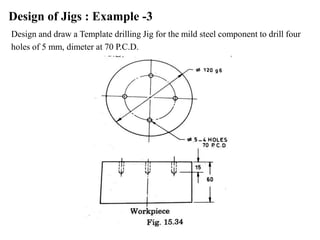
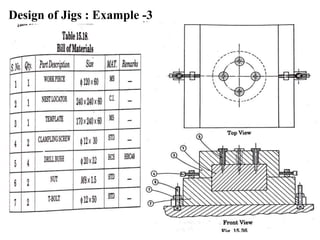
Design of Jigs : Example -3
Design and draw a Template drilling Jig for the mild steel component to drill four
holes of 5 mm, dimeter at 70 P.C.D.
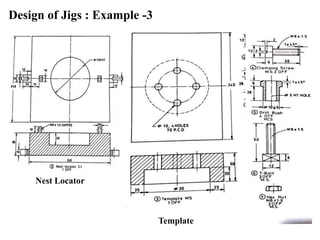
Design of Jigs : Example -3
Nest Locator
Template
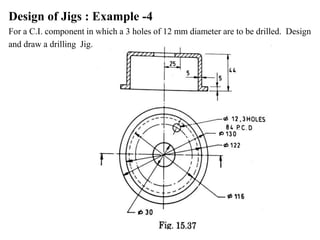
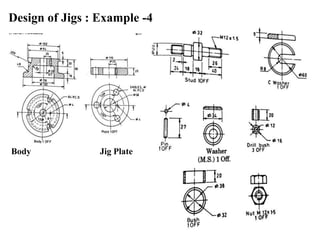
Design of Jigs : Example -4
For a C.I. component in which a 3 holes of 12 mm diameter are to be drilled. Design
and draw a drilling Jig.
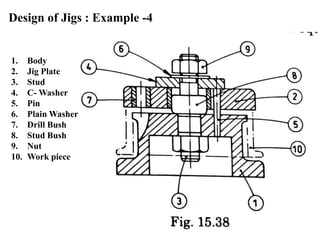
Design of Jigs : Example -4
1. Body
2. Jig Plate
3. Stud
4. C- Washer
5. Pin
6. Plain Washer
7. Drill Bush
8. Stud Bush
9. Nut
10. Work piece
Design of Jigs : Example -4
Body Jig Plate
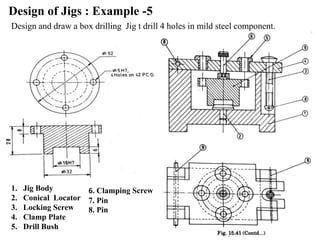
Design of Jigs : Example -5
Design and draw a box drilling Jig t drill 4 holes in mild steel component.
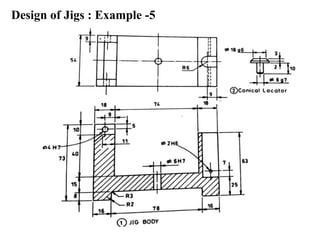
1. Jig Body
2. Conical Locator
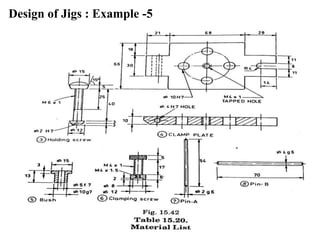
3. Locking Screw
4. Clamp Plate
5. Drill Bush
6. Clamping Screw
7. Pin
8. Pin
Design of Jigs : Example -5
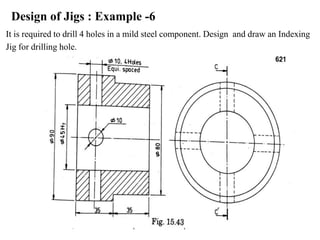
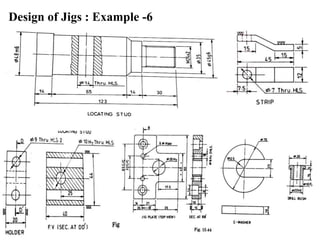
Design of Jigs : Example -6
It is required to drill 4 holes in a mild steel component. Design and draw an Indexing
Jig for drilling hole.
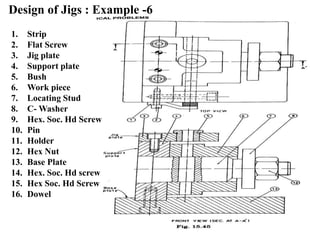
Design of Jigs : Example -6
1. Strip
2. Flat Screw
3. Jig plate
4. Support plate
5. Bush
6. Work piece
7. Locating Stud
8. C- Washer
9. Hex. Soc. Hd Screw
10. Pin
11. Holder
12. Hex Nut
13. Base Plate
14. Hex. Soc. Hd screw
15. Hex Soc. Hd Screw
16. Dowel
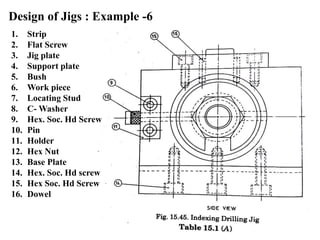
Design of Jigs : Example -6
1. Strip
2. Flat Screw
3. Jig plate
4. Support plate
5. Bush
6. Work piece
7. Locating Stud
8. C- Washer
9. Hex. Soc. Hd Screw
10. Pin
11. Holder
12. Hex Nut
13. Base Plate
14. Hex. Soc. Hd screw
15. Hex Soc. Hd Screw
16. Dowel
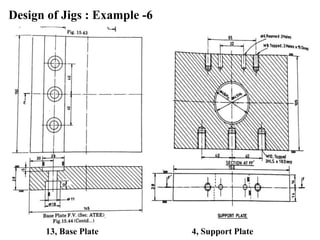
Design of Jigs : Example -6
13, Base Plate 4, Support Plate
Design of Jigs : Example -6
Design of Fixtures :
Fixtures name is derived /fact /it is always fastened to a m/c or bench
Fixtures are designed specifically for an operation and so named like
 Milling Fixtures
 Turning Fixtures
 Tapping Fixtures
 Assembling Fixtures
 Fixtures for grinding
 Fixtures for broaching
 Fixtures for boring/ drilling
 Fixtures for welding
Difference between Jig and Fixtures
1. A fixtures holds and position the work but does not guide like jig
2. Fixtures are heavier in construction, Jigs are lighter in construction
3. Bolted rigidly on machine table, Jigs are not bolted
4. Subjected to higher cutting forces, Clamping must be big, Hexagonal
nuts used to clamp, Jigs to lighter forces, Hand nuts used.
5. Fixtures can be used for all machining applications, Jig not for all.
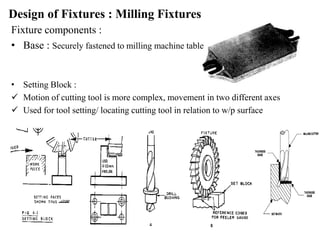
Design of Fixtures : Milling Fixtures
Fixture components :
• Base : Securely fastened to milling machine table
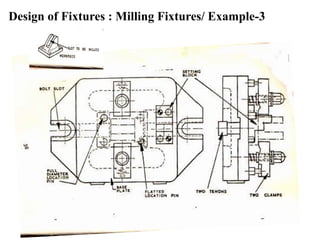
• Setting Block :
 Motion of cutting tool is more complex, movement in two different axes
 Used for tool setting/ locating cutting tool in relation to w/p surface
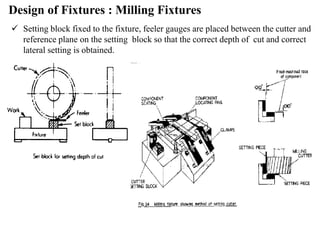
Design of Fixtures : Milling Fixtures
 Setting block fixed to the fixture, feeler gauges are placed between the cutter and
reference plane on the setting block so that the correct depth of cut and correct
lateral setting is obtained.
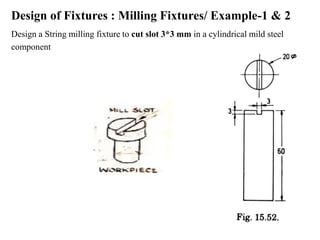
Design of Fixtures : Milling Fixtures/ Example-1 & 2
Design a String milling fixture to cut slot 3*3 mm in a cylindrical mild steel
component
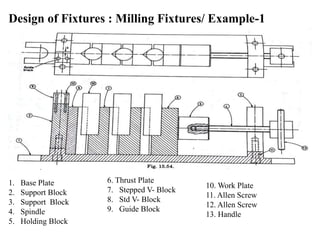
Design of Fixtures : Milling Fixtures/ Example-1
1. Base Plate
2. Support Block
3. Support Block
4. Spindle
5. Holding Block
6. Thrust Plate
7. Stepped V- Block
8. Std V- Block
9. Guide Block
10. Work Plate
11. Allen Screw
12. Allen Screw
13. Handle
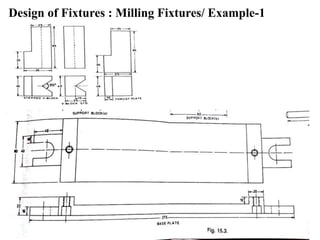
Design of Fixtures : Milling Fixtures/ Example-1
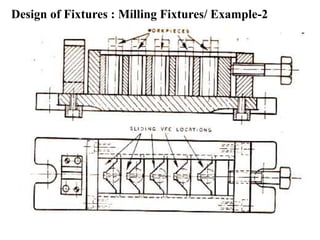
Design of Fixtures : Milling Fixtures/ Example-2
Design of Fixtures : Milling Fixtures/ Example-3
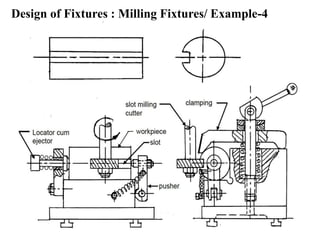
Design of Fixtures : Milling Fixtures/ Example-4
References :
1. Introduction to Jigs and Fixtures , 3rd Edition, M.H.A. Kempster, The
English Language Book Society and Hodder And Stoughton, London.
2. Jigs and Fixtures, 3rd Edition, P. H. Joshi, Tata McGraw Hill Education
private limited, New Delhi.
3. Tool Engineering and Design, G.R. Nagpal, Khanna Publishers, Delhi
4. A Text Book of Production Technology, P.C. Sharma, S. Chand &
Company Ltd. Ramnagar New Delhi.
5. Jigs and Fixture Design, Fifth Edtion, Edward G. Hoffman, Thomson
Delmar Learining, a division of Thomson Learing Inc.

Jigs & Fixtures

  • 1.
  • 2.
    Jigs & Fixtures Fixture: Mechanical device (Strong & Rigid) designed and used in M/c shops to enable easy, quick & consistently accurate locating , supporting and Clamping Workpiece against tool for higher productivity and quality in batch Production. Jig : Jig is a fixture having additional system of tool guidance.
  • 3.
    Advantages of Jigsand Fixtures : 1. Minimize tool breakage, guidance of cutting tool, drill, reamer 2. Minimize the possibility of human error, partially automates the M/c tool. 3. Permit the use of less skilled labor 4. Reduce manufacturing time, cost
  • 4.
    Design of Jigs& Fixtures : Major Parts comprising jig & fixtures // elements to be designed : 1. Base and Body or Frame : Strong and rigid 2. Locating elements /System : for positioning and orientation of the blank 3. Supporting System 4. Clamping System/elements 5. Tool guides- bushings 6. Indexing Mechanism –plates / systems 7. Auxiliary elements : fasteners
  • 5.
    12 : Degreesof Freedom 3-2-1, 4-2-1,Principle of Location: Pins A, B, C : Restrict 1,2,3,4,7 , no of D.O F. ( Rotation about X and Y axis and translation along -ve Z- Axis) Pins D, E : Restrict 5,6, 12 , no of D.O.F. (Rotation about Z axis and , Translation along +ve Y – axis ) Pin F : Restrict 10 , no of D.O.F. ( Translation along –ve X-axis) Remaining D.O.F are : 8 ,9,11, Which can be arrested by Locating and Clamping (Translation along +ve, Z-axis, +ve , X-axis, -ve , Y-axis) F 8 D E A B C F
  • 6.
    Design of Jigs: Element / Part-1: Base Body or Frame
  • 7.
    Design of Jigs: Element / Part-2 & 3, Locating & Supporting Devices Rules / Principles :  Locating : 1. One or more surfaces preferably machined are to be taken for reference. 2. Locating should be easy , quick and accurate 3. The locating pins should be as far as possible 4. System should be Fool proof and redundancy should be avoided 5. Vee block and cones should be used for self locating solid and hollow cylindrical jobs  Supporting : 1. Supporting should be provided at least at three points 2. Unsupported span should not be large to cause sagging 3. Proper recess should be provided for supporting large flat area 4. If more than three pins are required for supporting large work pieces then the additional pins are to be spring loaded or adjustable
  • 8.
    Locating & SupportingDevices Rules / Principles :
  • 9.
    Locating & SupportingDevices Rules / Principles :
  • 10.
    Locators / Methods:  Locating by Flat surfaces: Solid Supports : Easiest and Cheapest, Less accurate, used where m/c surface act as locating point.
  • 11.
  • 12.
    Locators / Methods: Adjustable Supports :
  • 13.
    Locators / Methods:  Locating by Hole one or two :
  • 14.
    Locators / Methods:  Locating on mandrel or plug :  Nesting / Profile Locators :
  • 15.
    Locators / Methods:  Nesting / Profile Locators :  Used for Cylindrical W/p  No need of supplementary locating devices  But it is difficult to lift out of the cavity  Some time finger slots are provided  It encloses the w/p fully
  • 16.
    Locators / Methods:  Nesting / Profile Locators :  Full Nest for work pieces other than cylinders Encloses the work completely  For large W/p , partial nests are used to Enclose certain contours of the W/p
  • 17.
    Design of Jigs: Element/Part -4, Clamping Principles :  Clamping must be strong , rigid and Stable, unaffected by vibrations, easy, quick.  Should not hinder loading and unloading work, interfere with operator of m/c tool.  Clamping force should act against rigid part and not damage the job.  Use minimum Standard parts , Use pads of softer material such as nylon or fiber  Wearing parts have to be hard and replaceable  Clamping should be fool proof, Reliablity, safety and low cost
  • 18.
  • 19.
    Clamping Methods ;Ordinary Clamping:
  • 20.
    Clamping Methods ;Ordinary Clamping:
  • 21.
    Clamping Methods ;Quick acting Clamping: Cam Operated Clamp
  • 22.
    Clamping Methods ;Quick acting Clamping:
  • 23.
    Clamping Methods ;Quick acting Clamping: Button Clamps
  • 24.
    Clamping Methods ;Quick acting Clamping:
  • 25.
    Design of Jigs: Element /Part-5, Tool Guides Bushings : Tool Guides / Bushes are Provided : (0.00025 to 0.0025 larger than drill size , can drill 10,000 to 15, 000 holes ) 1. To eliminate elastic spring back ,to locate & guide tool relative to the work. 2. No need of marking, 3. Reduce tool run out, off 4. No hole expansion ovalisation 5. Reduces tool breakage
  • 26.
    Types of Bushes: 1. Press Fit Bushings : Installed directly in jig body, Less Accuracy. 2. Liner Bushings : Master Bushings, Permanently fixed to jig body. guide to renewable type of bushings:
  • 27.
    Types of Bushes: 3. Renewable Bushings :  For periodic replacement  In large production , due to wear  Sliding fit into liner bush  Retaining screw for preventing rotation lift  Can be removed only after removing retaining screw 4. Slip Bushings:  For two or more tools to cut  On same axis, different diameter  Drilling followed by reaming  Slip bush is used for each tool  Retaining screw for preventing rotation lift
  • 28.
    Types of Bushes: Screw Bush Holds the bush in place Makes bush adjustable Can be used for locating Can be used to clamp
  • 29.
    Design of Jigs: Element/Part-6, Indexing Mechanism  Used to move the work piece relative to machine table or spindle.  Used for quick, accurate location of work piece in number of specific positions.
  • 30.
    Design of Jigs: Element/Part-6, Indexing Mechanism
  • 31.
    Design of Jigs: Element/Part-6, Indexing Mechanism
  • 32.
    Types of Jigs: Template Jig : Based on construction and method of operation Drill Jigs are Classified as  Simple plate of metal or wood which carries correct location of holes to be made in the workpiece. Size of template should be same as that of workpiece.  Directly placed on the part , No Clamping arrangement  Eliminates marking need completely, Least expensive
  • 33.
    Types of Jigs: Plate Jig :  A Template jig with work piece clamping system  Located and Clamped directly on the work piece and bolted in position
  • 34.
  • 35.
  • 36.
    Design of Jigs: Principles : 1. Should allow easy and quick loading and unloading of work piece 2. Should be as open as possible to minimize chip or burr accumulations 3. Fool proofing provision should be there. 4. The use of ejection devices to force the work piece out from the jig or fixture 5. Design for safety : avoid sharp corners , bolts and nuts should be inside the body of jig or fixtures.
  • 37.
    Design of Jigs: Example -1
  • 38.
    Design of Jigs: Element 2 &3, Locating & Supporting
  • 39.
    Design of Jigs: Element -4, Clamping
  • 40.
    Design of Jigs: Element-5, Tool Guidance
  • 41.
  • 42.
  • 43.
    Design of Jigs: Example -3 Design and draw a Template drilling Jig for the mild steel component to drill four holes of 5 mm, dimeter at 70 P.C.D.
  • 44.
    Design of Jigs: Example -3
  • 45.
    Design of Jigs: Example -3 Nest Locator Template
  • 46.
    Design of Jigs: Example -4 For a C.I. component in which a 3 holes of 12 mm diameter are to be drilled. Design and draw a drilling Jig.
  • 47.
    Design of Jigs: Example -4 1. Body 2. Jig Plate 3. Stud 4. C- Washer 5. Pin 6. Plain Washer 7. Drill Bush 8. Stud Bush 9. Nut 10. Work piece
  • 48.
    Design of Jigs: Example -4 Body Jig Plate
  • 49.
    Design of Jigs: Example -5 Design and draw a box drilling Jig t drill 4 holes in mild steel component. 1. Jig Body 2. Conical Locator 3. Locking Screw 4. Clamp Plate 5. Drill Bush 6. Clamping Screw 7. Pin 8. Pin
  • 50.
    Design of Jigs: Example -5
  • 51.
    Design of Jigs: Example -5
  • 52.
    Design of Jigs: Example -6 It is required to drill 4 holes in a mild steel component. Design and draw an Indexing Jig for drilling hole.
  • 53.
    Design of Jigs: Example -6 1. Strip 2. Flat Screw 3. Jig plate 4. Support plate 5. Bush 6. Work piece 7. Locating Stud 8. C- Washer 9. Hex. Soc. Hd Screw 10. Pin 11. Holder 12. Hex Nut 13. Base Plate 14. Hex. Soc. Hd screw 15. Hex Soc. Hd Screw 16. Dowel
  • 54.
    Design of Jigs: Example -6 1. Strip 2. Flat Screw 3. Jig plate 4. Support plate 5. Bush 6. Work piece 7. Locating Stud 8. C- Washer 9. Hex. Soc. Hd Screw 10. Pin 11. Holder 12. Hex Nut 13. Base Plate 14. Hex. Soc. Hd screw 15. Hex Soc. Hd Screw 16. Dowel
  • 55.
    Design of Jigs: Example -6 13, Base Plate 4, Support Plate
  • 56.
    Design of Jigs: Example -6
  • 57.
    Design of Fixtures: Fixtures name is derived /fact /it is always fastened to a m/c or bench Fixtures are designed specifically for an operation and so named like  Milling Fixtures  Turning Fixtures  Tapping Fixtures  Assembling Fixtures  Fixtures for grinding  Fixtures for broaching  Fixtures for boring/ drilling  Fixtures for welding Difference between Jig and Fixtures 1. A fixtures holds and position the work but does not guide like jig 2. Fixtures are heavier in construction, Jigs are lighter in construction 3. Bolted rigidly on machine table, Jigs are not bolted 4. Subjected to higher cutting forces, Clamping must be big, Hexagonal nuts used to clamp, Jigs to lighter forces, Hand nuts used. 5. Fixtures can be used for all machining applications, Jig not for all.
  • 58.
    Design of Fixtures: Milling Fixtures Fixture components : • Base : Securely fastened to milling machine table • Setting Block :  Motion of cutting tool is more complex, movement in two different axes  Used for tool setting/ locating cutting tool in relation to w/p surface
  • 59.
    Design of Fixtures: Milling Fixtures  Setting block fixed to the fixture, feeler gauges are placed between the cutter and reference plane on the setting block so that the correct depth of cut and correct lateral setting is obtained.
  • 60.
    Design of Fixtures: Milling Fixtures/ Example-1 & 2 Design a String milling fixture to cut slot 3*3 mm in a cylindrical mild steel component
  • 61.
    Design of Fixtures: Milling Fixtures/ Example-1 1. Base Plate 2. Support Block 3. Support Block 4. Spindle 5. Holding Block 6. Thrust Plate 7. Stepped V- Block 8. Std V- Block 9. Guide Block 10. Work Plate 11. Allen Screw 12. Allen Screw 13. Handle
  • 62.
    Design of Fixtures: Milling Fixtures/ Example-1
  • 63.
    Design of Fixtures: Milling Fixtures/ Example-2
  • 64.
    Design of Fixtures: Milling Fixtures/ Example-3
  • 65.
    Design of Fixtures: Milling Fixtures/ Example-4
  • 66.
    References : 1. Introductionto Jigs and Fixtures , 3rd Edition, M.H.A. Kempster, The English Language Book Society and Hodder And Stoughton, London. 2. Jigs and Fixtures, 3rd Edition, P. H. Joshi, Tata McGraw Hill Education private limited, New Delhi. 3. Tool Engineering and Design, G.R. Nagpal, Khanna Publishers, Delhi 4. A Text Book of Production Technology, P.C. Sharma, S. Chand & Company Ltd. Ramnagar New Delhi. 5. Jigs and Fixture Design, Fifth Edtion, Edward G. Hoffman, Thomson Delmar Learining, a division of Thomson Learing Inc.