Introduction to Set-up Reduction /
Quick Changeover Concepts
December 7 2016
Julian Kalac
BOTTLENECK
3
CONTINUOUS FLOW
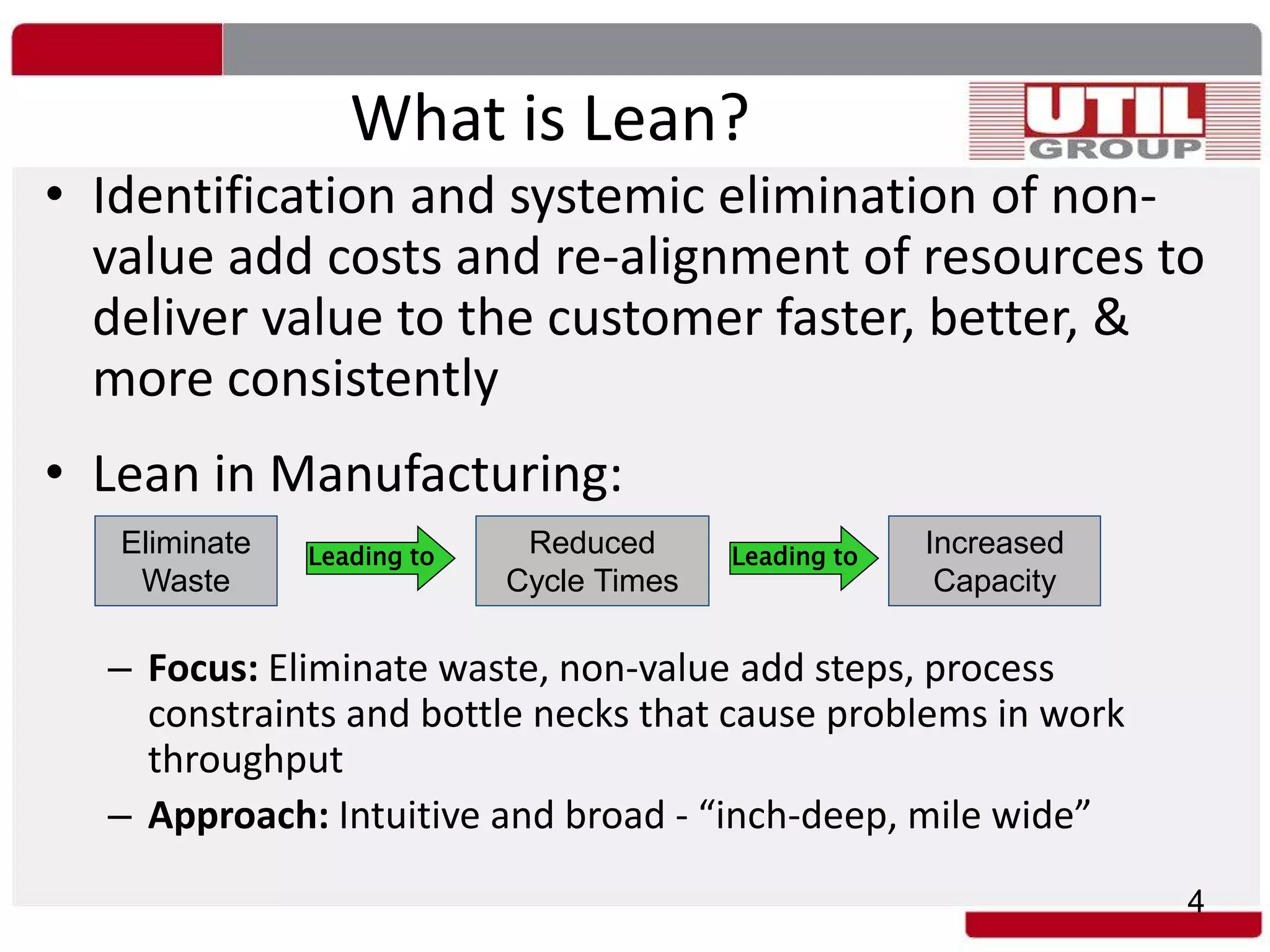
• Identification and systemic elimination of non-
value add costs and re-alignment of resources to
deliver value to the customer faster, better, &
more consistently
• Lean in Manufacturing:
– Focus: Eliminate waste, non-value add steps, process
constraints and bottle necks that cause problems in work
throughput
– Approach: Intuitive and broad - “inch-deep, mile wide”
4
What is Lean?
Leading to Leading toEliminate
Waste
Reduced
Cycle Times
Increased
Capacity
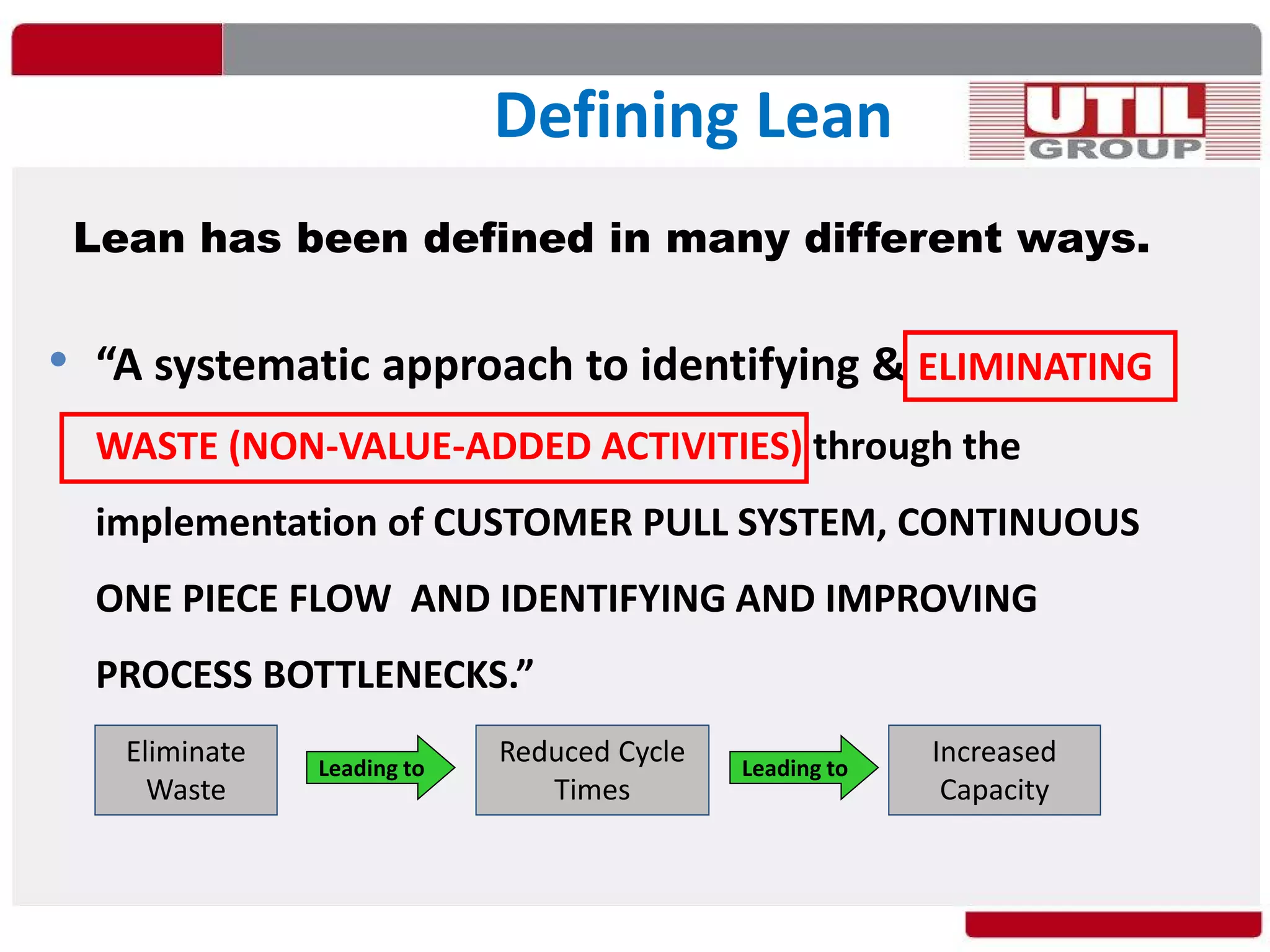
Defining Lean
• “A systematic approach to identifying & ELIMINATING
WASTE (NON-VALUE-ADDED ACTIVITIES) through the
implementation of CUSTOMER PULL SYSTEM, CONTINUOUS
ONE PIECE FLOW AND IDENTIFYING AND IMPROVING
PROCESS BOTTLENECKS.”
Lean has been defined in many different ways.
Leading to Leading to
Eliminate
Waste
Reduced Cycle
Times
Increased
Capacity
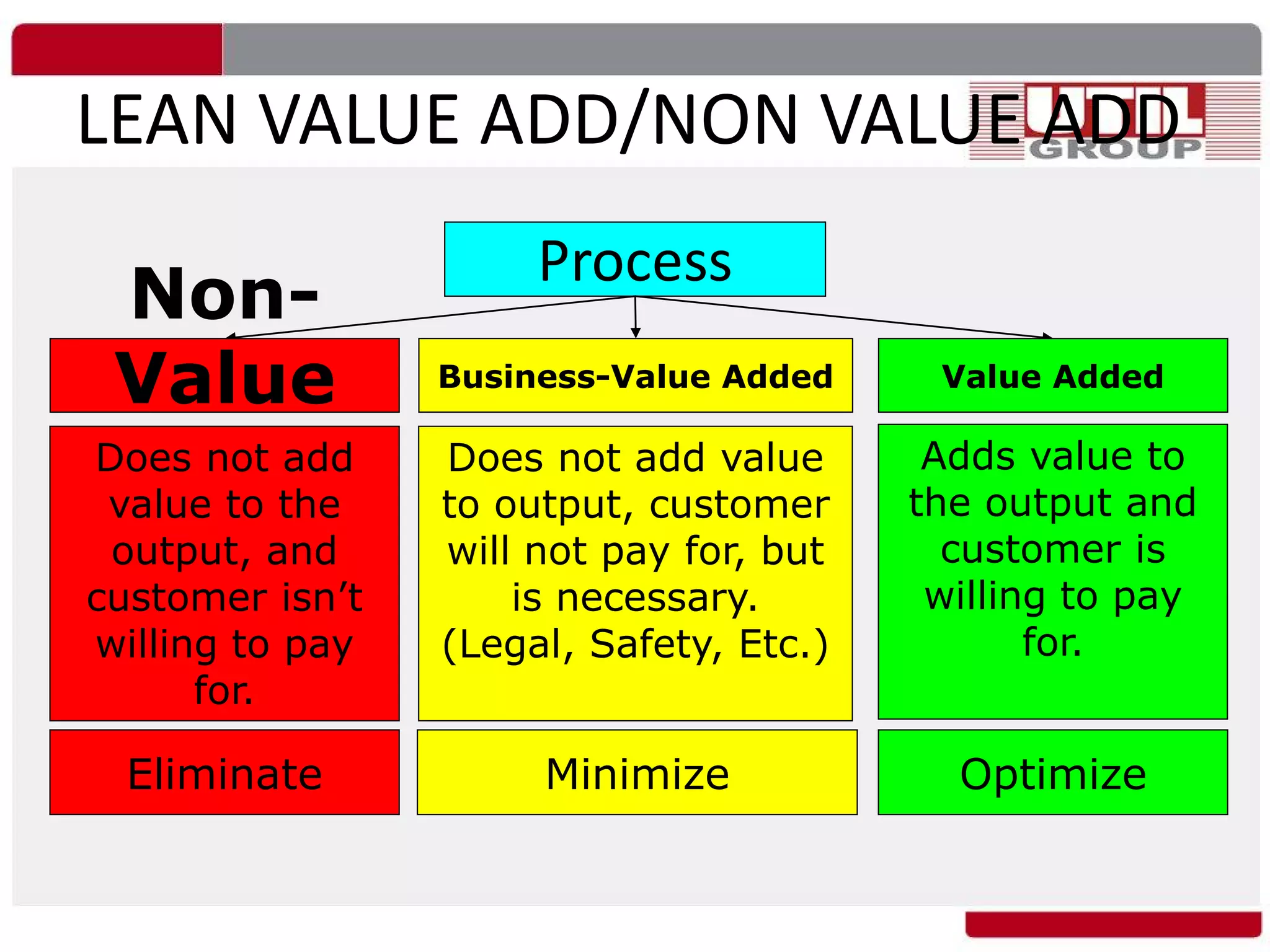
Process
Value Added
Adds value to
the output and
customer is
willing to pay
for.
Optimize
Non-
Value
AddedDoes not add
value to the
output, and
customer isn’t
willing to pay
for.
Eliminate
Business-Value Added
Does not add value
to output, customer
will not pay for, but
is necessary.
(Legal, Safety, Etc.)
Minimize
LEAN VALUE ADD/NON VALUE ADD
Eliminating the Wastes
Value Added
Typically 95% of all lead time is non-value added
1. Overproduction
2. Waiting
3. Transportation
4. Non-Value Added Processing
5. Excess Inventory/Material
6. Defects
7. Excess Motion
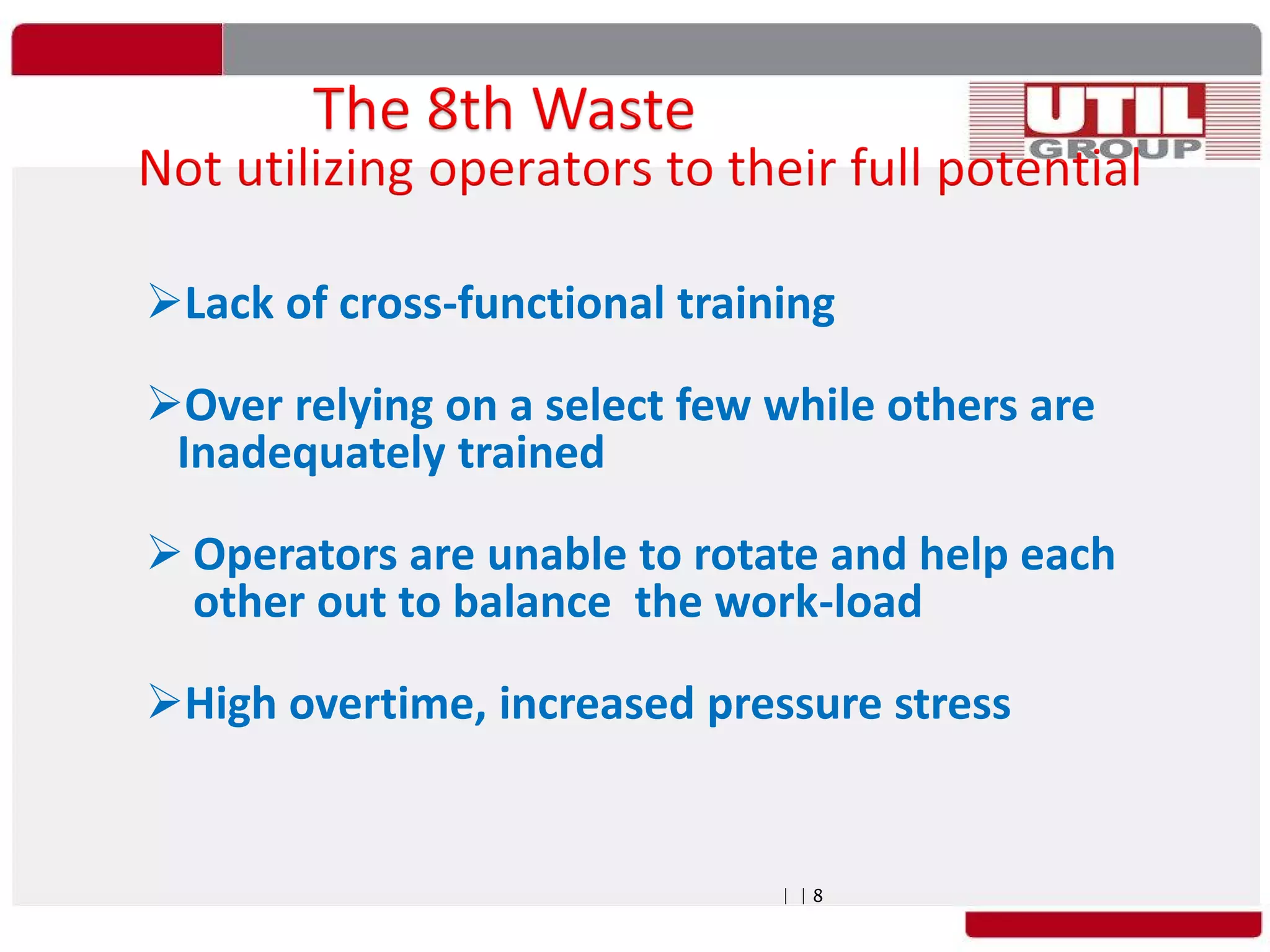
8. Underutilized People
Non-Value Added
5%
| | 8
Lack of cross-functional training
Over relying on a select few while others are
Inadequately trained
 Operators are unable to rotate and help each
other out to balance the work-load
High overtime, increased pressure stress
• Cycle Time is dictated by the slowest (bottleneck) operation in the
cell.
40
min
20
min
25
min
15
min
30
min
1
54
3
2
•What operation controls the cycle?
•How can you relieve the bottleneck?
P1 P2 P3 P4 Min/Pcs=
Min/Pc 20 40 12 20
P1 P2 P3 P4 Min/Pcs=
Min/Pc 25 30 22 25
P1 P2 P3 P4 Min/Pcs=
Min/Pc 25 25 27 25
What is the cycle time of each process
Spot the bottleneck
Bottleneck Management:
•Maintain buffer in front of bottleneck
– (never starve the bottleneck !)
•Improve bottleneck operation
•Cross train on bottleneck
– Improve Tooling/Equipment or Process
– Balance activities / operations
11
Cost of Poor Quality (COPQ)
Not Doing What is Right the First Time
12
Lost managemant
time cost
Maintenance
cost
Lost opportunity
Lost assets cost
Rerun cost
Lost
business,
goodwill cost
Lost
credibility
cost
Prevention cost
appraisal cost
Project
rework cost
Litigation
SS Titanic
Management
Waste Costs:
Costs driven by problems and process steps that add no value
to products & services delivered to customers
Appraisal Costs:
Costs incurred to determine the degree
of conformance to customer needs
Prevention Costs:
Costs incurred to keep failure and
appraisal costs to a minimum
Failure Costs:
Costs directly incurred
due to defects internal
to the system or after
delivery to the
customer
Basic Lean Concepts
Poke yoke = Error Proofing
• Eliminate/minimize chance for human error
to avoid mistakes
– Prevention Poke Yoke
• Stops the process before failures occur
• Does not allow defects to pass through the process
5 STEPS IN LEAN
• The Five Principles of “Lean Thinking”
1. Define TAKT TIME (min/pc)
2. Map the value stream
3. Eliminating waste, NON-VALUE ADD
4. Continuous Flow production
5. Pursue perfection (continual improvement)
14
What is SMED?
Helping
Our Customers Be More
Successful . . .
SMED stands for:
Single Minute Exchange of Die, methodology
used to reduce setup/changeover time on
machines, equipment
• Developed by TOYOTA for the Japanese Auto
• TOYOTA reduced 3 day car assembly setup
time into 8 min (single minutes)
• That is the reason why TOYOTA called it
Single Minute Exchange Die
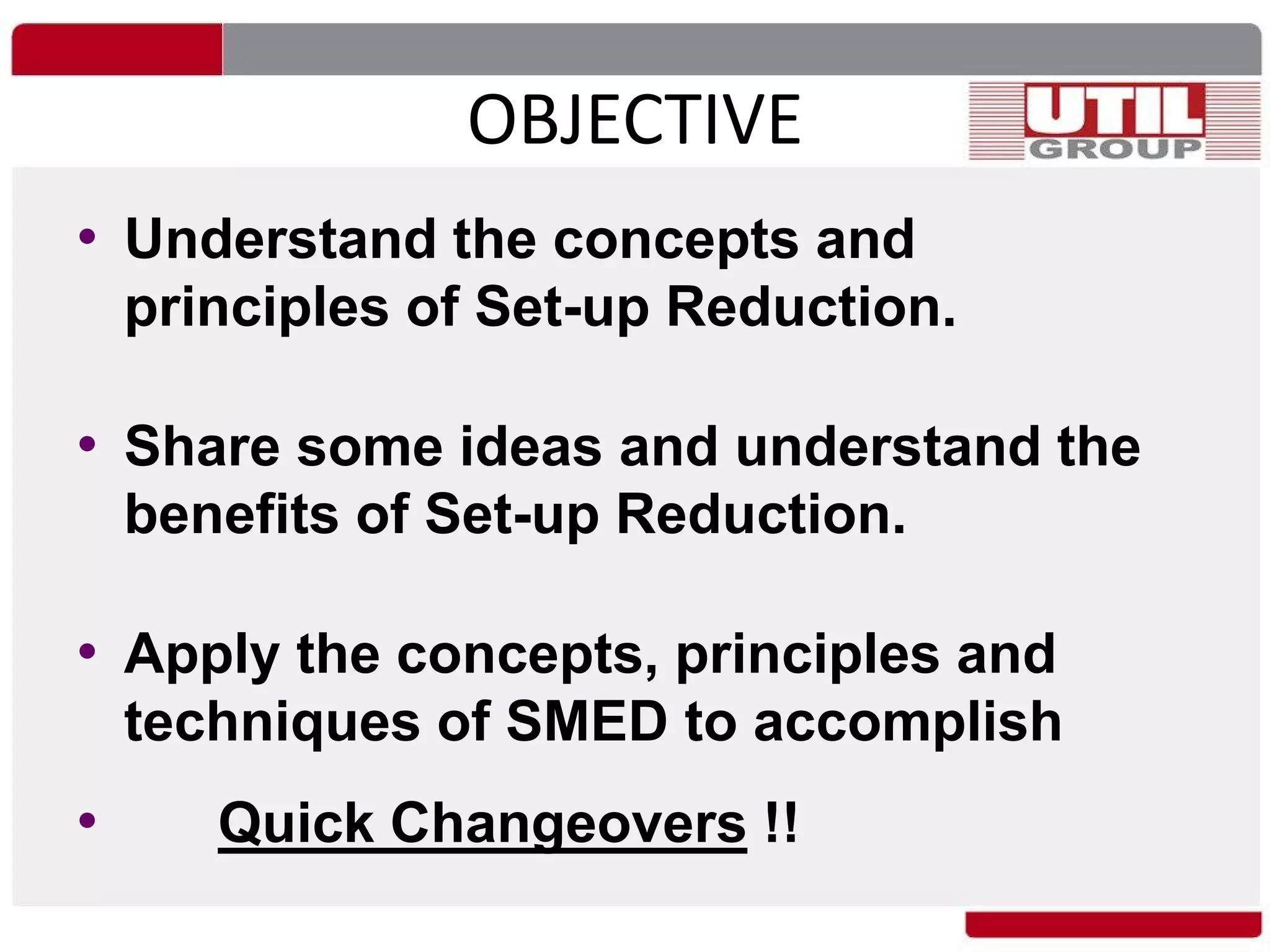
OBJECTIVE
• Understand the concepts and
principles of Set-up Reduction.
• Share some ideas and understand the
benefits of Set-up Reduction.
• Apply the concepts, principles and
techniques of SMED to accomplish
• Quick Changeovers !!
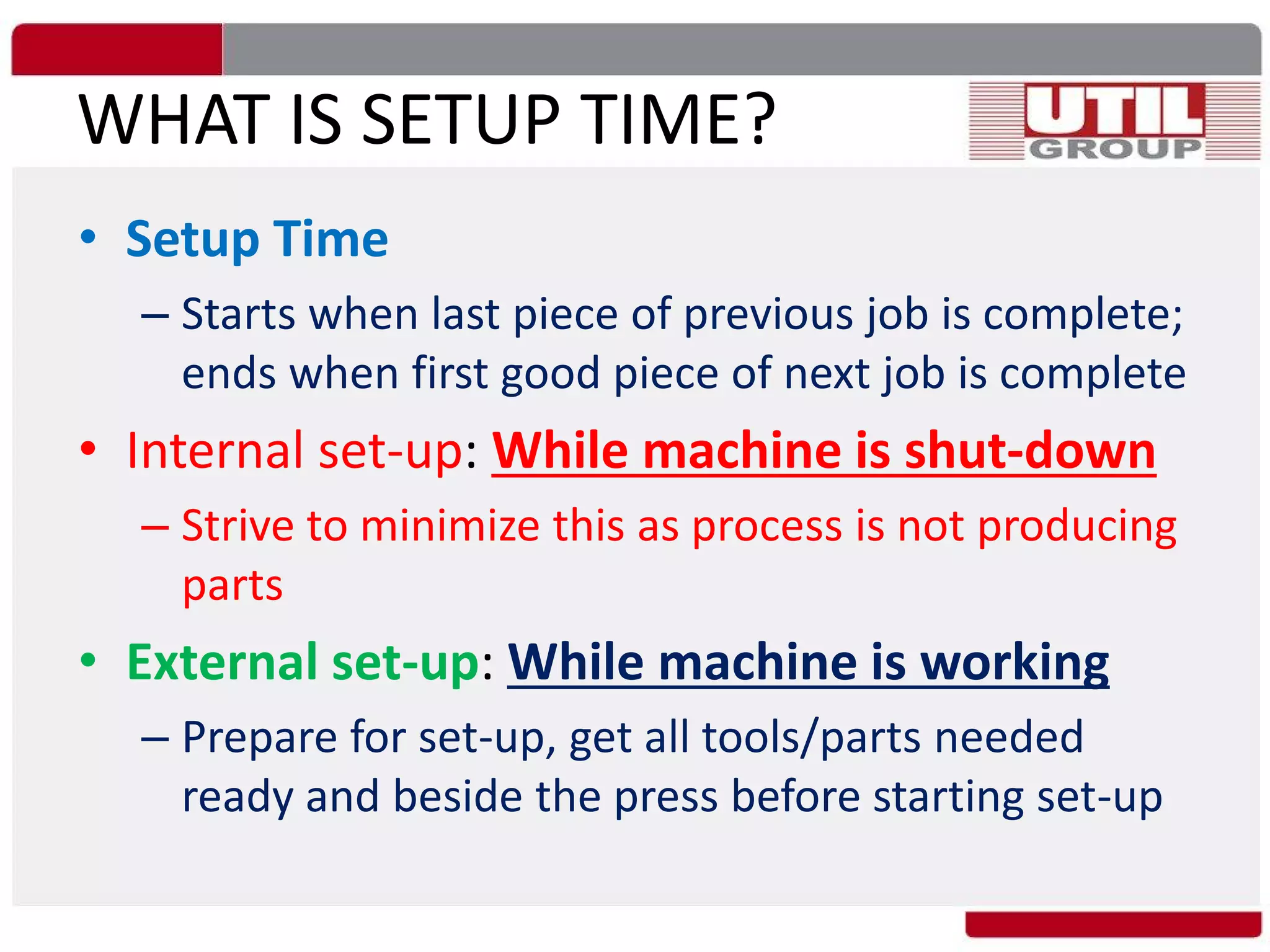
WHAT IS SETUP TIME?
• Setup Time
– Starts when last piece of previous job is complete;
ends when first good piece of next job is complete
• Internal set-up: While machine is shut-down
– Strive to minimize this as process is not producing
parts
• External set-up: While machine is working
– Prepare for set-up, get all tools/parts needed
ready and beside the press before starting set-up
Examples Internal vs External
• Internal setup:
• Removing dies and tooling from press, adjusting
Die and shut height in the press, feeding coil into
straightener,
• External setup:
• Checking work order for next job, preparing
needed tools, Staging dies tools, coils for next set-
up, moving coils to the press, inspecting parts,
DIE changeover
Current setup time= 60min
Target setup Time < 15min
How do you do it?
• Next Slide
7 STEPS TO SMED
• 1 Observe video record current set-up process
• 2. Separate Internal and External elements.
• 3. Improve/simplify each setup STEP
• 4. Observe video record NEW set-up process.
• 5 Standardize changeover across all 3 shifts
• 6. Develop Standardize Operating Procedure .
• 7. Track results and deploy on other presses
Apply SMED Changeover method
Review Time Observation and Video
with the team
 Identify opportunities
 Internal vs. External
 Value Added Vs Non-Value Added
 Normal vs. Abnormal
 Seven Types of Waste
 Automatic, Manual, Walking,
 and Waiting times
 Solicit ideas for countermeasures /
improvements
SMED 1000T Punch Press
Automotive Suspension Parts
By Julian Kalac
SETUP ISSUES
• Press Frequent changeover dies 2/day
• Die setup = 2hrs,
• Coil Feeder setup = 1.5hrs
• Conveyor setup= 45min
• Part Chute assy setup = 40min
Die Issues
• Progressive Dies large 6”x 4” loaded by forklift,
• Start of next job not known
• Die requires inspection and first off sign off
• Coils 10.000 lbs only 1 feeder one crane
• Die shut height different for each die
• Each Die has to be located differently in
bolster plate
• 56 bolts x different lengths 8” to 12” length)
used in die setup
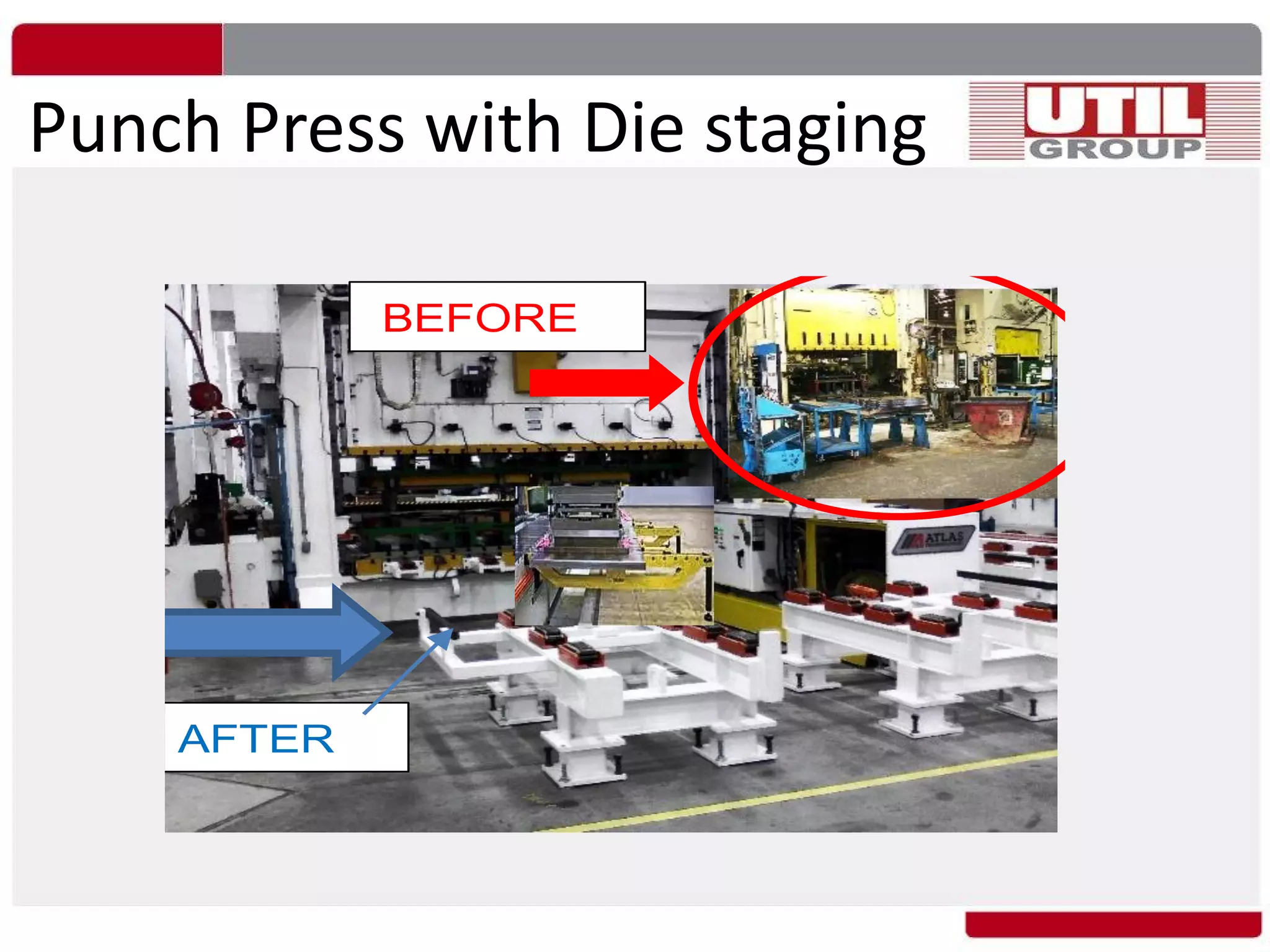
SMED PRESS SETUP
o Standardized Die Carts & shadow bo
o Documented SOP and validated set-
 Reduced setup/changeover time from 4hrs t
Setup/Changeover T
BEFORE
AFTER
Punch Press with Die staging
DIES ORGANIZED
Department Reference #
Confirmed ByProcess Owner Date Chapter Rev. PageIssuer
1 of 111
1000 Ton Press
102013Jan KrolOperatorJULIAN KALAC
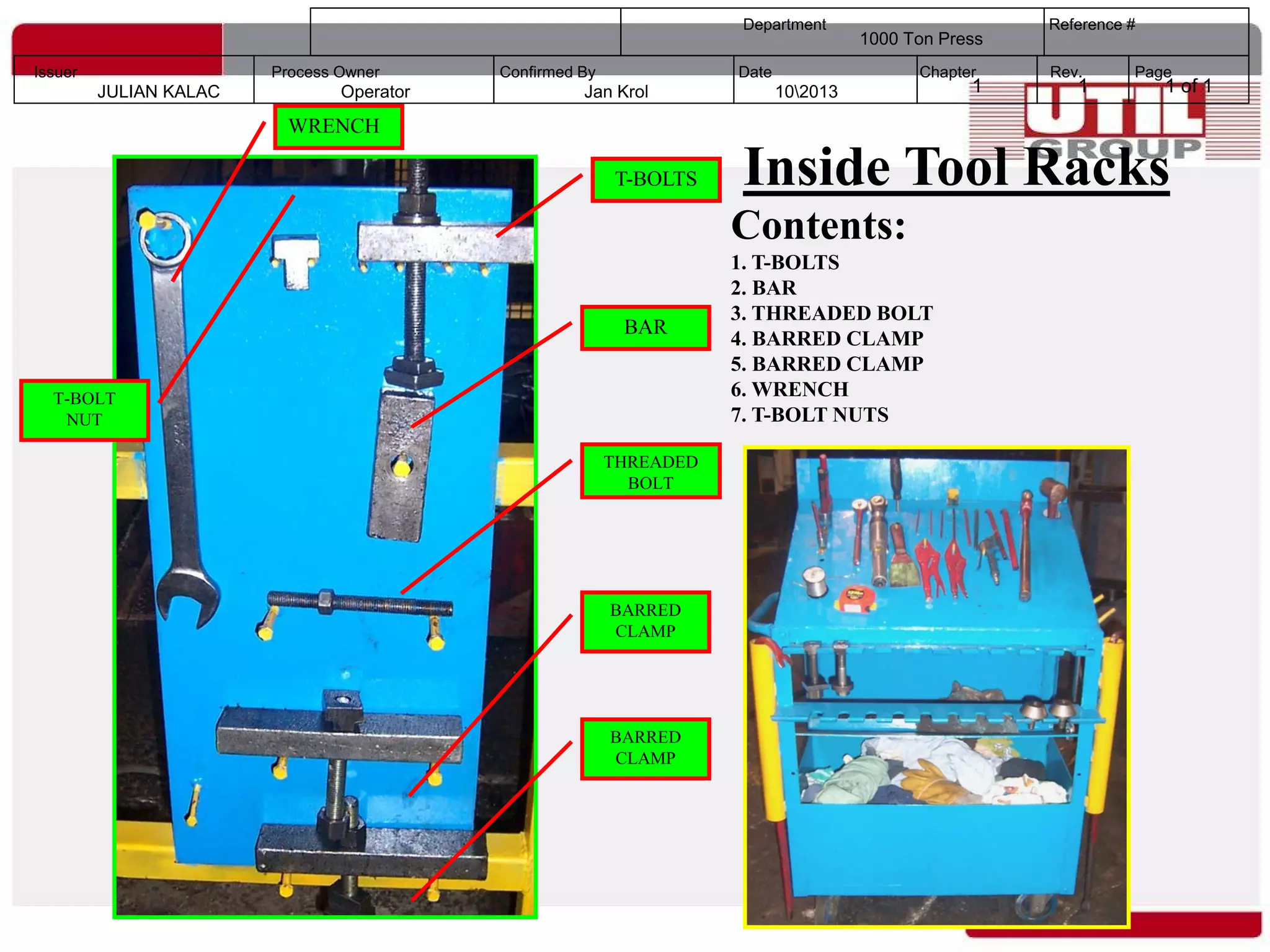
Inside Tool Racks
Contents:
1. T-BOLTS
2. BAR
3. THREADED BOLT
4. BARRED CLAMP
5. BARRED CLAMP
6. WRENCH
7. T-BOLT NUTS
BAR
WRENCH
T-BOLTS
THREADED
BOLT
BARRED
CLAMP
BARRED
CLAMP
T-BOLT
NUT
SMED Tool ideas
SMED coil Ideas
Die Shadow Box
1. Only the final turn on a bolt
adds value
2. The interrupted screw (or
interrupted thread) provides
one means of clamping and unclamping
something quickly. Artillery breeches have been
sealed in this manner since the nineteenth
century.
DIFFERENT BOLTS/SCREWS
Next step
• Need 1 team from each shift to Video record
coil changeover
• Review the video find ways to reduce the
changeover time by 50%
• Simplify the setup and verify across all 3 shifts
• Video record the improvements
• Document it into a Standard Operating
Procedure (SOP)
• Train all other crews/operators on the SOP
| | 36

LEAN SMED TRAINING FOR SUPERVISORS AND OPERATORS

  • 1.
    Introduction to Set-upReduction / Quick Changeover Concepts December 7 2016 Julian Kalac
  • 2.
  • 3.
  • 4.
    • Identification andsystemic elimination of non- value add costs and re-alignment of resources to deliver value to the customer faster, better, & more consistently • Lean in Manufacturing: – Focus: Eliminate waste, non-value add steps, process constraints and bottle necks that cause problems in work throughput – Approach: Intuitive and broad - “inch-deep, mile wide” 4 What is Lean? Leading to Leading toEliminate Waste Reduced Cycle Times Increased Capacity
  • 5.
    Defining Lean • “Asystematic approach to identifying & ELIMINATING WASTE (NON-VALUE-ADDED ACTIVITIES) through the implementation of CUSTOMER PULL SYSTEM, CONTINUOUS ONE PIECE FLOW AND IDENTIFYING AND IMPROVING PROCESS BOTTLENECKS.” Lean has been defined in many different ways. Leading to Leading to Eliminate Waste Reduced Cycle Times Increased Capacity
  • 6.
    Process Value Added Adds valueto the output and customer is willing to pay for. Optimize Non- Value AddedDoes not add value to the output, and customer isn’t willing to pay for. Eliminate Business-Value Added Does not add value to output, customer will not pay for, but is necessary. (Legal, Safety, Etc.) Minimize LEAN VALUE ADD/NON VALUE ADD
  • 7.
    Eliminating the Wastes ValueAdded Typically 95% of all lead time is non-value added 1. Overproduction 2. Waiting 3. Transportation 4. Non-Value Added Processing 5. Excess Inventory/Material 6. Defects 7. Excess Motion 8. Underutilized People Non-Value Added 5%
  • 8.
    | | 8 Lackof cross-functional training Over relying on a select few while others are Inadequately trained  Operators are unable to rotate and help each other out to balance the work-load High overtime, increased pressure stress
  • 9.
    • Cycle Timeis dictated by the slowest (bottleneck) operation in the cell. 40 min 20 min 25 min 15 min 30 min 1 54 3 2 •What operation controls the cycle? •How can you relieve the bottleneck?
  • 10.
    P1 P2 P3P4 Min/Pcs= Min/Pc 20 40 12 20 P1 P2 P3 P4 Min/Pcs= Min/Pc 25 30 22 25 P1 P2 P3 P4 Min/Pcs= Min/Pc 25 25 27 25 What is the cycle time of each process Spot the bottleneck
  • 11.
    Bottleneck Management: Bottleneck Management: •Maintainbuffer in front of bottleneck – (never starve the bottleneck !) •Improve bottleneck operation •Cross train on bottleneck – Improve Tooling/Equipment or Process – Balance activities / operations 11
  • 12.
    Cost of PoorQuality (COPQ) Not Doing What is Right the First Time 12 Lost managemant time cost Maintenance cost Lost opportunity Lost assets cost Rerun cost Lost business, goodwill cost Lost credibility cost Prevention cost appraisal cost Project rework cost Litigation SS Titanic Management Waste Costs: Costs driven by problems and process steps that add no value to products & services delivered to customers Appraisal Costs: Costs incurred to determine the degree of conformance to customer needs Prevention Costs: Costs incurred to keep failure and appraisal costs to a minimum Failure Costs: Costs directly incurred due to defects internal to the system or after delivery to the customer
  • 13.
    Basic Lean Concepts Pokeyoke = Error Proofing • Eliminate/minimize chance for human error to avoid mistakes – Prevention Poke Yoke • Stops the process before failures occur • Does not allow defects to pass through the process
  • 14.
    5 STEPS INLEAN • The Five Principles of “Lean Thinking” 1. Define TAKT TIME (min/pc) 2. Map the value stream 3. Eliminating waste, NON-VALUE ADD 4. Continuous Flow production 5. Pursue perfection (continual improvement) 14
  • 15.
    What is SMED? Helping OurCustomers Be More Successful . . . SMED stands for: Single Minute Exchange of Die, methodology used to reduce setup/changeover time on machines, equipment • Developed by TOYOTA for the Japanese Auto • TOYOTA reduced 3 day car assembly setup time into 8 min (single minutes) • That is the reason why TOYOTA called it Single Minute Exchange Die
  • 16.
    OBJECTIVE • Understand theconcepts and principles of Set-up Reduction. • Share some ideas and understand the benefits of Set-up Reduction. • Apply the concepts, principles and techniques of SMED to accomplish • Quick Changeovers !!
  • 17.
    WHAT IS SETUPTIME? • Setup Time – Starts when last piece of previous job is complete; ends when first good piece of next job is complete • Internal set-up: While machine is shut-down – Strive to minimize this as process is not producing parts • External set-up: While machine is working – Prepare for set-up, get all tools/parts needed ready and beside the press before starting set-up
  • 18.
    Examples Internal vsExternal • Internal setup: • Removing dies and tooling from press, adjusting Die and shut height in the press, feeding coil into straightener, • External setup: • Checking work order for next job, preparing needed tools, Staging dies tools, coils for next set- up, moving coils to the press, inspecting parts,
  • 19.
    DIE changeover Current setuptime= 60min Target setup Time < 15min How do you do it? • Next Slide
  • 21.
    7 STEPS TOSMED • 1 Observe video record current set-up process • 2. Separate Internal and External elements. • 3. Improve/simplify each setup STEP • 4. Observe video record NEW set-up process. • 5 Standardize changeover across all 3 shifts • 6. Develop Standardize Operating Procedure . • 7. Track results and deploy on other presses
  • 22.
    Apply SMED Changeovermethod Review Time Observation and Video with the team  Identify opportunities  Internal vs. External  Value Added Vs Non-Value Added  Normal vs. Abnormal  Seven Types of Waste  Automatic, Manual, Walking,  and Waiting times  Solicit ideas for countermeasures / improvements
  • 23.
    SMED 1000T PunchPress Automotive Suspension Parts By Julian Kalac
  • 24.
    SETUP ISSUES • PressFrequent changeover dies 2/day • Die setup = 2hrs, • Coil Feeder setup = 1.5hrs • Conveyor setup= 45min • Part Chute assy setup = 40min
  • 25.
    Die Issues • ProgressiveDies large 6”x 4” loaded by forklift, • Start of next job not known • Die requires inspection and first off sign off • Coils 10.000 lbs only 1 feeder one crane • Die shut height different for each die • Each Die has to be located differently in bolster plate • 56 bolts x different lengths 8” to 12” length) used in die setup
  • 26.
  • 27.
    o Standardized DieCarts & shadow bo o Documented SOP and validated set-  Reduced setup/changeover time from 4hrs t Setup/Changeover T BEFORE AFTER Punch Press with Die staging
  • 28.
  • 29.
    Department Reference # ConfirmedByProcess Owner Date Chapter Rev. PageIssuer 1 of 111 1000 Ton Press 102013Jan KrolOperatorJULIAN KALAC Inside Tool Racks Contents: 1. T-BOLTS 2. BAR 3. THREADED BOLT 4. BARRED CLAMP 5. BARRED CLAMP 6. WRENCH 7. T-BOLT NUTS BAR WRENCH T-BOLTS THREADED BOLT BARRED CLAMP BARRED CLAMP T-BOLT NUT
  • 30.
  • 31.
  • 32.
  • 33.
    1. Only thefinal turn on a bolt adds value 2. The interrupted screw (or interrupted thread) provides one means of clamping and unclamping something quickly. Artillery breeches have been sealed in this manner since the nineteenth century. DIFFERENT BOLTS/SCREWS
  • 34.
    Next step • Need1 team from each shift to Video record coil changeover • Review the video find ways to reduce the changeover time by 50% • Simplify the setup and verify across all 3 shifts • Video record the improvements • Document it into a Standard Operating Procedure (SOP) • Train all other crews/operators on the SOP
  • 35.