PRODUCTION PART APPROVAL PROCESS  (PPAP)
Production Part Approval Process  Understanding ISO/TS 16949:2002 Basic requirements  Overview of PPAP requirements  Understanding of  Submission Level Process Flow Process FMEA  Capability Study MSA
 
Production Part Approval Process  Objectives:   Understand when PPAP submissions are required   Understand requirements for PPAP submissions   Understand the different PPAP submission levels   Understanding of the forms used for PPAP submissions   Understanding where the PPAP submission fits into the  APQP  cycle   
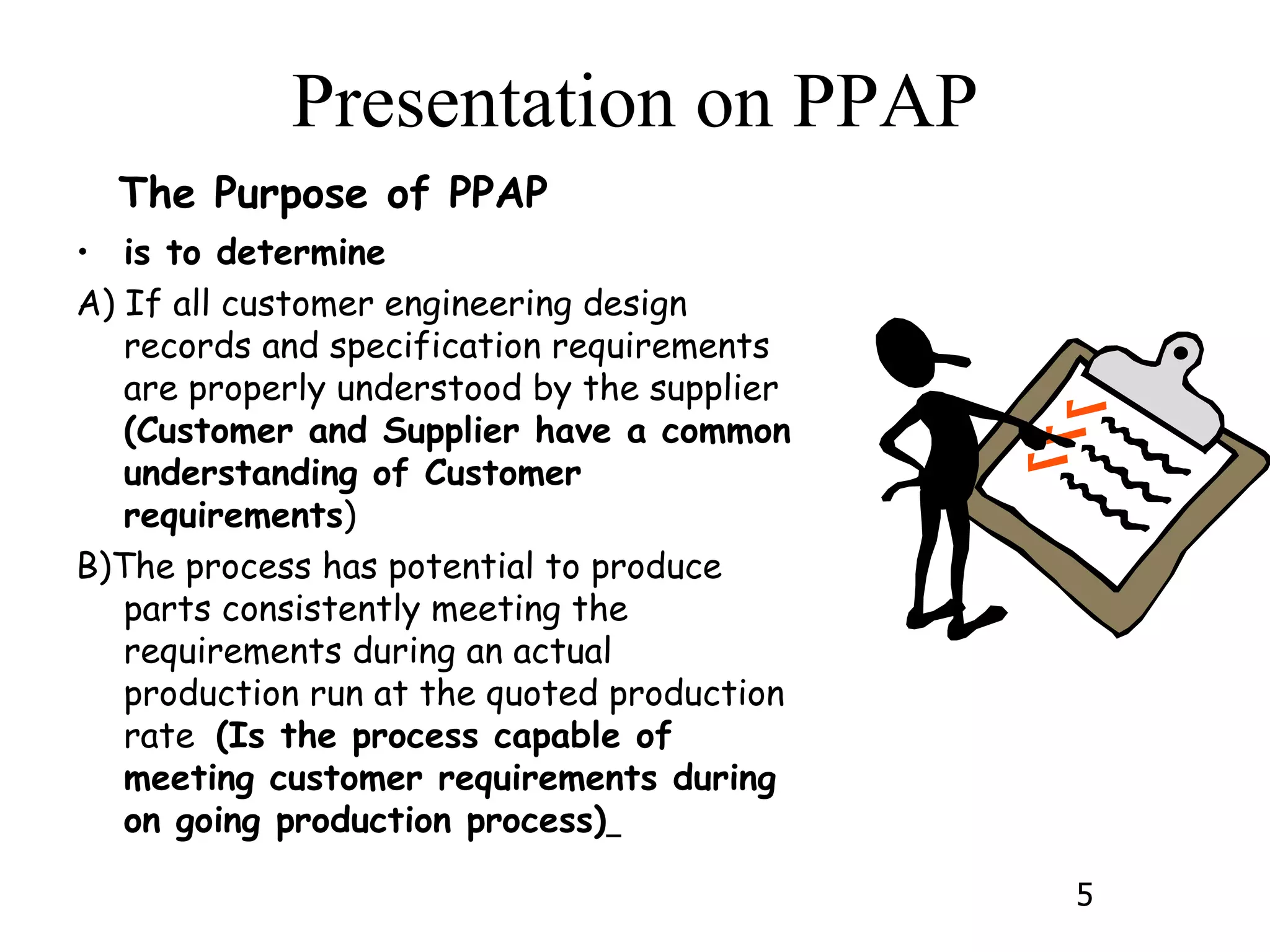
The Purpose of PPAP is to determine   A) If all customer engineering design records and specification requirements are properly understood by the supplier  (Customer and Supplier have a common understanding of Customer requirements )  B)The process has potential to produce parts consistently meeting the requirements during an actual production run at the quoted production rate  (Is the process capable of meeting customer requirements during on going production process)
Applicability of PPAP PPAP shall apply to External and internal suppliers sites of: Bulk Material  Production Material Production Parts  Service Parts For Bulk material PPAP is not required unless asked by the customer. A supplier of production parts / service parts shall comply with the PPAP requirements  unless the same is  formally waived by the Customer (documented evidences should be available)
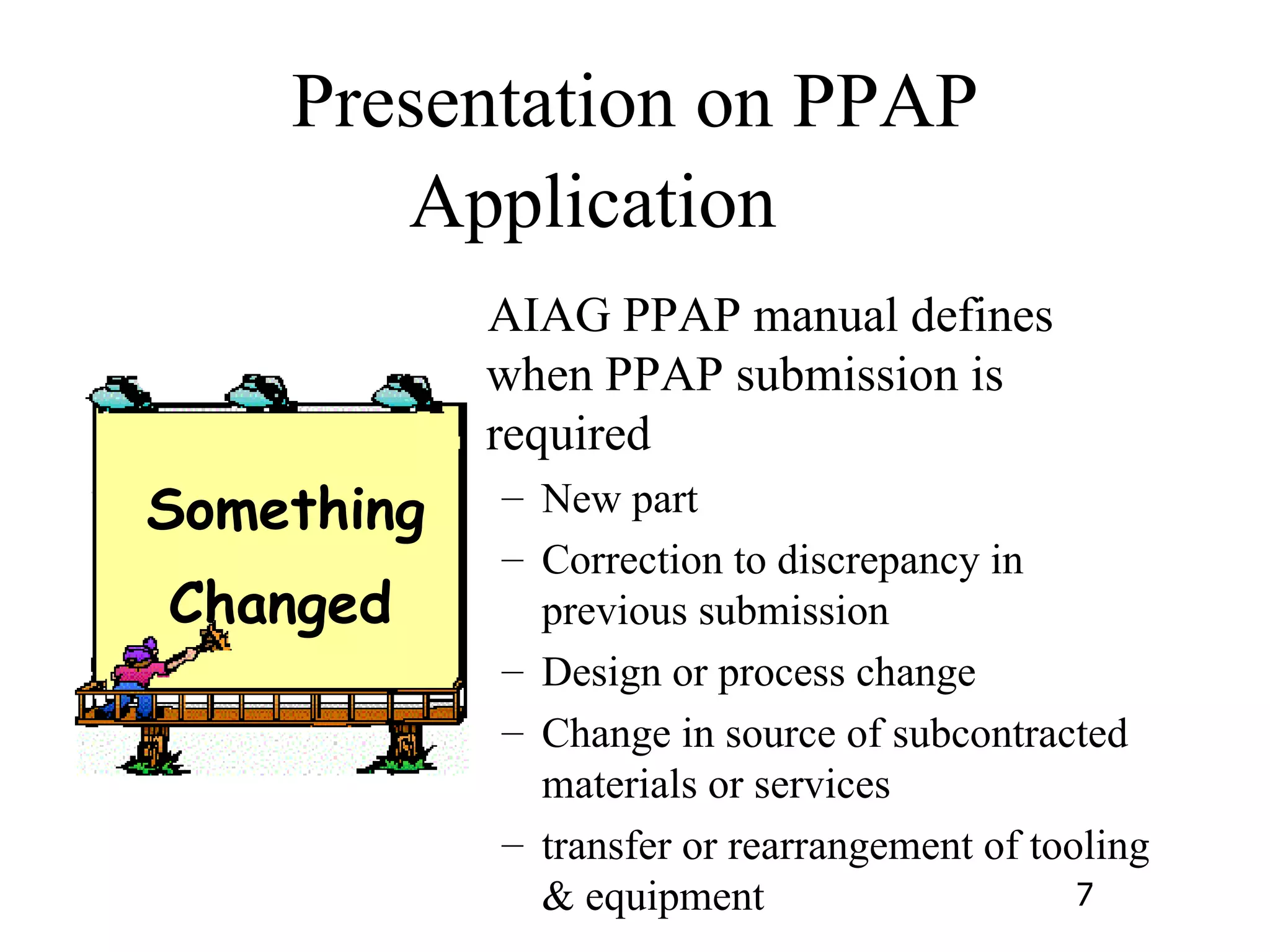
Application AIAG PPAP manual defines when PPAP submission is required  New part Correction to discrepancy in previous submission Design or process change Change in source of subcontracted materials or services transfer or rearrangement of tooling & equipment Something Changed
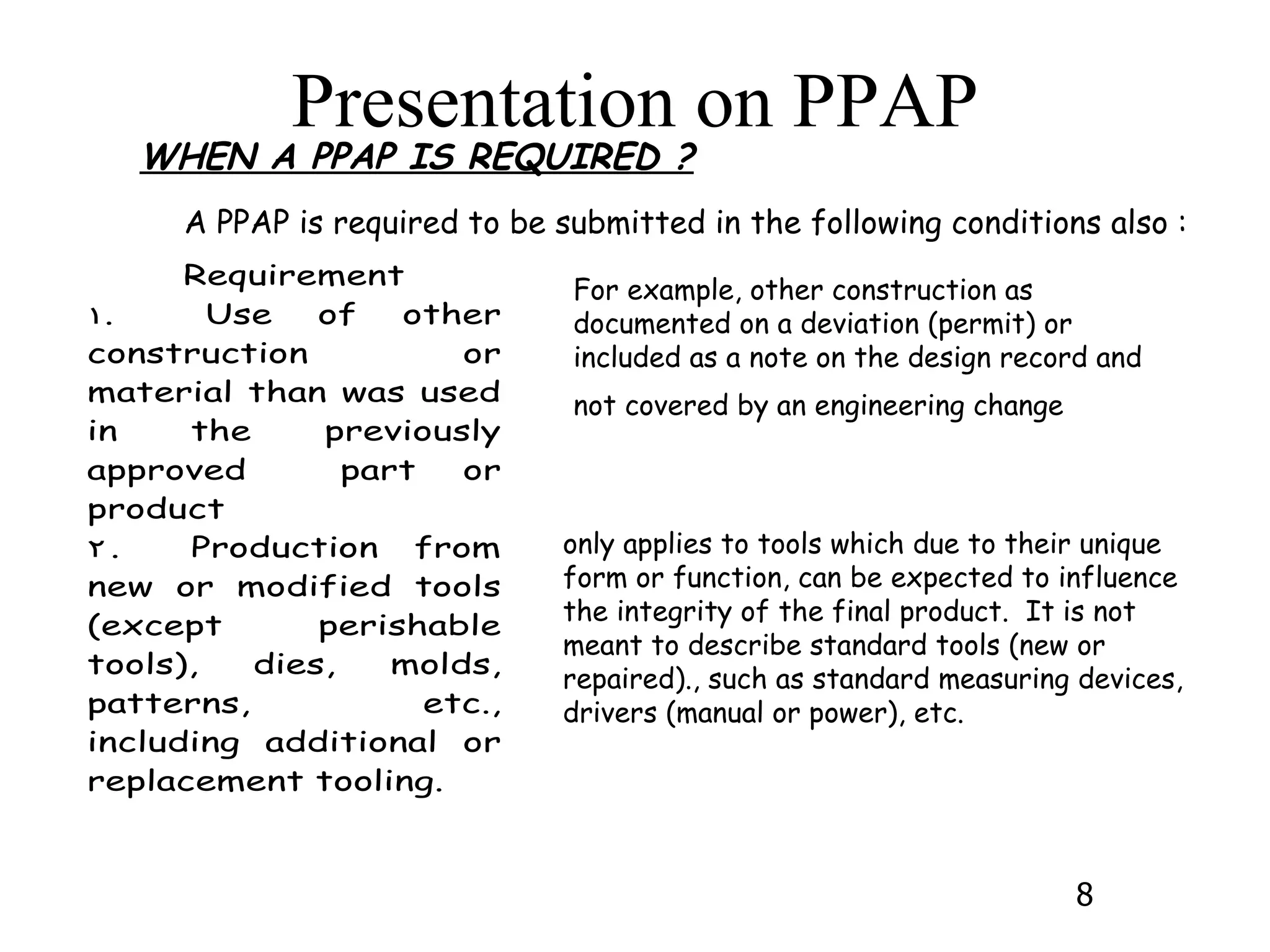
WHEN A PPAP IS REQUIRED ? A PPAP is required to be submitted in the following conditions also : For example, other construction as documented on a deviation (permit) or included as a note on the design record and not covered by an engineering change   only applies to tools which due to their unique form or function, can be expected to influence the integrity of the final product.  It is not meant to describe standard tools (new or repaired)., such as standard measuring devices, drivers (manual or power), etc.
WHEN A PPAP IS REQUIRED ? Refurbishment means the reconstruction and/or modification of a tool or machine or to increase the capacity, performance, or change its existing function (Not normal maintenance, repair etc..) Rearrangement is defined as activity which changes the sequence of product/process flow from that documented in the process flow diagram (including the addition of a  new process). minor changes to add to safety requirements can be made with out customer approval, provided these changes does not lead to a change in the process flow sequence
WHEN A PPAP IS REQUIRED ? Production process tooling and/or equipment transferred between buildings or facilities in one or more locations. Suppliers are responsible for approval of subcontracted material and services that do not affect customer fit, form, function, durability, or performance requirements.
WHEN A PPAP IS REQUIRED ? For product that has been produced  after tooling has been inactive for twelve months or more,   Notification is required when the part has had no active purchase order and the existing tooling has been inactive for volume production  for twelve months or more .  The only exception  is when the part has low volume e.g. service or specialty vehicles.  However, a customer may specify certain PPAP requirements for service parts.
WHEN A PPAP IS REQUIRED ? Any change after, which affects customer requirements for fit, form, function, performance, and/or durability requires notification to the customer. NOTE: The fit, form, function, performance, and/or durability requirements should be part of customer specifications as agreed on during contract review.
WHEN A PPAP IS REQUIRED ? These changes would normally be expected to have an effect on the performance of the product.
WHEN A PPAP IS REQUIRED ? For change in test method, supplier should have evidence that the new method provides results equivalent to the old method.
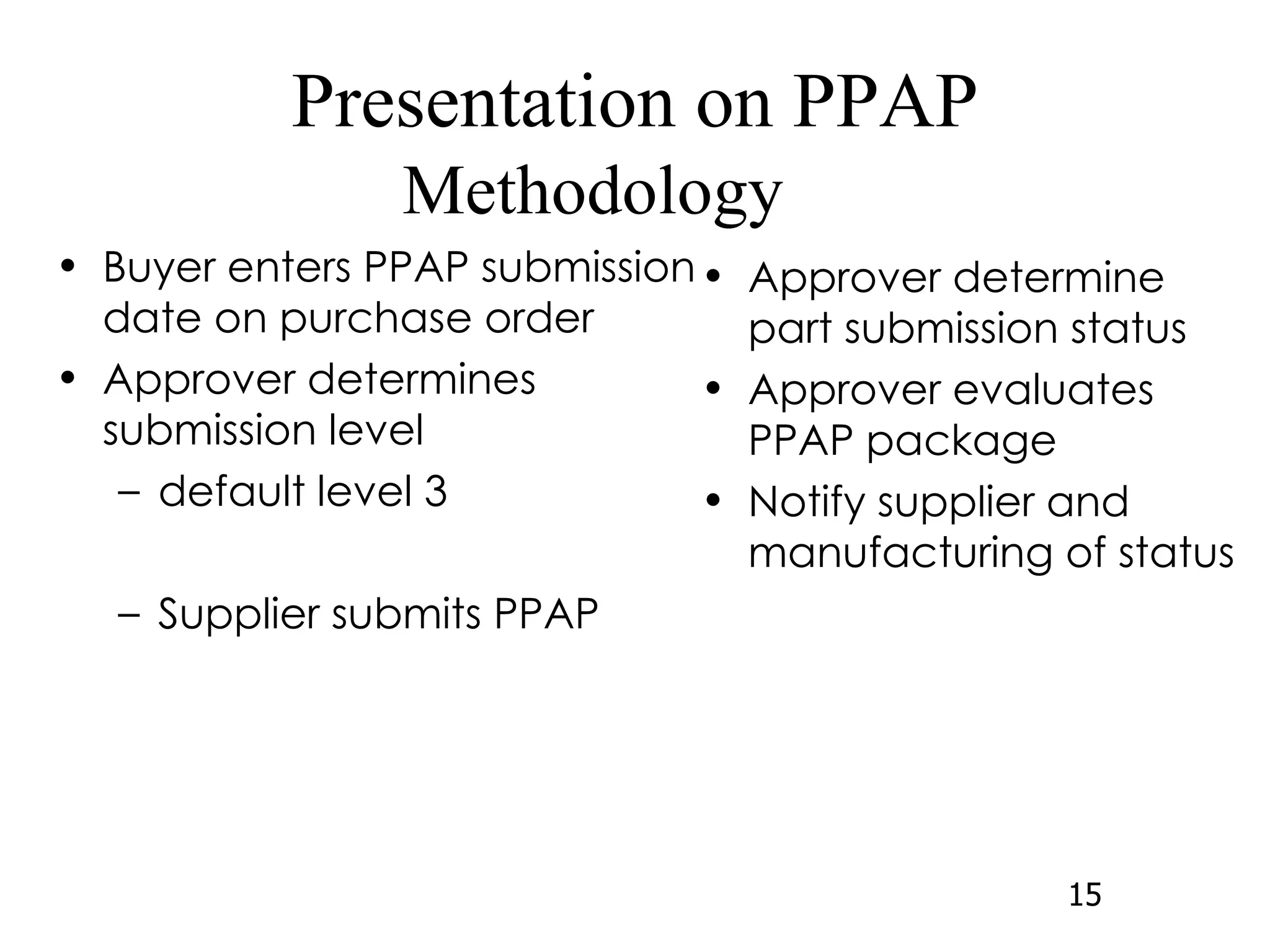
Methodology Buyer enters PPAP submission date on purchase order Approver determines submission level default level 3 Supplier submits PPAP Approver determine part submission status  Approver evaluates PPAP package Notify supplier and manufacturing of status
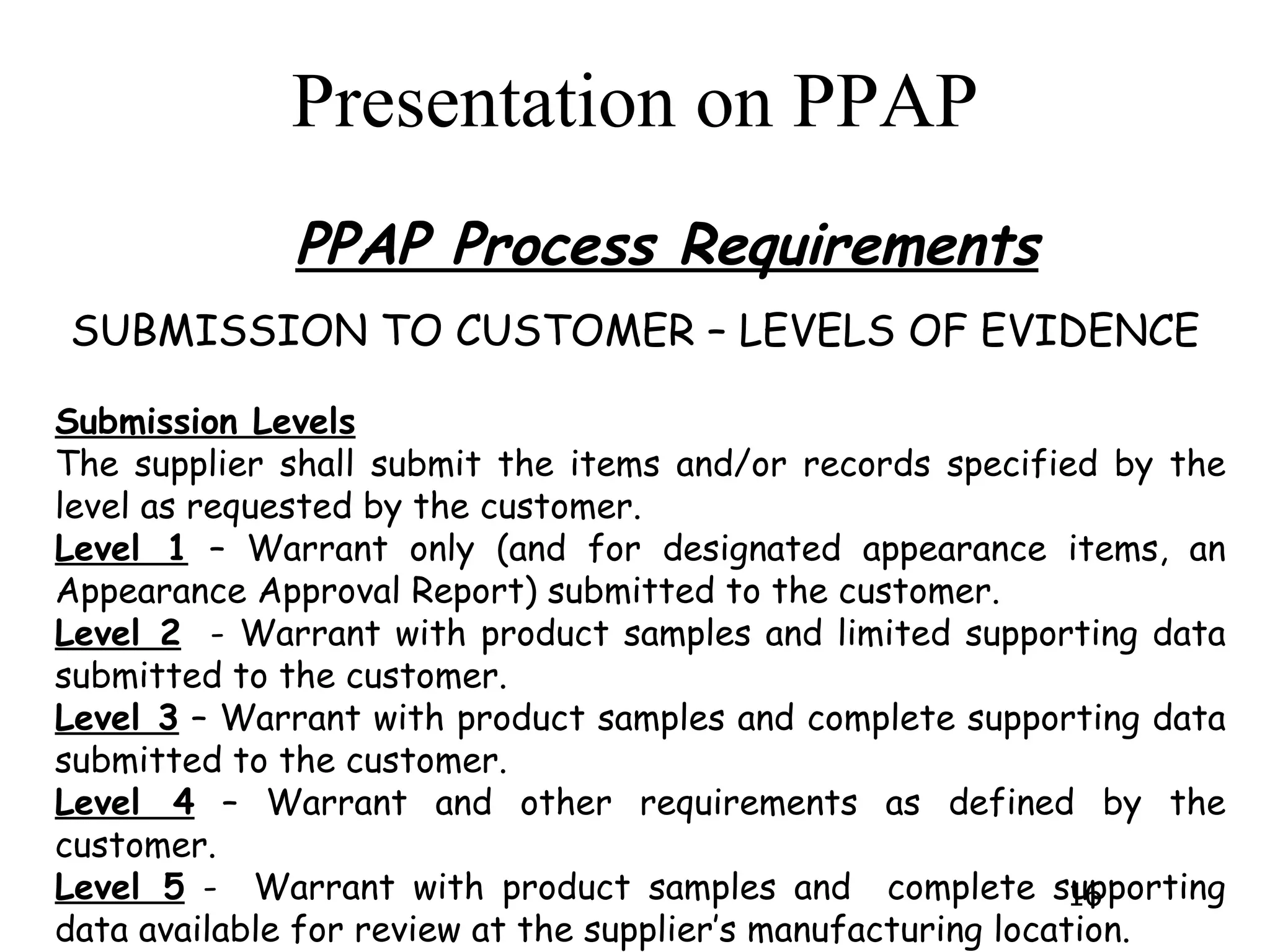
PPAP Process Requirements SUBMISSION TO CUSTOMER – LEVELS OF EVIDENCE Submission Levels The supplier shall submit the items and/or records specified by the level as requested by the customer. Level 1  – Warrant only (and for designated appearance items, an Appearance Approval Report) submitted to the customer. Level 2   - Warrant with product samples and limited supporting data submitted to the customer. Level 3  – Warrant with product samples and complete supporting data submitted to the customer. Level 4  – Warrant and other requirements as defined by the customer. Level 5  -  Warrant with product samples and  complete supporting data available for review at the supplier’s manufacturing location.
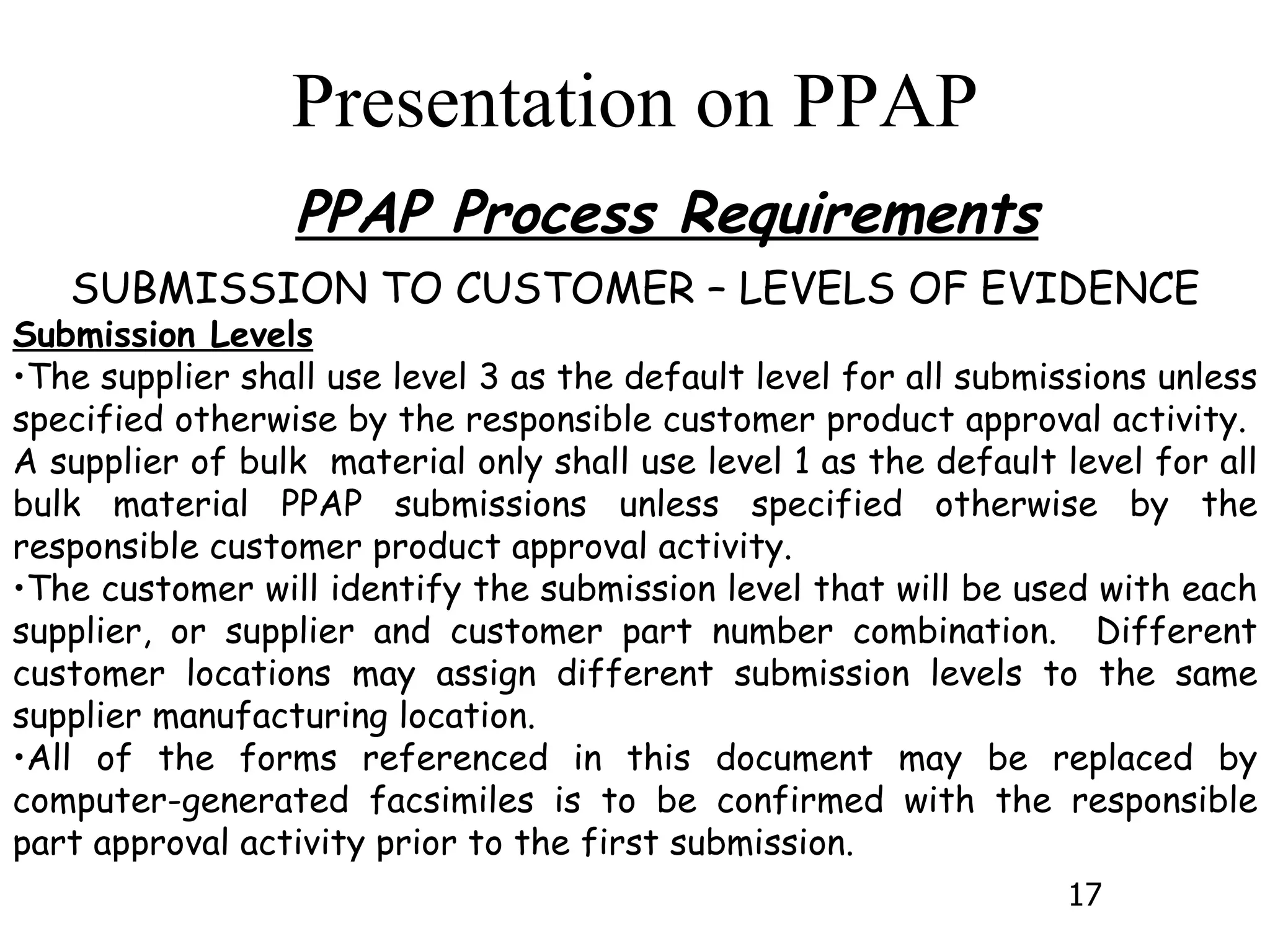
PPAP Process Requirements SUBMISSION TO CUSTOMER – LEVELS OF EVIDENCE Submission Levels The supplier shall use level 3 as the default level for all submissions unless specified otherwise by the responsible customer product approval activity.  A supplier of bulk  material only shall use level 1 as the default level for all bulk material PPAP submissions unless specified otherwise by the responsible customer product approval activity. The customer will identify the submission level that will be used with each supplier, or supplier and customer part number combination.  Different customer locations may assign different submission levels to the same supplier manufacturing location. All of the forms referenced in this document may be replaced by computer-generated facsimiles is to be confirmed with the responsible part approval activity prior to the first submission.
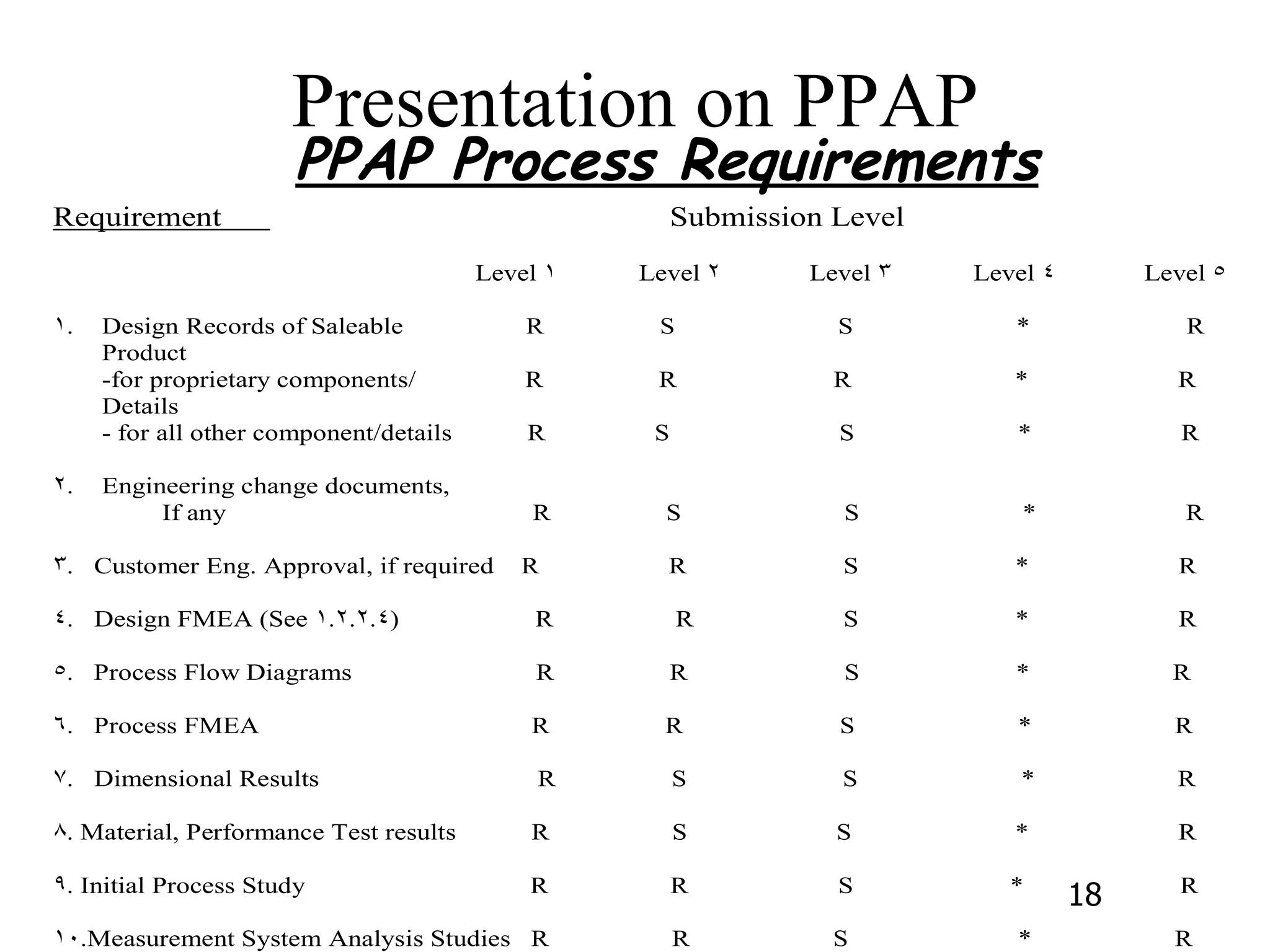
PPAP Process Requirements
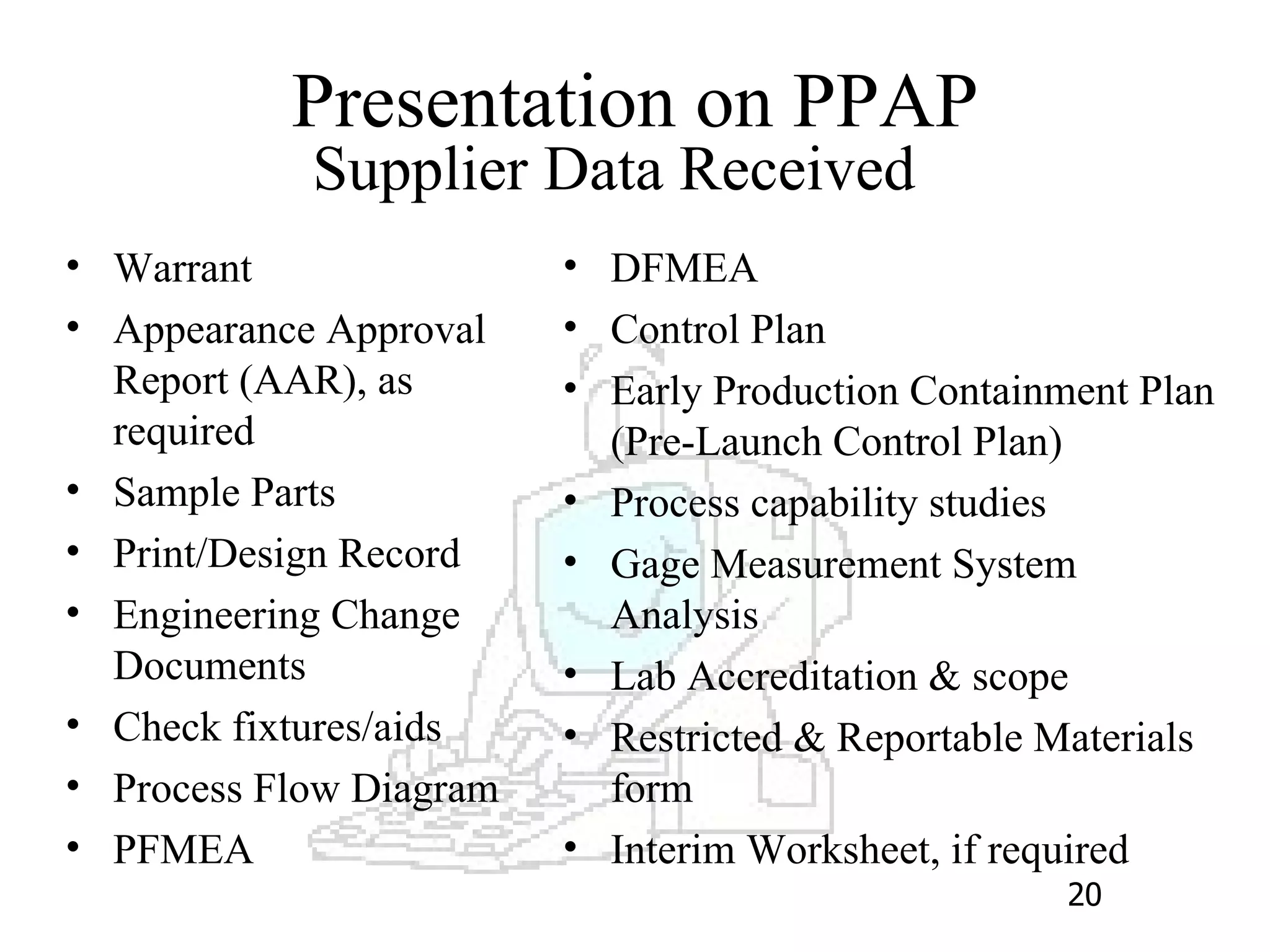
DFMEA Control Plan Early Production Containment Plan (Pre-Launch Control Plan) Process capability studies Gage Measurement System Analysis Lab Accreditation & scope Restricted & Reportable Materials form Interim Worksheet, if required Supplier Data Received Warrant Appearance Approval Report (AAR), as required Sample Parts Print/Design Record Engineering Change Documents Check fixtures/aids Process Flow Diagram PFMEA

PPAP

  • 1.
  • 2.
    Production Part ApprovalProcess Understanding ISO/TS 16949:2002 Basic requirements Overview of PPAP requirements Understanding of Submission Level Process Flow Process FMEA Capability Study MSA
  • 3.
  • 4.
    Production Part ApprovalProcess Objectives:   Understand when PPAP submissions are required   Understand requirements for PPAP submissions   Understand the different PPAP submission levels   Understanding of the forms used for PPAP submissions   Understanding where the PPAP submission fits into the APQP cycle   
  • 5.
    The Purpose ofPPAP is to determine A) If all customer engineering design records and specification requirements are properly understood by the supplier (Customer and Supplier have a common understanding of Customer requirements ) B)The process has potential to produce parts consistently meeting the requirements during an actual production run at the quoted production rate (Is the process capable of meeting customer requirements during on going production process)
  • 6.
    Applicability of PPAPPPAP shall apply to External and internal suppliers sites of: Bulk Material Production Material Production Parts Service Parts For Bulk material PPAP is not required unless asked by the customer. A supplier of production parts / service parts shall comply with the PPAP requirements unless the same is formally waived by the Customer (documented evidences should be available)
  • 7.
    Application AIAG PPAPmanual defines when PPAP submission is required New part Correction to discrepancy in previous submission Design or process change Change in source of subcontracted materials or services transfer or rearrangement of tooling & equipment Something Changed
  • 8.
    WHEN A PPAPIS REQUIRED ? A PPAP is required to be submitted in the following conditions also : For example, other construction as documented on a deviation (permit) or included as a note on the design record and not covered by an engineering change only applies to tools which due to their unique form or function, can be expected to influence the integrity of the final product. It is not meant to describe standard tools (new or repaired)., such as standard measuring devices, drivers (manual or power), etc.
  • 9.
    WHEN A PPAPIS REQUIRED ? Refurbishment means the reconstruction and/or modification of a tool or machine or to increase the capacity, performance, or change its existing function (Not normal maintenance, repair etc..) Rearrangement is defined as activity which changes the sequence of product/process flow from that documented in the process flow diagram (including the addition of a new process). minor changes to add to safety requirements can be made with out customer approval, provided these changes does not lead to a change in the process flow sequence
  • 10.
    WHEN A PPAPIS REQUIRED ? Production process tooling and/or equipment transferred between buildings or facilities in one or more locations. Suppliers are responsible for approval of subcontracted material and services that do not affect customer fit, form, function, durability, or performance requirements.
  • 11.
    WHEN A PPAPIS REQUIRED ? For product that has been produced after tooling has been inactive for twelve months or more, Notification is required when the part has had no active purchase order and the existing tooling has been inactive for volume production for twelve months or more . The only exception is when the part has low volume e.g. service or specialty vehicles. However, a customer may specify certain PPAP requirements for service parts.
  • 12.
    WHEN A PPAPIS REQUIRED ? Any change after, which affects customer requirements for fit, form, function, performance, and/or durability requires notification to the customer. NOTE: The fit, form, function, performance, and/or durability requirements should be part of customer specifications as agreed on during contract review.
  • 13.
    WHEN A PPAPIS REQUIRED ? These changes would normally be expected to have an effect on the performance of the product.
  • 14.
    WHEN A PPAPIS REQUIRED ? For change in test method, supplier should have evidence that the new method provides results equivalent to the old method.
  • 15.
    Methodology Buyer entersPPAP submission date on purchase order Approver determines submission level default level 3 Supplier submits PPAP Approver determine part submission status Approver evaluates PPAP package Notify supplier and manufacturing of status
  • 16.
    PPAP Process RequirementsSUBMISSION TO CUSTOMER – LEVELS OF EVIDENCE Submission Levels The supplier shall submit the items and/or records specified by the level as requested by the customer. Level 1 – Warrant only (and for designated appearance items, an Appearance Approval Report) submitted to the customer. Level 2 - Warrant with product samples and limited supporting data submitted to the customer. Level 3 – Warrant with product samples and complete supporting data submitted to the customer. Level 4 – Warrant and other requirements as defined by the customer. Level 5 - Warrant with product samples and complete supporting data available for review at the supplier’s manufacturing location.
  • 17.
    PPAP Process RequirementsSUBMISSION TO CUSTOMER – LEVELS OF EVIDENCE Submission Levels The supplier shall use level 3 as the default level for all submissions unless specified otherwise by the responsible customer product approval activity. A supplier of bulk material only shall use level 1 as the default level for all bulk material PPAP submissions unless specified otherwise by the responsible customer product approval activity. The customer will identify the submission level that will be used with each supplier, or supplier and customer part number combination. Different customer locations may assign different submission levels to the same supplier manufacturing location. All of the forms referenced in this document may be replaced by computer-generated facsimiles is to be confirmed with the responsible part approval activity prior to the first submission.
  • 18.
  • 19.
  • 20.
    DFMEA Control PlanEarly Production Containment Plan (Pre-Launch Control Plan) Process capability studies Gage Measurement System Analysis Lab Accreditation & scope Restricted & Reportable Materials form Interim Worksheet, if required Supplier Data Received Warrant Appearance Approval Report (AAR), as required Sample Parts Print/Design Record Engineering Change Documents Check fixtures/aids Process Flow Diagram PFMEA

Editor's Notes

  • #16 Default level for raw material is 4 PPAP package forms, checklists, charts, capability analysis, measurement analysis included in PPAPall in an Electronic Format