TQM review
• Highlightthe problem
• Identify opportunity [Histograms, Pareto diagram]
• Analyze problem [Fishbone, CEDAC]
• Operational planning [Poka yoke]
“Quality in a service or product is not what you put into it. It is what the client or
customer gets out of it”
-Peter Drucker
Causes of Variability
•Normal
• Common
• Random/Chance
• Inherent
• Abnormal
• Assignable
• External
• Special
5.
Process Control
• Thegoal of process control is to identify if the variability is assignable
or random
• And, take appropriate action
• How to identify?
• Control charts
6.
Control chart
• Ifvariability is too much (beyond a band), it could be due to
assignable reasons
• Statistical Process Control (SPC) involves establishing a control band of
acceptable variation in the process performance
• Control band [LCL, UCL]
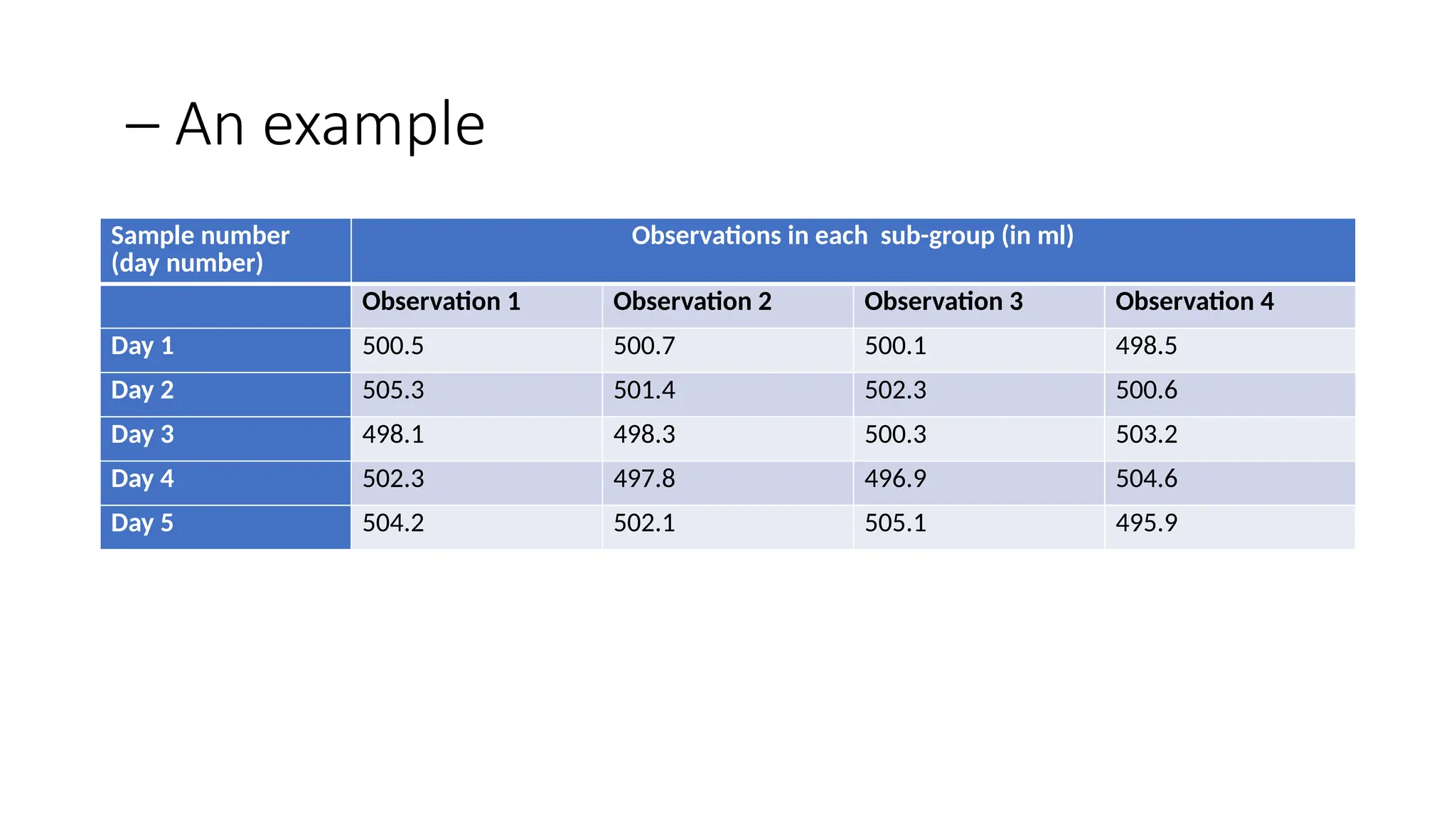
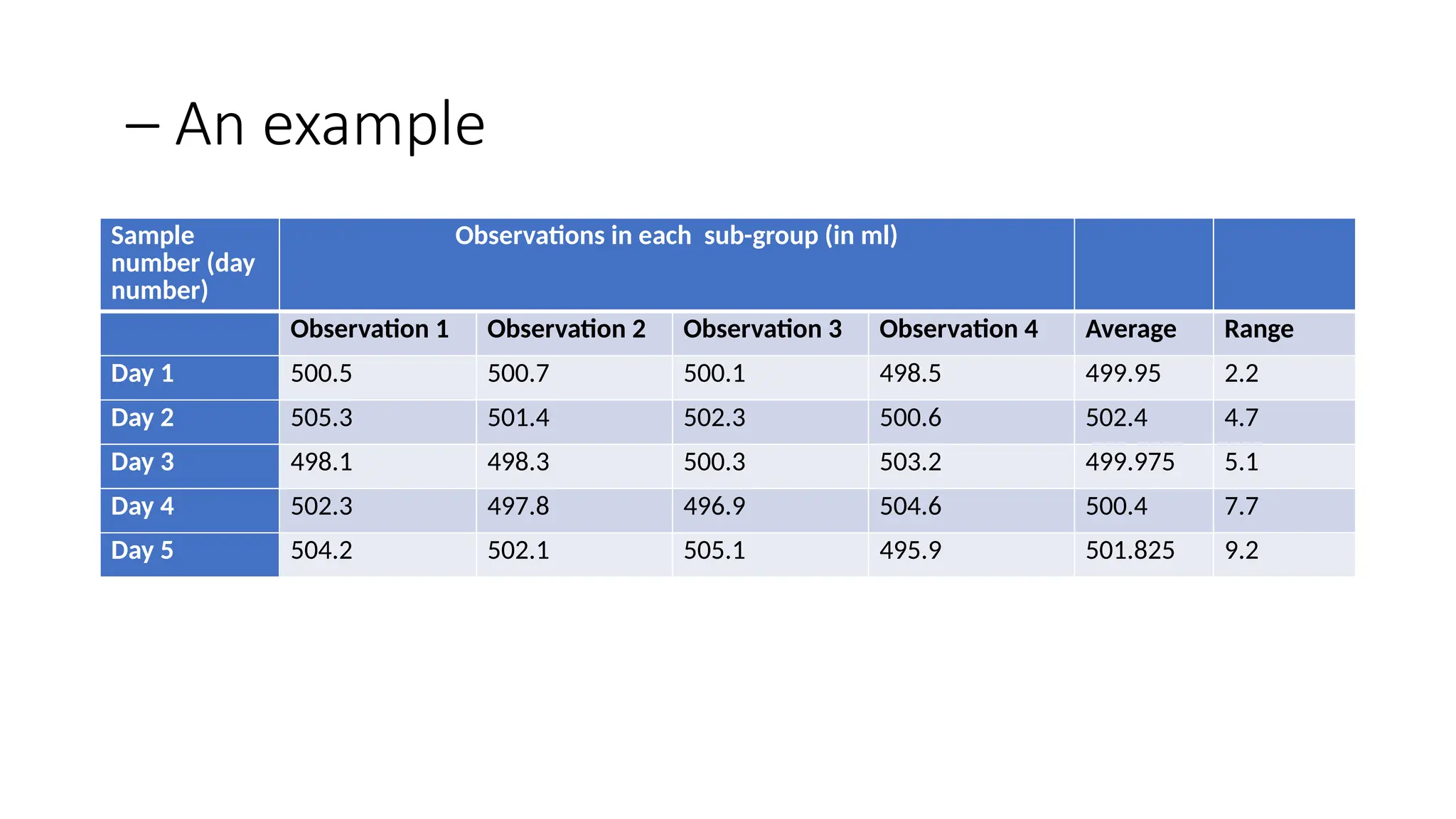
– An example
Samplenumber
(day number)
Observations in each sub-group (in ml)
Observation 1 Observation 2 Observation 3 Observation 4
Day 1 500.5 500.7 500.1 498.5
Day 2 505.3 501.4 502.3 500.6
Day 3 498.1 498.3 500.3 503.2
Day 4 502.3 497.8 496.9 504.6
Day 5 504.2 502.1 505.1 495.9
11.
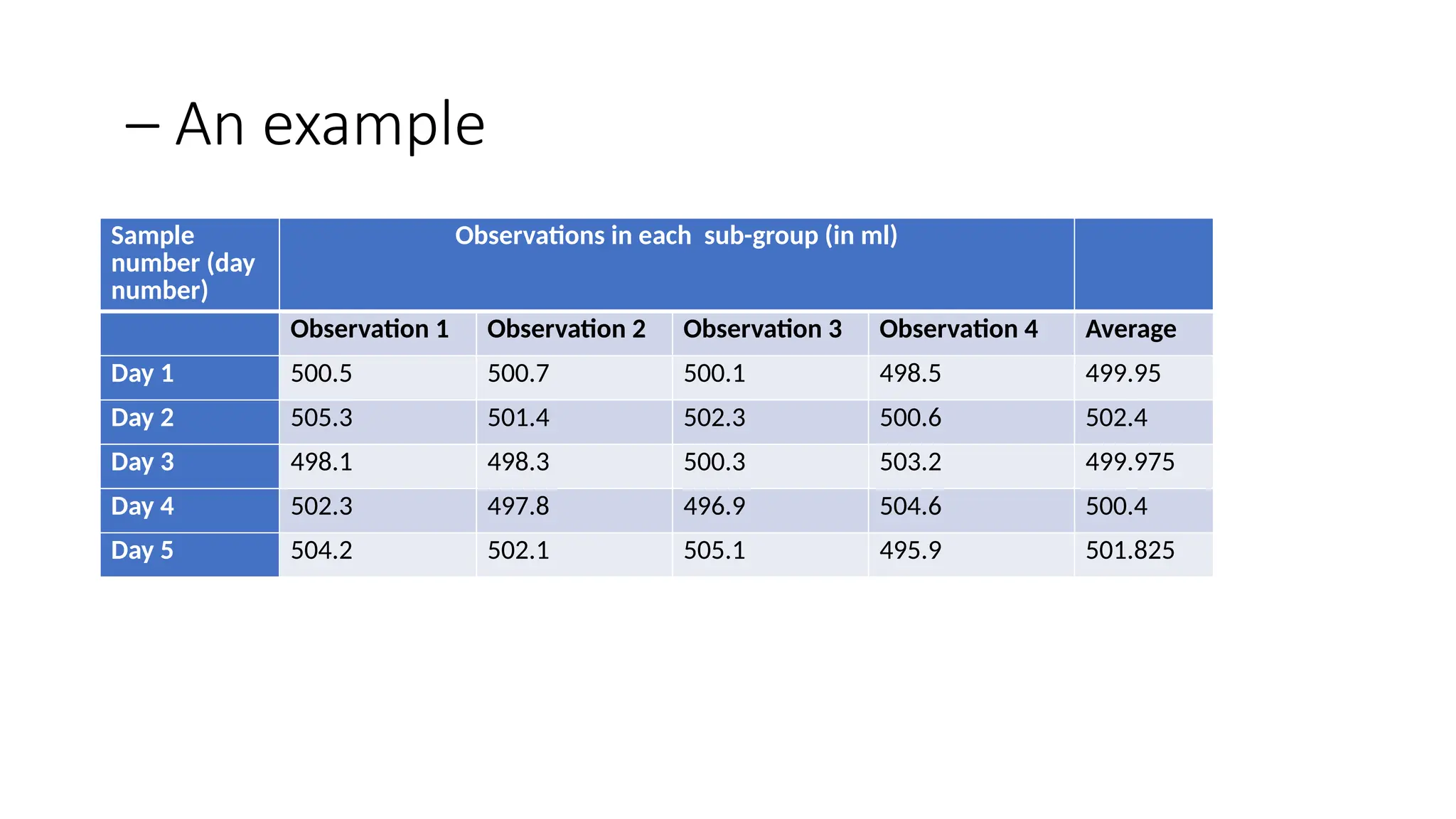
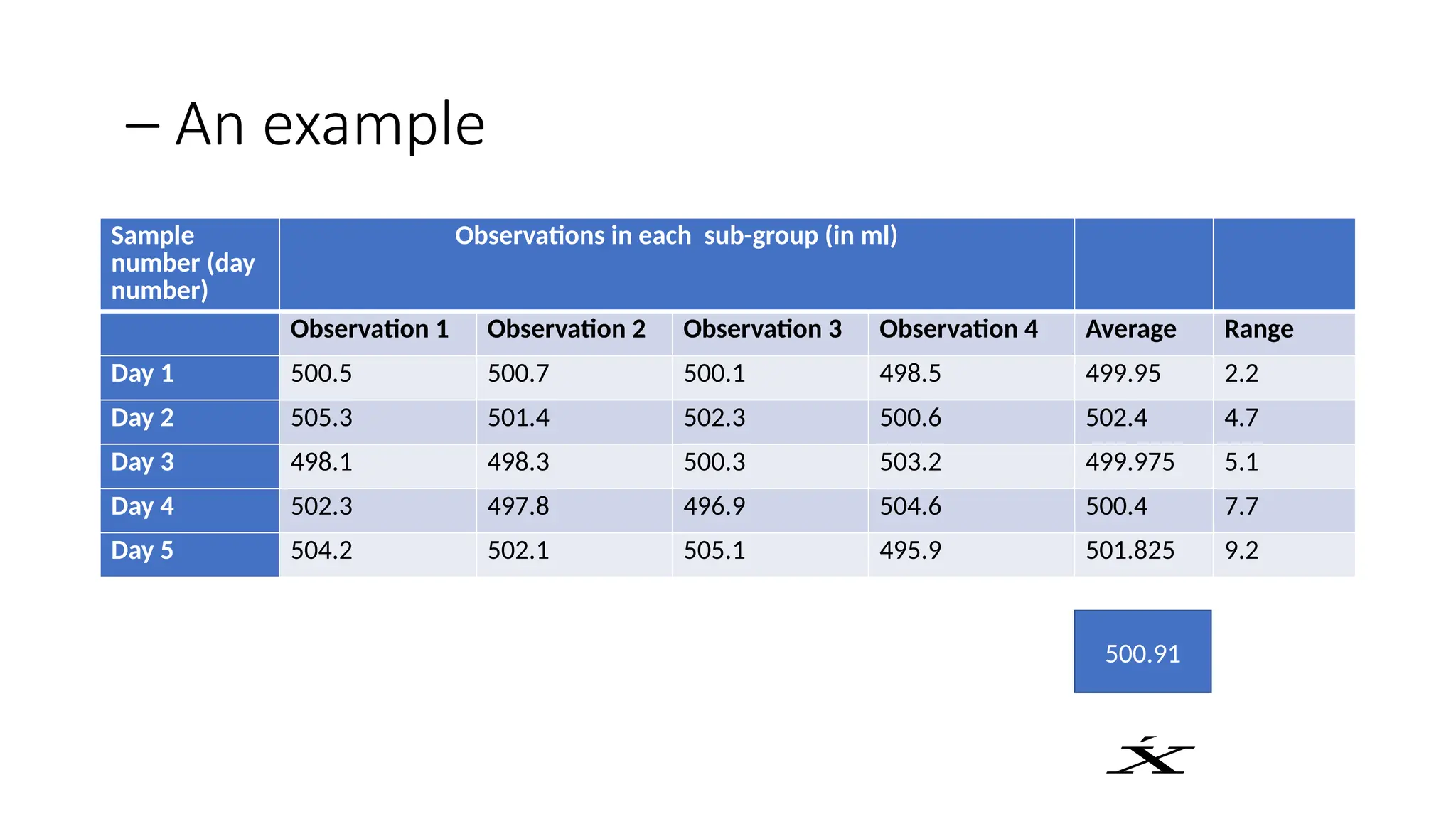
– An example
Sample
number(day
number)
Observations in each sub-group (in ml)
Observation 1 Observation 2 Observation 3 Observation 4 Average
Day 1 500.5 500.7 500.1 498.5 499.95
Day 2 505.3 501.4 502.3 500.6 502.4
Day 3 498.1 498.3 500.3 503.2 499.975
Day 4 502.3 497.8 496.9 504.6 500.4
Day 5 504.2 502.1 505.1 495.9 501.825
12.
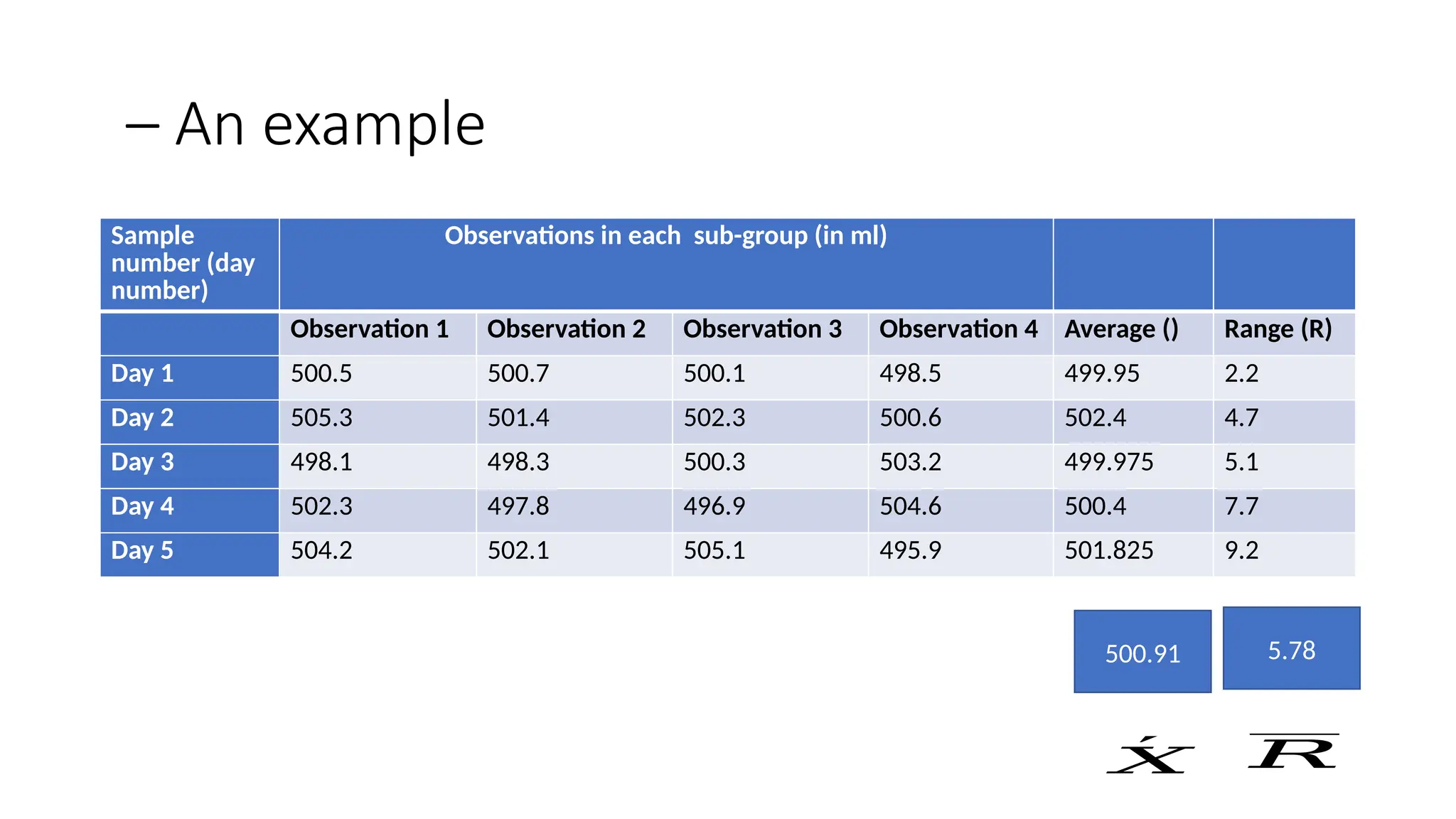
– An example
Sample
number(day
number)
Observations in each sub-group (in ml)
Observation 1 Observation 2 Observation 3 Observation 4 Average Range
Day 1 500.5 500.7 500.1 498.5 499.95 2.2
Day 2 505.3 501.4 502.3 500.6 502.4 4.7
Day 3 498.1 498.3 500.3 503.2 499.975 5.1
Day 4 502.3 497.8 496.9 504.6 500.4 7.7
Day 5 504.2 502.1 505.1 495.9 501.825 9.2
13.
– An example
Sample
number(day
number)
Observations in each sub-group (in ml)
Observation 1 Observation 2 Observation 3 Observation 4 Average Range
Day 1 500.5 500.7 500.1 498.5 499.95 2.2
Day 2 505.3 501.4 502.3 500.6 502.4 4.7
Day 3 498.1 498.3 500.3 503.2 499.975 5.1
Day 4 502.3 497.8 496.9 504.6 500.4 7.7
Day 5 504.2 502.1 505.1 495.9 501.825 9.2
500.91
´
𝑋
14.
– An example
Sample
number(day
number)
Observations in each sub-group (in ml)
Observation 1 Observation 2 Observation 3 Observation 4 Average () Range (R)
Day 1 500.5 500.7 500.1 498.5 499.95 2.2
Day 2 505.3 501.4 502.3 500.6 502.4 4.7
Day 3 498.1 498.3 500.3 503.2 499.975 5.1
Day 4 502.3 497.8 496.9 504.6 500.4 7.7
Day 5 504.2 502.1 505.1 495.9 501.825 9.2
500.91
´
𝑋
5.78
𝑅
15.
– An example
Sample
number(day
number)
Observations in each sub-group (in ml)
Observation 1 Observation 2 Observation 3 Observation 4 Average () Range (R)
Day 1 500.5 500.7 500.1 498.5 499.95 2.2
Day 2 505.3 501.4 502.3 500.6 502.4 4.7
Day 3 498.1 498.3 500.3 503.2 499.975 5.1
Day 4 502.3 497.8 496.9 504.6 500.4 7.7
Day 5 504.2 502.1 505.1 495.9 501.825 9.2
500.91
´
𝑋
5.78
𝑅
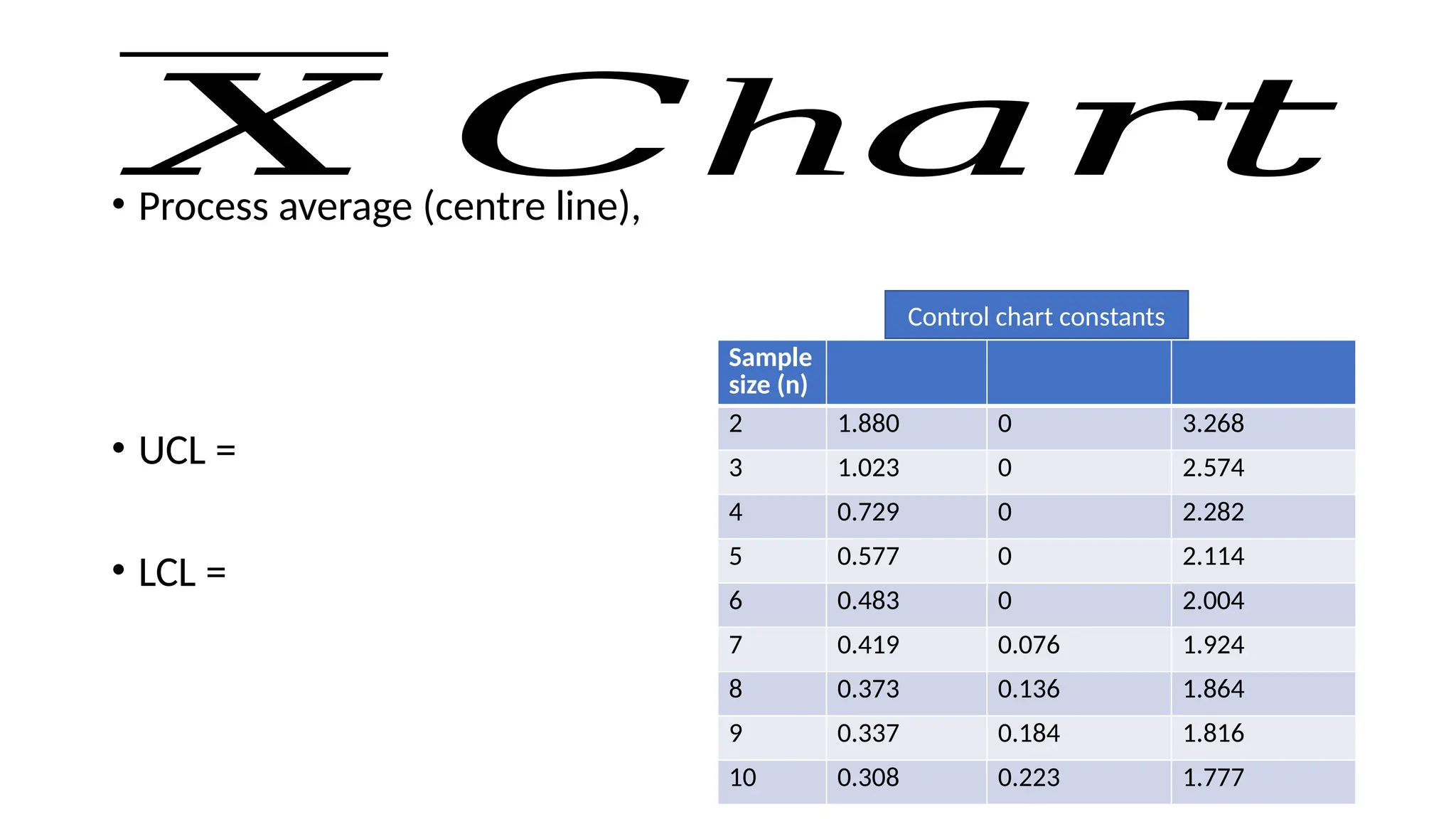
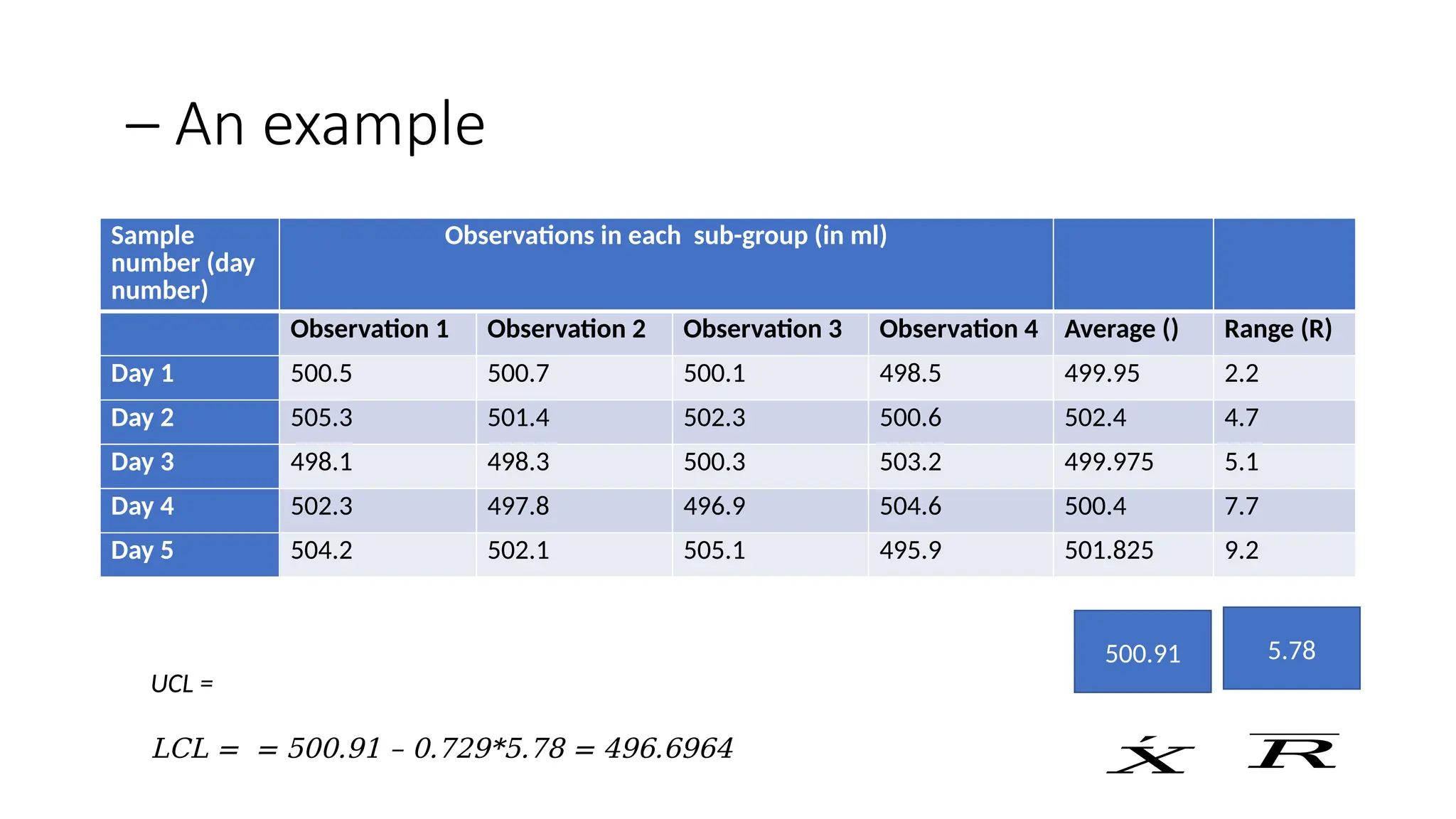
UCL =
LCL = = 500.91 – 0.729*5.78 = 496.6964
16.
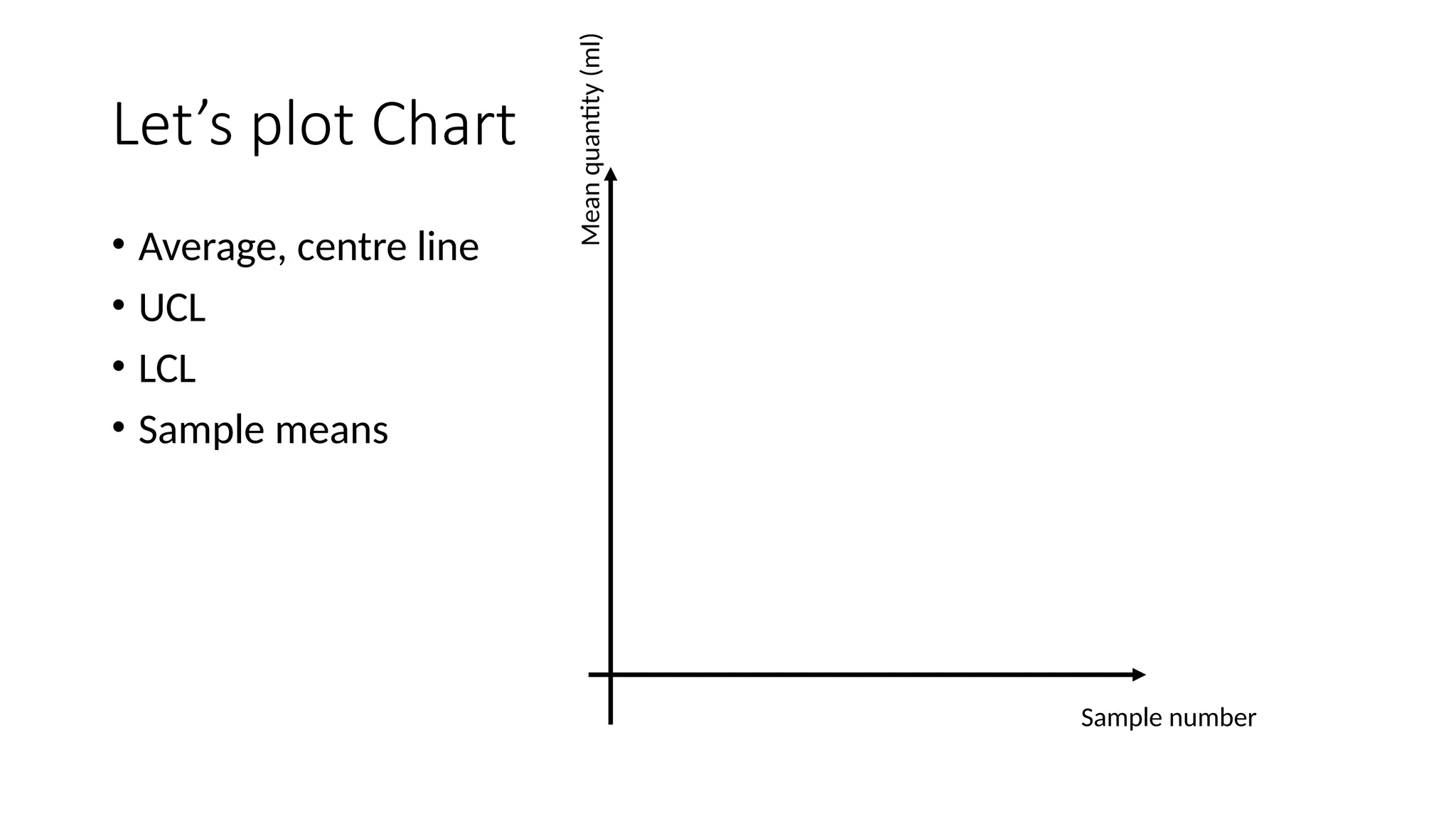
Let’s plot Chart
•Average, centre line
• UCL
• LCL
• Sample means
Sample number
Mean
quantity
(ml)
17.
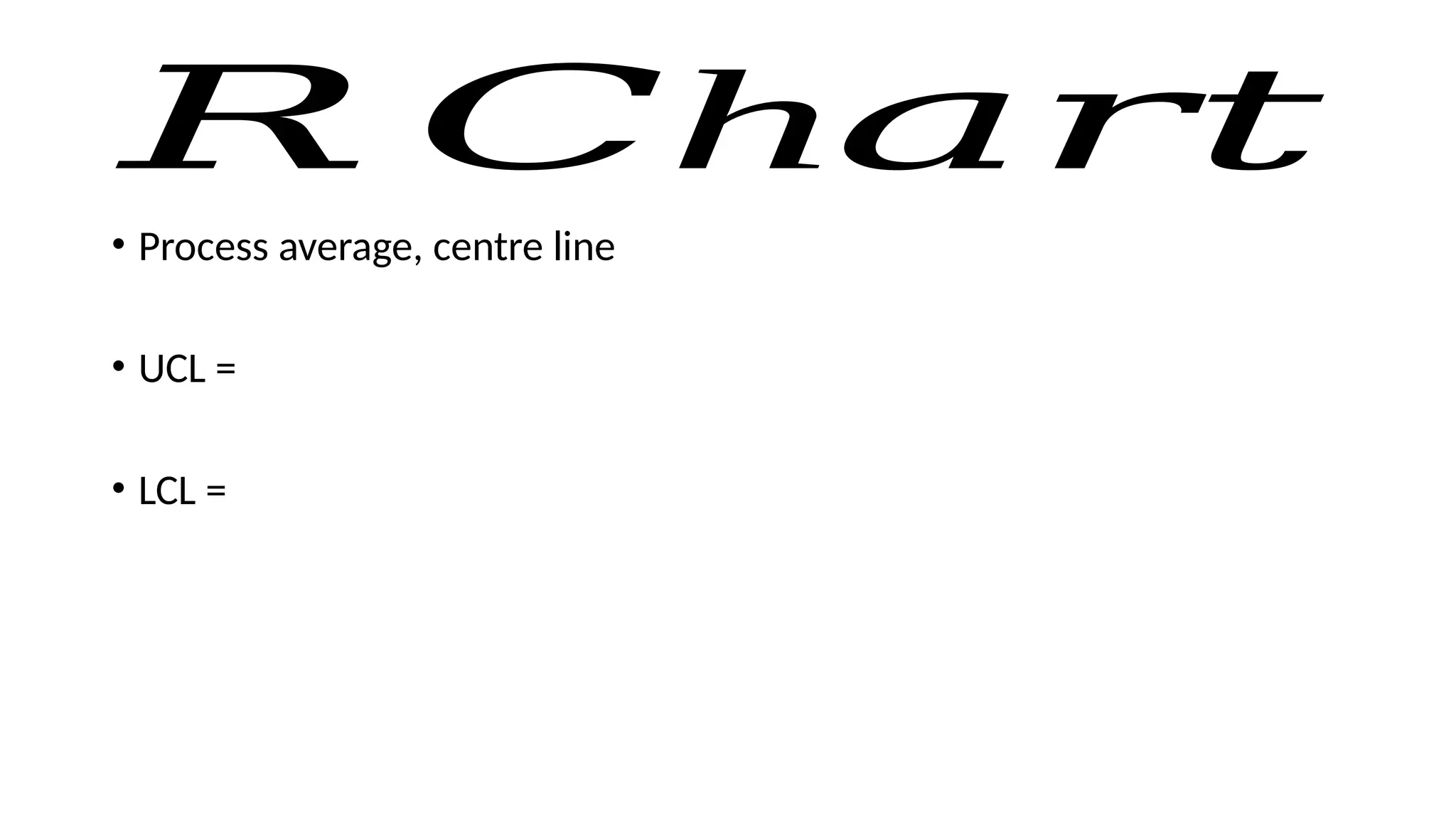
𝑅 h
𝐶 𝑎𝑟𝑡
•Process average, centre line
• UCL =
• LCL =
18.
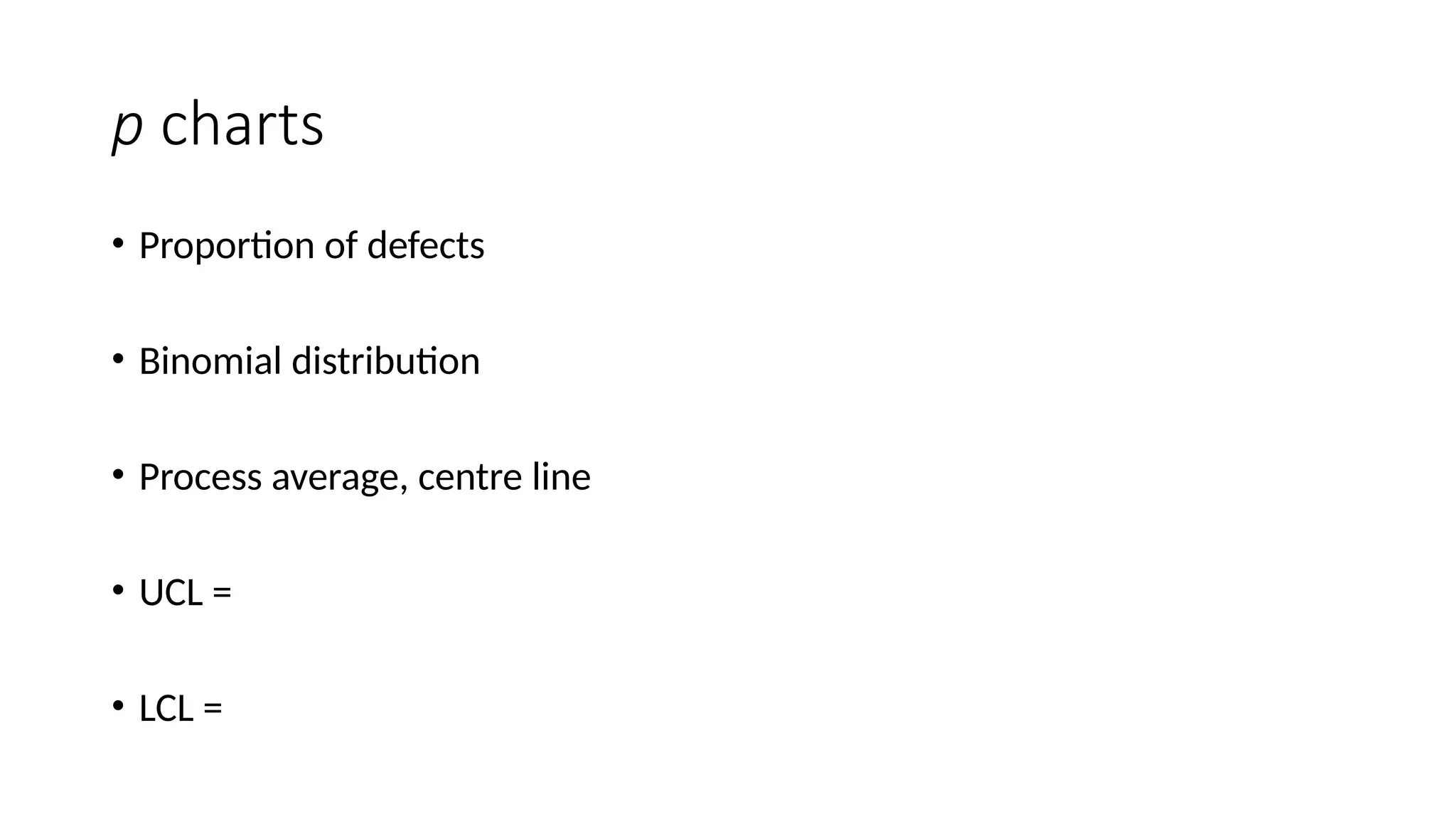
p charts
• Proportionof defects
• Binomial distribution
• Process average, centre line
• UCL =
• LCL =
19.
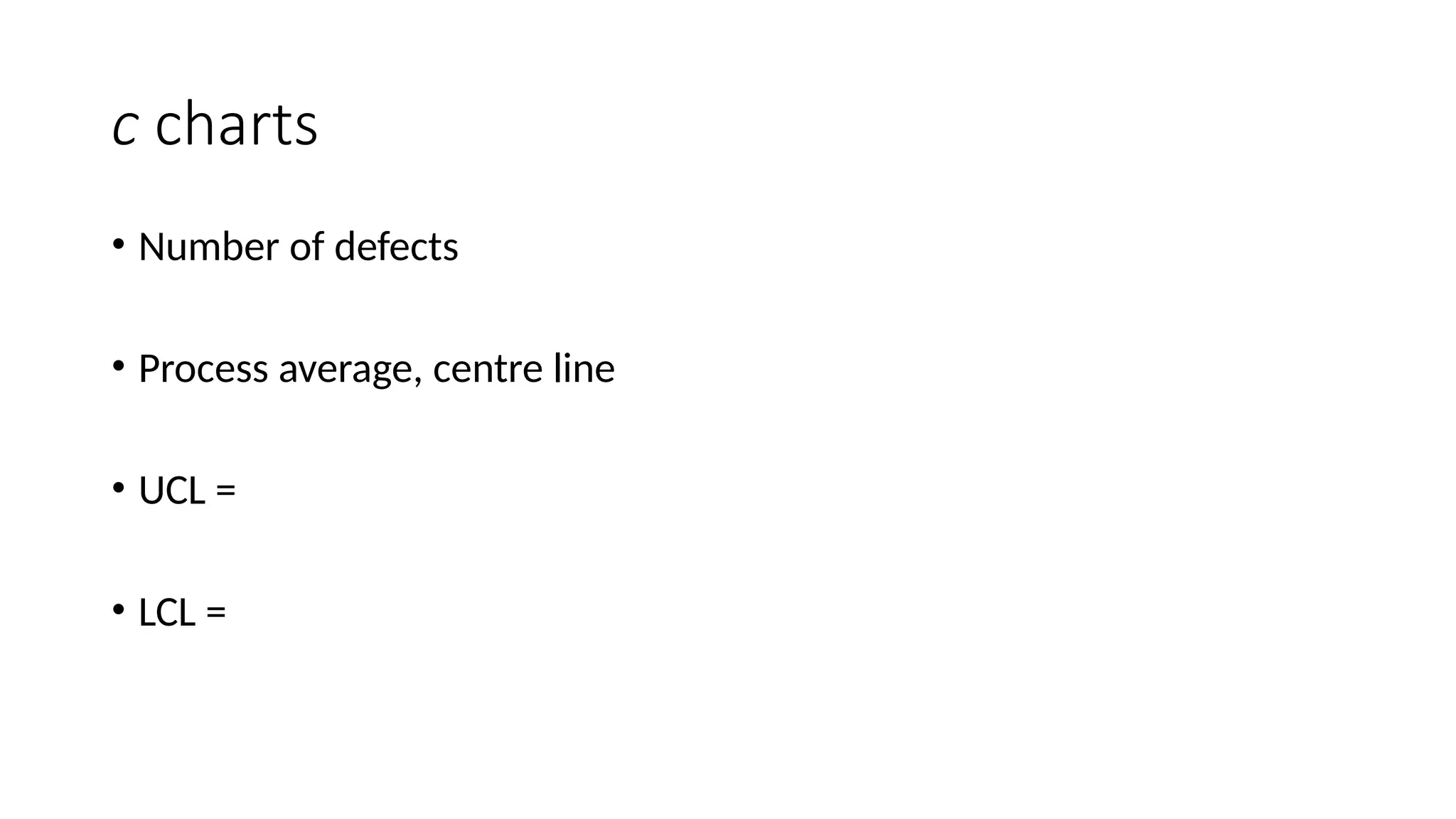
c charts
• Numberof defects
• Process average, centre line
• UCL =
• LCL =
Process Capability
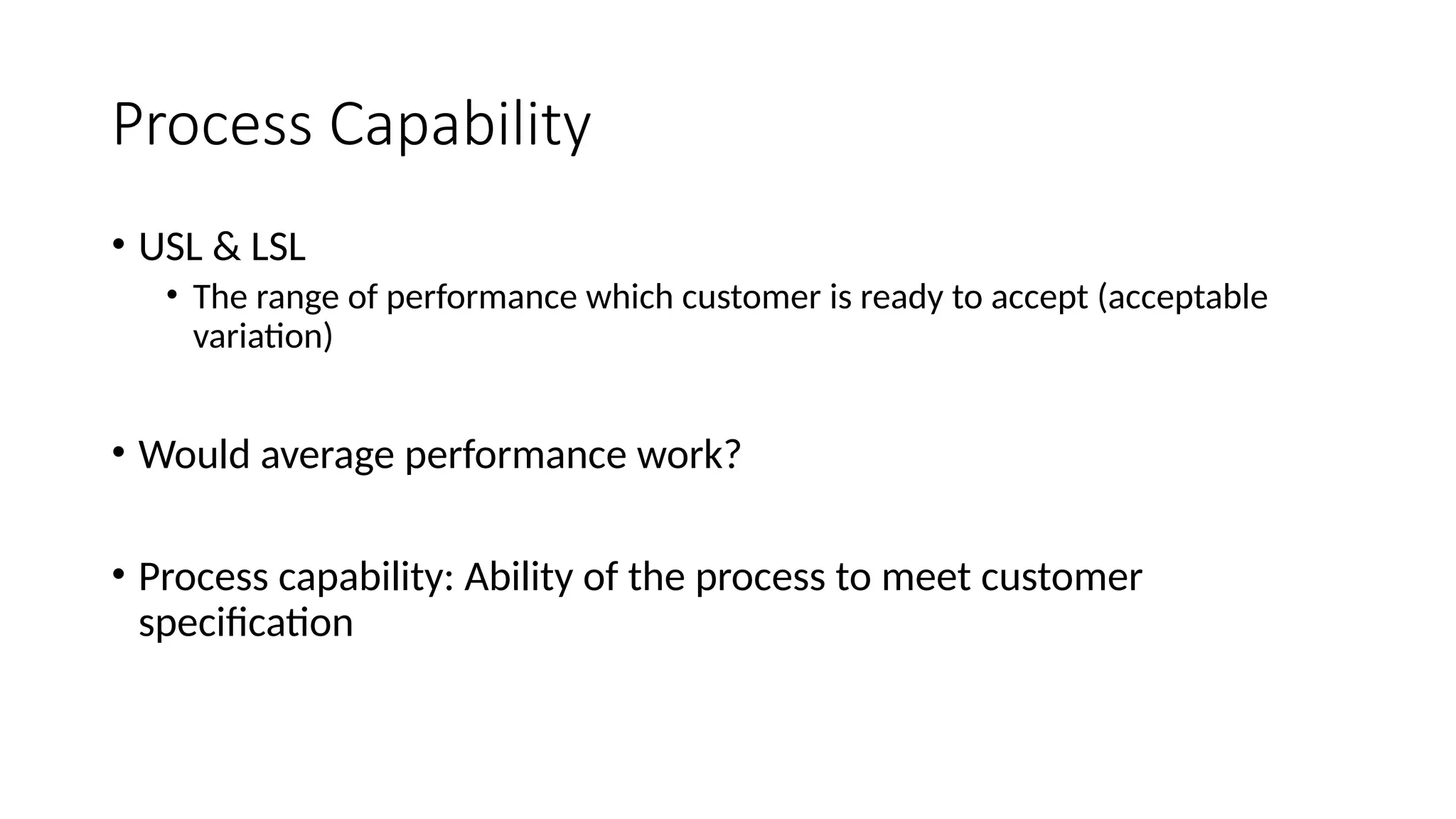
• USL& LSL
• The range of performance which customer is ready to accept (acceptable
variation)
• Would average performance work?
• Process capability: Ability of the process to meet customer
specification
Sigma capability
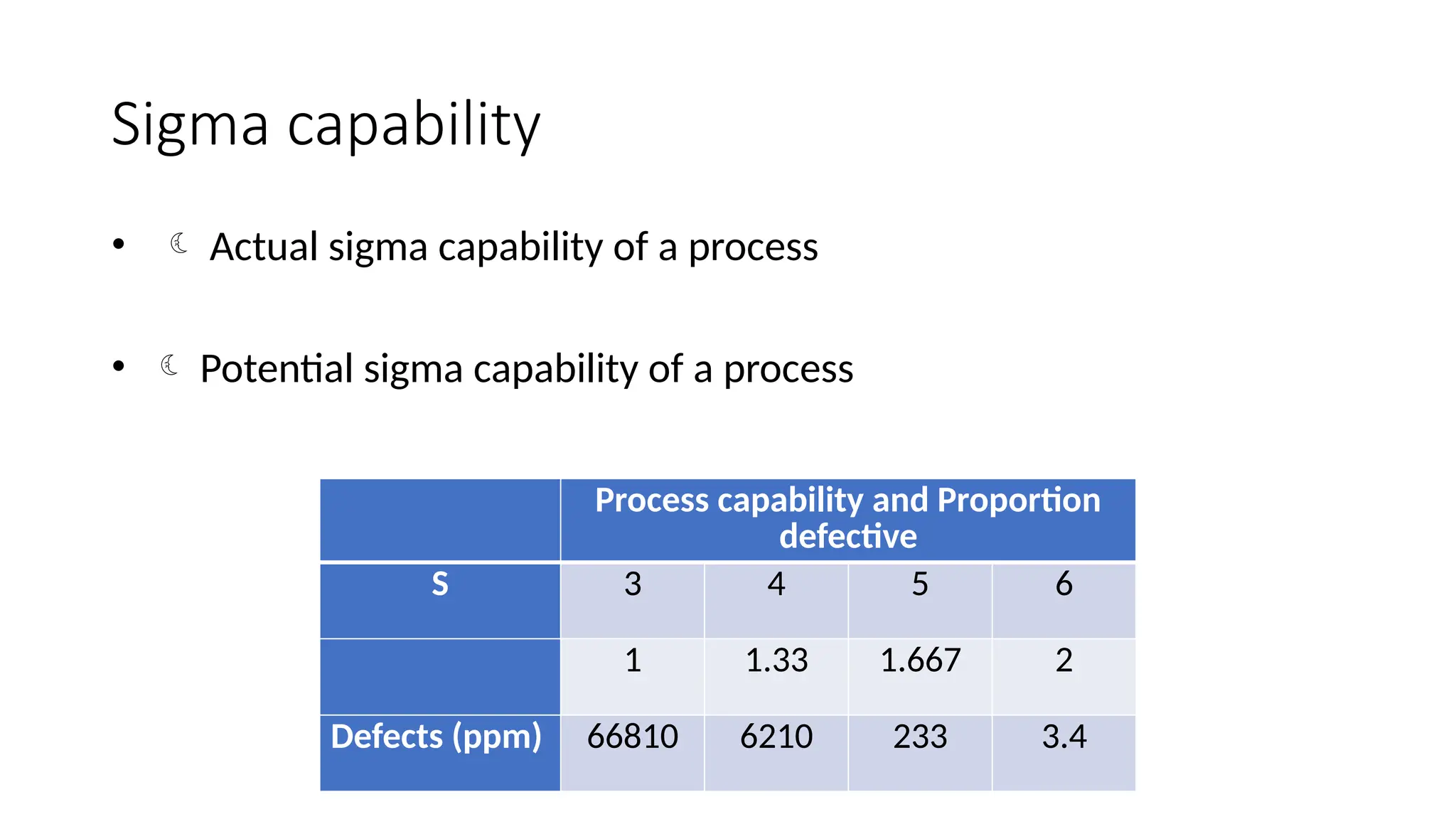
• Actual sigma capability of a process
• Potential sigma capability of a process
Process capability and Proportion
defective
S 3 4 5 6
1 1.33 1.667 2
Defects (ppm) 66810 6210 233 3.4
24.
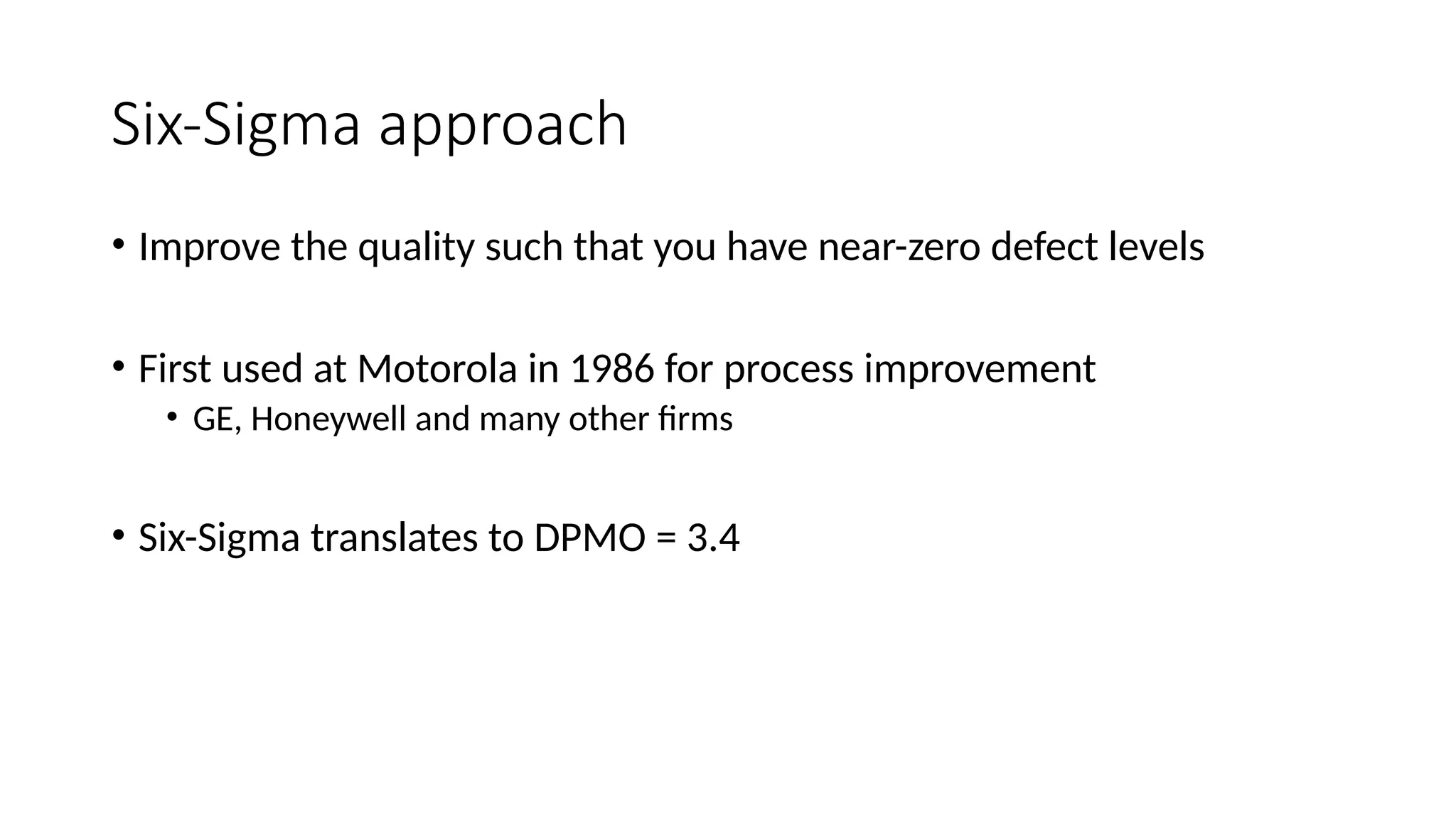
Six-Sigma approach
• Improvethe quality such that you have near-zero defect levels
• First used at Motorola in 1986 for process improvement
• GE, Honeywell and many other firms
• Six-Sigma translates to DPMO = 3.4
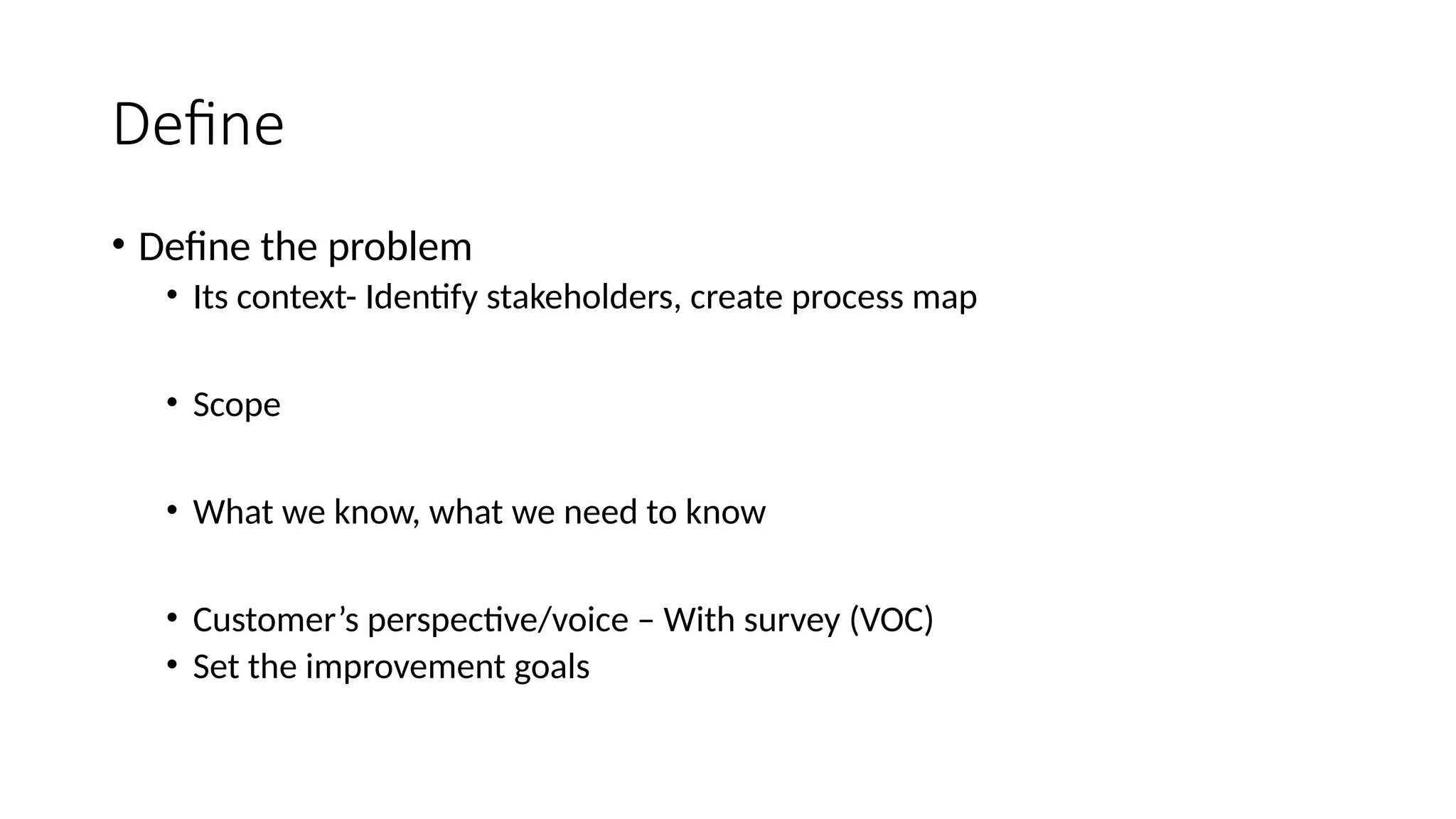
Define
• Define theproblem
• Its context- Identify stakeholders, create process map
• Scope
• What we know, what we need to know
• Customer’s perspective/voice – With survey (VOC)
• Set the improvement goals
27.
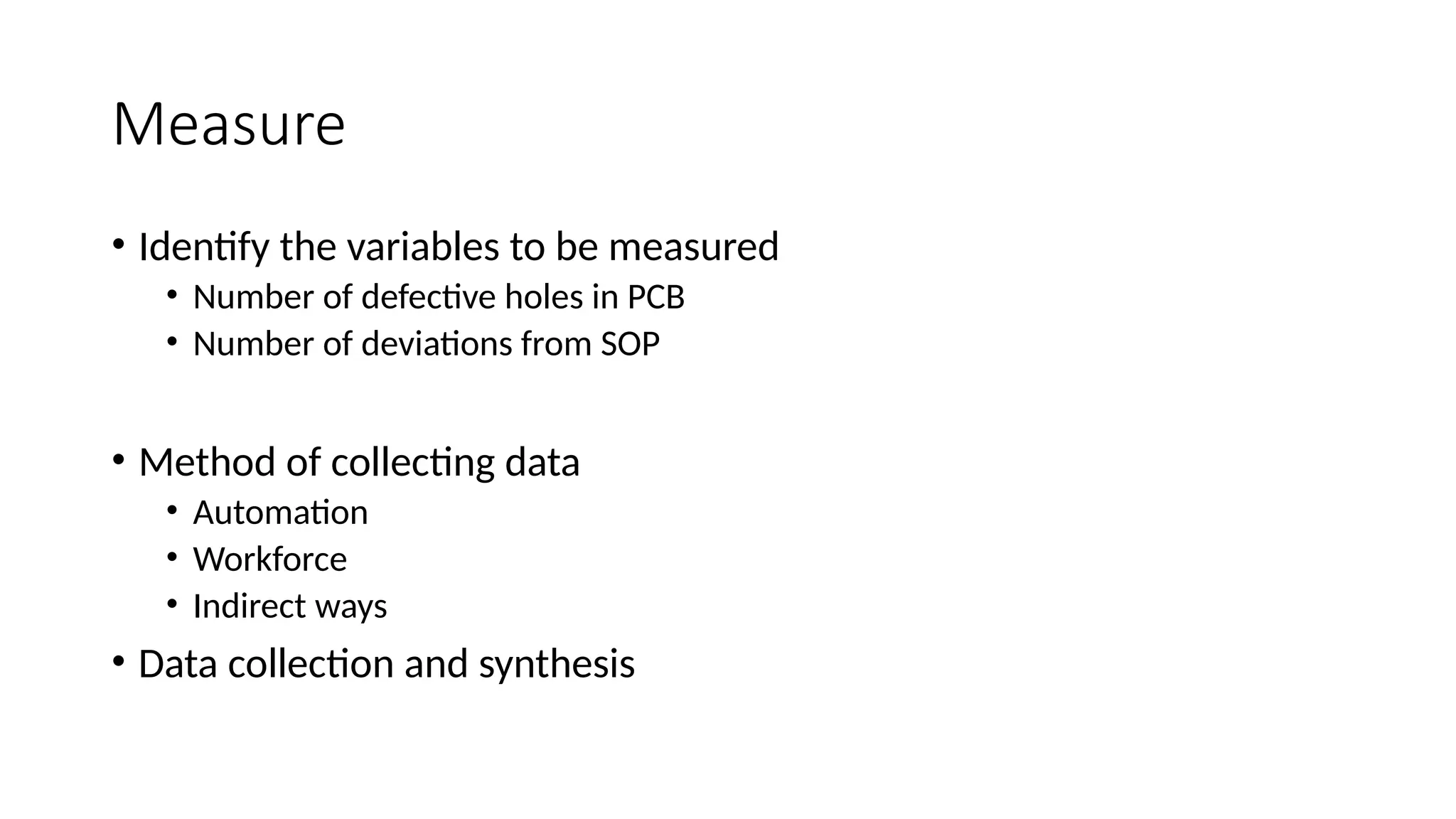
Measure
• Identify thevariables to be measured
• Number of defective holes in PCB
• Number of deviations from SOP
• Method of collecting data
• Automation
• Workforce
• Indirect ways
• Data collection and synthesis
28.
Analyze
• Possible causesof bad quality
• Identify areas to reduce defects
• Develop and apply tools for analysis
• Graphs, charts
• Identify possible source of variation
• How can we eliminate causes of variation?
29.
Analyze
• Sharpness causingvariability
• The sharpness of cutting tool changes with time and temperature
• Hardness causing variability
• Hardness of bread changes with moisture, texture
30.
Improve
• Elimination ofroot causes of variability
• Generating and validating improvement alternatives
• Create new process map or SOP
• About frequent sharpening or moisture control
31.
Control
• Ensure thatprocess follows new plan/standard
• Develop control plan
• Organize training for new plan
• Establish new plan as a standard
![TQM review
• Highlight the problem
• Identify opportunity [Histograms, Pareto diagram]
• Analyze problem [Fishbone, CEDAC]
• Operational planning [Poka yoke]
“Quality in a service or product is not what you put into it. It is what the client or
customer gets out of it”
-Peter Drucker](https://image.slidesharecdn.com/processcontrol-250707205258-6e22a532/75/Process-Control-with-management-from-iim-2-2048.jpg)
![Control chart
• If variability is too much (beyond a band), it could be due to
assignable reasons
• Statistical Process Control (SPC) involves establishing a control band of
acceptable variation in the process performance
• Control band [LCL, UCL]](https://image.slidesharecdn.com/processcontrol-250707205258-6e22a532/75/Process-Control-with-management-from-iim-6-2048.jpg)