Control Charts
for Attributes
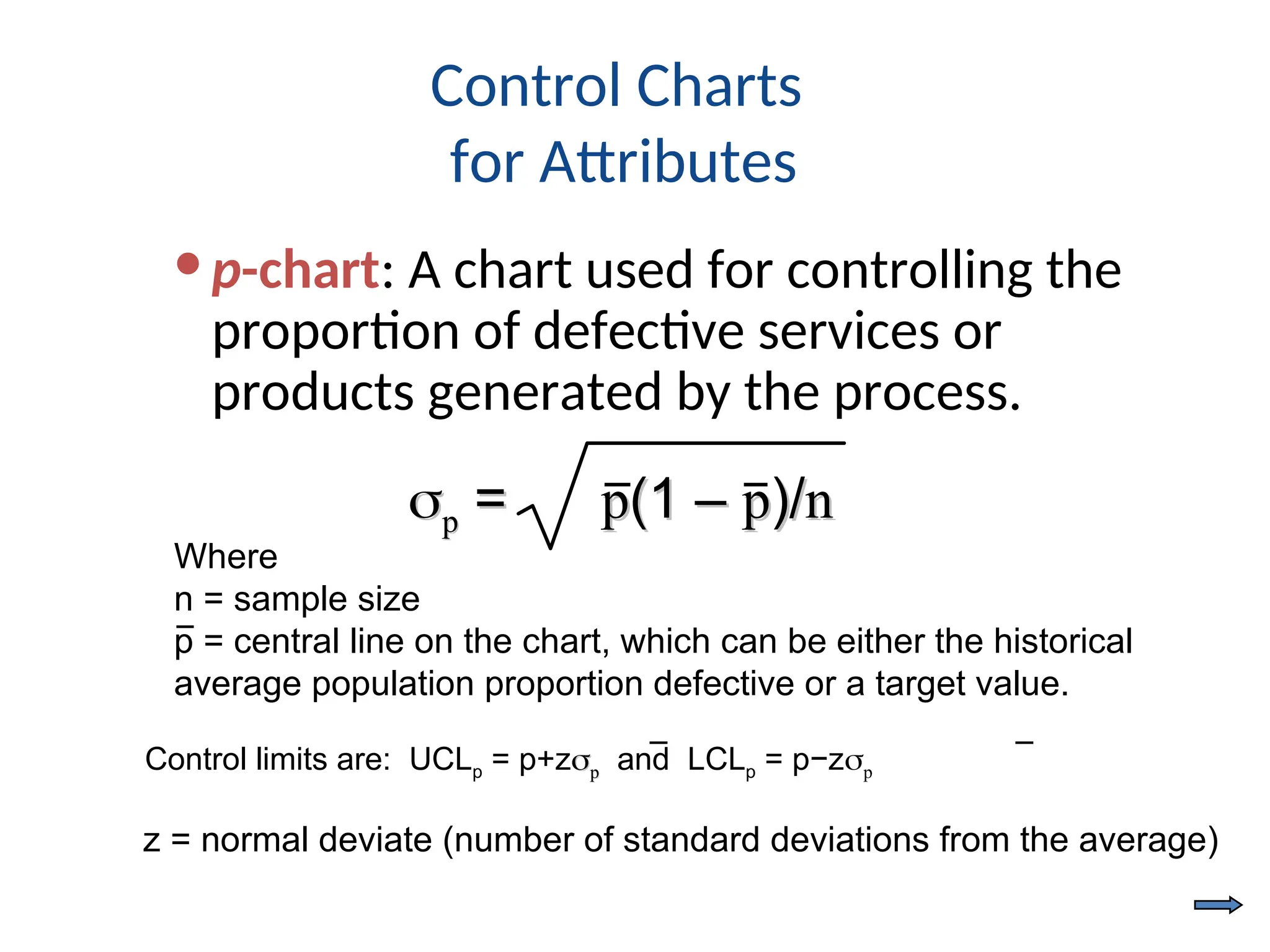
p-chart: A chart used for controlling the
proportion of defective services or
products generated by the process.

p
p =
= p
p(1 –
(1 – p
p)/
)/n
n
Where
n = sample size
p = central line on the chart, which can be either the historical
average population proportion defective or a target value.
z = normal deviate (number of standard deviations from the average)
Control limits are: UCLp = p+z
p
p and LCLp = p−zp
– –
Hometown Bank
Hometown Bank
Example
Example
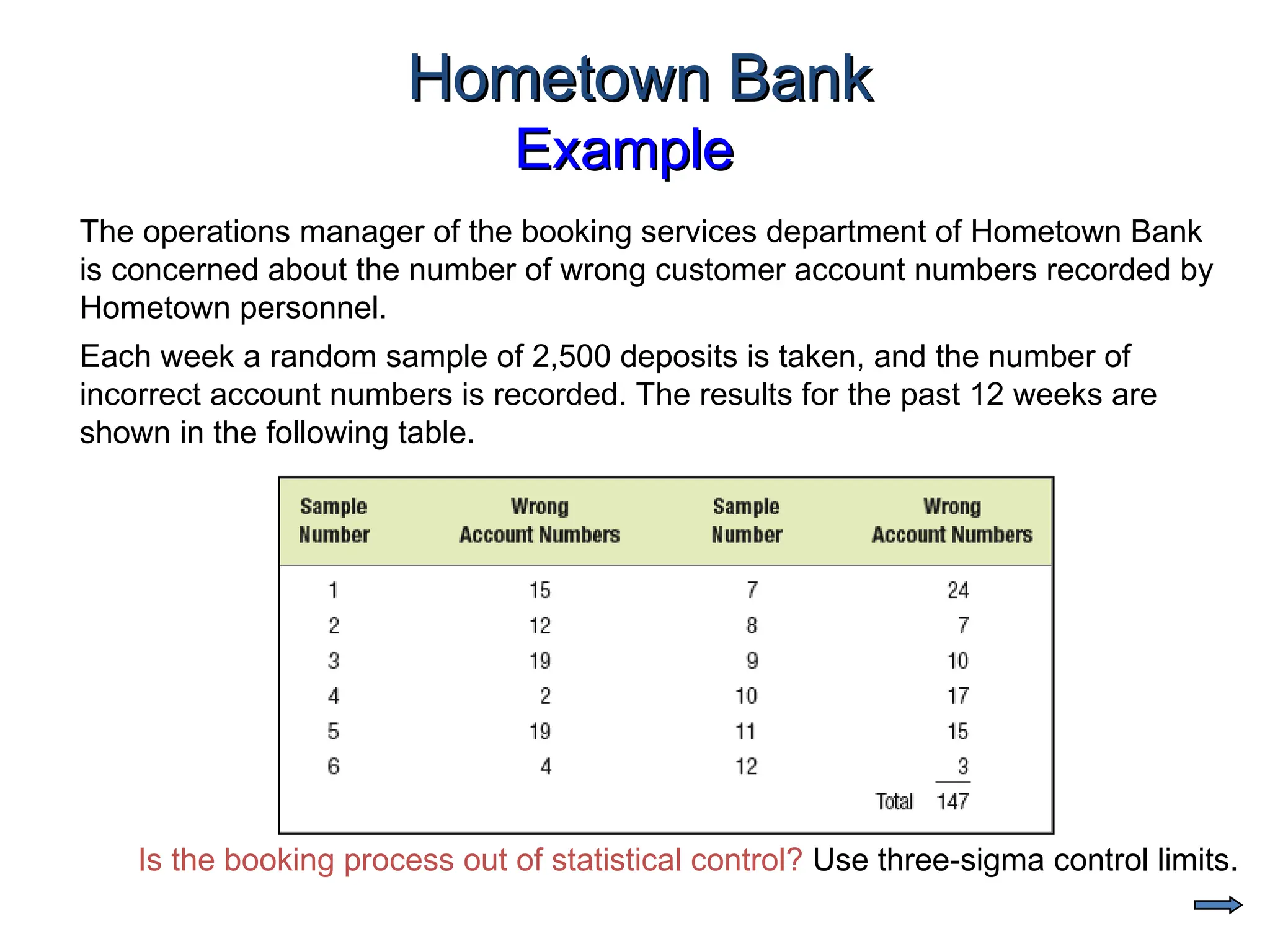
The operations manager of the booking services department of Hometown Bank
is concerned about the number of wrong customer account numbers recorded by
Hometown personnel.
Each week a random sample of 2,500 deposits is taken, and the number of
incorrect account numbers is recorded. The results for the past 12 weeks are
shown in the following table.
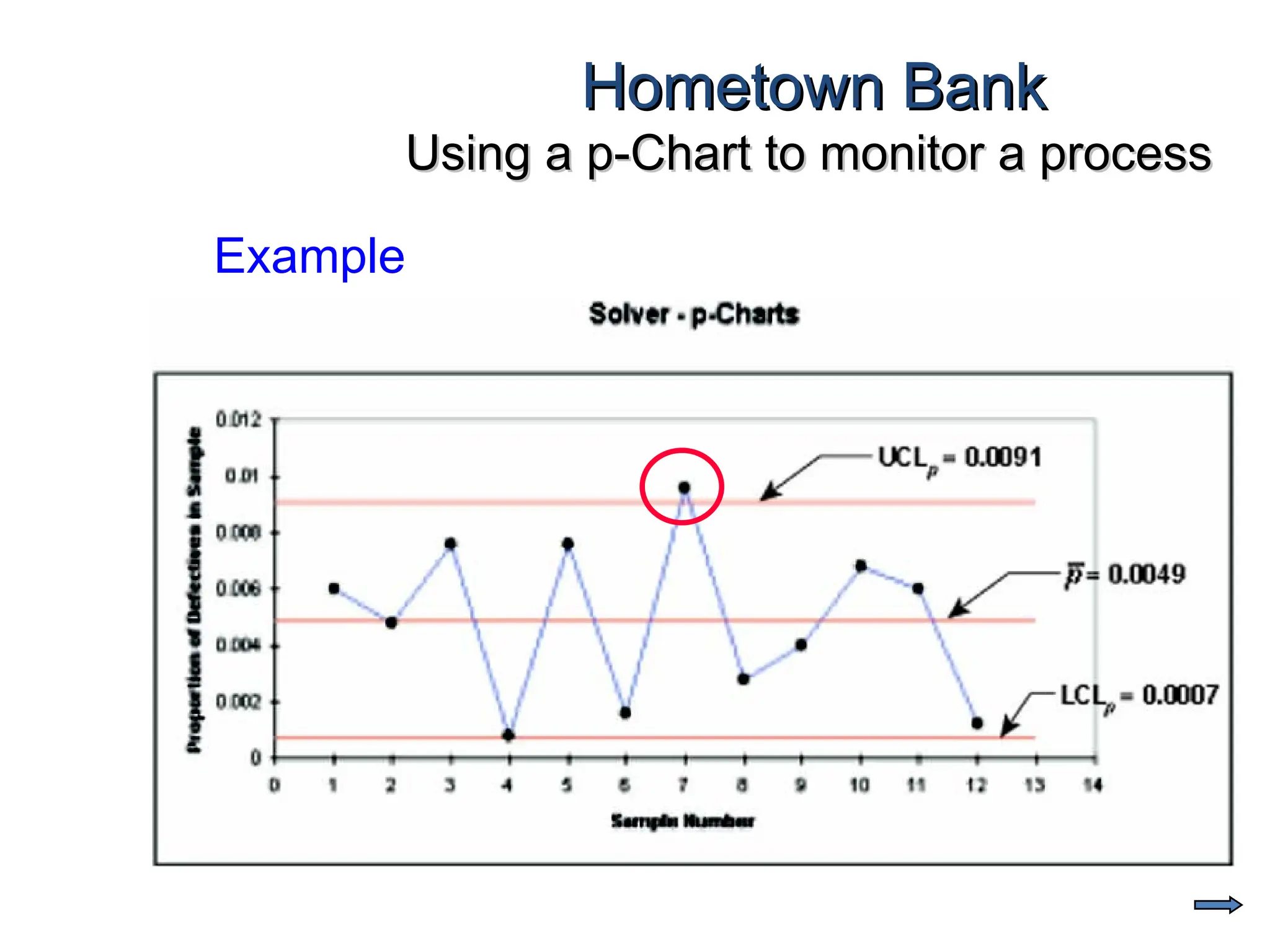
Is the booking process out of statistical control? Use three-sigma control limits.
Sample Wrong Proportion
Number Account # Defective
1 15 0.006
2 12 0.0048
3 19 0.0076
4 2 0.0008
5 19 0.0076
6 4 0.0016
7 24 0.0096
8 7 0.0028
9 10 0.004
10 17 0.0068
11 15 0.006
12 3 0.0012
Total 147
Hometown Bank
Hometown Bank
Using a p-Chart to monitor a process
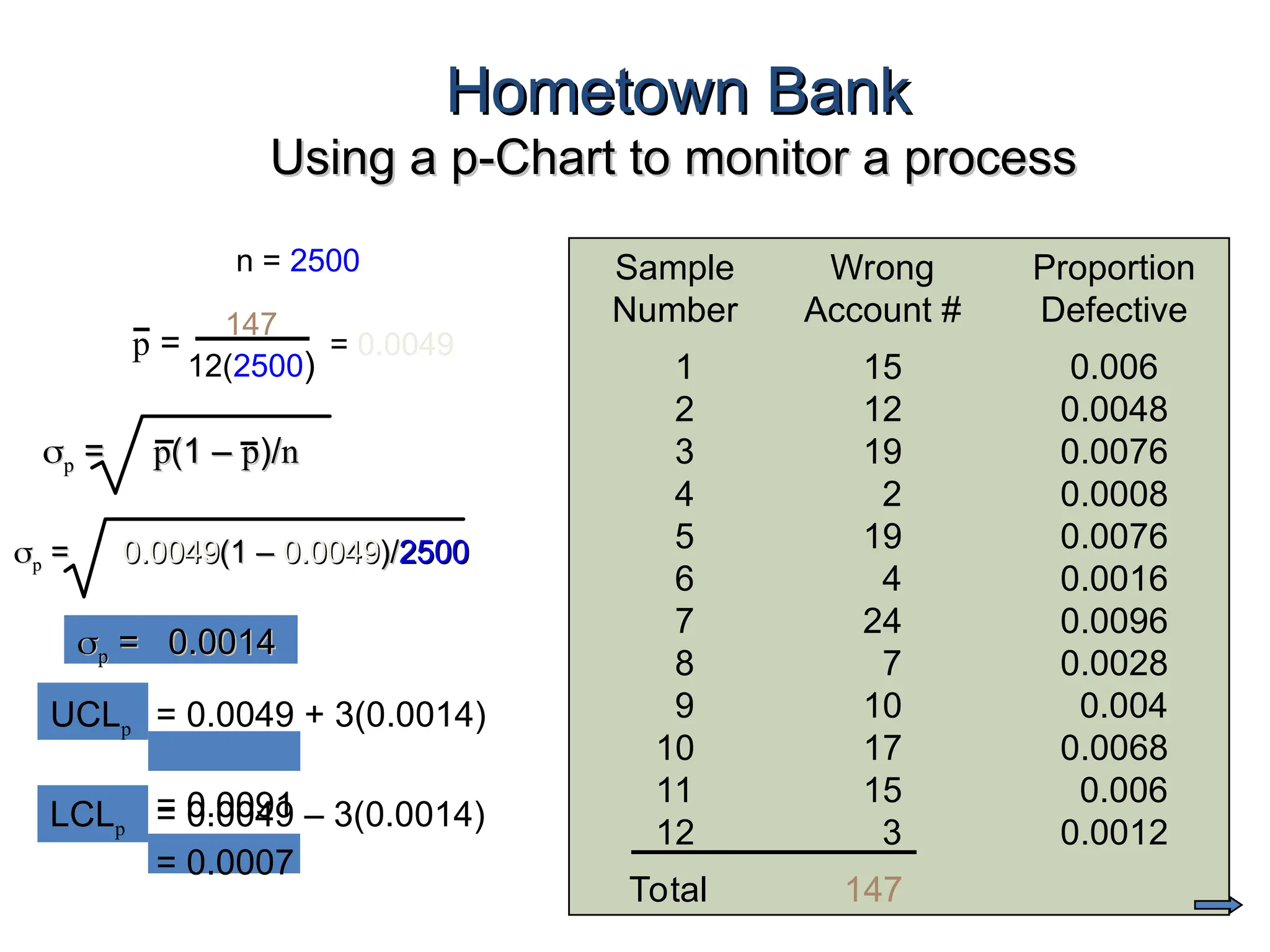
n = 2500
p =
147
12(2500)
= 0.0049

p
p =
= p
p(1 –
(1 – p
p)/
)/n
n

p
p =
= 0.0049
0.0049(1 –
(1 – 0.0049
0.0049)/
)/2500
2500

p
p = 0.0014
= 0.0014
UCLp = 0.0049 + 3(0.0014)
= 0.0091
LCLp = 0.0049 – 3(0.0014)
= 0.0007
Hometown Bank
Hometown Bank
Using a p-Chart to monitor a process
Example
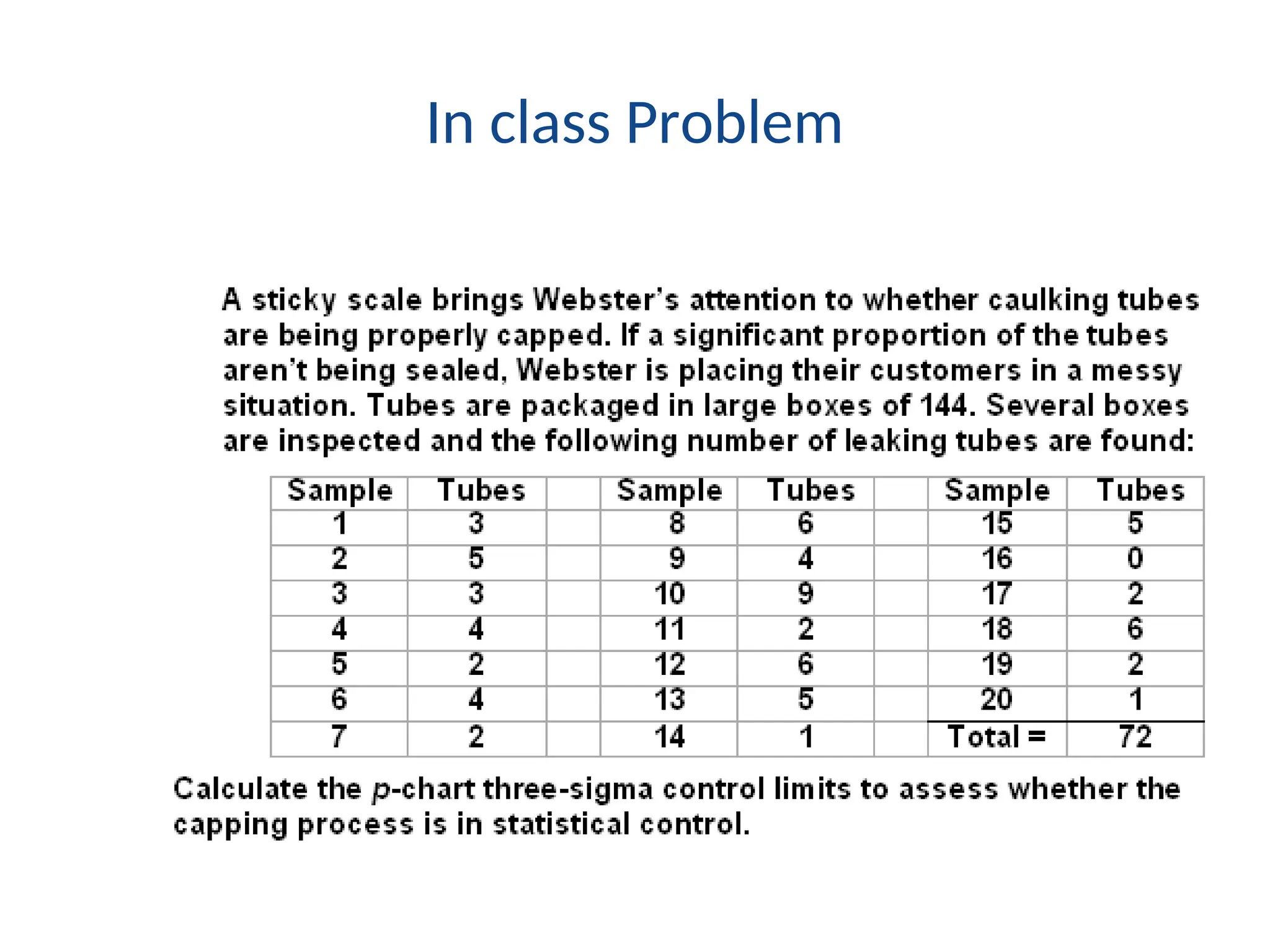
In class Problem
Control Charts
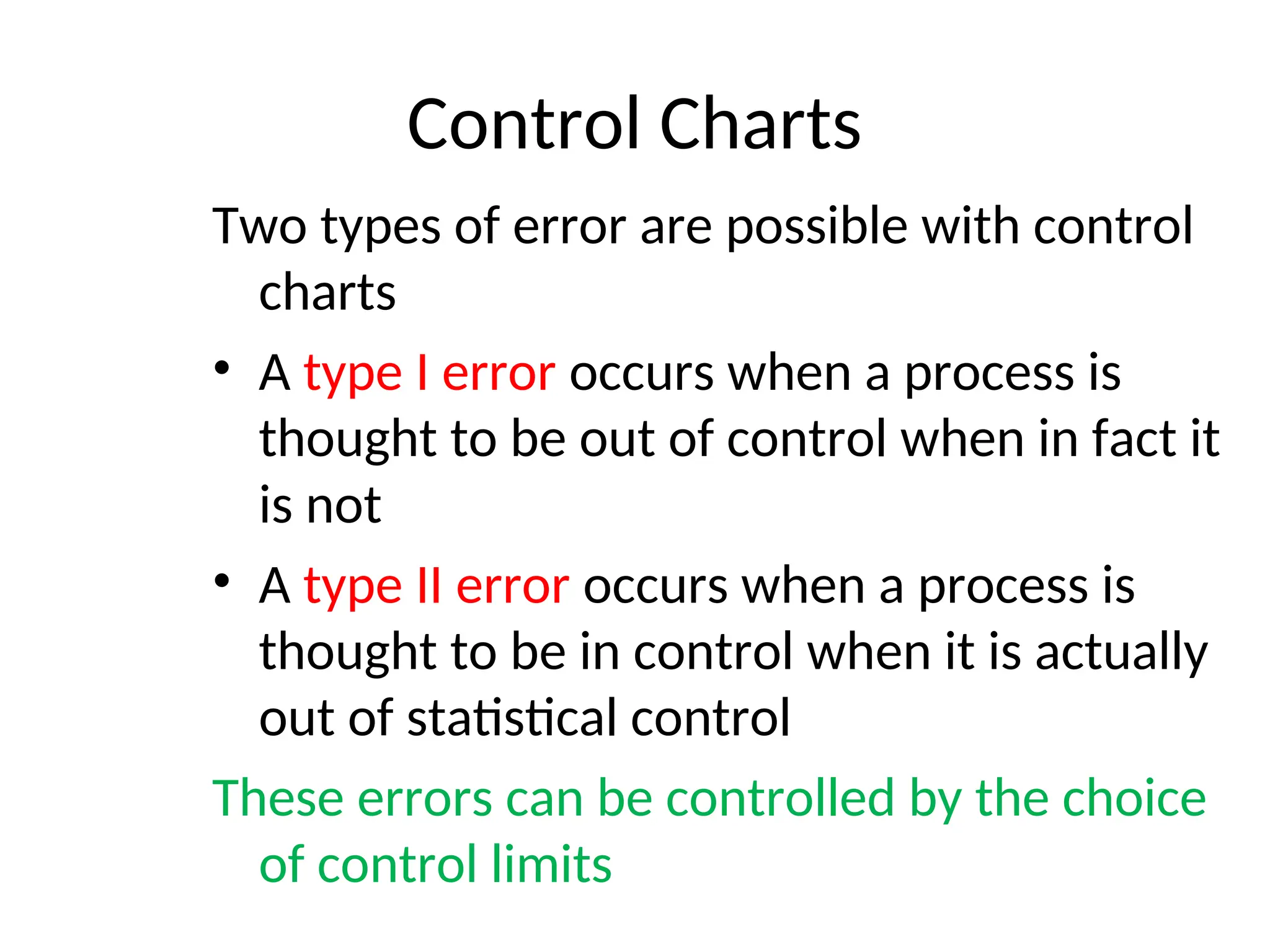
Two types of error are possible with control
charts
• A type I error occurs when a process is
thought to be out of control when in fact it
is not
• A type II error occurs when a process is
thought to be in control when it is actually
out of statistical control
These errors can be controlled by the choice
of control limits
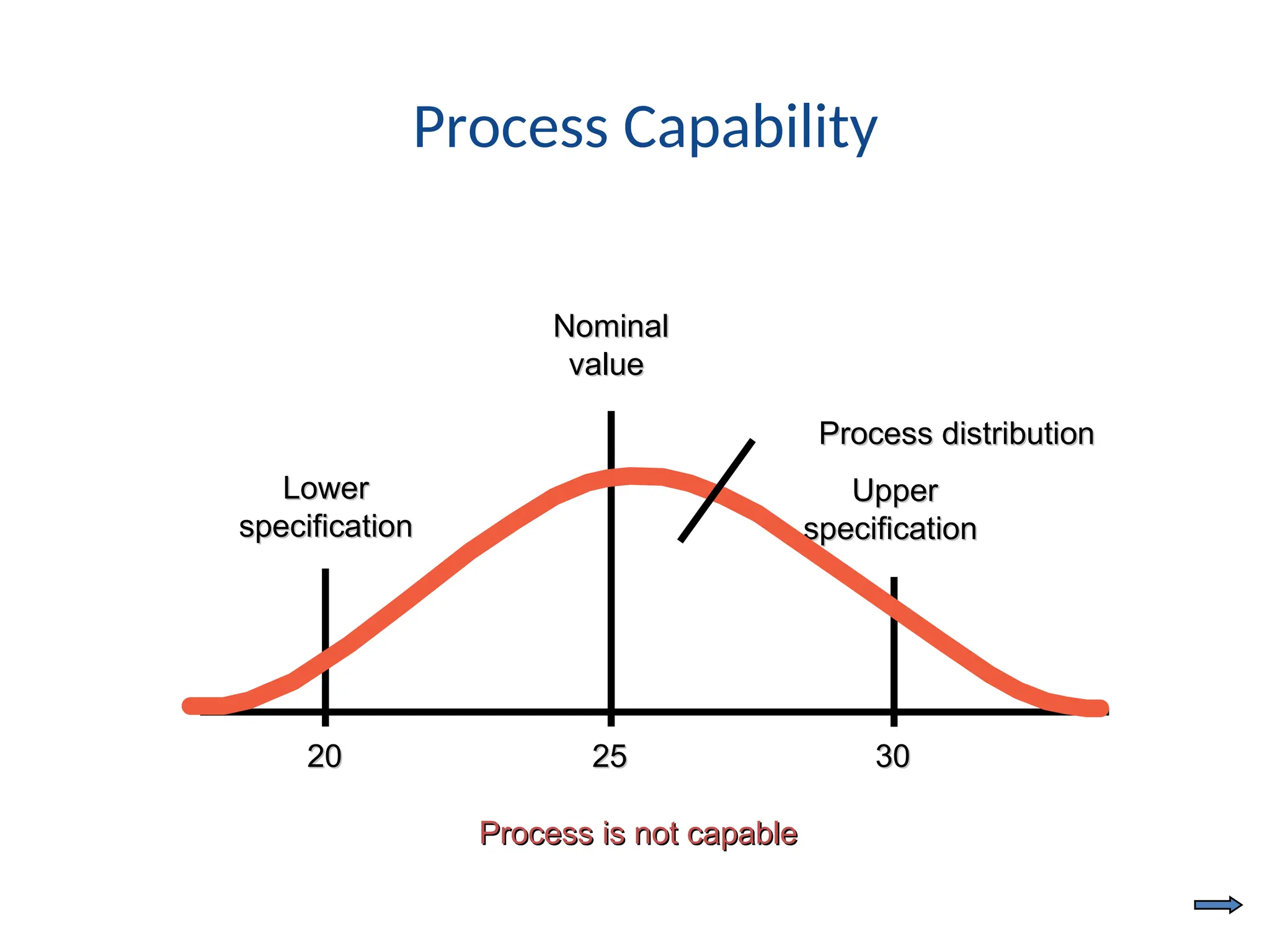
Process Capability
• Process capability is the ability of the
process to meet the design specifications
for a service or product.
• Nominal value is a target for design
specifications.
• Tolerance is an allowance above or below
the nominal value.
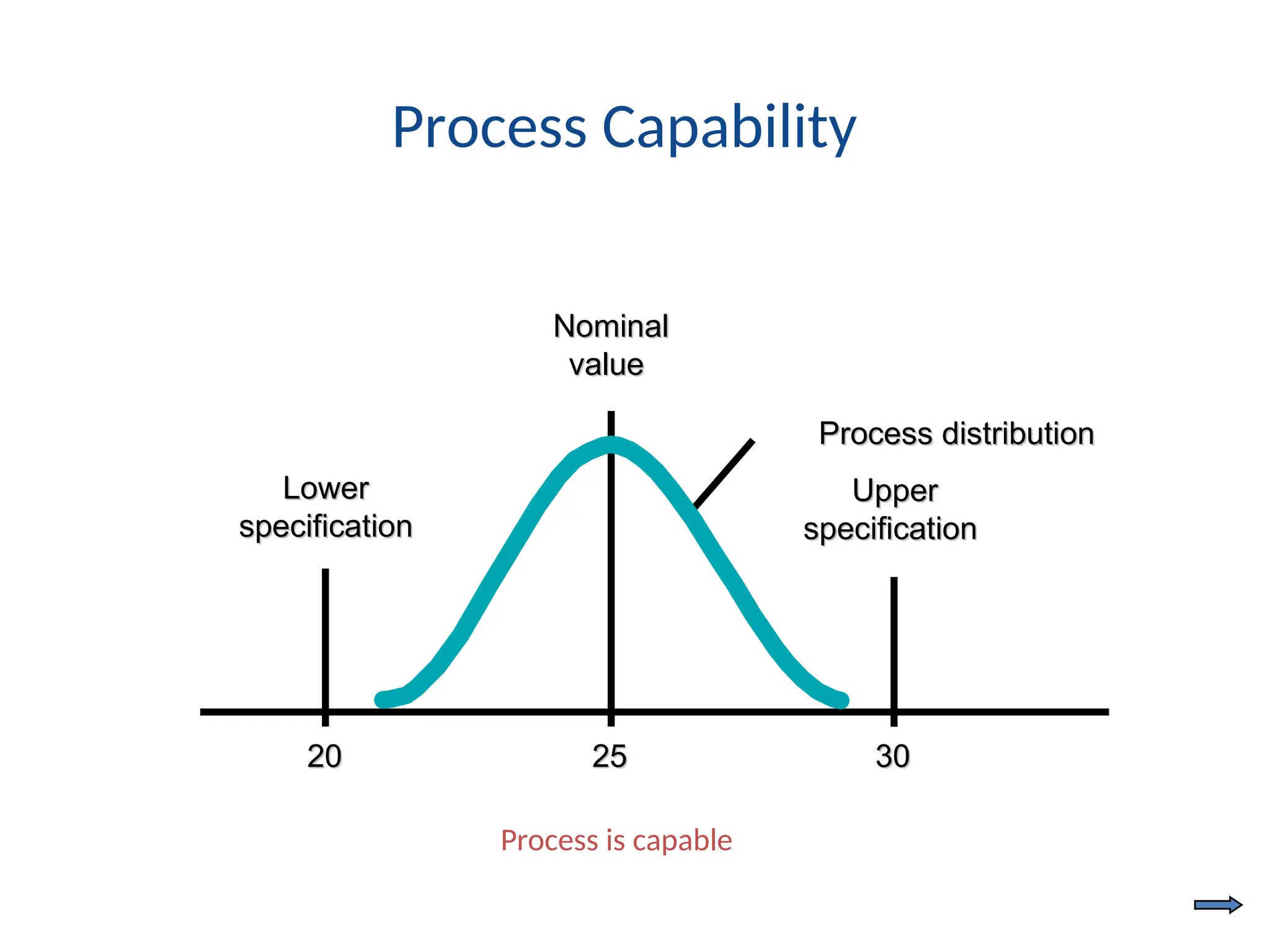
20
20 25
25 30
30
Upper
Upper
specification
specification
Lower
Lower
specification
specification
Nominal
Nominal
value
value
Process Capability
Process is capable
Process distribution
Process is not capable
20
20 25
25 30
30
Upper
Upper
specification
specification
Lower
Lower
specification
specification
Nominal
Nominal
value
value
Process distribution
Process Capability
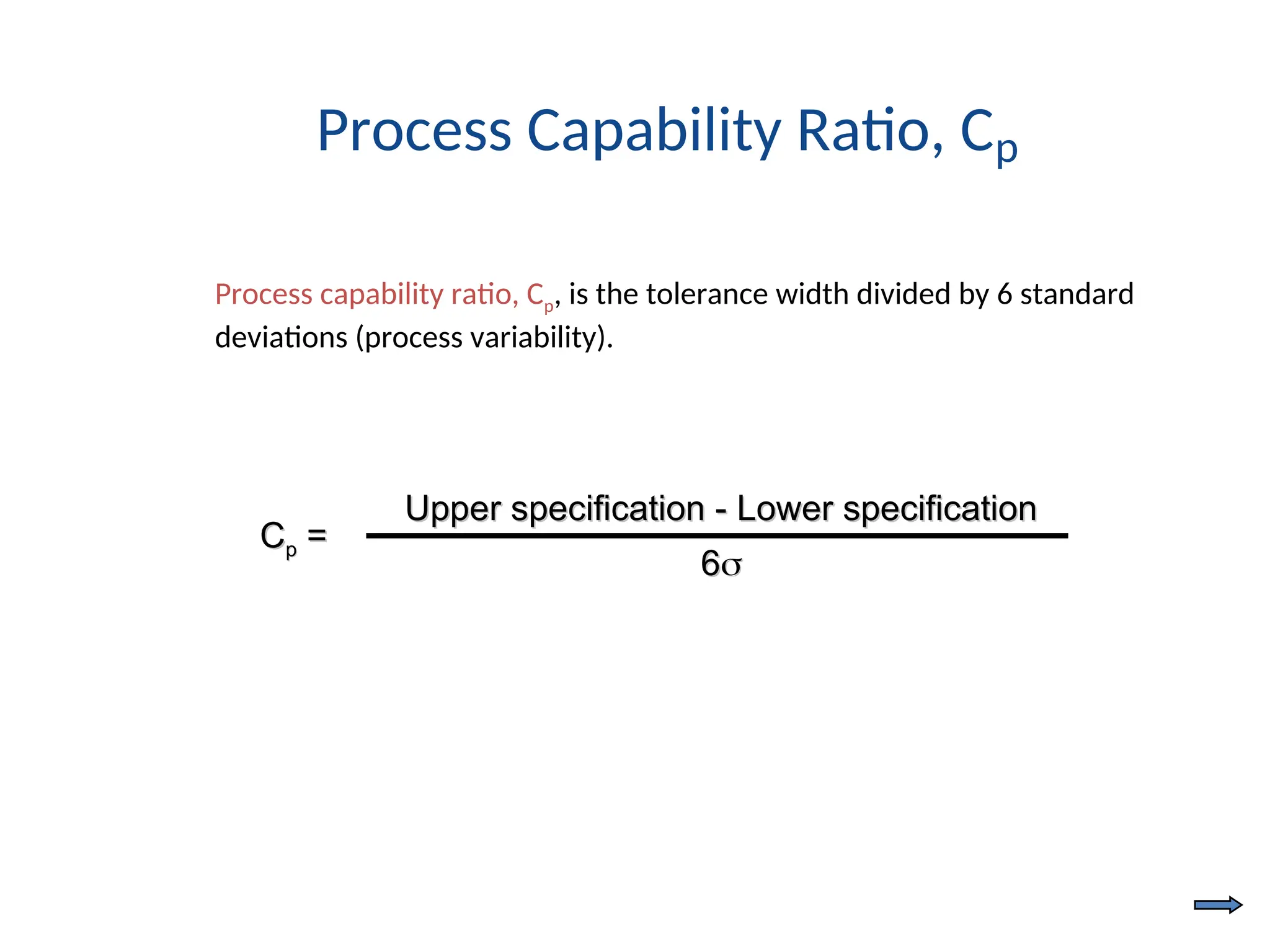
Process capability ratio, Cp, is the tolerance width divided by 6 standard
deviations (process variability).
Process Capability Ratio, Cp
C
Cp
p =
=
Upper specification - Lower specification
6
6

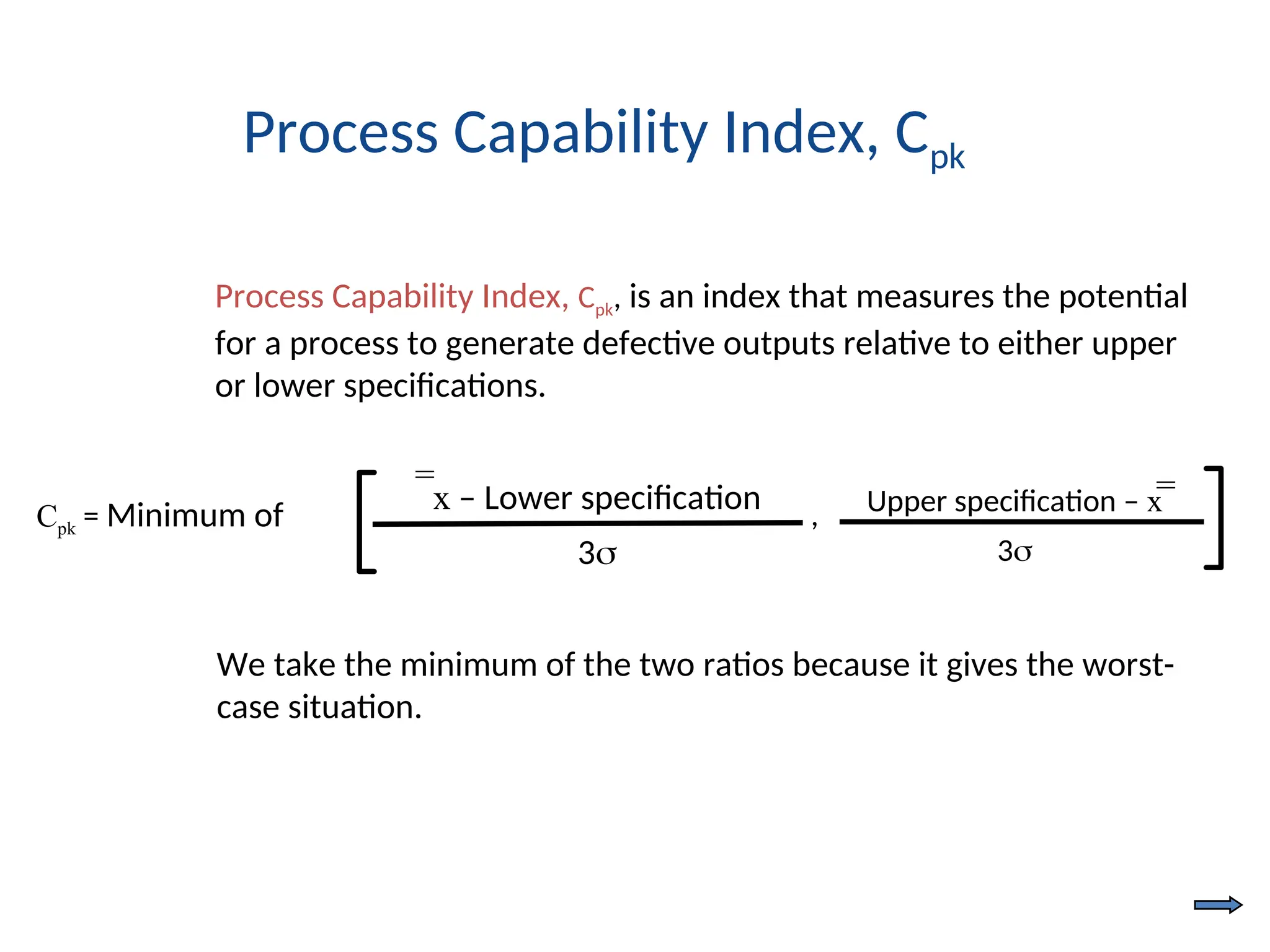
Cpk = Minimum of Upper specification – x
3
x – Lower specification
3
,
= =
Process Capability Index, Cpk, is an index that measures the potential
for a process to generate defective outputs relative to either upper
or lower specifications.
Process Capability Index, Cpk
We take the minimum of the two ratios because it gives the worst-
case situation.
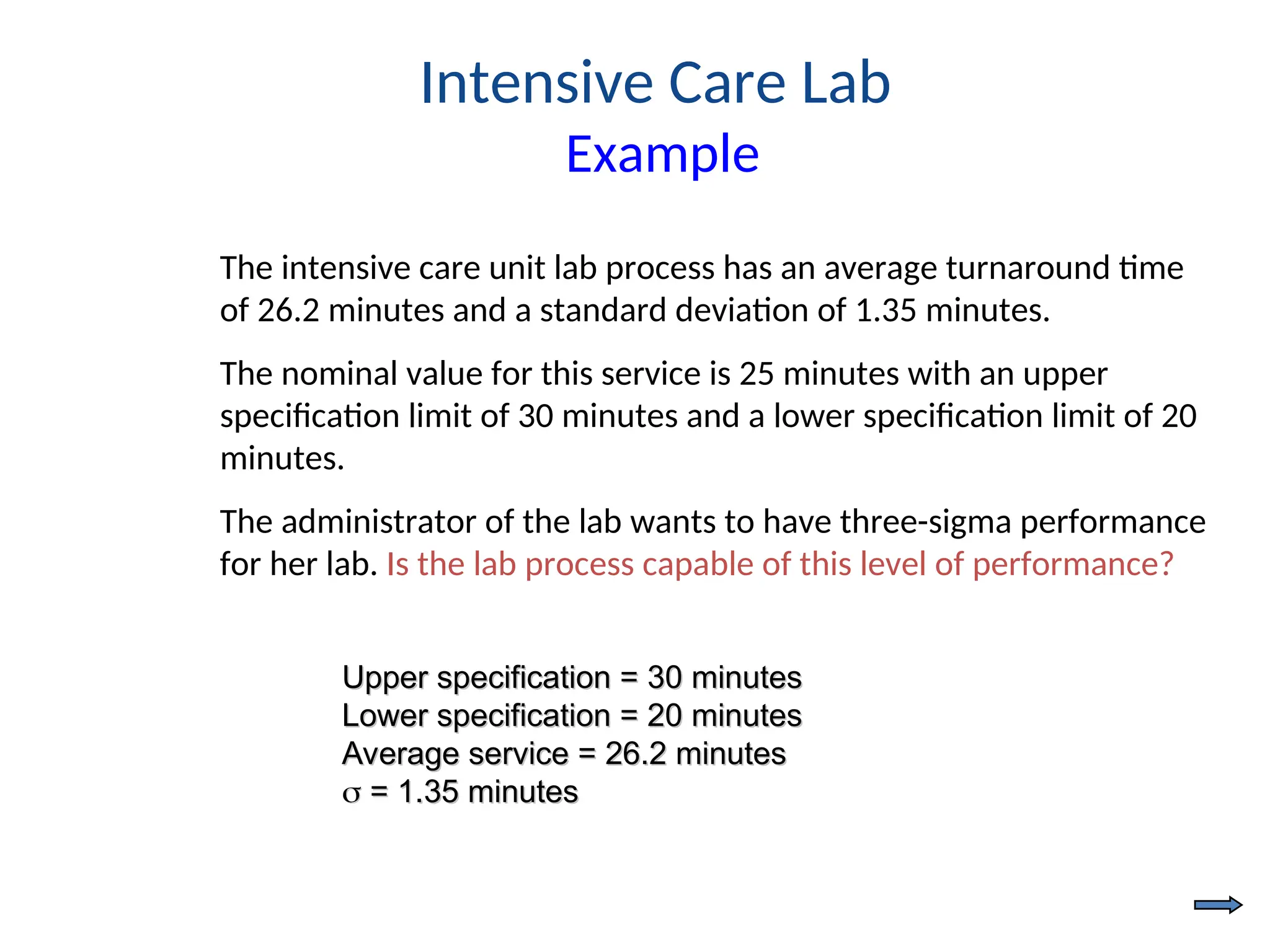
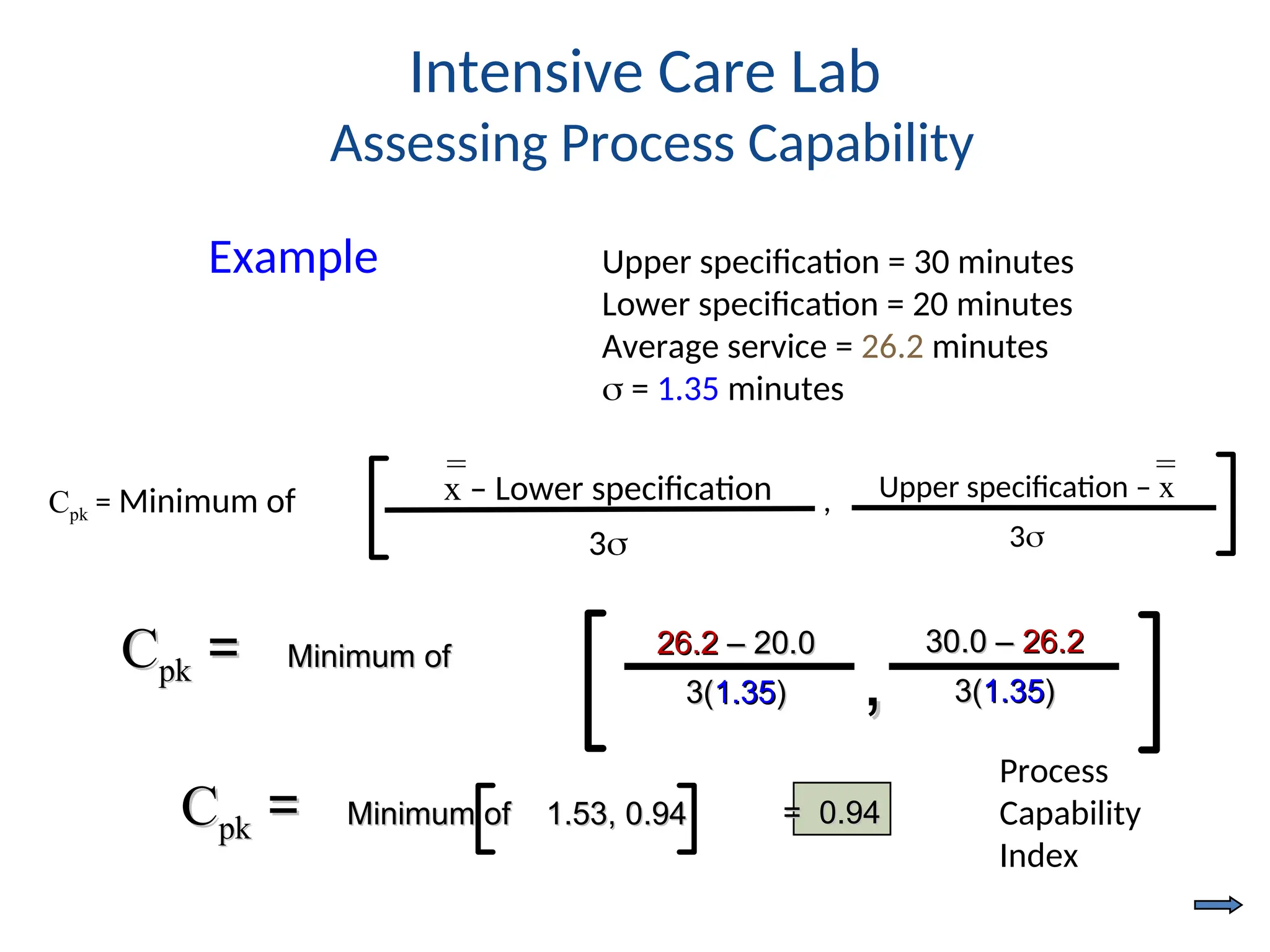
Intensive Care Lab
Example
Upper specification = 30 minutes
Lower specification = 20 minutes
Average service = 26.2 minutes

 = 1.35 minutes
= 1.35 minutes
The intensive care unit lab process has an average turnaround time
of 26.2 minutes and a standard deviation of 1.35 minutes.
The nominal value for this service is 25 minutes with an upper
specification limit of 30 minutes and a lower specification limit of 20
minutes.
The administrator of the lab wants to have three-sigma performance
for her lab. Is the lab process capable of this level of performance?
Cpk = Minimum of Upper specification – x
3
x – Lower specification
3
,
= =
Upper specification = 30 minutes
Lower specification = 20 minutes
Average service = 26.2 minutes
 = 1.35 minutes
Intensive Care Lab
Assessing Process Capability
C
Cpk
pk =
= Minimum of
Minimum of 26.2
26.2 – 20.0
– 20.0
3(
3(1.35
1.35)
) ,
,
30.0 –
30.0 – 26.2
26.2
3(
3(1.35
1.35)
)
C
Cpk
pk =
= Minimum of 1.53, 0.94
Minimum of 1.53, 0.94 = 0.94
= 0.94
Process
Capability
Index
Example
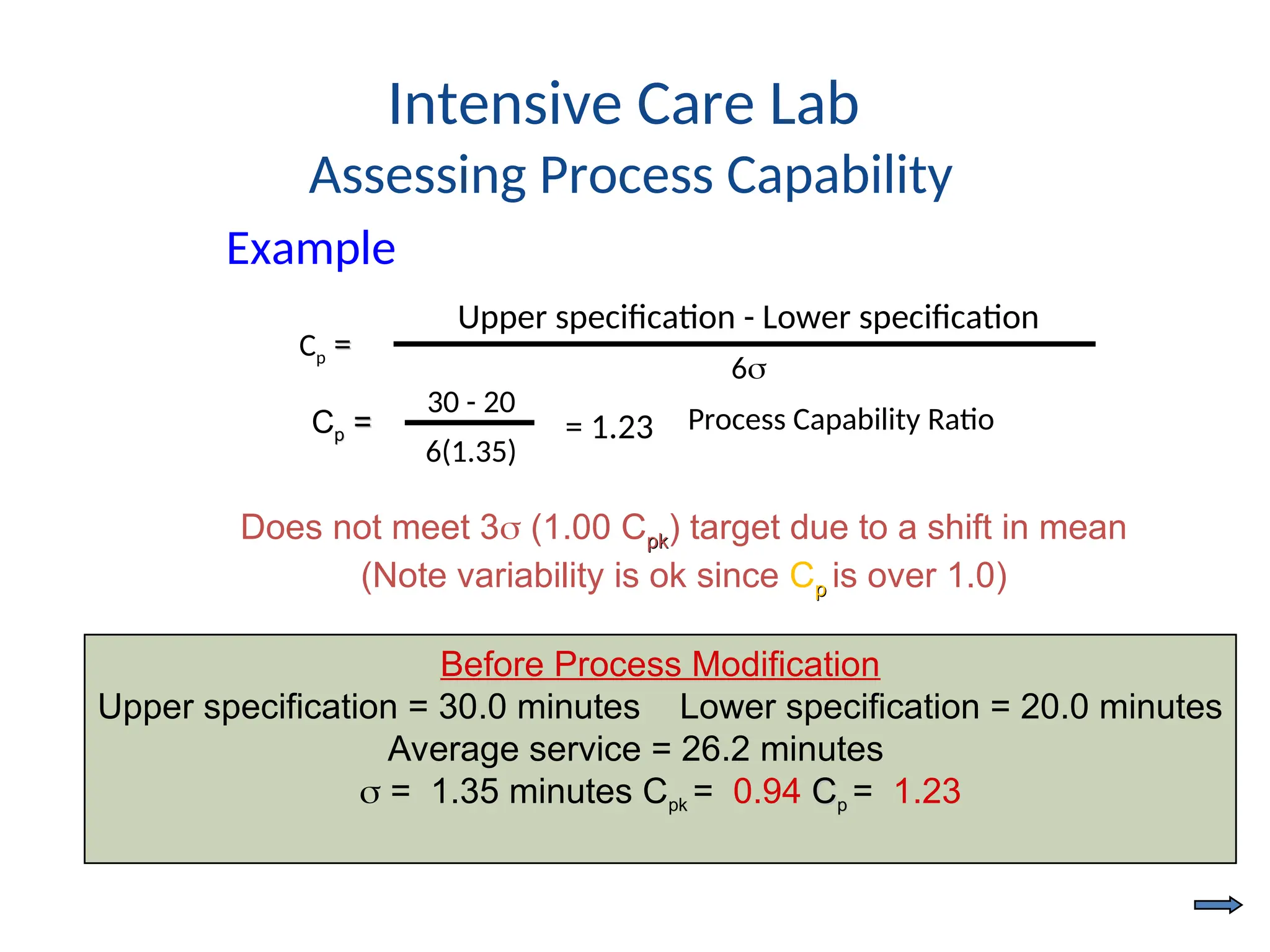
Cp =
=
Upper specification - Lower specification
6
Cp
p =
=
30 - 20
6(1.35)
= 1.23 Process Capability Ratio
Before Process Modification
Upper specification = 30.0 minutes Lower specification = 20.0 minutes
Average service = 26.2 minutes
 = 1.35 minutes Cpk = 0.94 C
Cp
p = 1.23
Intensive Care Lab
Assessing Process Capability
Does not meet 3 (1.00 Cpk
pk) target due to a shift in mean
(Note variability is ok since Cp
p is over 1.0)
Example
In Class Problem
In Class Problem
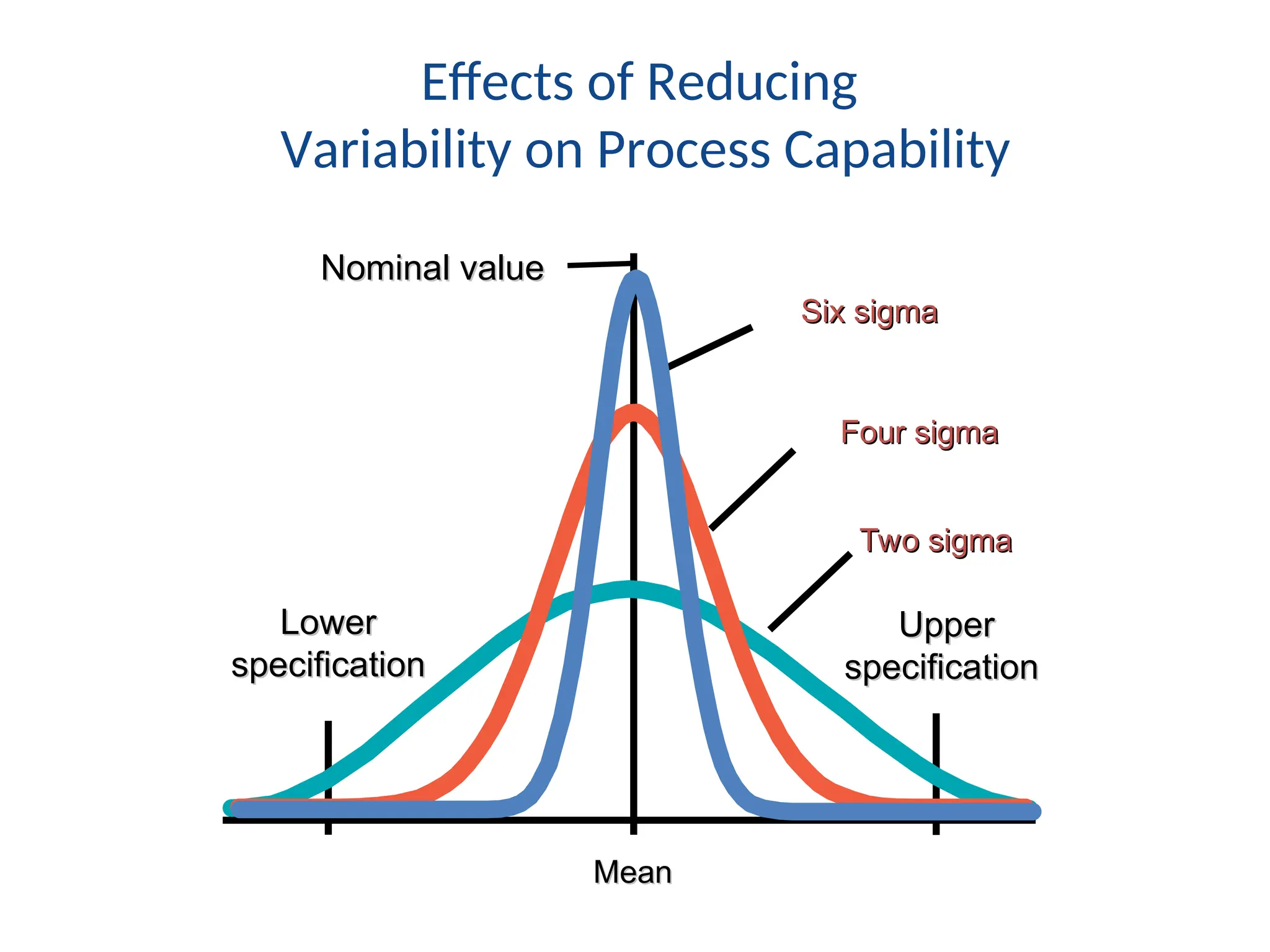
Lower
Lower
specification
specification
Mean
Mean
Upper
Upper
specification
specification
Nominal value
Nominal value
Six sigma
Six sigma
Four sigma
Four sigma
Two sigma
Two sigma
Effects of Reducing
Variability on Process Capability
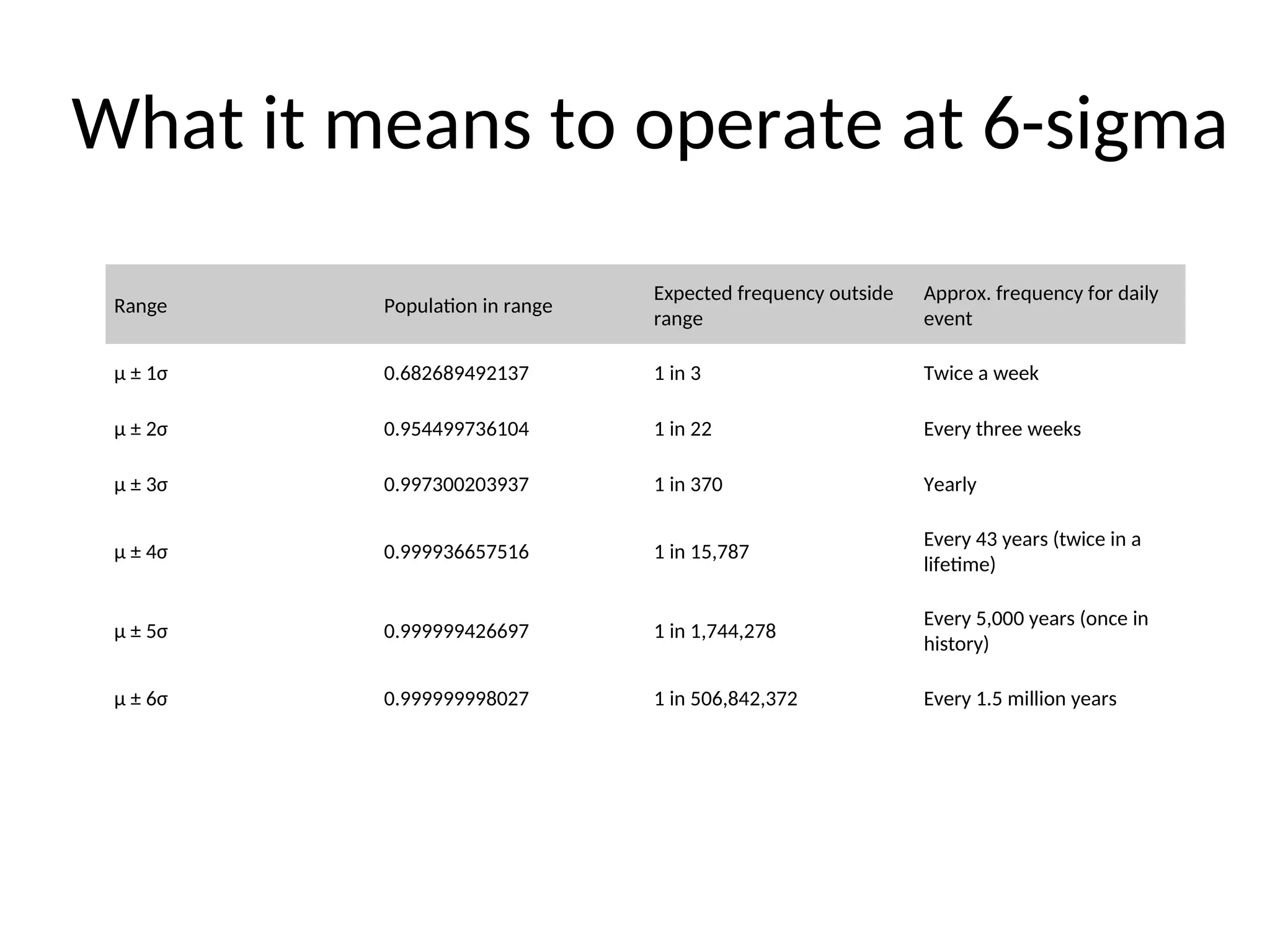
Range Population in range
Expected frequency outside
range
Approx. frequency for daily
event
μ ± 1σ 0.682689492137 1 in 3 Twice a week
μ ± 2σ 0.954499736104 1 in 22 Every three weeks
μ ± 3σ 0.997300203937 1 in 370 Yearly
μ ± 4σ 0.999936657516 1 in 15,787
Every 43 years (twice in a
lifetime)
μ ± 5σ 0.999999426697 1 in 1,744,278
Every 5,000 years (once in
history)
μ ± 6σ 0.999999998027 1 in 506,842,372 Every 1.5 million years
What it means to operate at 6-sigma
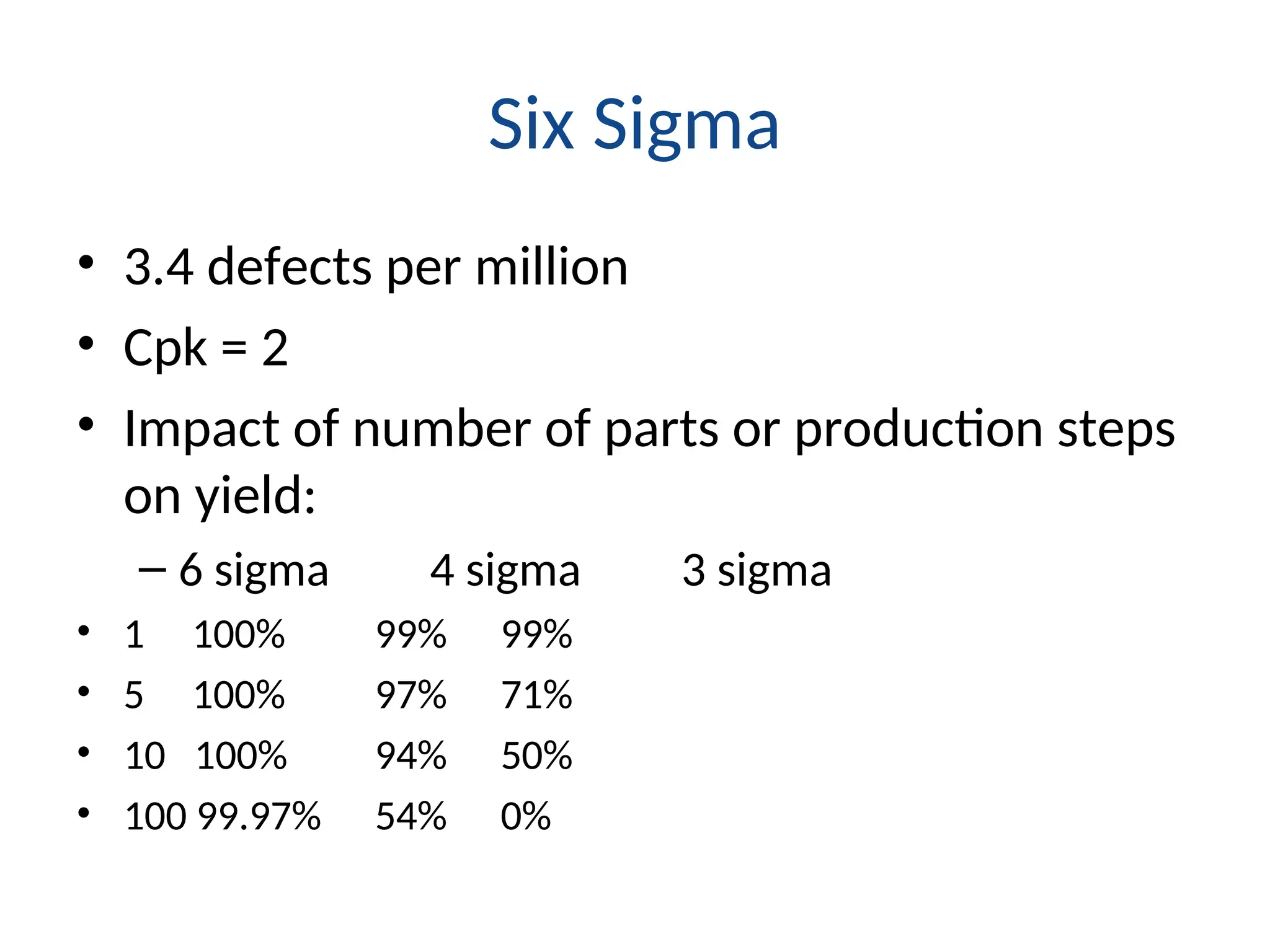
Six Sigma
• 3.4 defects per million
• Cpk = 2
• Impact of number of parts or production steps
on yield:
– 6 sigma 4 sigma 3 sigma
• 1 100% 99% 99%
• 5 100% 97% 71%
• 10 100% 94% 50%
• 100 99.97% 54% 0%
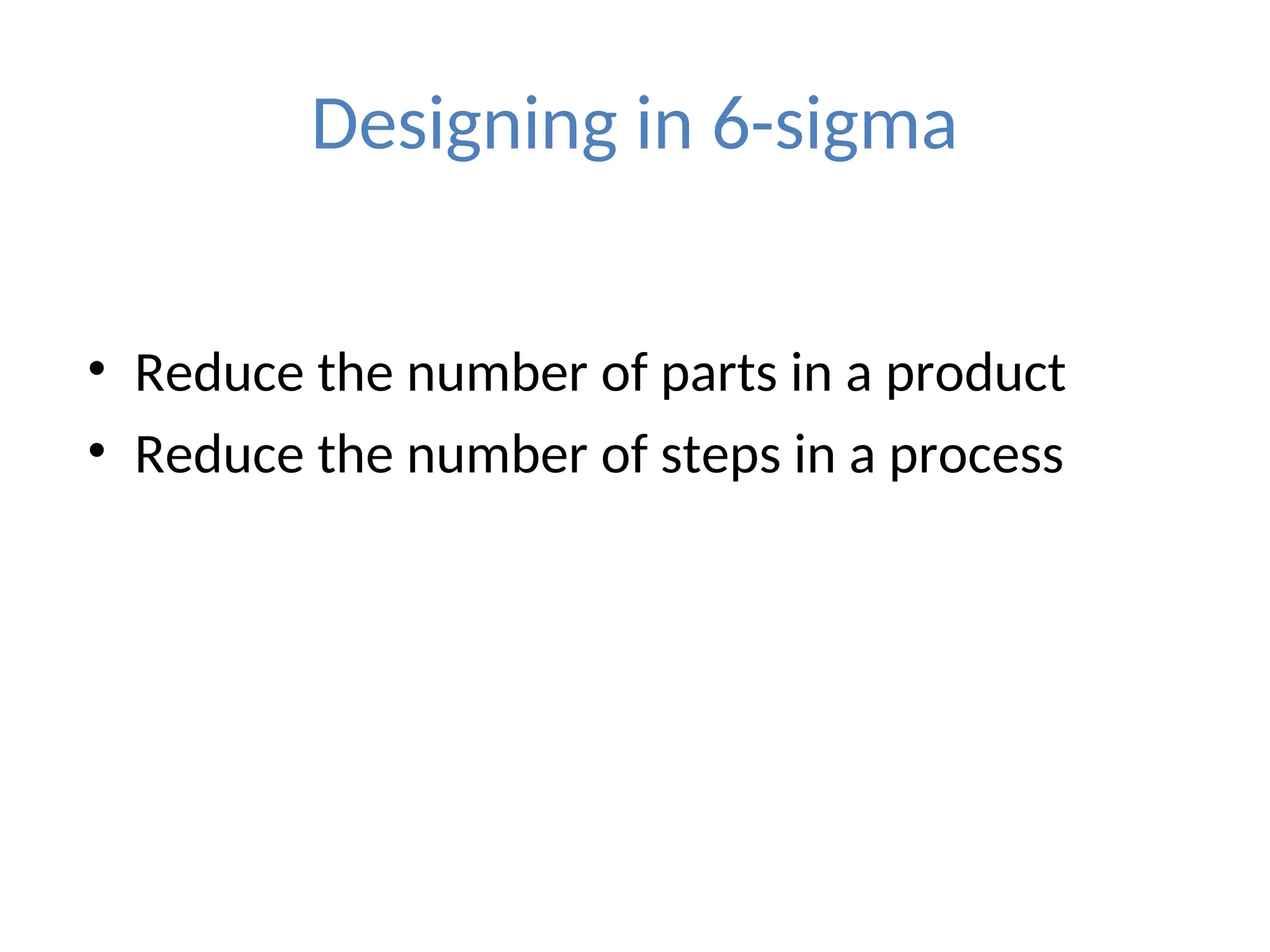
Designing in 6-sigma
• Reduce the number of parts in a product
• Reduce the number of steps in a process
Six Sigma
• Six Sigma is a comprehensive and flexible system for
achieving, sustaining, and maximizing business success
by minimizing defects and variability in processes.
• It relies heavily on the principles and tools of TQM.
• It is driven by a close understanding of customer needs;
the disciplined use of facts, data, and statistical analysis;
and diligent attention to managing, improving, and
reinventing business processes.
Six Sigma
Improvement Model
1. Define Determine the current process
characteristics critical to customer satisfaction
and identify any gaps.
2. Measure Quantify the work the process does
that affects the gap.
3. Analyze Use data on measures to perform
process analysis.
4. Improve Modify or redesign existing methods to
meet the new performance objectives.
5. Control Monitor the process to make sure high
performance levels are maintained.
Six Sigma
Implementation
 Top Down Commitment from corporate leaders.
 Measurement Systems to Track Progress
 Tough Goal Setting through benchmarking best-
in-class companies.
 Education: Employees must be trained in the
“whys” and “how-tos” of quality.
 Communication: Successes are as important to
understanding as failures.
 Customer Priorities: Never lose sight of the
customer’s priorities.
Six Sigma Education
• Green Belt: An employee who achieved the first level of
training in a Six Sigma program and spends part of his or
her time teaching and helping teams with their projects.
• Black Belt: An employee who reached the highest level of
training in a Six Sigma program and spends all of his or
her time teaching and leading teams involved in Six Sigma
projects.
• Master Black Belt: Full-time teachers and mentors to
several black belts.
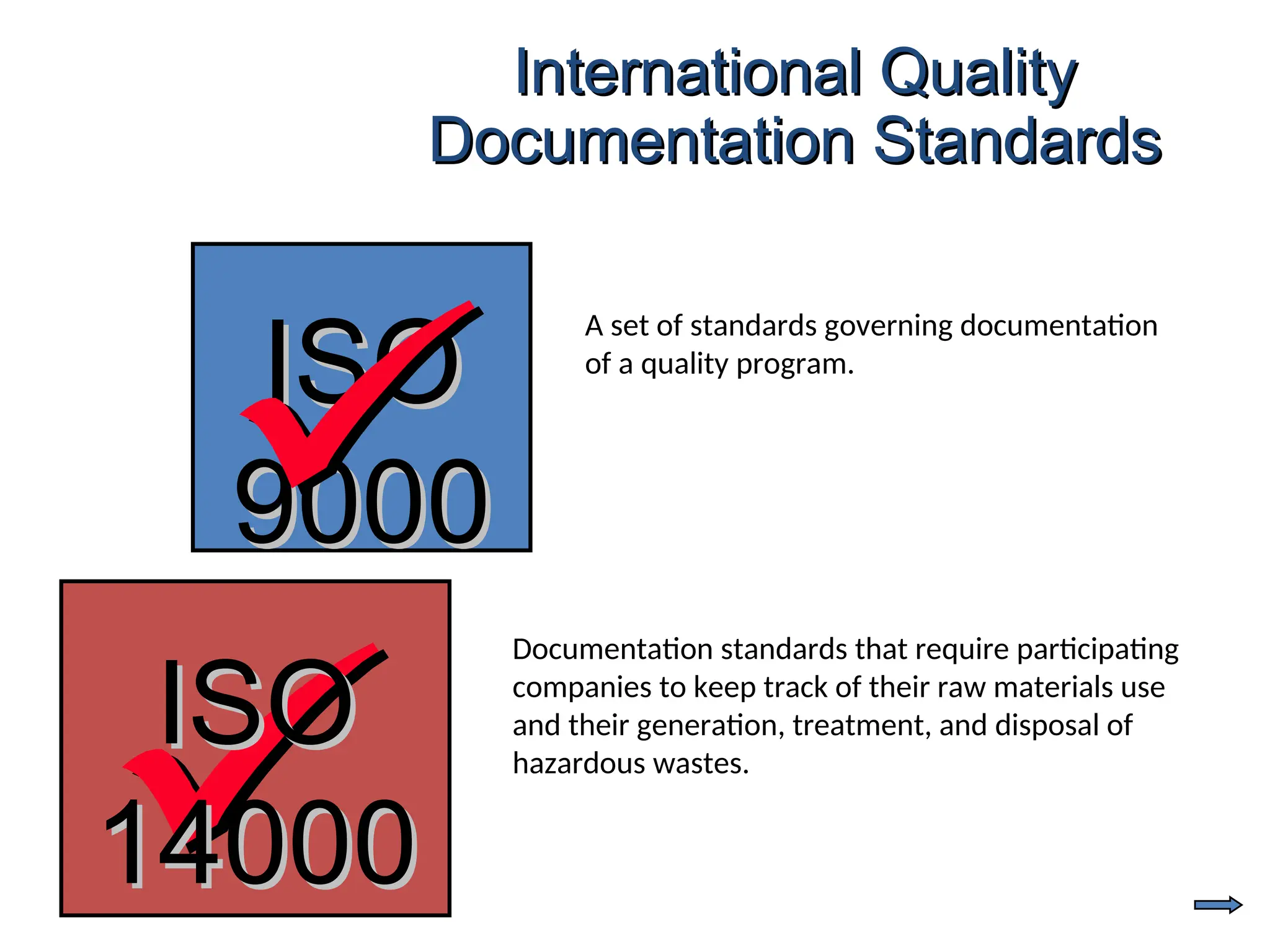
International Quality
Documentation Standards
ISO
ISO
9000
9000
A set of standards governing documentation
of a quality program.
ISO
ISO
14000
14000
Documentation standards that require participating
companies to keep track of their raw materials use
and their generation, treatment, and disposal of
hazardous wastes.
1. Category 1 ─ Leadership
120 points
2. Category 2 ─ Strategic Planning
85 points
3. Category 3 ─ Customer and Market Focus
85 points
4. Category 4 ─ Measurement, Analysis, and
Knowledge Management
Malcolm Baldrige National Quality
Award
Named after the late secretary of commerce, a strong proponent of
enhancing quality as a means of reducing the trade deficit. The
award promotes, recognizes, and publicizes quality strategies and
achievements.

This ppt was about Process Capability study

  • 1.
    Control Charts for Attributes p-chart:A chart used for controlling the proportion of defective services or products generated by the process.  p p = = p p(1 – (1 – p p)/ )/n n Where n = sample size p = central line on the chart, which can be either the historical average population proportion defective or a target value. z = normal deviate (number of standard deviations from the average) Control limits are: UCLp = p+z p p and LCLp = p−zp – –
  • 2.
    Hometown Bank Hometown Bank Example Example Theoperations manager of the booking services department of Hometown Bank is concerned about the number of wrong customer account numbers recorded by Hometown personnel. Each week a random sample of 2,500 deposits is taken, and the number of incorrect account numbers is recorded. The results for the past 12 weeks are shown in the following table. Is the booking process out of statistical control? Use three-sigma control limits.
  • 3.
    Sample Wrong Proportion NumberAccount # Defective 1 15 0.006 2 12 0.0048 3 19 0.0076 4 2 0.0008 5 19 0.0076 6 4 0.0016 7 24 0.0096 8 7 0.0028 9 10 0.004 10 17 0.0068 11 15 0.006 12 3 0.0012 Total 147 Hometown Bank Hometown Bank Using a p-Chart to monitor a process Using a p-Chart to monitor a process n = 2500 p = 147 12(2500) = 0.0049  p p = = p p(1 – (1 – p p)/ )/n n  p p = = 0.0049 0.0049(1 – (1 – 0.0049 0.0049)/ )/2500 2500  p p = 0.0014 = 0.0014 UCLp = 0.0049 + 3(0.0014) = 0.0091 LCLp = 0.0049 – 3(0.0014) = 0.0007
  • 4.
    Hometown Bank Hometown Bank Usinga p-Chart to monitor a process Using a p-Chart to monitor a process Example
  • 5.
  • 6.
    Control Charts Two typesof error are possible with control charts • A type I error occurs when a process is thought to be out of control when in fact it is not • A type II error occurs when a process is thought to be in control when it is actually out of statistical control These errors can be controlled by the choice of control limits
  • 7.
    Process Capability • Processcapability is the ability of the process to meet the design specifications for a service or product. • Nominal value is a target for design specifications. • Tolerance is an allowance above or below the nominal value.
  • 8.
  • 9.
    Process is notcapable Process is not capable 20 20 25 25 30 30 Upper Upper specification specification Lower Lower specification specification Nominal Nominal value value Process distribution Process distribution Process Capability
  • 10.
    Process capability ratio,Cp, is the tolerance width divided by 6 standard deviations (process variability). Process Capability Ratio, Cp C Cp p = = Upper specification - Lower specification Upper specification - Lower specification 6 6 
  • 11.
    Cpk = Minimumof Upper specification – x 3 x – Lower specification 3 , = = Process Capability Index, Cpk, is an index that measures the potential for a process to generate defective outputs relative to either upper or lower specifications. Process Capability Index, Cpk We take the minimum of the two ratios because it gives the worst- case situation.
  • 12.
    Intensive Care Lab Example Upperspecification = 30 minutes Upper specification = 30 minutes Lower specification = 20 minutes Lower specification = 20 minutes Average service = 26.2 minutes Average service = 26.2 minutes   = 1.35 minutes = 1.35 minutes The intensive care unit lab process has an average turnaround time of 26.2 minutes and a standard deviation of 1.35 minutes. The nominal value for this service is 25 minutes with an upper specification limit of 30 minutes and a lower specification limit of 20 minutes. The administrator of the lab wants to have three-sigma performance for her lab. Is the lab process capable of this level of performance?
  • 13.
    Cpk = Minimumof Upper specification – x 3 x – Lower specification 3 , = = Upper specification = 30 minutes Lower specification = 20 minutes Average service = 26.2 minutes  = 1.35 minutes Intensive Care Lab Assessing Process Capability C Cpk pk = = Minimum of Minimum of 26.2 26.2 – 20.0 – 20.0 3( 3(1.35 1.35) ) , , 30.0 – 30.0 – 26.2 26.2 3( 3(1.35 1.35) ) C Cpk pk = = Minimum of 1.53, 0.94 Minimum of 1.53, 0.94 = 0.94 = 0.94 Process Capability Index Example
  • 14.
    Cp = = Upper specification- Lower specification 6 Cp p = = 30 - 20 6(1.35) = 1.23 Process Capability Ratio Before Process Modification Upper specification = 30.0 minutes Lower specification = 20.0 minutes Average service = 26.2 minutes  = 1.35 minutes Cpk = 0.94 C Cp p = 1.23 Intensive Care Lab Assessing Process Capability Does not meet 3 (1.00 Cpk pk) target due to a shift in mean (Note variability is ok since Cp p is over 1.0) Example
  • 15.
  • 16.
  • 17.
    Lower Lower specification specification Mean Mean Upper Upper specification specification Nominal value Nominal value Sixsigma Six sigma Four sigma Four sigma Two sigma Two sigma Effects of Reducing Variability on Process Capability
  • 18.
    Range Population inrange Expected frequency outside range Approx. frequency for daily event μ ± 1σ 0.682689492137 1 in 3 Twice a week μ ± 2σ 0.954499736104 1 in 22 Every three weeks μ ± 3σ 0.997300203937 1 in 370 Yearly μ ± 4σ 0.999936657516 1 in 15,787 Every 43 years (twice in a lifetime) μ ± 5σ 0.999999426697 1 in 1,744,278 Every 5,000 years (once in history) μ ± 6σ 0.999999998027 1 in 506,842,372 Every 1.5 million years What it means to operate at 6-sigma
  • 19.
    Six Sigma • 3.4defects per million • Cpk = 2 • Impact of number of parts or production steps on yield: – 6 sigma 4 sigma 3 sigma • 1 100% 99% 99% • 5 100% 97% 71% • 10 100% 94% 50% • 100 99.97% 54% 0%
  • 20.
    Designing in 6-sigma •Reduce the number of parts in a product • Reduce the number of steps in a process
  • 21.
    Six Sigma • SixSigma is a comprehensive and flexible system for achieving, sustaining, and maximizing business success by minimizing defects and variability in processes. • It relies heavily on the principles and tools of TQM. • It is driven by a close understanding of customer needs; the disciplined use of facts, data, and statistical analysis; and diligent attention to managing, improving, and reinventing business processes.
  • 22.
    Six Sigma Improvement Model 1.Define Determine the current process characteristics critical to customer satisfaction and identify any gaps. 2. Measure Quantify the work the process does that affects the gap. 3. Analyze Use data on measures to perform process analysis. 4. Improve Modify or redesign existing methods to meet the new performance objectives. 5. Control Monitor the process to make sure high performance levels are maintained.
  • 23.
    Six Sigma Implementation  TopDown Commitment from corporate leaders.  Measurement Systems to Track Progress  Tough Goal Setting through benchmarking best- in-class companies.  Education: Employees must be trained in the “whys” and “how-tos” of quality.  Communication: Successes are as important to understanding as failures.  Customer Priorities: Never lose sight of the customer’s priorities.
  • 24.
    Six Sigma Education •Green Belt: An employee who achieved the first level of training in a Six Sigma program and spends part of his or her time teaching and helping teams with their projects. • Black Belt: An employee who reached the highest level of training in a Six Sigma program and spends all of his or her time teaching and leading teams involved in Six Sigma projects. • Master Black Belt: Full-time teachers and mentors to several black belts.
  • 25.
    International Quality International Quality DocumentationStandards Documentation Standards ISO ISO 9000 9000 A set of standards governing documentation of a quality program. ISO ISO 14000 14000 Documentation standards that require participating companies to keep track of their raw materials use and their generation, treatment, and disposal of hazardous wastes.
  • 26.
    1. Category 1─ Leadership 120 points 2. Category 2 ─ Strategic Planning 85 points 3. Category 3 ─ Customer and Market Focus 85 points 4. Category 4 ─ Measurement, Analysis, and Knowledge Management Malcolm Baldrige National Quality Award Named after the late secretary of commerce, a strong proponent of enhancing quality as a means of reducing the trade deficit. The award promotes, recognizes, and publicizes quality strategies and achievements.