



5/29/2017 1
 Condition
 Prevalence
 Optics ,physiology and anatomy
 Symptoms & signs
 Diagnostic procedures
 Management
 Reference
5/29/2017 2
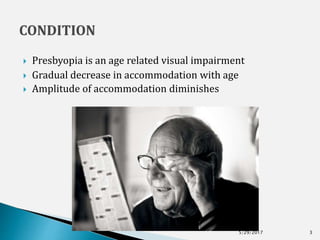
 Presbyopia is an age related visual impairment
 Gradual decrease in accommodation with age
 Amplitude of accommodation diminishes
5/29/2017 3
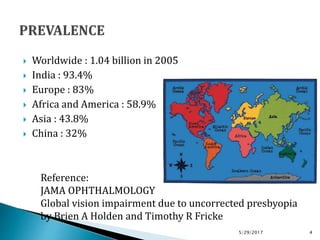
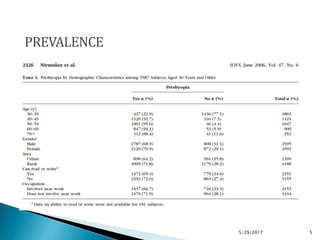
 Worldwide : 1.04 billion in 2005
 India : 93.4%
 Europe : 83%
 Africa and America : 58.9%
 Asia : 43.8%
 China : 32%
5/29/2017 4
Reference:
JAMA OPHTHALMOLOGY
Global vision impairment due to uncorrected presbyopia
by Brien A Holden and Timothy R Fricke
5/29/2017 5
PREVALENCE
5/29/2017 6
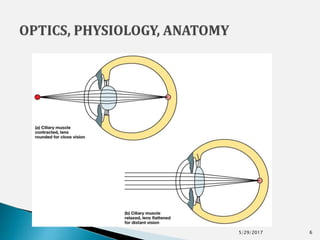
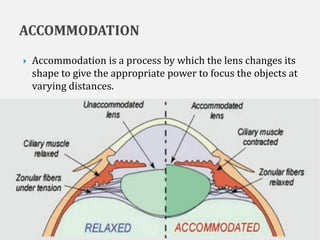
 Accommodation is a process by which the lens changes its
shape to give the appropriate power to focus the objects at
varying distances.
5/29/2017 7
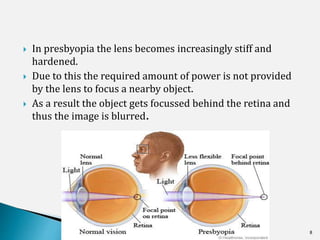
 In presbyopia the lens becomes increasingly stiff and
hardened.
 Due to this the required amount of power is not provided
by the lens to focus a nearby object.
 As a result the object gets focussed behind the retina and
thus the image is blurred.
5/29/2017 8
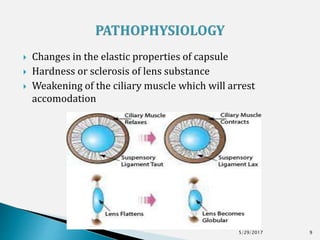
 Changes in the elastic properties of capsule
 Hardness or sclerosis of lens substance
 Weakening of the ciliary muscle which will arrest
accomodation
5/29/2017 9
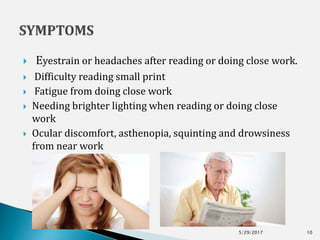
 Eyestrain or headaches after reading or doing close work.
 Difficulty reading small print
 Fatigue from doing close work
 Needing brighter lighting when reading or doing close
work
 Ocular discomfort, asthenopia, squinting and drowsiness
from near work
5/29/2017 10
5/29/2017 11
 PATIENT HISTORY: Patients often report
problems with reading like,
 Being able to read for short periods only
 Noticing blurred or double print
 Unable to read fine prints, tearing
 Requiring more lighting and distance
 Headache and drowsiness
5/29/2017 12
5/29/2017 13
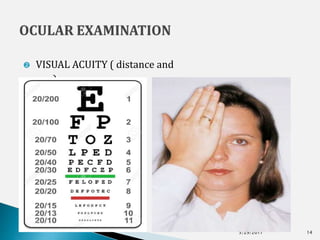
 VISUAL ACUITY ( distance and
near)
5/29/2017 14
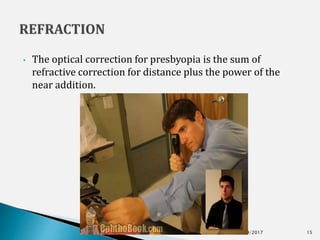
• The optical correction for presbyopia is the sum of
refractive correction for distance plus the power of the
near addition.
5/29/2017 15
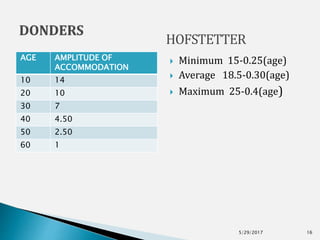
AGE AMPLITUDE OF
ACCOMMODATION
10 14
20 10
30 7
40 4.50
50 2.50
60 1
 Minimum 15-0.25(age)
 Average 18.5-0.30(age)
 Maximum 25-0.4(age)
5/29/2017 16
HOFSTETTER
5/29/2017 17
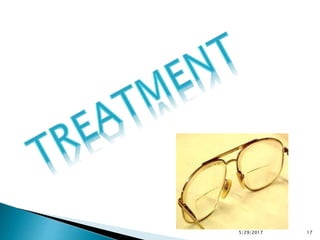
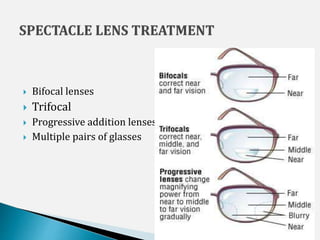
 Bifocal lenses
 Trifocal
 Progressive addition lenses
 Multiple pairs of glasses
5/29/2017 18
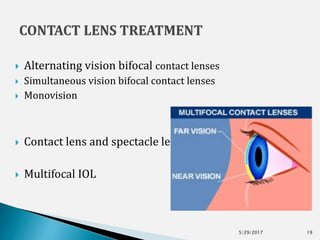
 Alternating vision bifocal contact lenses
 Simultaneous vision bifocal contact lenses
 Monovision
 Contact lens and spectacle lenses.
 Multifocal IOL
5/29/2017 19
 A new glasses were developed by researchers at University of
Utah in the US which contain lenses made of glycerin enclosed
by flexible rubber-like membranes in the front and back
 In the bridge of the glasses is a distance meter that measures the
distance from the glasses to an object via pulses of infra red
light. When the wearer looks at an object, the meter measures
the distance and tells the actuators how to curve the lenses
 Before putting them on the wearers have to input their
eyeglasses prescription into an accompanying smartphone app,
which calibrates the lenses via a bluetooth connection.
 REFERENCE: The Hindu Dated 27/01/2017
5/29/2017 20
 American optometry association,2011- Revised by
Nancy Carlson, O.D. Approved by the AOA board of
trustees
 Refractive management of ametropia – Kenneth e.
Brookman Second edition
 Andhra Pradesh eye disease study: A population
Based assessment of Presbyopia in the state of
Andhra Pradesh, South India 2006
5/29/2017 21
5/29/2017 22

Presbyopia

  • 1.
  • 2.
     Condition  Prevalence Optics ,physiology and anatomy  Symptoms & signs  Diagnostic procedures  Management  Reference 5/29/2017 2
  • 3.
     Presbyopia isan age related visual impairment  Gradual decrease in accommodation with age  Amplitude of accommodation diminishes 5/29/2017 3
  • 4.
     Worldwide :1.04 billion in 2005  India : 93.4%  Europe : 83%  Africa and America : 58.9%  Asia : 43.8%  China : 32% 5/29/2017 4 Reference: JAMA OPHTHALMOLOGY Global vision impairment due to uncorrected presbyopia by Brien A Holden and Timothy R Fricke
  • 5.
  • 6.
  • 7.
     Accommodation isa process by which the lens changes its shape to give the appropriate power to focus the objects at varying distances. 5/29/2017 7
  • 8.
     In presbyopiathe lens becomes increasingly stiff and hardened.  Due to this the required amount of power is not provided by the lens to focus a nearby object.  As a result the object gets focussed behind the retina and thus the image is blurred. 5/29/2017 8
  • 9.
     Changes inthe elastic properties of capsule  Hardness or sclerosis of lens substance  Weakening of the ciliary muscle which will arrest accomodation 5/29/2017 9
  • 10.
     Eyestrain orheadaches after reading or doing close work.  Difficulty reading small print  Fatigue from doing close work  Needing brighter lighting when reading or doing close work  Ocular discomfort, asthenopia, squinting and drowsiness from near work 5/29/2017 10
  • 11.
  • 12.
     PATIENT HISTORY:Patients often report problems with reading like,  Being able to read for short periods only  Noticing blurred or double print  Unable to read fine prints, tearing  Requiring more lighting and distance  Headache and drowsiness 5/29/2017 12
  • 13.
  • 14.
     VISUAL ACUITY( distance and near) 5/29/2017 14
  • 15.
    • The opticalcorrection for presbyopia is the sum of refractive correction for distance plus the power of the near addition. 5/29/2017 15
  • 16.
    AGE AMPLITUDE OF ACCOMMODATION 1014 20 10 30 7 40 4.50 50 2.50 60 1  Minimum 15-0.25(age)  Average 18.5-0.30(age)  Maximum 25-0.4(age) 5/29/2017 16 HOFSTETTER
  • 17.
  • 18.
     Bifocal lenses Trifocal  Progressive addition lenses  Multiple pairs of glasses 5/29/2017 18
  • 19.
     Alternating visionbifocal contact lenses  Simultaneous vision bifocal contact lenses  Monovision  Contact lens and spectacle lenses.  Multifocal IOL 5/29/2017 19
  • 20.
     A newglasses were developed by researchers at University of Utah in the US which contain lenses made of glycerin enclosed by flexible rubber-like membranes in the front and back  In the bridge of the glasses is a distance meter that measures the distance from the glasses to an object via pulses of infra red light. When the wearer looks at an object, the meter measures the distance and tells the actuators how to curve the lenses  Before putting them on the wearers have to input their eyeglasses prescription into an accompanying smartphone app, which calibrates the lenses via a bluetooth connection.  REFERENCE: The Hindu Dated 27/01/2017 5/29/2017 20
  • 21.
     American optometryassociation,2011- Revised by Nancy Carlson, O.D. Approved by the AOA board of trustees  Refractive management of ametropia – Kenneth e. Brookman Second edition  Andhra Pradesh eye disease study: A population Based assessment of Presbyopia in the state of Andhra Pradesh, South India 2006 5/29/2017 21
  • 22.