ANIMAL KINGDOM
PHYLUM PORIFERA
Hello!
I am Swetha
Bachelors in Optometry
You can find me at @
https://unacademy.com/user/swetha.chandran304/courses
Place your screenshot here
Introduction, Other features, Body wall, Canal system,
Skeleton, Digestion, Respiration, Excretion, Reproduction
Synopsis
Introduction
INTRODUCTION
◈ Ellias proved that sponges are animals.
◈ Robert grant gave the name Porifera.
◈ Study of sponges is known as Parazoology.
◈ Phylogenetically evolved from choano flagillates
(Proterospongia)
◈ All are aquatic, mostly marine but few are found in fresh
water also. They are sessible, solitary or colonial.
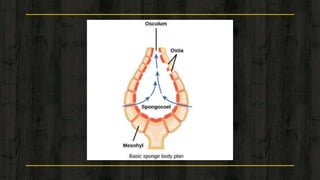
◈ Entire body with pres i.e. numerous mouthlets Ostia and
one opening for exit Osculum.
Other features
OTHER FEATURES
◈ Sponges have various body form and shapes i.e. Gase
shape, cylindrical with radial symmetry (Leucosolenia),
irregular shape (asymmetrical).
◈ Sponges have cellular level of organisation with two
germ layer i.e. Diploblasitc and do not posses head and
appendages.
Body wall
BODY WALL
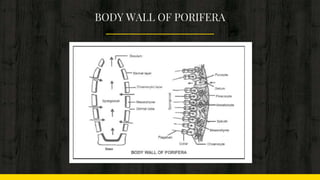
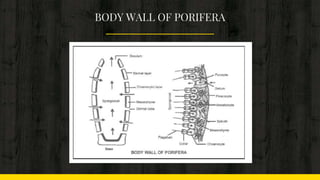
◈ Outer Dermal layer or Pinacoderm – Pinacocytes (Flat
cells), Procytes (oval)
◈ Inner Choanocytic layer or Choanoderm –
Characteristic of Porifera, Contains collar cells or
Choanocytes (flagellated)
◈ Choanocytes discovered by H.J. Clark
◈ Between these two layers gelatinous material
Mesenchyme is there. Amoebocytes are present here.
BODY WALL OF PORIFERA
AMOEBOCYTES
◈ Scleroblast - For skeleton
◈ Spongioblast - For skeleton
◈ Thesocytes - For food storage (Glycogen)
◈ Phagocytes - To engulf by phagocytosis
◈ Trophocytes - For Distribution of food
◈ Archaeocytes - Formation ova & spermatazoa (Totipotant
cells)
◈ Collencytes - Connective tissue cell
◈ Chromocytes - Pigmented Myocytes - Highly contractile (at
osculum)
BODY WALL OF PORIFERA
Canal system
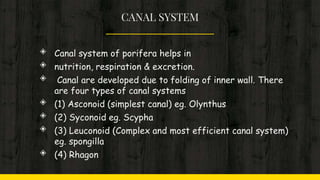
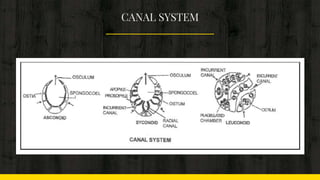
CANAL SYSTEM
◈ Canal system of porifera helps in
◈ nutrition, respiration & excretion.
◈ Canal are developed due to folding of inner wall. There
are four types of canal systems
◈ (1) Asconoid (simplest canal) eg. Olynthus
◈ (2) Syconoid eg. Scypha
◈ (3) Leuconoid (Complex and most efficient canal system)
eg. spongilla
◈ (4) Rhagon
CANAL SYSTEM
Skeleton
SKELETON
◈ Skeleton is internal, consist of tiny calcarious
calcoblast or siliceous spicules sillicoblast or fine
spongin fibre spongioblast, located in mesenchyma.
◈ Scleroblast secrets spicules and Spongioblast secrets
spongin fibre.
◈ Spicule types: monoaxon, triaxon, tetraaxon, polyaxon
Digestion
DIGESTION
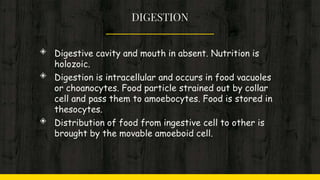
◈ Digestive cavity and mouth in absent. Nutrition is
holozoic.
◈ Digestion is intracellular and occurs in food vacuoles
or choanocytes. Food particle strained out by collar
cell and pass them to amoebocytes. Food is stored in
thesocytes.
◈ Distribution of food from ingestive cell to other is
brought by the movable amoeboid cell.
Respiration
Excretion
Nervous system
RESPIRATION AND EXCRETION
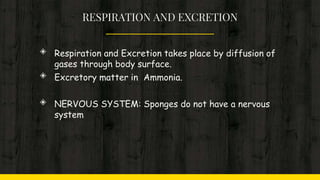
◈ Respiration and Excretion takes place by diffusion of
gases through body surface.
◈ Excretory matter in Ammonia.
◈ NERVOUS SYSTEM: Sponges do not have a nervous
system
Reproduction
REPRODUCTION
◈ Asexual - By Budding - Special cell mass Gemmules
containing Archaeocytes.
◈ Endogenous budding of asexual reproduction is sponge is
known as Gemmulation.
◈ Sexual - Sponges are Hermaphrodite, fertilization
internal and cross fertilization (Protogynous condition).
Important
organisms
IMPORTANT ORGANISMS
◈ Largest sponge - Spheciospongia
◈ Hypothetical simple sponge & between larva & sponge
Olynthus
◈ Scrimps - (Spongicula fish) A crustacean, shows
commensalisms with Euplecella
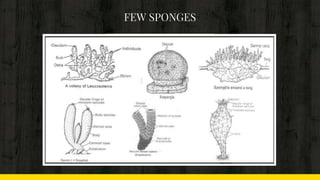
FEW SPONGES
Thanks!
Any questions?
You can find me at @
https://unacademy.com/user/swetha.chandran304/courses
Follow me or drop your queries in the comment box

Porifera

  • 1.
  • 2.
    Hello! I am Swetha Bachelorsin Optometry You can find me at @ https://unacademy.com/user/swetha.chandran304/courses
  • 3.
  • 4.
    Introduction, Other features,Body wall, Canal system, Skeleton, Digestion, Respiration, Excretion, Reproduction Synopsis
  • 5.
  • 6.
    INTRODUCTION ◈ Ellias provedthat sponges are animals. ◈ Robert grant gave the name Porifera. ◈ Study of sponges is known as Parazoology. ◈ Phylogenetically evolved from choano flagillates (Proterospongia) ◈ All are aquatic, mostly marine but few are found in fresh water also. They are sessible, solitary or colonial. ◈ Entire body with pres i.e. numerous mouthlets Ostia and one opening for exit Osculum.
  • 8.
  • 9.
    OTHER FEATURES ◈ Spongeshave various body form and shapes i.e. Gase shape, cylindrical with radial symmetry (Leucosolenia), irregular shape (asymmetrical). ◈ Sponges have cellular level of organisation with two germ layer i.e. Diploblasitc and do not posses head and appendages.
  • 10.
  • 11.
    BODY WALL ◈ OuterDermal layer or Pinacoderm – Pinacocytes (Flat cells), Procytes (oval) ◈ Inner Choanocytic layer or Choanoderm – Characteristic of Porifera, Contains collar cells or Choanocytes (flagellated) ◈ Choanocytes discovered by H.J. Clark ◈ Between these two layers gelatinous material Mesenchyme is there. Amoebocytes are present here.
  • 12.
    BODY WALL OFPORIFERA
  • 13.
    AMOEBOCYTES ◈ Scleroblast -For skeleton ◈ Spongioblast - For skeleton ◈ Thesocytes - For food storage (Glycogen) ◈ Phagocytes - To engulf by phagocytosis ◈ Trophocytes - For Distribution of food ◈ Archaeocytes - Formation ova & spermatazoa (Totipotant cells) ◈ Collencytes - Connective tissue cell ◈ Chromocytes - Pigmented Myocytes - Highly contractile (at osculum)
  • 14.
    BODY WALL OFPORIFERA
  • 15.
  • 16.
    CANAL SYSTEM ◈ Canalsystem of porifera helps in ◈ nutrition, respiration & excretion. ◈ Canal are developed due to folding of inner wall. There are four types of canal systems ◈ (1) Asconoid (simplest canal) eg. Olynthus ◈ (2) Syconoid eg. Scypha ◈ (3) Leuconoid (Complex and most efficient canal system) eg. spongilla ◈ (4) Rhagon
  • 17.
  • 18.
  • 19.
    SKELETON ◈ Skeleton isinternal, consist of tiny calcarious calcoblast or siliceous spicules sillicoblast or fine spongin fibre spongioblast, located in mesenchyma. ◈ Scleroblast secrets spicules and Spongioblast secrets spongin fibre. ◈ Spicule types: monoaxon, triaxon, tetraaxon, polyaxon
  • 20.
  • 21.
    DIGESTION ◈ Digestive cavityand mouth in absent. Nutrition is holozoic. ◈ Digestion is intracellular and occurs in food vacuoles or choanocytes. Food particle strained out by collar cell and pass them to amoebocytes. Food is stored in thesocytes. ◈ Distribution of food from ingestive cell to other is brought by the movable amoeboid cell.
  • 22.
  • 23.
    RESPIRATION AND EXCRETION ◈Respiration and Excretion takes place by diffusion of gases through body surface. ◈ Excretory matter in Ammonia. ◈ NERVOUS SYSTEM: Sponges do not have a nervous system
  • 24.
  • 25.
    REPRODUCTION ◈ Asexual -By Budding - Special cell mass Gemmules containing Archaeocytes. ◈ Endogenous budding of asexual reproduction is sponge is known as Gemmulation. ◈ Sexual - Sponges are Hermaphrodite, fertilization internal and cross fertilization (Protogynous condition).
  • 26.
  • 27.
    IMPORTANT ORGANISMS ◈ Largestsponge - Spheciospongia ◈ Hypothetical simple sponge & between larva & sponge Olynthus ◈ Scrimps - (Spongicula fish) A crustacean, shows commensalisms with Euplecella
  • 28.
  • 29.
    Thanks! Any questions? You canfind me at @ https://unacademy.com/user/swetha.chandran304/courses Follow me or drop your queries in the comment box