ACCOMMODATION
PRESENTED BY:
REEMA DANDAVATE
T.Y.B.OPTOMETRY
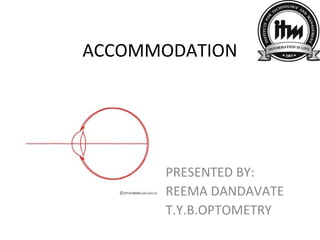
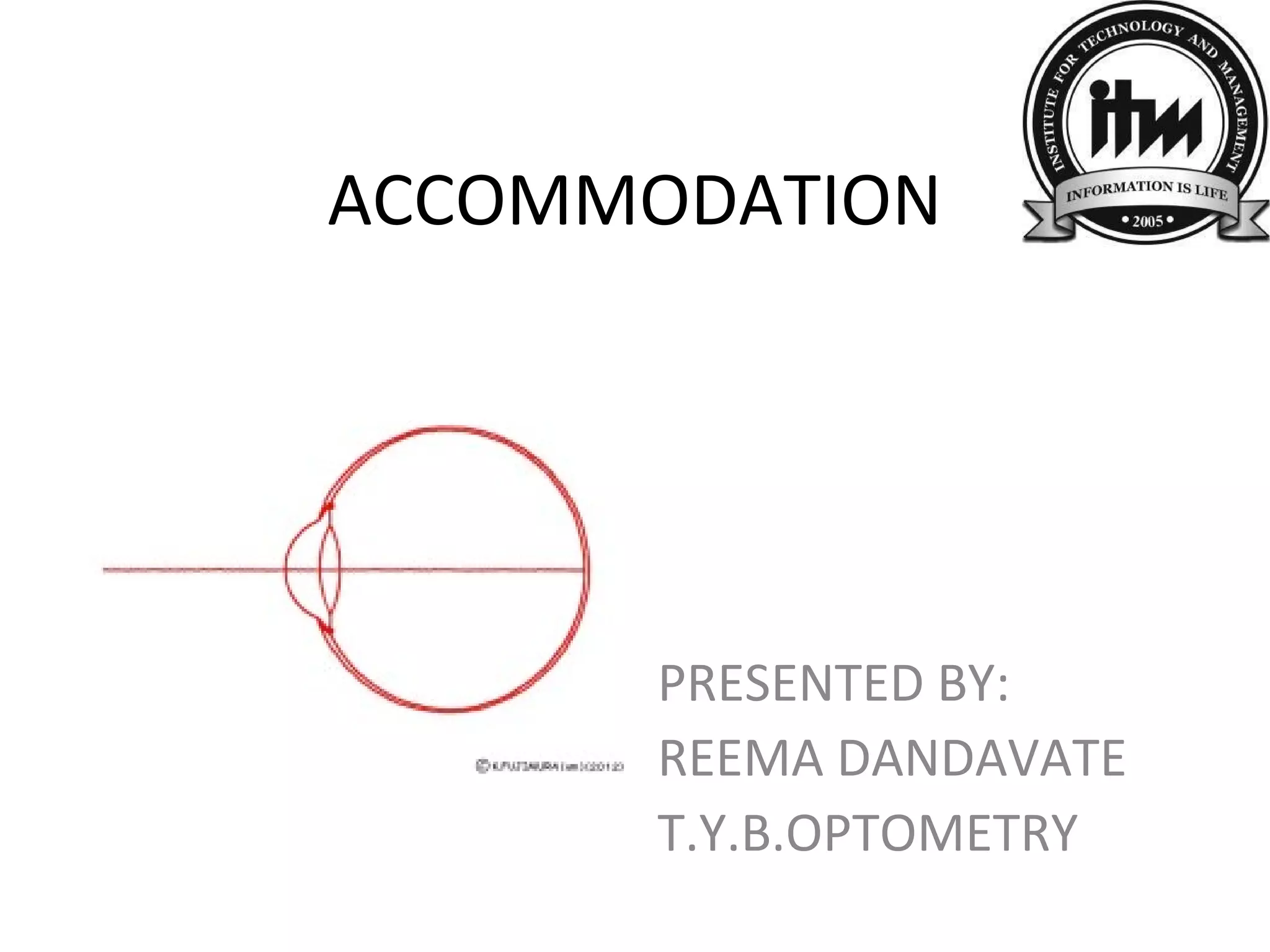
WHAT IS ACCOMMODATION ?
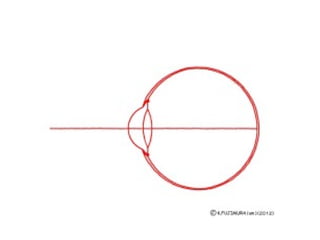
• KNOWN FACT : in an emmetropic eye, parallel rays of
light coming from infinity are brought to focus on retina,
with accommodation at rest.
• WHAT ABOUT THE DIVERGING RAYS COMING FROM
NEAR OBJECT ?
• Our eyes has been provided with a unique mechanism by
which we can even focus the diverging rays coming from
near object on retina in bid to see clearly. 
ACCOMMODATION.
• IN IT THERE IS INCREASE IN LENS POWER.
SOME TERMINOLOGIES...
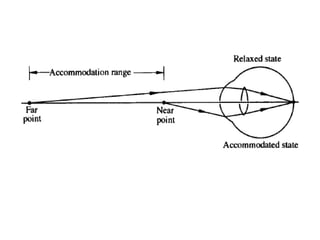
• NEAR POINT OF ACCOMMODATION :
• The nearest point at which small objects can
be seen clearly is called near point of
accommodation or punctum proximum.
• the distant point is called far point off
accommodation or punctum remotum.
• RANGE OF ACCOMMODATION:
• The distance between near point and far point
is called range of accommodation.
• AMPLITUDE OF ACCOMMODATION:
• The difference between DIOPTRIC power,
needed to focus at near point (P) and to focus
at far point (R), is called amplitude of
accommodation (A). Thus, A=P-R
POINTS TO BE KNOWN...
• In HYPROPIC eye, far point is virtual and lies
behind the eye.
• In MYOPIC eye, far point is real and lies in
front of the eye.
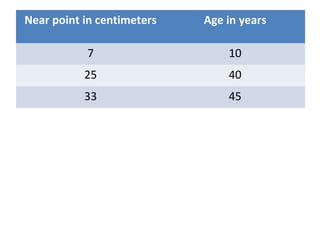
• In an EMMETROPIC eye, far point is at infinity
and near point varies with age...
Near point in centimeters Age in years
7 10
25 40
33 45
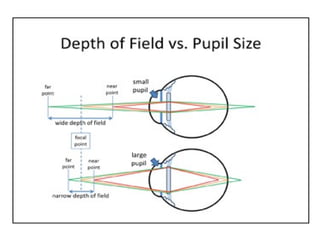
DEPTH OF FIELD...
• The range of distance from the eye in which
an object appears clear without change in
accommodation is termed depth of field.
• It reduces the necessity for precise
accommodation.
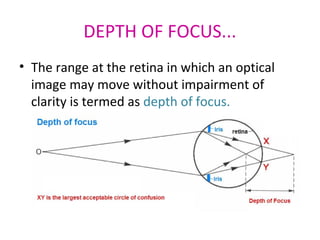
DEPTH OF FOCUS...
• The range at the retina in which an optical
image may move without impairment of
clarity is termed as depth of focus.
THEORIES OF ACCOMMODATION…
• Numerous theories have been proposed on
accommodation.
• Few of these are as follows.
PROOF OF EXISTENCE OF
ACCOMMODATION
• Till 17th
century  unknown that it is necessry
for eye to change its power in order to focus
• 1619  Christopher Scheiner gave proof of
existence of accommodation.
• 1801 Thomas Young demonstrated lens is
responsible for accommodation
TSHERNING’S theory
• This theory attributed increased curvature of capsule
to increasing tension of the zonules.
• It states that contraction of ciliary muscle pulls
zonules directly and increases tension of capsule at
equator of lens, which leads to bulging of poles.
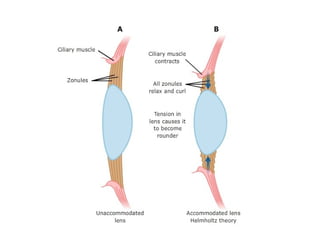
Relaxation theory of HELMHOLTZ
• Also known as the “Capsular Theory”.
• He considered that lens was elastic and in
normal state it is stretched and flattened
by tension of the suspensory ligaments.
• During accommodation, contraction of ciliary
muscle shortens ciliary ring and moves
towards the equator of the lens.
• Relax the suspensory ligaments, relieving
strain.
• Lens assumes more spherical form, increasing
thickness and decreasing diameter.
GULLSTRAND mechanical model of
accommodation
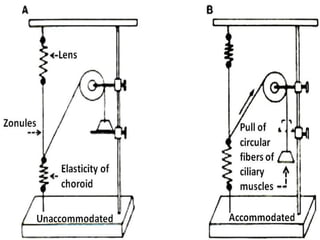
• It is based on HELMHOLTZ hypothesis
• GULLSTRAND devised a mechanical model to
explain accommodation.
• It shows in unaccommodated state elasticity
of choroid is stronger than lens. When
accommodation comes into play weight i.e
ciliary muscles contract to overcome elasticity
of choroid.
• It helps lens to take accommodated shape.
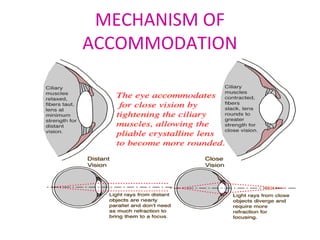
MECHANISM OF
ACCOMMODATION
Changes in eye due to
accommodation...

Slackening of the zonules

Change in the curvature of lens surface

Anterior pole

Axial thickness

Changes in the tension of lens capsule

The lens sinks down
Change within the lens substance
Pupillary constriction and convergence of eyes
The choroid
The ora serrata
AC/A ratio
• The AC/A ratio is the relationship between
accommodative convergence (AC) expressed
in prism diopetrs, and accommodation (A)
expressed in lens diopters.
• This relationship is linear one and is thought
to be relatively stable throughout life.
• Normal AC/A ratio- 3-5 prism D for 1D of
accommodation.
NEGATIVE RELATIVE
ACCOMMODATION (NRA)
• NRA is a measure of its maximum ability to
relax accommodation while maintaining clear,
single binocular vision.
POSITIVE RELATIVE
ACCOMMODATION (PRA)
• PRA is ameasure of maximum ability to
stimulate accommodation while maintaining
clear, single binocular vision.
REACTION TIME
It refers to a time lapse between the
presentation of an accommodative stimulus and
occurrence of accommodative response.
•Average reaction time for far-to-near
accommodation is 0.64 sec and for near-to-far is
0.56 sec
Types of Accommodation
• Tonic accommodation
– It is due to tonus of ciliary muscle and is active in absence
of a stimulus. The resting state of accommodation is not at
infinity but rather at an intermediate distance.
• Proximal accommodation
– Is induced by the awareness of the nearness of a target.
This is independent of the actual dioptric stimulus.
• Reflex accommodation
– Is an automatic adjustment response to blur which is
made to maintain a clear and sharp retinal image.
• Convergence-accommodation
– Amount of accommodation stimulated or relaxed
associated with convergence.
– The link between accommodation and convergence is
known as accommodative convergence and is
expressed clinically as AC/A ratio.
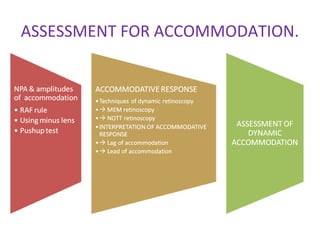
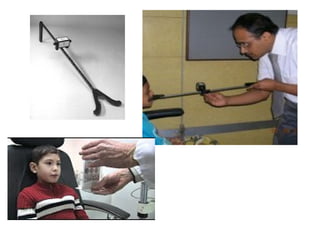
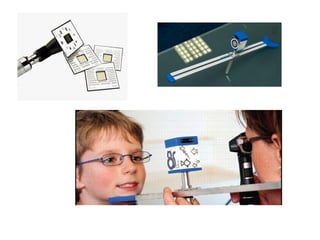
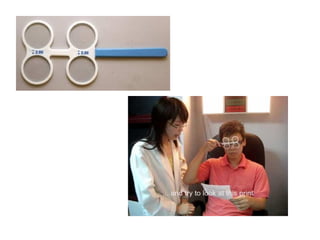
ASSESSMENT FOR ACCOMMODATION.
ANNOMALIES OF
ACCOMMODATON…
ANOMALIES OF
ACCOMMODATION
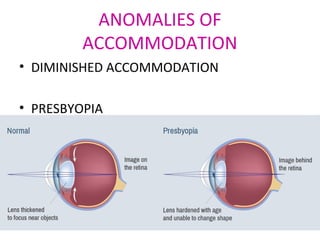
• DIMINISHED ACCOMMODATION
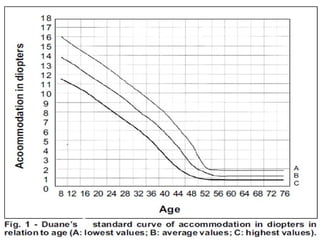
• PRESBYOPIA
Presbyopia
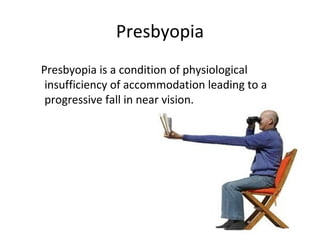
Presbyopia is a condition of physiological
insufficiency of accommodation leading to a
progressive fall in near vision.
Pathophysiology
• In emmetropic eye far point is infinity and near
point varies with age (being about 7 cm at 10
years, 25 cm at 40 years and 33 cm at 45 years).
• We read from 25 cm. After 40 years, the near
point recedes beyond normal reading or working
range.
• Failing near vision due to age-related decrease in
amplitude of accommodation is called
presbyopia.
Causes
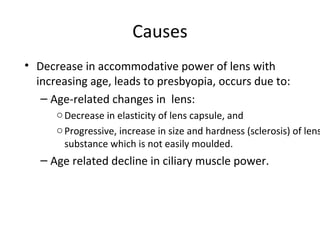
• Decrease in accommodative power of lens with
increasing age, leads to presbyopia, occurs due to:
– Age-related changes in lens:
oDecrease in elasticity of lens capsule, and
oProgressive, increase in size and hardness (sclerosis) of lens
substance which is not easily moulded.
– Age related decline in ciliary muscle power.
Premature presbyopia:
• Uncorrected hypermetropia.
• Premature sclerosis of the crystalline lens.
• General debility causing pre-senile weakness of
ciliary muscle.
• Chronic simple glaucoma.
Symptoms
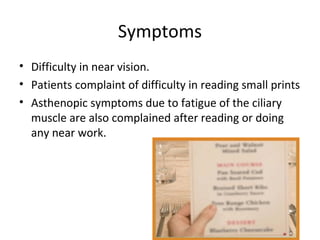
• Difficulty in near vision.
• Patients complaint of difficulty in reading small prints
• Asthenopic symptoms due to fatigue of the ciliary
muscle are also complained after reading or doing
any near work.
Optical treatment
• Prescription of appropriate convex glasses for near
work.
• A rough guide for providing presbyopic glasses in an
emmetrope can be made from patient’s age.
– About +1 DS is required at the age of 40-45 years,
– +1.5 DS at 45-50 years,
– + 2 DS at 50-55 years,
– +2.5 DS at 55-60 years.
Basic principles of presbyopic
correction
• Refractive error for distance is corrected first.
• Correction needed in each eye should be tested
separately and add it to distant correction.
• Near point should be fixed according to the profession of
patient.
• Weakest convex lens with which one can see clearly at
near point should be prescribed, overcorrection will also
result in asthenopic symptoms.
• Presbyopic spectacles may be unifocal, bifocal or
varifocal.
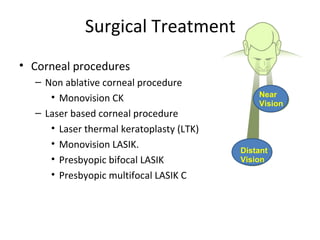
Surgical Treatment
• Corneal procedures
– Non ablative corneal procedure
• Monovision CK
– Laser based corneal procedure
• Laser thermal keratoplasty (LTK)
• Monovision LASIK.
• Presbyopic bifocal LASIK
• Presbyopic multifocal LASIK C
Near
Vision
Distant
Vision
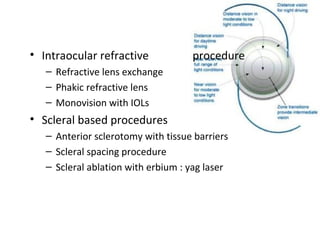
• Intraocular refractive procedure
– Refractive lens exchange
– Phakic refractive lens
– Monovision with IOLs
• Scleral based procedures
– Anterior sclerotomy with tissue barriers
– Scleral spacing procedure
– Scleral ablation with erbium : yag laser
Insufficiency of accommodation
• Condition in which accommodative power is
constantly less than lower limit of normal range
according to patient’s age.
Etiology
• Premature sclerosis of lens
• Weakness of ciliary muscle due to systemic causes:
Debilitating illness, anemia, toxemia, malnutrition,
diabetes mellitus, pregnancy, stress etc.
• Weakness of ciliary muscle due to local causes:
PAOG, mild cyclitis as during onset of sympathetic
ophthalmia.
Clinical features
• Features of eye strain and asthenopia.
• Head ach, fatigue & irritability of the eyes, while
attempting near work.
• Near work is blurred & becomes difficult or
impossible.
• Disturbance of convergence : intermittent diplopia.
• It is stable condition, if due to sclerosis of lens.
• But is not stable in association with ciliary muscle
weakness.
Treatment
• Identification & treatment of any systemic cause.
• Any refractive error should be corrected & if vision
for near work is seriously blurred then additional
near correction has to be prescribed same as
presbyopia.
• If associated with convergence excess then full
spherical correction.
• Convergence insufficiency is there, then base in
prisms can be added.
• Prismatic correction added should bring near
point of convergence to same distance as near
point of accommodation.
• Weakest convex lenses should be prescribed, so
as to exercise and stimulate accommodation.
• After recovery additional correction should be
made weaker and weaker from time to time.
• Accommodative exercises.
– While do exercises patient should wear
correction for distance.
– Should be done simultaneously in both eyes, even
if associated with convergence insufficiency.
– But with convergence excess then the exercise
should done with one eye alternately.
– Accommodation test card exercise.
– Useless in generalized debility and sclerosis of
lens.
Ill-Sustained accommodation
• Accommodation fatigue.
• It is a situation in which though range of
accommodation is in normal range but it cannot sustain
it for a sufficient period of time.
• Initial stage of insufficiency of accommodation.
• It occurs due to
– Stage of convalescence from debilitating illness
– Stage of generalized tiredness
– When the patient is relaxed in the bed
Clinical features
• These symptoms are most commonly reported
at the end of the day
• Blurred vision after prolonged near work.
• Headaches
• Eyestrain
• Fatigue, sleepiness and a loss of comprehension
with continued reading
• A dull 'pulling' sensation around the eye.
Treatment
• Near work should be curtailed during debilitating
illness.
• General tonic measures should be taken.
• The condition of illumination and posture while
doing near work, should be improved.
Inertia of accommodation
• It is a condition in which patient faces difficulty in
altering the range of accommodation.
• Amplitude of accommodation is normal.
• Ability to make use of this amplitude quickly and for
long periods of time is inadequate.
Clinical features
• Difficulty changing focus from one distance to
another
• Headaches
• Eyestrain
• Fatigue
• Difficulty sustaining near tasks
• Blurred vision
Treatment: correcting any refractive error and
accommodative exercises.
Paralysis of accommodation
• Cycloplegia, refers to complete absence of
accommodation.
• Causes
– Atropine, homatropine or other parasympatholytic
drugs.
– Internal ophthalmoplegia (paralysis of ciliary
muscle and sphincter pupillae)due to neuritis
associated with diphtheria, syphilis, diabetes,
alcoholism, cerebral or meningeal diseases.
– Complete third nerve paralysis due to intracranial
or orbital causes.
– Systemic medications such as anti-hypertensive,
antidepressants.
Clinical features
• Blurred vision at near
• Photophobia or a 'dazzling' effect
• Diplopia
• Micropsia: objects may appear smaller than they
are due to a false sense of distance
• Enlarged pupil.
Treatment
• An effort should be made to find out the cause and
try to eliminate it.
• Self-recovery occurs in drug-induced paralysis and in
diphtheric cases (once systemic disease is treated).
• Dark-glasses effective in reducing glare.
• Convex lenses for near vision, if the paralysis is
permanent.
Excessive accommodation
• Accommodative response is greater than the
accommodative stimulus.
• There is functional increase in tonus of ciliary muscle,
results in a constant accommodative effect.
Causes
• Young hypermetropes frequently uses excessive
accommodation as a physiological adaptation
• Young myopes performing excessive near work,
associated with excessive convergence.
• Astigmatic error in young patients
• Presbyopes in the beginning
• Use of improper and ill fitting spectacles
Precipitating factors
• Excessive near work done, especially in dim or
excessive illumination.
• General debility, physical or mental ill health
Symptoms
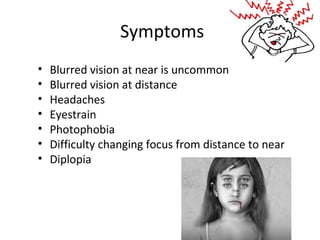
• Blurred vision at near is uncommon
• Blurred vision at distance
• Headaches
• Eyestrain
• Photophobia
• Difficulty changing focus from distance to near
• Diplopia
Treatment
• It has a good prognosis.
• Refractive error should be corrected after carefully
performed cycloplegic refraction.
• Near work should be stopped for some time, after
that it should be done with proper illumination
conditions.
Spasm of accommodation
• Spasm of accommodation refers to exertion of
abnormally excessive accommodation.
Causes
• Drug induced spasm of accommodation is known
to occur after use of strong miotics.
• Spontaneous spasm of accommodation: attempt
to compensate for a refractive anomaly.
• Occurs when excessive near work is done with
bad illumination, bad reading position, state of
neurosis, mental stress or anxiety.
Clinical features
• Defective vision: due to induced myopia.
• Asthenopic symptoms
• Precipitating factors like marked degree of
muscular imbalance, trigeminal neuralgia, a
dental lesion, general intoxication.
Treatment
• Relaxation of ciliary muscle by atropine for 4 weeks
or more and
• Prohibition of near work allow prompt recovery from
spasm of accommodation.
• Elimination of the associated causative factors to
prevent the recurrence.
Reference…
• BOOKS…
• Primary care optometry
• A.K.Khurana (optics and refraction)
• A.K.Khurana (squint and orthoptics)
• REFERENCE PPT…
• www.slideshare.net/RohitRao2/accommodation-of-eye
• www.slideshare.net/laxmieyeinstitute/accommodation-
35905316
• IMAGES…
• Google
Accommodation reema

Accommodation reema

  • 1.
  • 2.
    WHAT IS ACCOMMODATION? • KNOWN FACT : in an emmetropic eye, parallel rays of light coming from infinity are brought to focus on retina, with accommodation at rest. • WHAT ABOUT THE DIVERGING RAYS COMING FROM NEAR OBJECT ? • Our eyes has been provided with a unique mechanism by which we can even focus the diverging rays coming from near object on retina in bid to see clearly.  ACCOMMODATION. • IN IT THERE IS INCREASE IN LENS POWER.
  • 4.
    SOME TERMINOLOGIES... • NEARPOINT OF ACCOMMODATION : • The nearest point at which small objects can be seen clearly is called near point of accommodation or punctum proximum. • the distant point is called far point off accommodation or punctum remotum.
  • 5.
    • RANGE OFACCOMMODATION: • The distance between near point and far point is called range of accommodation. • AMPLITUDE OF ACCOMMODATION: • The difference between DIOPTRIC power, needed to focus at near point (P) and to focus at far point (R), is called amplitude of accommodation (A). Thus, A=P-R
  • 7.
    POINTS TO BEKNOWN... • In HYPROPIC eye, far point is virtual and lies behind the eye. • In MYOPIC eye, far point is real and lies in front of the eye. • In an EMMETROPIC eye, far point is at infinity and near point varies with age...
  • 8.
    Near point incentimeters Age in years 7 10 25 40 33 45
  • 9.
    DEPTH OF FIELD... •The range of distance from the eye in which an object appears clear without change in accommodation is termed depth of field. • It reduces the necessity for precise accommodation.
  • 11.
    DEPTH OF FOCUS... •The range at the retina in which an optical image may move without impairment of clarity is termed as depth of focus.
  • 12.
    THEORIES OF ACCOMMODATION… •Numerous theories have been proposed on accommodation. • Few of these are as follows.
  • 13.
    PROOF OF EXISTENCEOF ACCOMMODATION • Till 17th century  unknown that it is necessry for eye to change its power in order to focus • 1619  Christopher Scheiner gave proof of existence of accommodation. • 1801 Thomas Young demonstrated lens is responsible for accommodation
  • 14.
    TSHERNING’S theory • Thistheory attributed increased curvature of capsule to increasing tension of the zonules. • It states that contraction of ciliary muscle pulls zonules directly and increases tension of capsule at equator of lens, which leads to bulging of poles.
  • 15.
    Relaxation theory ofHELMHOLTZ • Also known as the “Capsular Theory”. • He considered that lens was elastic and in normal state it is stretched and flattened by tension of the suspensory ligaments. • During accommodation, contraction of ciliary muscle shortens ciliary ring and moves towards the equator of the lens. • Relax the suspensory ligaments, relieving strain. • Lens assumes more spherical form, increasing thickness and decreasing diameter.
  • 17.
    GULLSTRAND mechanical modelof accommodation • It is based on HELMHOLTZ hypothesis • GULLSTRAND devised a mechanical model to explain accommodation. • It shows in unaccommodated state elasticity of choroid is stronger than lens. When accommodation comes into play weight i.e ciliary muscles contract to overcome elasticity of choroid. • It helps lens to take accommodated shape.
  • 19.
  • 20.
    Changes in eyedue to accommodation...  Slackening of the zonules  Change in the curvature of lens surface  Anterior pole  Axial thickness  Changes in the tension of lens capsule  The lens sinks down
  • 21.
    Change within thelens substance Pupillary constriction and convergence of eyes The choroid The ora serrata
  • 22.
    AC/A ratio • TheAC/A ratio is the relationship between accommodative convergence (AC) expressed in prism diopetrs, and accommodation (A) expressed in lens diopters. • This relationship is linear one and is thought to be relatively stable throughout life. • Normal AC/A ratio- 3-5 prism D for 1D of accommodation.
  • 23.
    NEGATIVE RELATIVE ACCOMMODATION (NRA) •NRA is a measure of its maximum ability to relax accommodation while maintaining clear, single binocular vision.
  • 24.
    POSITIVE RELATIVE ACCOMMODATION (PRA) •PRA is ameasure of maximum ability to stimulate accommodation while maintaining clear, single binocular vision.
  • 25.
    REACTION TIME It refersto a time lapse between the presentation of an accommodative stimulus and occurrence of accommodative response. •Average reaction time for far-to-near accommodation is 0.64 sec and for near-to-far is 0.56 sec
  • 26.
    Types of Accommodation •Tonic accommodation – It is due to tonus of ciliary muscle and is active in absence of a stimulus. The resting state of accommodation is not at infinity but rather at an intermediate distance. • Proximal accommodation – Is induced by the awareness of the nearness of a target. This is independent of the actual dioptric stimulus.
  • 27.
    • Reflex accommodation –Is an automatic adjustment response to blur which is made to maintain a clear and sharp retinal image. • Convergence-accommodation – Amount of accommodation stimulated or relaxed associated with convergence. – The link between accommodation and convergence is known as accommodative convergence and is expressed clinically as AC/A ratio.
  • 28.
  • 32.
  • 33.
    ANOMALIES OF ACCOMMODATION • DIMINISHEDACCOMMODATION • PRESBYOPIA
  • 34.
    Presbyopia Presbyopia is acondition of physiological insufficiency of accommodation leading to a progressive fall in near vision.
  • 35.
    Pathophysiology • In emmetropiceye far point is infinity and near point varies with age (being about 7 cm at 10 years, 25 cm at 40 years and 33 cm at 45 years). • We read from 25 cm. After 40 years, the near point recedes beyond normal reading or working range. • Failing near vision due to age-related decrease in amplitude of accommodation is called presbyopia.
  • 37.
    Causes • Decrease inaccommodative power of lens with increasing age, leads to presbyopia, occurs due to: – Age-related changes in lens: oDecrease in elasticity of lens capsule, and oProgressive, increase in size and hardness (sclerosis) of lens substance which is not easily moulded. – Age related decline in ciliary muscle power.
  • 38.
    Premature presbyopia: • Uncorrectedhypermetropia. • Premature sclerosis of the crystalline lens. • General debility causing pre-senile weakness of ciliary muscle. • Chronic simple glaucoma.
  • 39.
    Symptoms • Difficulty innear vision. • Patients complaint of difficulty in reading small prints • Asthenopic symptoms due to fatigue of the ciliary muscle are also complained after reading or doing any near work.
  • 40.
    Optical treatment • Prescriptionof appropriate convex glasses for near work. • A rough guide for providing presbyopic glasses in an emmetrope can be made from patient’s age. – About +1 DS is required at the age of 40-45 years, – +1.5 DS at 45-50 years, – + 2 DS at 50-55 years, – +2.5 DS at 55-60 years.
  • 41.
    Basic principles ofpresbyopic correction • Refractive error for distance is corrected first. • Correction needed in each eye should be tested separately and add it to distant correction. • Near point should be fixed according to the profession of patient. • Weakest convex lens with which one can see clearly at near point should be prescribed, overcorrection will also result in asthenopic symptoms. • Presbyopic spectacles may be unifocal, bifocal or varifocal.
  • 42.
    Surgical Treatment • Cornealprocedures – Non ablative corneal procedure • Monovision CK – Laser based corneal procedure • Laser thermal keratoplasty (LTK) • Monovision LASIK. • Presbyopic bifocal LASIK • Presbyopic multifocal LASIK C Near Vision Distant Vision
  • 43.
    • Intraocular refractiveprocedure – Refractive lens exchange – Phakic refractive lens – Monovision with IOLs • Scleral based procedures – Anterior sclerotomy with tissue barriers – Scleral spacing procedure – Scleral ablation with erbium : yag laser
  • 44.
    Insufficiency of accommodation •Condition in which accommodative power is constantly less than lower limit of normal range according to patient’s age.
  • 45.
    Etiology • Premature sclerosisof lens • Weakness of ciliary muscle due to systemic causes: Debilitating illness, anemia, toxemia, malnutrition, diabetes mellitus, pregnancy, stress etc. • Weakness of ciliary muscle due to local causes: PAOG, mild cyclitis as during onset of sympathetic ophthalmia.
  • 46.
    Clinical features • Featuresof eye strain and asthenopia. • Head ach, fatigue & irritability of the eyes, while attempting near work. • Near work is blurred & becomes difficult or impossible. • Disturbance of convergence : intermittent diplopia. • It is stable condition, if due to sclerosis of lens. • But is not stable in association with ciliary muscle weakness.
  • 47.
    Treatment • Identification &treatment of any systemic cause. • Any refractive error should be corrected & if vision for near work is seriously blurred then additional near correction has to be prescribed same as presbyopia. • If associated with convergence excess then full spherical correction.
  • 48.
    • Convergence insufficiencyis there, then base in prisms can be added. • Prismatic correction added should bring near point of convergence to same distance as near point of accommodation. • Weakest convex lenses should be prescribed, so as to exercise and stimulate accommodation. • After recovery additional correction should be made weaker and weaker from time to time.
  • 49.
    • Accommodative exercises. –While do exercises patient should wear correction for distance. – Should be done simultaneously in both eyes, even if associated with convergence insufficiency. – But with convergence excess then the exercise should done with one eye alternately. – Accommodation test card exercise. – Useless in generalized debility and sclerosis of lens.
  • 50.
    Ill-Sustained accommodation • Accommodationfatigue. • It is a situation in which though range of accommodation is in normal range but it cannot sustain it for a sufficient period of time. • Initial stage of insufficiency of accommodation. • It occurs due to – Stage of convalescence from debilitating illness – Stage of generalized tiredness – When the patient is relaxed in the bed
  • 51.
    Clinical features • Thesesymptoms are most commonly reported at the end of the day • Blurred vision after prolonged near work. • Headaches • Eyestrain • Fatigue, sleepiness and a loss of comprehension with continued reading • A dull 'pulling' sensation around the eye.
  • 52.
    Treatment • Near workshould be curtailed during debilitating illness. • General tonic measures should be taken. • The condition of illumination and posture while doing near work, should be improved.
  • 53.
    Inertia of accommodation •It is a condition in which patient faces difficulty in altering the range of accommodation. • Amplitude of accommodation is normal. • Ability to make use of this amplitude quickly and for long periods of time is inadequate.
  • 54.
    Clinical features • Difficultychanging focus from one distance to another • Headaches • Eyestrain • Fatigue • Difficulty sustaining near tasks • Blurred vision Treatment: correcting any refractive error and accommodative exercises.
  • 55.
    Paralysis of accommodation •Cycloplegia, refers to complete absence of accommodation. • Causes – Atropine, homatropine or other parasympatholytic drugs. – Internal ophthalmoplegia (paralysis of ciliary muscle and sphincter pupillae)due to neuritis associated with diphtheria, syphilis, diabetes, alcoholism, cerebral or meningeal diseases.
  • 56.
    – Complete thirdnerve paralysis due to intracranial or orbital causes. – Systemic medications such as anti-hypertensive, antidepressants.
  • 57.
    Clinical features • Blurredvision at near • Photophobia or a 'dazzling' effect • Diplopia • Micropsia: objects may appear smaller than they are due to a false sense of distance • Enlarged pupil.
  • 58.
    Treatment • An effortshould be made to find out the cause and try to eliminate it. • Self-recovery occurs in drug-induced paralysis and in diphtheric cases (once systemic disease is treated). • Dark-glasses effective in reducing glare. • Convex lenses for near vision, if the paralysis is permanent.
  • 59.
    Excessive accommodation • Accommodativeresponse is greater than the accommodative stimulus. • There is functional increase in tonus of ciliary muscle, results in a constant accommodative effect.
  • 60.
    Causes • Young hypermetropesfrequently uses excessive accommodation as a physiological adaptation • Young myopes performing excessive near work, associated with excessive convergence. • Astigmatic error in young patients • Presbyopes in the beginning • Use of improper and ill fitting spectacles
  • 61.
    Precipitating factors • Excessivenear work done, especially in dim or excessive illumination. • General debility, physical or mental ill health
  • 62.
    Symptoms • Blurred visionat near is uncommon • Blurred vision at distance • Headaches • Eyestrain • Photophobia • Difficulty changing focus from distance to near • Diplopia
  • 63.
    Treatment • It hasa good prognosis. • Refractive error should be corrected after carefully performed cycloplegic refraction. • Near work should be stopped for some time, after that it should be done with proper illumination conditions.
  • 64.
    Spasm of accommodation •Spasm of accommodation refers to exertion of abnormally excessive accommodation.
  • 65.
    Causes • Drug inducedspasm of accommodation is known to occur after use of strong miotics. • Spontaneous spasm of accommodation: attempt to compensate for a refractive anomaly. • Occurs when excessive near work is done with bad illumination, bad reading position, state of neurosis, mental stress or anxiety.
  • 66.
    Clinical features • Defectivevision: due to induced myopia. • Asthenopic symptoms • Precipitating factors like marked degree of muscular imbalance, trigeminal neuralgia, a dental lesion, general intoxication.
  • 67.
    Treatment • Relaxation ofciliary muscle by atropine for 4 weeks or more and • Prohibition of near work allow prompt recovery from spasm of accommodation. • Elimination of the associated causative factors to prevent the recurrence.
  • 68.
    Reference… • BOOKS… • Primarycare optometry • A.K.Khurana (optics and refraction) • A.K.Khurana (squint and orthoptics) • REFERENCE PPT… • www.slideshare.net/RohitRao2/accommodation-of-eye • www.slideshare.net/laxmieyeinstitute/accommodation- 35905316 • IMAGES… • Google