BinocularBalancing
Sahira tayyab
Bsvs
3rd year
Binocular balancing
 The final important step of subjective refraction is to make
certain that accomadation has been relaxed equally in the 2 eyes
is known as binocular balancing.
PURPOSE :
– To Equalize accommodation between the two eyes
– Not to equalize the best corrected visual acuity between the two
eyes:
CANNOT BE PERFORMED WHEN:
– px suppresses one eye
– strabismus exists
– px has only one eye
Why?
– Pre-presbyopic patients can accommodate during the
distance monocular refraction
– Patients may actually accommodate different amounts in
the left and right eyes
Methods for binocular balance
technique:
There are various methods that may be employed to perform binocular balancing of a
prescription . These include:
– 1 Successive Alternate Occlusion
– 2Vertical Prism Dissociation
– 3Blurring or fogging (Humphriss Immediate Contrast)
– 4 Polarized or Vectographic
– 5 Turville Infinity Balance (Septum technique)
1.Successive Alternate
Occlusion:
–Procedure:
– ADD plus lenses binocularly till px barely sees 20 /50 line(6/18) over the
Rx you just achieved from the monocular subjective refraction
– examiner performs slow alternate occlusion
– Px compares of letters between 2 eyes
– “I know this is blurry, I want you to tell me which image is clearer, or are
they both equally blurred.”
– END POINT
– end point is equal acuity b/w 2 eyes
– If one eye clearer than
– Plus lenses added in + 0.25DS steps before clearer eye to equalize the blur
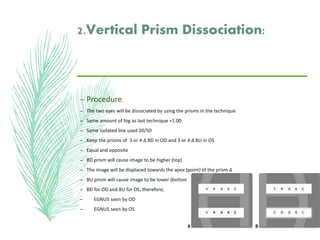
2.Vertical Prism Dissociation:
– Procedure:
– The two eyes will be dissociated by using the prisms in the technique
– Same amount of fog as last technique +1.00
– Same isolated line used 20/50
– Keep the prisms of 3 or 4 Δ BD in OD and 3 or 4 Δ BU in OS
– Equal and opposite
– BD prism will cause image to be higher (top)
– The image will be displaced towards the apex (point) of the prism Δ
– BU prism will cause image to be lower (bottom)
– BD for OD and BU for OS, therefore;
– EGNU5 seen by OD
– EGNU5 seen by OS
Cont’d…!!!
–Patient instructions: “I know these images are blurred, I want
you to take a few seconds and look at the image on the top, and then
take a few seconds and look at the image on the bottom, tell me is one
image clearer or are they equally blurred?”
– If the patient reports the top image clearer, add +0.25DS to the OD
and repeat the question
– If the patient reports the lower image clearer add +0.25DS to the OS
and repeat the question
– Now px report both eyes see blur it means we balance the
accommodation with +0.25DS
– At the end remove prism and fog lenses that are use for the balancing
and correct the lenses
3.Fogging method / humphriss immediate
contrast test:
Procedure:
Place +0.75DS/+1.00DS fogging lens before the LE
Fogging verified lens should blur 3_4 lines on chart
Present +0.25DS lens ( lens 1)over RE , replace with _0.25DS lens (lens2)and once again
revert to +0.25DS (lens1)
Px asked to compare lenses 1 2 and 1
Px must report which lens makes target clearer sharper and comfortable to look
If px reports lens 2 better then add _0.25DS lens
Present lenses 1 2 and 1 again
END POINT:
Px reports view through both lenses is the same
Reversal
Once RE Rx balanced fog RE and perform procedure on LE
4.Polaroid Technique
/(Vectographic)
– Polaroid Filters are used to partially dissociate the two eyes
– FZBD FZBD
– While wearing polaroid filters (P in phoropter knob), each
eye sees a separate line and the rod in the middle serves as
a fusion lock
Polaroid Technique
– Fog by +1.00 OD and OS
– Same technique as the vertical prism dissociation
– Make appropriate adjustments
– Most natural binocular balance technique as diplopia and
prism are not introduced
5.Septum Technique:
– Separate the visual fields with a septum in the refracting
lane
– Each eye sees part of the line
– Fog by a +1.00 DS
– Same instruction set as vertical prism dissociation
Reference :
– American academy
– Zadnik
– Internet
– Notes
Binocular balancing

Binocular balancing

  • 1.
  • 2.
    Binocular balancing  Thefinal important step of subjective refraction is to make certain that accomadation has been relaxed equally in the 2 eyes is known as binocular balancing. PURPOSE : – To Equalize accommodation between the two eyes – Not to equalize the best corrected visual acuity between the two eyes: CANNOT BE PERFORMED WHEN: – px suppresses one eye – strabismus exists – px has only one eye
  • 3.
    Why? – Pre-presbyopic patientscan accommodate during the distance monocular refraction – Patients may actually accommodate different amounts in the left and right eyes
  • 4.
    Methods for binocularbalance technique: There are various methods that may be employed to perform binocular balancing of a prescription . These include: – 1 Successive Alternate Occlusion – 2Vertical Prism Dissociation – 3Blurring or fogging (Humphriss Immediate Contrast) – 4 Polarized or Vectographic – 5 Turville Infinity Balance (Septum technique)
  • 5.
    1.Successive Alternate Occlusion: –Procedure: – ADDplus lenses binocularly till px barely sees 20 /50 line(6/18) over the Rx you just achieved from the monocular subjective refraction – examiner performs slow alternate occlusion – Px compares of letters between 2 eyes – “I know this is blurry, I want you to tell me which image is clearer, or are they both equally blurred.” – END POINT – end point is equal acuity b/w 2 eyes – If one eye clearer than – Plus lenses added in + 0.25DS steps before clearer eye to equalize the blur
  • 6.
    2.Vertical Prism Dissociation: –Procedure: – The two eyes will be dissociated by using the prisms in the technique – Same amount of fog as last technique +1.00 – Same isolated line used 20/50 – Keep the prisms of 3 or 4 Δ BD in OD and 3 or 4 Δ BU in OS – Equal and opposite – BD prism will cause image to be higher (top) – The image will be displaced towards the apex (point) of the prism Δ – BU prism will cause image to be lower (bottom) – BD for OD and BU for OS, therefore; – EGNU5 seen by OD – EGNU5 seen by OS
  • 7.
    Cont’d…!!! –Patient instructions: “Iknow these images are blurred, I want you to take a few seconds and look at the image on the top, and then take a few seconds and look at the image on the bottom, tell me is one image clearer or are they equally blurred?” – If the patient reports the top image clearer, add +0.25DS to the OD and repeat the question – If the patient reports the lower image clearer add +0.25DS to the OS and repeat the question – Now px report both eyes see blur it means we balance the accommodation with +0.25DS – At the end remove prism and fog lenses that are use for the balancing and correct the lenses
  • 8.
    3.Fogging method /humphriss immediate contrast test: Procedure: Place +0.75DS/+1.00DS fogging lens before the LE Fogging verified lens should blur 3_4 lines on chart Present +0.25DS lens ( lens 1)over RE , replace with _0.25DS lens (lens2)and once again revert to +0.25DS (lens1) Px asked to compare lenses 1 2 and 1 Px must report which lens makes target clearer sharper and comfortable to look If px reports lens 2 better then add _0.25DS lens Present lenses 1 2 and 1 again END POINT: Px reports view through both lenses is the same Reversal Once RE Rx balanced fog RE and perform procedure on LE
  • 9.
    4.Polaroid Technique /(Vectographic) – PolaroidFilters are used to partially dissociate the two eyes – FZBD FZBD – While wearing polaroid filters (P in phoropter knob), each eye sees a separate line and the rod in the middle serves as a fusion lock
  • 10.
    Polaroid Technique – Fogby +1.00 OD and OS – Same technique as the vertical prism dissociation – Make appropriate adjustments – Most natural binocular balance technique as diplopia and prism are not introduced
  • 11.
    5.Septum Technique: – Separatethe visual fields with a septum in the refracting lane – Each eye sees part of the line – Fog by a +1.00 DS – Same instruction set as vertical prism dissociation
  • 12.
    Reference : – Americanacademy – Zadnik – Internet – Notes