ANIMAL KINGDOM
PHYLUM MOLLUSCA
Hello!
I am Swetha
Bachelors in Optometry
You can find me at @
https://unacademy.com/user/swetha.chandran304/courses
Place your screenshot here
Introduction, Other features, Body wall and parts,
Digestion, Respiration, Circulation, excretion, Nervous
system, Reproduction
Synopsis
Introduction
INTRODUCTION
◈ It is second largest Phylum.
◈ Mollusca (Soft bodied) are marine. Some are also
found in fresh water or on land.
◈ Johnston coined the name Mollusca.
◈ Study of this phylum is known as Malacology
◈ Study of shell of molluscan is known as Concology.
Other features
OTHER FEATURES
◈ Body is unsegmented with variety of shapes.
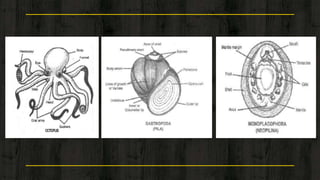
◈ Neopilina is exceptionally segmented.
◈ They are usually bilateral. Few are secondarily
asymmetrical (snail) due to twisting (Torsion) during
growth.
◈ These are triploblastic with organ system level of
organisation.
Body wall
Body parts
BODY WALL AND PARTS
◈ Body wall includes one layered epidermis (usually
ciliated) with unstriped muscles found in bundles
◈ Body parts consist of
◈ Head with sense organ. Head is absent in Pelecypod
◈ Dorsal visceral mass containing organs system
◈ Ventral foot for locomotion
◈ Thin fleshy fold or outgrowth of dorsal body wall
covers the body. This fold is called mantle or pallim.
BODY PART
◈ The mantle usually secretes as a external limy shell
◈ Shell is made up of Calcium carbonate and choncheolin
protein
◈ Shell may also be internal (Cattle fish), reduced and
even absent (Octopus)
◈ Coelom is greatly reduced.
◈ It is presented by cavities in the pericardium kidneys
and gonads. Space among the viscera contain blood and
form haemocoel.
Digestion
DIGESTION
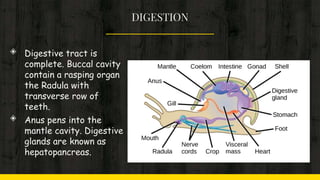
◈ Digestive tract is
complete. Buccal cavity
contain a rasping organ
the Radula with
transverse row of
teeth.
◈ Anus pens into the
mantle cavity. Digestive
glands are known as
hepatopancreas.
Respiration
RESPIRATION
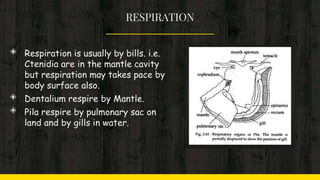
◈ Respiration is usually by bills. i.e.
Ctenidia are in the mantle cavity
but respiration may takes pace by
body surface also.
◈ Dentalium respire by Mantle.
◈ Pila respire by pulmonary sac on
land and by gills in water.
Circulation
CIRCULATION
◈ Circulatory system is open.
◈ It includes dorsal pulsatile heart and a few arteries
that open into sinuses.
◈ Cephalopoda has closed type of circulatory system
◈ Blood has a copper containing, blue respiratory
pigment Haemocyanin.
◈ Blood is colourless with ameobocytes.
Excretion
EXCRETION
◈ Excretory system includes 1 or 2 pairs of sac like
kidneys, which open into the mantle cavity. Kidney of
molluscans are Metanephridia known as Kaber’s organs
or Organ of Bojanus.
◈ Excretory matter is ammonia or uric acid.
Nervous system
NERVOUS SYSTEM
◈ Three paired ganglia:
◈ Cerebral (above the mouth)
◈ Pedal (in the foot)
◈ Visceral (in visceral mass)
◈ Sense organs:
◈ Eye - Present over a stalk called ommatophore
◈ Statocyst/Lithocyst - For equilibrium in foot
◈ Osphradia - Chemoreceptor/Olfactory as well as for
testing chemical & physical nature of water.
Reproduction
REPRODUCTION
◈ Sexes usually separate (snail has ovotestis). Gonads
have ducts.
◈ Fertilization may be external or internal.
◈ Cleavage is spiral, determinate, unequal and
holoblastic.
◈ Development is - Direct or indirect.
◈ Trochophore is very common larva of Mollusca phylum.
Larva Glochidium (Fresh water mussel) and Veliger,
(Pila)
Thanks!
Any questions?
You can find me at @
https://unacademy.com/user/swetha.chandran304/courses
Follow me or drop your queries in the comment box

Mollusca

  • 1.
  • 2.
    Hello! I am Swetha Bachelorsin Optometry You can find me at @ https://unacademy.com/user/swetha.chandran304/courses
  • 3.
  • 4.
    Introduction, Other features,Body wall and parts, Digestion, Respiration, Circulation, excretion, Nervous system, Reproduction Synopsis
  • 5.
  • 6.
    INTRODUCTION ◈ It issecond largest Phylum. ◈ Mollusca (Soft bodied) are marine. Some are also found in fresh water or on land. ◈ Johnston coined the name Mollusca. ◈ Study of this phylum is known as Malacology ◈ Study of shell of molluscan is known as Concology.
  • 7.
  • 8.
    OTHER FEATURES ◈ Bodyis unsegmented with variety of shapes. ◈ Neopilina is exceptionally segmented. ◈ They are usually bilateral. Few are secondarily asymmetrical (snail) due to twisting (Torsion) during growth. ◈ These are triploblastic with organ system level of organisation.
  • 9.
  • 10.
    BODY WALL ANDPARTS ◈ Body wall includes one layered epidermis (usually ciliated) with unstriped muscles found in bundles ◈ Body parts consist of ◈ Head with sense organ. Head is absent in Pelecypod ◈ Dorsal visceral mass containing organs system ◈ Ventral foot for locomotion ◈ Thin fleshy fold or outgrowth of dorsal body wall covers the body. This fold is called mantle or pallim.
  • 12.
    BODY PART ◈ Themantle usually secretes as a external limy shell ◈ Shell is made up of Calcium carbonate and choncheolin protein ◈ Shell may also be internal (Cattle fish), reduced and even absent (Octopus) ◈ Coelom is greatly reduced. ◈ It is presented by cavities in the pericardium kidneys and gonads. Space among the viscera contain blood and form haemocoel.
  • 13.
  • 14.
    DIGESTION ◈ Digestive tractis complete. Buccal cavity contain a rasping organ the Radula with transverse row of teeth. ◈ Anus pens into the mantle cavity. Digestive glands are known as hepatopancreas.
  • 15.
  • 16.
    RESPIRATION ◈ Respiration isusually by bills. i.e. Ctenidia are in the mantle cavity but respiration may takes pace by body surface also. ◈ Dentalium respire by Mantle. ◈ Pila respire by pulmonary sac on land and by gills in water.
  • 17.
  • 18.
    CIRCULATION ◈ Circulatory systemis open. ◈ It includes dorsal pulsatile heart and a few arteries that open into sinuses. ◈ Cephalopoda has closed type of circulatory system ◈ Blood has a copper containing, blue respiratory pigment Haemocyanin. ◈ Blood is colourless with ameobocytes.
  • 19.
  • 20.
    EXCRETION ◈ Excretory systemincludes 1 or 2 pairs of sac like kidneys, which open into the mantle cavity. Kidney of molluscans are Metanephridia known as Kaber’s organs or Organ of Bojanus. ◈ Excretory matter is ammonia or uric acid.
  • 21.
  • 22.
    NERVOUS SYSTEM ◈ Threepaired ganglia: ◈ Cerebral (above the mouth) ◈ Pedal (in the foot) ◈ Visceral (in visceral mass) ◈ Sense organs: ◈ Eye - Present over a stalk called ommatophore ◈ Statocyst/Lithocyst - For equilibrium in foot ◈ Osphradia - Chemoreceptor/Olfactory as well as for testing chemical & physical nature of water.
  • 23.
  • 24.
    REPRODUCTION ◈ Sexes usuallyseparate (snail has ovotestis). Gonads have ducts. ◈ Fertilization may be external or internal. ◈ Cleavage is spiral, determinate, unequal and holoblastic. ◈ Development is - Direct or indirect. ◈ Trochophore is very common larva of Mollusca phylum. Larva Glochidium (Fresh water mussel) and Veliger, (Pila)
  • 26.
    Thanks! Any questions? You canfind me at @ https://unacademy.com/user/swetha.chandran304/courses Follow me or drop your queries in the comment box